
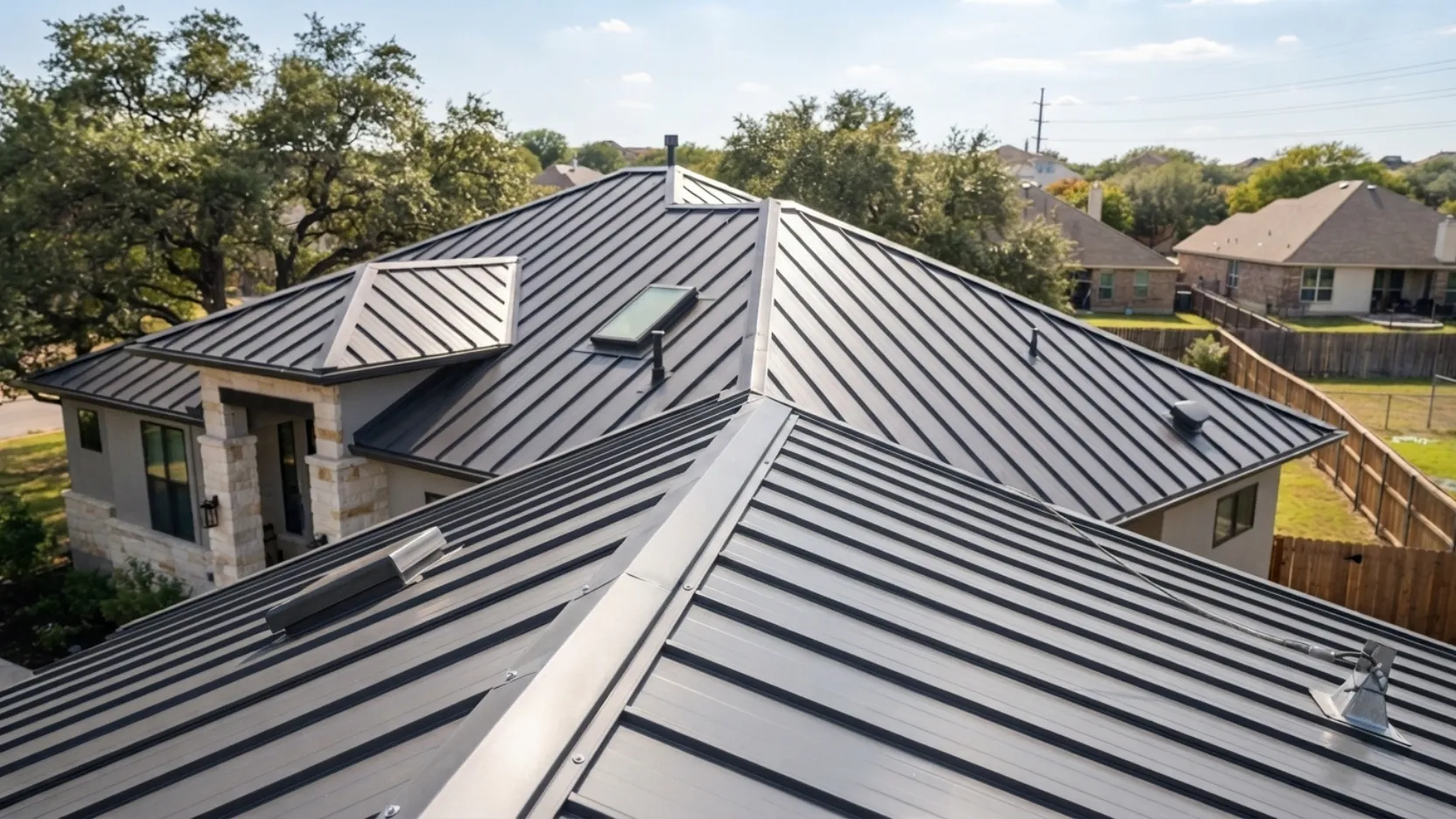
Metal roofing is one of the strongest long-term investments a San Antonio homeowner can make. It outlasts asphalt by decades, handles Texas hail and heat well, and can cut cooling costs with a reflective finish. The sticker price on day one is almost never the number on the final invoice.
The gap between the quoted panel price and the installed total is where surprises live. Underlayment upgrades, decking, permits, flashing and drip edge, tear-off and disposal, noise mitigation, insurance adjustments, and lifetime maintenance all add up. Locally, those add-ons commonly push the real cost about 20% to 35% above a thin base quote.
A lump-sum number without line items is a warning sign. A legitimate San Antonio metal quote itemizes panels, labor, underlayment, decking allowances, permits, flashing, drip edge, and disposal. Contractors who resist that breakdown are often the ones whose final invoice looks nothing like the first estimate.
By the end of this guide, you’ll know the main hidden cost categories, typical San Antonio ranges for each, and the questions to ask before you sign.
Table of Contents
- Why Quotes Understate the Real Price
- Underlayment Upgrades
- Decking Replacement and Structural Repairs
- Permits and City Inspections
- Flashing, Drip Edge, and Trim
- Tear-Off and Disposal
- Noise Mitigation and Insulation
- Insurance and Long-Term Maintenance
- Fully Loaded Cost Snapshot
- Common Questions About Hidden Metal Roof Costs
- Next Steps for San Antonio Homeowners
Why Quotes Understate the Real Price
Sales quotes often lead with panel price per square. Panels are only the visible layer. The waterproofing system also needs underlayment rated for metal, edge metal, ridge and valley details, penetrations, and a legal permit path. Skip any of those in the estimate and the invoice grows after you are committed.
When all categories are done correctly, a metal roof here commonly lasts 40+ years. Paying for those line items once is cheaper than fixing a low-bid install that voids warranties or fails inspection.
Practical rule: always ask for a fully itemized quote. One lump-sum number is hiding something.
Underlayment Upgrades
Metal expands and contracts hard in San Antonio. Summer roof surfaces can reach about 160°F, then cool overnight. Standard 15- or 30-lb felt was designed for asphalt. It tears, degrades, and off-gasses under that heat. The right product is a synthetic or self-adhering underlayment rated for metal temperature ranges and panel slip.
On a 2,000 sq ft roof, upgrading from felt to proper synthetic underlayment typically adds about $600 to $1,400. Full self-adhering membrane across the deck can add about $1,500 to $3,000. Felt-only low quotes often show $0 to $300 for underlayment—and that is the wrong product for Texas metal.
Ask for the product name and manufacturer on the written quote. If the answer is “felt” or they cannot name a product, treat that as a red flag.
Decking Replacement and Structural Repairs
Rotted plywood, soft OSB, and damaged sheathing are rarely in the base bid because they are found at tear-off. Per-sheet replacement commonly runs about $75 to $150. Five to ten bad sheets add about $375 to $1,500. Larger section replacement can run $800 to $2,500. Rafter or structural work is uncommon but can reach $2,000 to $8,000+.
No contractor can finalize decking cost before tear-off. They can lock a per-sheet price in writing and walk the attic with you first. Soft spots, staining, and delamination are often visible from below before the old roof comes off.
Practical rule: get the per-sheet decking price in writing before work starts so mid-project charges are not open-ended.
Permits and City Inspections
A full roof replacement in San Antonio and most of Bexar County requires a permit and a city inspection. Skipping the permit to save money can create insurance claim problems and disclosure issues at sale.
Typical City of San Antonio residential roofing permit fees run about $150 to $350. Re-inspection after a failed visit is often about $75 to $150. Many HOAs also require approval for metal (often $50 to $200), which can add weeks. If a contractor says permits are not needed, verify with Development Services—do not take their word alone.
Flashing, Drip Edge, and Trim
Panel pricing almost never includes the accessories that finish the system. Chimney flashing often runs about $300 to $600; skylight flashing about $200 to $450; drip edge about $1.50 to $3.00 per linear foot; ridge cap about $4 to $9 per linear foot; valley metal about $3 to $6; pipe boots about $50 to $150 each.
On a typical 2,000 sq ft San Antonio home, flashing, drip edge, and trim often total about $800 to $1,800. Complex roofs with multiple chimneys, skylights, and wall transitions can hit $1,500 to $3,500. Ask whether every accessory is included—not “if needed.”
Tear-Off and Disposal
Removing and hauling existing asphalt adds real labor and dump fees. Single-layer tear-off labor often runs about $1.00 to $1.75 per sq ft; double-layer about $1.50 to $2.50. Disposal/hauling for a standard 2,000 sq ft roof is often about $300 to $600; dumpster rental, if separate, about $300 to $500.
All-in single-layer tear-off and disposal commonly lands about $500 to $1,200; double-layer about $900 to $2,200. Overlay without tear-off can save money short-term, but it can hide deck problems, add weight, and affect some manufacturer warranties. Confirm layer count and warranty rules before you agree to leave the old roof on.
Noise Mitigation and Insulation
An uninsulated metal roof can sound loud in a San Antonio thunderstorm. Proper synthetic underlayment, attic insulation, and foam closure strips usually bring interior rain noise in line with a shingle roof.
Acoustic underlayment plus foam closures often add about $300 to $700. Full noise mitigation with an attic insulation upgrade commonly runs about $1,500 to $4,000. Include this in the original scope—retrofitting after install is harder and more expensive.
Insurance and Long-Term Maintenance
Class 4 impact-rated metal can qualify for Texas insurance discounts of about 20% to 30% with some carriers. Non-rated panels may get no discount. Call your agent before you sign and ask about Class 4 eligibility, cosmetic damage exclusions, and whether you must notify the carrier before work starts.
Metal is lower maintenance than asphalt—not maintenance-free. Plan inspections every 3 to 5 years (about $200 to $500), gutter cleaning (about $150 to $350 per year), a fastener pass around years 10 to 12 on screw-down systems (about $600 to $1,800), and possible recoating at 15 to 25 years (about $1.50 to $3.00 per sq ft, or $3,000 to $6,000 on a typical home). Standing seam usually needs less recoating attention than exposed-fastener panels.
Fully Loaded Cost Snapshot
This table assumes a 2,000 sq ft single-story San Antonio home with moderate pitch, one existing shingle layer, one chimney, and no skylights.
| Hidden cost category | Typical San Antonio add | Usually in base quote? |
|---|---|---|
| Synthetic underlayment upgrade | $600–$1,400 | Rarely |
| Decking (5–10 sheets) | $375–$1,500 | Never until tear-off |
| Permits and inspection | $150–$350 | Sometimes |
| Flashing, drip edge, ridge, trim | $800–$1,800 | Often excluded from panel quotes |
| Single-layer tear-off and disposal | $500–$1,200 | Sometimes |
| Noise mitigation (basic) | $300–$700 | Rarely discussed |
| Lifetime maintenance (avg over 40 yrs) | ~$200–$400 / year | Never in install price |
If the base panel-and-labor quote is about $15,000, a realistic fully loaded total often lands about $18,000 to $20,000+. The fix is an itemized quote on day one—not hoping add-ons stay small.
Common Questions About Hidden Metal Roof Costs
How much more will I pay beyond the quoted price?
Locally, final installed cost commonly runs 20% to 35% above a thin base panel quote when every category is included. Itemized bids close that surprise gap even when they look higher at first glance.
Is metal still worth it with all the add-ons?
For most San Antonio owners who will stay long enough to benefit, yes. Metal lasting 40 to 60 years with solid maintenance usually beats two or three asphalt replacements over the same horizon. Short ownership timelines change the math.
Can I skip tear-off to save money?
Sometimes over a single sound layer—saving roughly $500 to $1,200—but you lose deck inspection and may affect warranties. Multiple existing layers, leak history, or aging framing usually make tear-off the right call.
Will metal lower my insurance?
Only if the product is Class 4 rated and your carrier offers the discount. Verify the rating and the quote with your agent before you buy on “insurance savings” claims alone.
Next Steps for San Antonio Homeowners
Walk the attic, count existing layers, call your insurer about Class 4 discounts, and start any HOA approval early. Compare only itemized quotes that name underlayment, accessories, permits, disposal, and per-sheet decking rates.
If you want a fully loaded metal roof quote for your San Antonio home—without surprise add-ons at the end—RRSATX can inspect and price the complete system. Call 713-504-2341 or schedule online.