
A flat-roof addition can turn a small leak into a constant repair problem. In San Antonio, a patch that looks acceptable after a dry week may face intense heat, ultraviolet exposure, heavy rain, and hail before the season is over. Choosing the right membrane roof material means looking beyond the color or roll price. The roof deck, slope, drainage, attachment method, foot traffic, and seam quality all matter.
The four systems discussed here are TPO, EPDM, PVC, and modified bitumen. Each can work well, but each has conditions where it performs better or creates avoidable problems. The practical choice for a patio cover in Alamo Heights may not be the same choice for a restaurant roof near Downtown San Antonio or a large commercial building in Bexar County.
Table of Contents
- Why San Antonio Homeowners Are Choosing Membrane Roofs
- What Membrane Roofing Actually Is
- TPO Membrane Roofing in Plain English
- EPDM Membrane Roofing and Its Long Track Record
- PVC Membrane Roofing for Tough Environments
- Modified Bitumen Membrane Roofing Explained
- Side-by-Side Comparison of the Four Membranes
- Matching Membrane Type to Your Roof and Property
- How the San Antonio Climate Changes the Decision
- Maintenance and Inspection Habits That Extend Service Life
- Quick Reference and Next Steps for Homeowners
Why San Antonio Homeowners Are Choosing Membrane Roofs
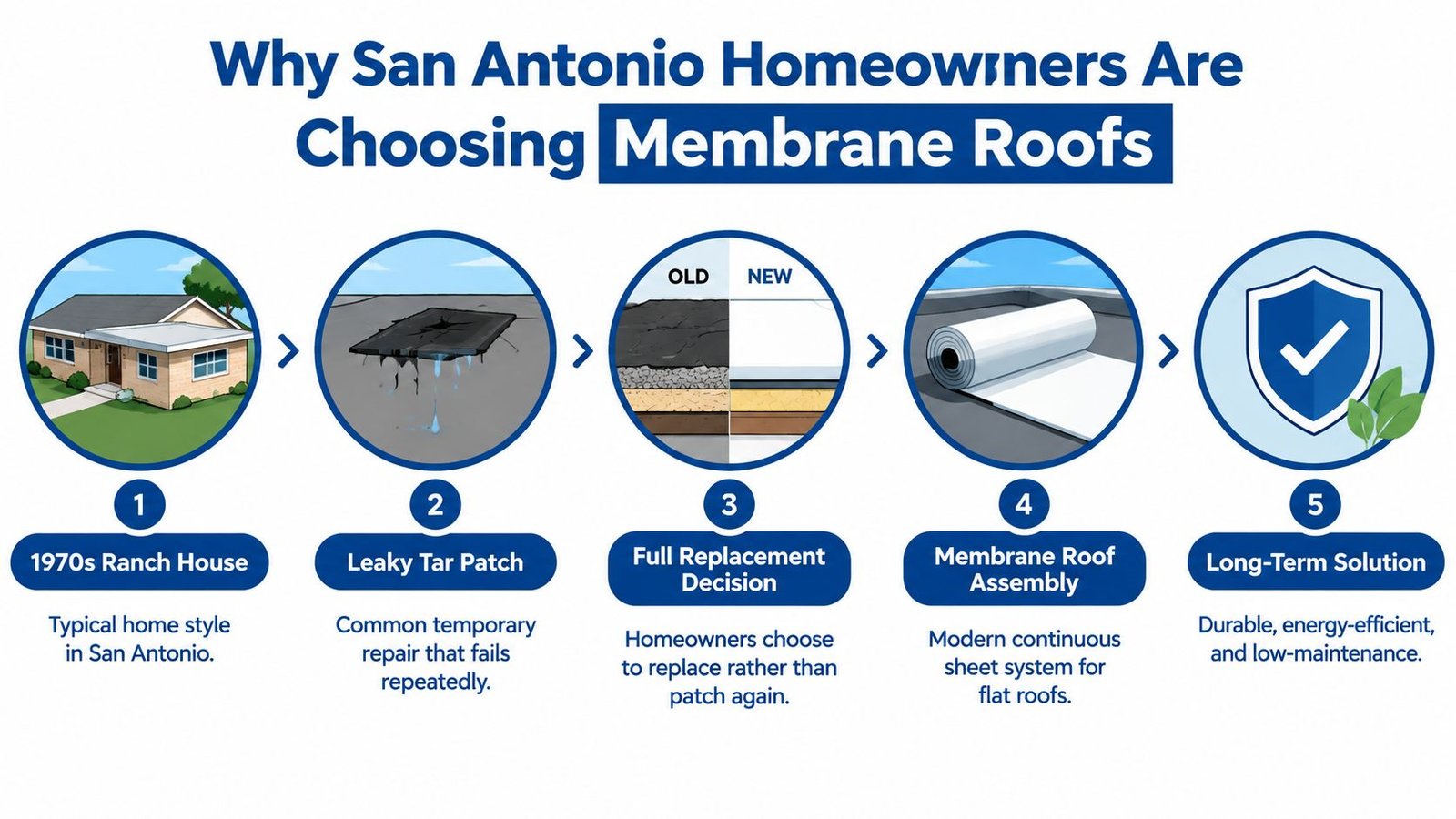
A homeowner stands on the flat-roof addition behind a 1970s ranch house, looking at the same tar patch that has been repaired more than once. The surface is dark, uneven, and beginning to split around a drain. After another heavy rain, water has stained the ceiling inside the addition. The decision is no longer whether to add another patch. It's whether the entire low-slope assembly needs a more dependable waterproofing system.
Across San Antonio, property owners are replacing failing roll roofing, old built-up gravel roofs, and temporary asphalt patches on patios, carports, garages, and additions. Single-ply membranes and modified bitumen create a cleaner finished surface with fewer exposed laps than many aging repair assemblies. White membranes can also reflect a significant portion of incoming solar energy, which matters when a roof sits over a bedroom, office, or enclosed porch.
Storm damage often makes the decision more urgent. Hail may bruise a surface, damage flashing, or expose weaknesses that weren't obvious from the ground. A practical post-storm home repair guide can help homeowners understand why interior water signs deserve prompt attention after severe weather.
Four material families with different strengths
- TPO: A heat-welded thermoplastic sheet commonly selected for reflective performance and commercial low-slope work.
- EPDM: A flexible synthetic rubber membrane with a long commercial history and a familiar installation process.
- PVC: A thermoplastic sheet chosen where grease, oils, or chemicals create a more demanding roof environment.
- Modified bitumen: A layered asphaltic system that offers redundancy and a substantial surface for smaller low-slope roofs.
The right question isn't which material wins everywhere. It's which system handles the roof's drainage, heat exposure, hail exposure, penetrations, maintenance demands, and intended use without relying on a temporary fix.
What Membrane Roofing Actually Is
Membrane roofing is a low-slope roofing category that keeps water out with continuous or semi-continuous sheets. Shingles and tiles depend on overlapping pieces and gravity-assisted drainage. A low-slope roof doesn't provide enough fall for those systems to shed water reliably, so the membrane, seams, flashing, and drains become the primary water-control layer.
That distinction matters on San Antonio porches, additions, carports, and commercial buildings. A roof can appear nearly flat from the yard while still requiring carefully designed slope, drainage, edge metal, penetrations, and overflow protection. Standing water places more pressure on seams and laps than a roof that drains quickly.
Single-ply and multi-ply systems
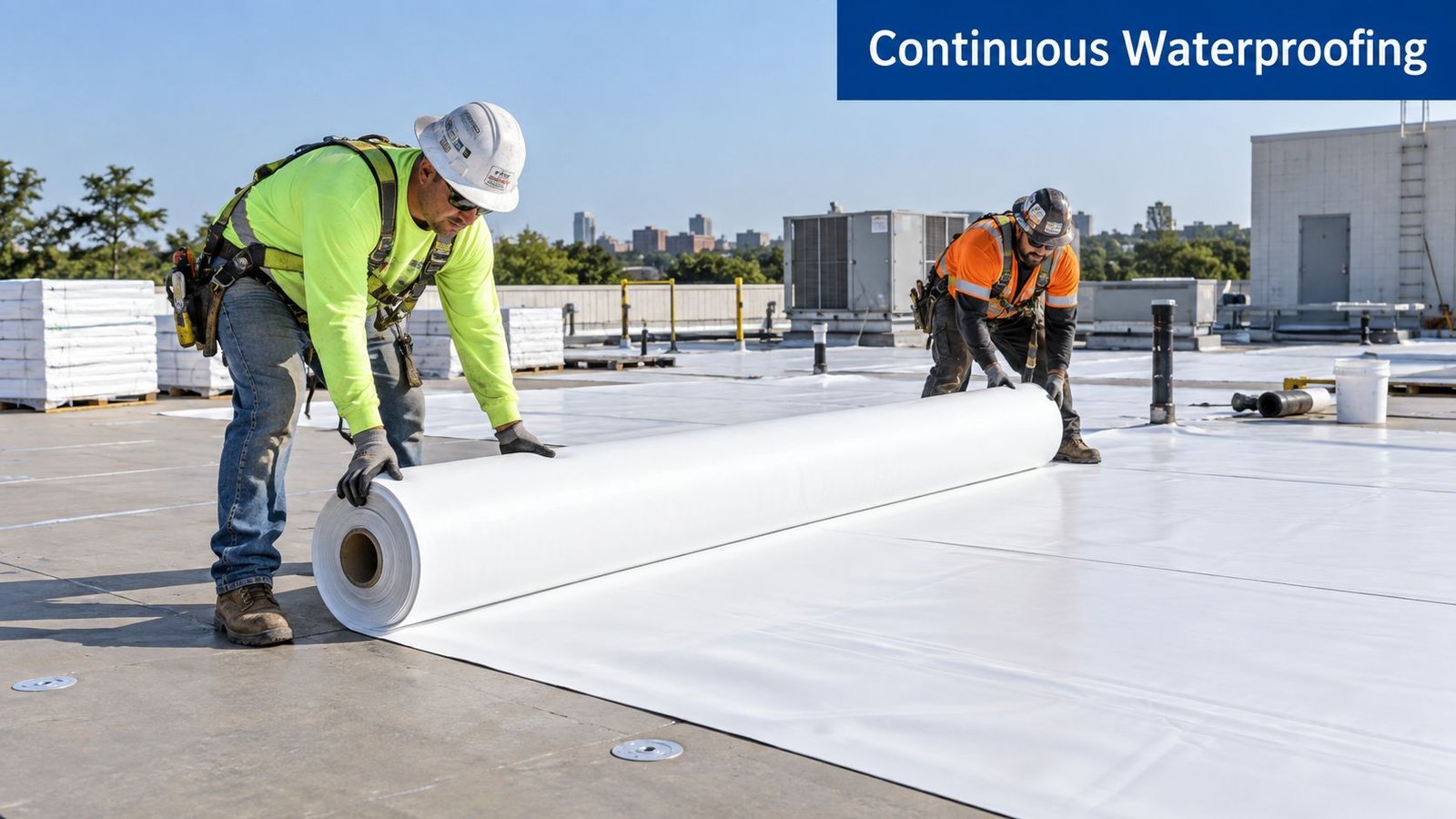
Single-ply membranes include TPO, EPDM, and PVC. Manufacturers produce them in wide rolls, and installers secure the sheets with one of several methods:
- Mechanically fastened: Plates and fasteners hold the membrane to the deck or insulation.
- Fully adhered: Adhesive bonds the sheet across the substrate, which can create a smooth appearance with fewer visible fasteners.
- Ballasted: Gravel or pavers hold the membrane in place where the assembly and structure are designed for that loading.
Modified bitumen uses multiple asphaltic layers, often a base sheet and cap sheet. The laps may be torch-applied, self-adhered, cold-applied, or mechanically secured, depending on the product and project conditions.
This guide focuses on low-slope residential and commercial roofs, not steep-slope shingle or tile decisions. A membrane can be the right solution for a flat-roof addition while being completely unnecessary on a conventional sloped home roof.
TPO Membrane Roofing in Plain English
Thermoplastic polyolefin, or TPO, is the white single-ply sheet commonly seen on San Antonio strip centers, warehouses, offices, and newer low-slope homes. The membrane contains a thermoplastic polyolefin compound, reinforcement, and scrim. TPO sheets are commonly produced in 45 to 80 mil thicknesses, but thickness alone doesn't tell you how the finished roof will perform.
Installers join TPO laps with hot-air welding. When the welder is set correctly and the surfaces are clean, the seam fuses into a continuous waterproofing joint. A rushed crew can create weak spots through inconsistent temperature, speed, pressure, or overlap preparation. That's why field seam inspection matters as much as the product label.
ASTM D6878 is the core material specification for weather-exposed TPO roofing. It evaluates dimensions, thickness, strength, elongation, tear resistance, heat aging, ozone resistance, water absorption, factory seam strength, and weather resistance. The ASTM D6878 specification supports a practical rule: don't select a membrane by nominal thickness alone.
Where TPO works well
Mechanically fastened TPO is common over steel decks and commercial insulation assemblies. Fully adhered TPO can suit wood decks, recover boards, and residential additions where the owner wants a clean surface without exposed rows of fastener plates.
White TPO is attractive in South Texas because it reflects solar energy. One product example recorded an initial solar reflectance of 0.79, falling to 0.70 after three years of uncleaned weathering, while its SRI changed from 99 to 85 over the same period (product reflectance data). Another product data sheet references an ENERGY STAR low-slope criterion of at least 0.65 initial reflectance and 0.50 after three years (TPO product data sheet).
TPO can offer a useful balance of reflectivity, seam strength, and installation flexibility. However, early-generation thin membranes developed a poor reputation in harsh Texas exposure, and today's installation still depends heavily on weld consistency. PVC generally provides greater chemical resistance and may offer a tougher surface, while TPO usually remains the more common value-oriented option. Properly installed and maintained TPO is often discussed in a 15 to 25 year service-life range, but actual performance depends on the complete assembly and workmanship.
| Attribute | Typical value | San Antonio note |
|---|---|---|
| Material | White reinforced thermoplastic sheet | Reflective surfaces can help reduce heat absorption |
| Thickness | 45 to 80 mil | Confirm reinforcement and tested performance, not thickness alone |
| Seam | Hot-air welded | Weld quality is a major workmanship issue |
| Attachment | Mechanical or fully adhered | Match the method to deck, wind design, and recover assembly |
| Main strength | Reflectivity and heat-welded laps | Well suited to many low-slope homes and businesses |
| Main concern | Weak welds or poor early-generation formulations | Hail, foot traffic, and rushed detailing still require attention |
For a local overview of installation options, see TPO roofing services in San Antonio.
EPDM Membrane Roofing and Its Long Track Record
EPDM is a synthetic rubber single-ply membrane that has been used on commercial roofs in North America for decades. It is commonly available in 45, 60, and 90 mil thicknesses, with black being the familiar color. Crews install it in large sheets using adhesive, mechanical fasteners, or ballast, depending on the roof design.
The material's history gives contractors confidence, but EPDM isn't automatically the right answer for every San Antonio roof. A landmark 1991 study examined 45 EPDM membranes from 13 U.S. states, with roofs ranging from 3 to 17 years old and manufactured between 1974 and 1988. The study found that 87% of the sampled roofs exceeded ASTM D4637 criteria for new EPDM sheet (EPDM performance history). That evidence helped establish EPDM as a durable membrane system.
The practical weakness of black rubber
Black EPDM absorbs solar heat. On a San Antonio roof over a conditioned room, the surface can become much hotter than a white membrane, increasing heat transfer through the assembly. A white coating or suitable ballast can change the surface behavior, but those options must be compatible with the roof design and manufacturer requirements.
EPDM seams are commonly made with primers, adhesives, and factory-applied seam tape. Those joints can perform well when prepared correctly, but they don't fuse through hot-air welding in the same way TPO and PVC seams do. Ponding water, poor lap preparation, and aged adhesives deserve close attention.
The rubber remains flexible through temperature changes, including colder weather. It can still be punctured by hail, sharp debris, or repeated foot traffic. EPDM often remains competitive for low-slope porches, garages, sheds, carports, and larger commercial roofs where the owner values a long record of use and doesn't need a bright reflective surface.
ASTM D4637 covers non-reinforced, reinforced, and fabric-backed EPDM sheets. Government specification language based on that standard distinguishes membrane types and references fabric-backed thicknesses around 2.04 mm or 2.31 mm, equal to 0.080 or 0.090 inches, for certain assemblies (ASTM D4637 reference). The attachment method, backing, thickness class, substrate, and wind design all affect the final result.
PVC Membrane Roofing for Tough Environments
PVC is a heat-welded thermoplastic single-ply membrane. Contractors value it for resistance to grease, oils, and many chemicals that can damage less specialized roofing materials. Hot-air-welded laps create a monolithic sheet when the installer prepares the membrane and controls the welding process correctly.
Commercial PVC products commonly use polyester or fiberglass reinforcement and are often supplied in 50 to 80 mil thicknesses. Bright white formulations provide strong solar reflectance, which can help reduce heat absorption on exposed roofs. A PVC specification may reference ASTM D6878 for the membrane and ASTM E1980 for SRI calculations, showing how manufacturers verify material performance with named test methods rather than broad marketing language (PVC and SRI specification).
Where PVC earns its place
PVC is particularly useful where the roof faces contaminants that ordinary roof materials may not tolerate well.
- Restaurants: Rooftop grease exhaust can deposit oils around fans and penetrations.
- Commercial kitchens: Animal fats and cooking oils create a harsher environment than a typical office roof.
- Industrial buildings: Chemical exposure or airborne fallout may influence material selection.
- Busy service roofs: Welded seams and a durable surface can help where maintenance crews regularly access equipment.
PVC costs more than many TPO and EPDM alternatives, and the premium only makes sense when the environment justifies it. The installer must still produce clean, consistent welds around drains, curbs, pipes, and equipment supports.
A material concern is plasticizer migration. If an older formulation loses plasticizer, the sheet can become brittle. Product quality, manufacturer history, installation details, and warranty language therefore matter more than a simple color or thickness comparison. A PVC roof can be an excellent choice for a restaurant, but it may be unnecessary for a quiet residential patio with no grease exposure.
Roof assemblies are also evaluated through separate performance standards. For example, a PVC assembly report describes testing for Class A fire classification under UL 790 or ASTM E108 and wind uplift under FM 4474 and UL 1897 (PVC assembly evaluation report). That distinction matters because the membrane itself and the complete roof assembly don't receive the same evaluation.
Modified Bitumen Membrane Roofing Explained
Modified bitumen combines asphalt with polymer modifiers and reinforcement to create a layered low-slope roofing system. APP and SBS are common modifier families. The finished assembly typically uses a base layer and a cap sheet, creating more than one waterproofing line rather than relying on a single sheet.
For San Antonio homes and small commercial buildings, two installation methods appear often. Torch-applied sheets use a propane flame to heat the underside and bond the membrane. Self-adhered sheets use adhesive backing and avoid open-flame work, which can be useful where fire safety rules, building conditions, or property operations make torch application unsuitable.
A substantial surface for smaller roofs
Granule-surfaced cap sheets protect the asphaltic surface from weather exposure and foot traffic. Smooth products can receive a compatible reflective coating when the assembly and manufacturer allow it. Modified bitumen works well on low-slope porches, garages, additions, and older roof sections where technicians may need occasional access.
The multi-ply construction provides useful redundancy. If one layer is damaged, another layer can remain as part of the water-shedding system. That doesn't excuse poor detailing, open laps, bad flashing, or standing water, but it does give the assembly more material depth than a thin single-ply sheet.
SBS modified bitumen uses synthetic rubber to add flexibility during temperature movement. Background material from SBS modified bitumen science discusses how formulation, reinforcement, ultimate elongation, and cyclic fatigue affect performance. Product differences remain important, so a contractor should specify the actual system rather than treating every modified bitumen roll as equivalent.
The trade-offs are clear. Modified bitumen feels heavier, takes longer to install, and torch application creates asphaltic odor and an open-flame hazard. Self-adhered systems reduce that hazard but require clean substrates, suitable temperatures, careful rolling, and precise lap work.
Side-by-Side Comparison of the Four Membranes
Service-life ranges are useful for framing a conversation, not promising an outcome. Drainage, ultraviolet exposure, hail, foot traffic, substrate movement, installation quality, maintenance, and warranty terms can move the result in either direction.
Installed cost per square varies with deck repairs, insulation, tear-off, access, flashing, drainage work, wind requirements, and labor. A cheaper sheet can become the more expensive roof if the assembly doesn't suit the building. The table uses qualitative cost positions instead of unsupported dollar estimates.
| Material | Lifespan | Seam method | Cost per square installed | Heat reflection | Hail resistance | Best fit |
|---|---|---|---|---|---|---|
| TPO | 15 to 25 years | Heat-welded | Low to mid | High in white formulations | Moderate, dependent on thickness and assembly | Reflective residential additions, retail, offices |
| EPDM | 25 to 30 years | Tape, primer, adhesive | Low to mid | Low when black | Moderate, with puncture concerns | Large commercial roofs, carports, sheds |
| PVC | 20 to 30 years | Heat-welded | Mid to high | High in white formulations | Moderate to high, product dependent | Restaurants, kitchens, chemical exposure |
| Modified bitumen | 15 to 25 years | Torch, self-adhered, or cold-applied laps | Mid | Low to moderate, depending on surfacing | Strong multi-ply impact tolerance | Porches, garages, additions, small commercial roofs |
What the table doesn't show
TPO and PVC offer heat-welded seams, which can be a major advantage when welds are prepared and inspected correctly. EPDM has a longer-established commercial track record, but its taped or adhered seams require disciplined preparation. Modified bitumen adds layered redundancy and can tolerate expected foot traffic better than a thin exposed sheet, though its installation is more involved.
A roof over a hot San Antonio attic may favor a white TPO or PVC surface. A roof with frequent maintenance traffic may favor a more substantial assembly. Ponding water must be addressed through drainage and design rather than assumed away through a material label.
Warranty language can diverge sharply. Read exclusions for ponding, hail, wind uplift, workmanship, flashing, seam coverage, and labor. Material coverage and installed-system coverage aren't the same thing.
Matching Membrane Type to Your Roof and Property
Start with the building's use, not the contractor's favorite product. A residential patio roof has different demands from a restaurant exhaust zone, and a large warehouse may prioritize installation logistics differently from a small garage addition.
TPO often fits low-slope residential additions, patio covers, and retail centers where a white reflective surface and welded seams are useful. It works especially well when the deck and recover board are suitable for mechanical fastening or full adhesion.
EPDM remains practical for larger commercial flat roofs, carports, sheds, and secondary structures where a black surface isn't a problem. Owners who value a long commercial track record may accept the extra heat absorption in exchange for a familiar rubber membrane and established repair practices.
PVC earns consideration around restaurants, commercial kitchens, rooftop grease exhaust, and industrial sites with chemical exposure. It can be excessive on a clean residential roof that has no grease or chemical burden.
Modified bitumen fits older San Antonio homes with small low-slope sections, porches, garages, and repair areas where two-ply redundancy and foot-traffic tolerance matter. Torch application requires strict fire controls, while self-adhered products require substrate and weather conditions that support reliable bonding.
For help identifying whether a roof needs a membrane system or a broader assembly correction, review flat roofing services.
Practical rule: Match the membrane to the roof's exposure, drainage, access, and use. Color alone isn't a specification.
How the San Antonio Climate Changes the Decision
South Texas heat changes how a membrane behaves. Roof assemblies face sustained summer exposure, intense ultraviolet radiation, sudden heavy rains, spring hailstorms, and occasional freezes that can stress aged materials. A national product comparison can miss the way those conditions combine on a San Antonio roof.
White TPO and PVC reflect more sunlight than black EPDM, which can help reduce heat transfer into the building. The trade-off is visible dirt streaking and the need to keep drains and reflective surfaces reasonably clean. Black EPDM absorbs more solar energy but has a long history of outdoor use and remains flexible through temperature changes.
Hail creates a different problem. A smooth single-ply sheet can suffer punctures or bruising from impact, especially where the roof also receives foot traffic or sharp debris. Modified bitumen's layered construction can offer more impact tolerance, but no exposed membrane should be treated as immune to severe hail.
The real local decision
A San Antonio property owner is balancing three competing needs:
- Reflectivity: Useful over conditioned space during long hot seasons.
- Puncture tolerance: Important where hail, branches, service work, or foot traffic are likely.
- Seam reliability: Essential because thermal movement and ponding water stress laps and details.
Choose the assembly that fits those conditions. A reflective sheet with poor welds won't perform as intended. A durable membrane with inadequate drainage can still develop leaks. A contractor should evaluate the deck, insulation, slope, penetrations, edge details, and expected service access before recommending a material.
Maintenance and Inspection Habits That Extend Service Life
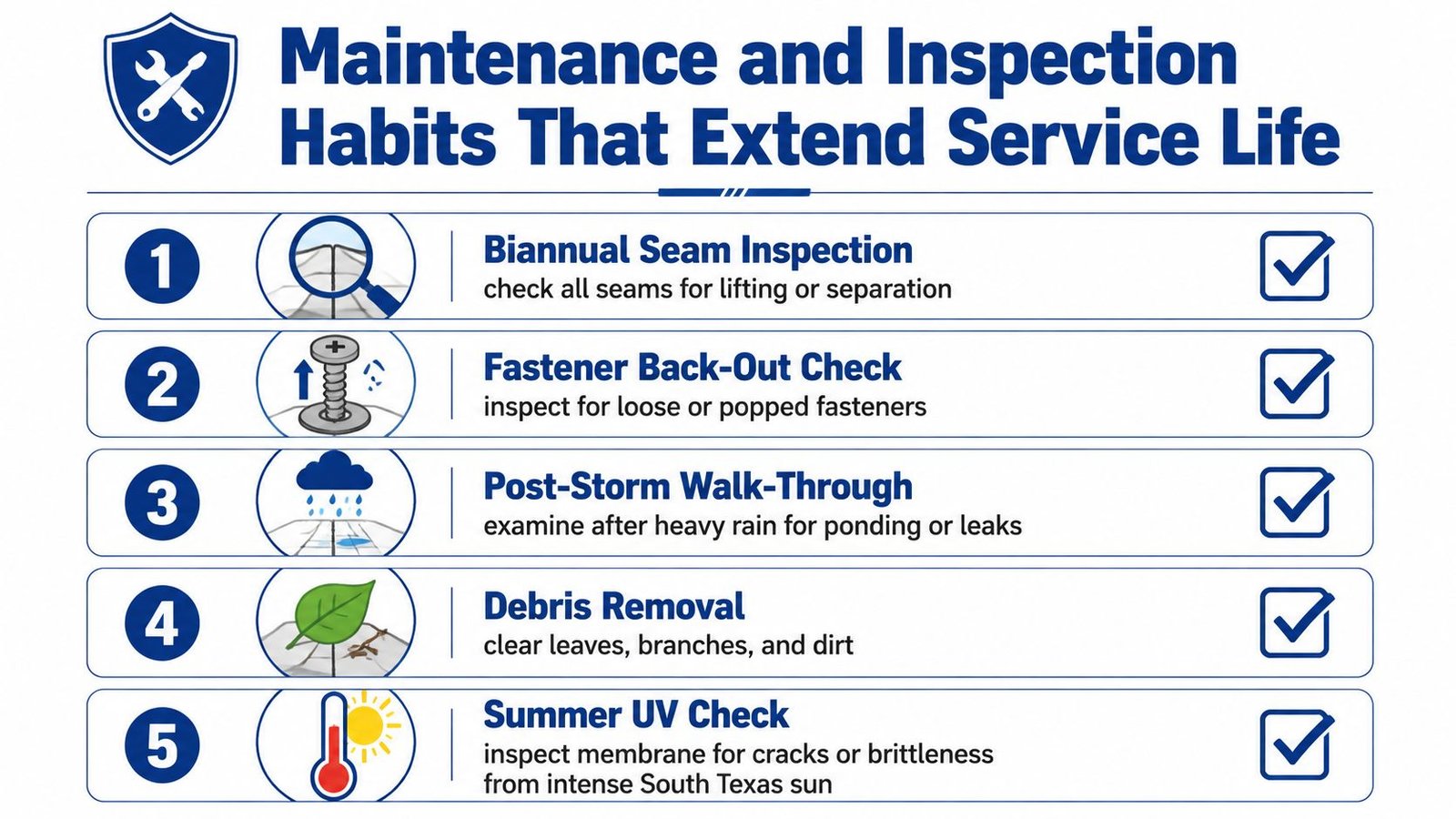
Membrane roofs need a simple maintenance rhythm. Schedule walk-throughs around spring storm activity and before heavy leaf fall, then inspect again after major hail or heavy rain. Focus on seams, drains, perimeter details, penetrations, and places where equipment or branches may have damaged the surface.
Keep leaves, branches, dirt, and other debris away from drains and scuppers. If water remains after rain, identify the drainage problem rather than assuming the membrane will tolerate it indefinitely. Restaurants should also keep grease deposits away from roof details and exhaust areas using cleaning methods approved for the assembly.
What to look for
- Seam movement: Watch for lifting, separation, open laps, or fishmouths.
- Fastener issues: Mechanically attached systems may show loose or popped fasteners.
- Surface damage: Exposed scrim, punctures, cuts, blisters, and soft spots need professional review.
- Interior evidence: Staining, bubbling paint, damp insulation, or musty odors can signal concealed moisture.
- Storm changes: Hail and wind can damage flashing or membrane areas that looked sound before the event.
Homeowners can inspect from the ground, clear accessible gutters, and photograph visible concerns. Don't climb onto a membrane roof without proper fall protection and training. A roofer should handle close seam checks, core cuts, infrared moisture readings, repairs, and any inspection requiring roof access.
Keep inspection photos, repair notes, product information, and warranty documents together. Insurance coverage and claim approval depend on the policy and evidence, so no contractor should promise an insurance result.
Quick Reference and Next Steps for Homeowners
Choose TPO when reflective performance and welded seams suit a residential or commercial low-slope roof. Choose EPDM when a proven rubber system and long commercial history matter. Choose PVC where grease, oils, or chemicals justify its added specialization. Choose modified bitumen for smaller low-slope areas where layered construction and foot-traffic tolerance are priorities.
Read warranty exclusions closely. Look for ponding limitations on EPDM, hail conditions for TPO, and the difference between seam coverage and material coverage on PVC. Before signing a contract, request a written assessment that may include core cuts or infrared moisture readings when concealed damage is suspected, and confirm the installer can follow the membrane manufacturer's requirements.
A free on-site inspection from a San Antonio contractor experienced with all four systems can connect the material choice to the actual roof, deck, drainage, and property use.
RRSATX provides free roof inspections, written findings, repairs, replacements, storm-damage support, and commercial TPO and flat-roof installation across San Antonio and nearby communities. Call 713-504-2341 or visit RRSATX to schedule an inspection and discuss the membrane roof material that fits your property.