
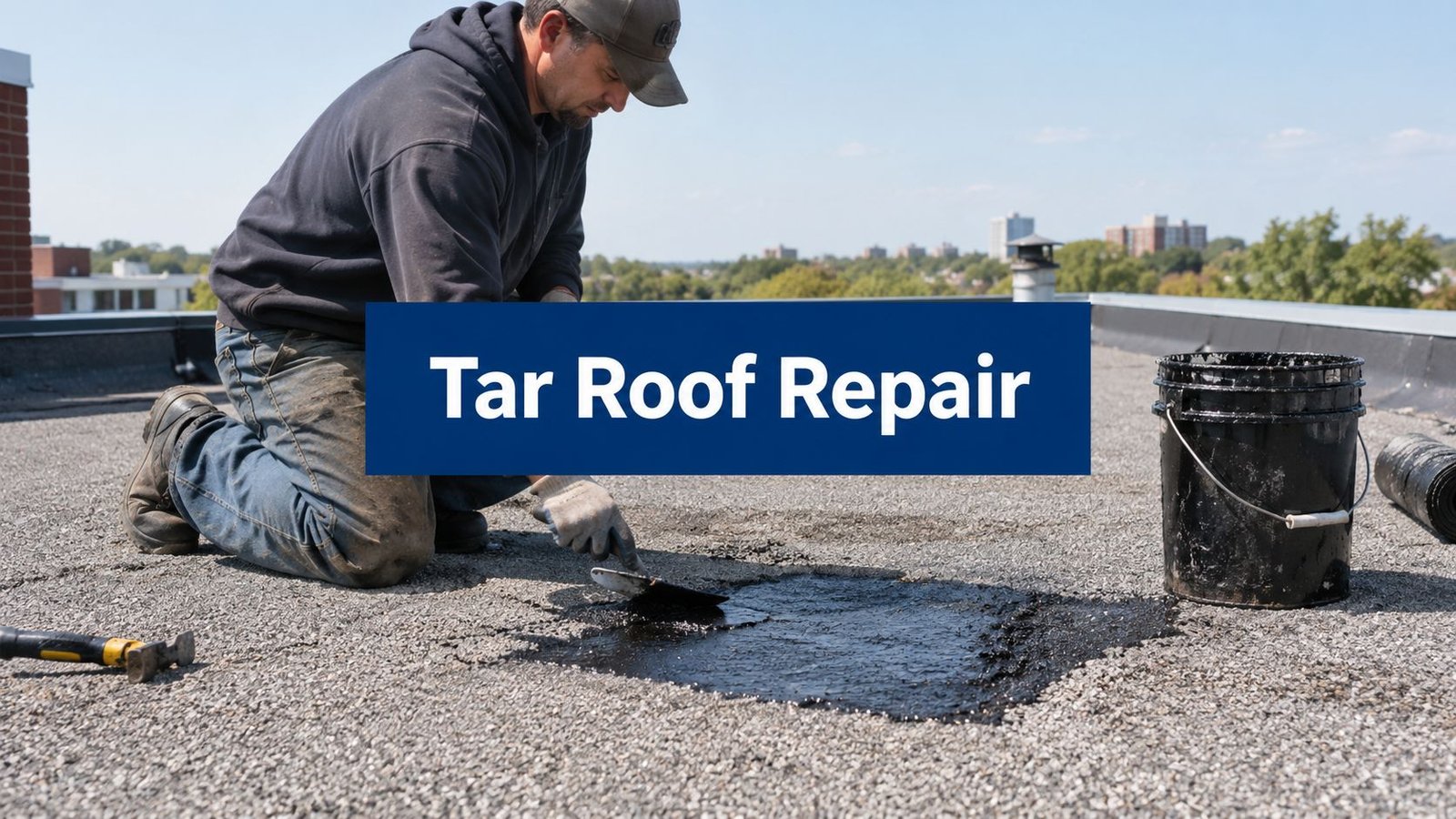
The first call usually goes like this. A homeowner in San Antonio notices a brown spot on the ceiling after a hot stretch, then the next spring storm makes it worse, and now the flat roof looks fine from the ground but keeps leaking from somewhere else. With tar roofing repair, that's the problem, the leak path often doesn't match the stain, because built-up roofs are layered systems, not a single sheet you can spot-fix from below. If you're sorting through that kind of leak, a local guide like Digital Skyrocket roofing SEO can help roof companies show up where inquiries are happening, but the roof itself still has to be diagnosed the right way.
San Antonio roofs take a beating from heat, heavy rain, and hail, so a tar roof that starts acting up after storm season isn't unusual. Older built-up roofing began as rag felt soaked in tar and layered with hot tar and gravel, and modern repairs still have to respect that layered structure, not just seal the top surface IIBEC historical overview. On a roof like that, a quick dab of coating can hide the symptom and miss the cause.
Tar roofing repair works best when somebody traces where water entered, what layers are wet, and whether the assembly still has enough sound material to repair. RRSATX handles that kind of roof inspection and repair work across San Antonio, including flat and low-slope systems, but the bigger lesson is simple, a patch only lasts when it ties into dry, solid roofing. On hot South Texas roofs, that's the difference between a temporary seal and a repair that restores the assembly.
Table of Contents
- Introduction to Tar Roofing Repair in San Antonio
- How Tar and Built Up Roofs Fail and Where Leaks Start
- Proven Repair Methods That Last on Flat Tar Roofs
- Choosing the Right Materials for Your Repair Situation
- When Repair Is No Longer the Smart Fix
- Staying Safe and Getting Lasting Results in San Antonio
Introduction to Tar Roofing Repair in San Antonio
A flat roof in San Antonio often starts failing in small ways. A split at a seam, loose flashing near a wall, or a patch that held through one season can open back up after the next run of sun and storm. Tar roofing repair works best when the roof is treated as an assembly, not as a surface to seal and forget.
What a tar roof really is
The old built-up roof system, often called BUR, uses multiple plies, bitumen, and a gravel or mineral surfacing layer IIBEC historical overview. That layered build matters in San Antonio. Many older roofs were not installed as one sheet, so a repair may need to tie into several plies instead of closing one crack.
That is why the visible damage can look minor while the problem sits deeper. Water can move under the surfacing, into seams, and along transitions before it shows up inside. In our heat, the repair has to fit the roof's construction, or the fix only hides the leak for a while.
Practical rule: If a tar roof leaks twice, the first repair probably treated the symptom, not the cause.
A local search presence can help roof companies be found locally, but the roof itself still has to be diagnosed the right way. On a layered roof, the patch has to match the layers.
Why San Antonio roofs need a local approach
San Antonio roofs take heat, heavy rain, and hail. Spring storms are a regular problem here, and Express-News hail report shows how often severe hail hits the area and how much of it arrives in the spring months. That timing matters because hail and driving rain can crack flashing, bruise the surface, and reopen older patches.
A repair plan here has to account for storm damage, high roof temperatures, and the fact that a clean-looking surface can still hide trapped moisture. Quick sealing has its place when you need to stop active water entry fast. A lasting repair costs more up front, but it preserves the assembly instead of burying a weak spot under another coat.
How Tar and Built Up Roofs Fail and Where Leaks Start
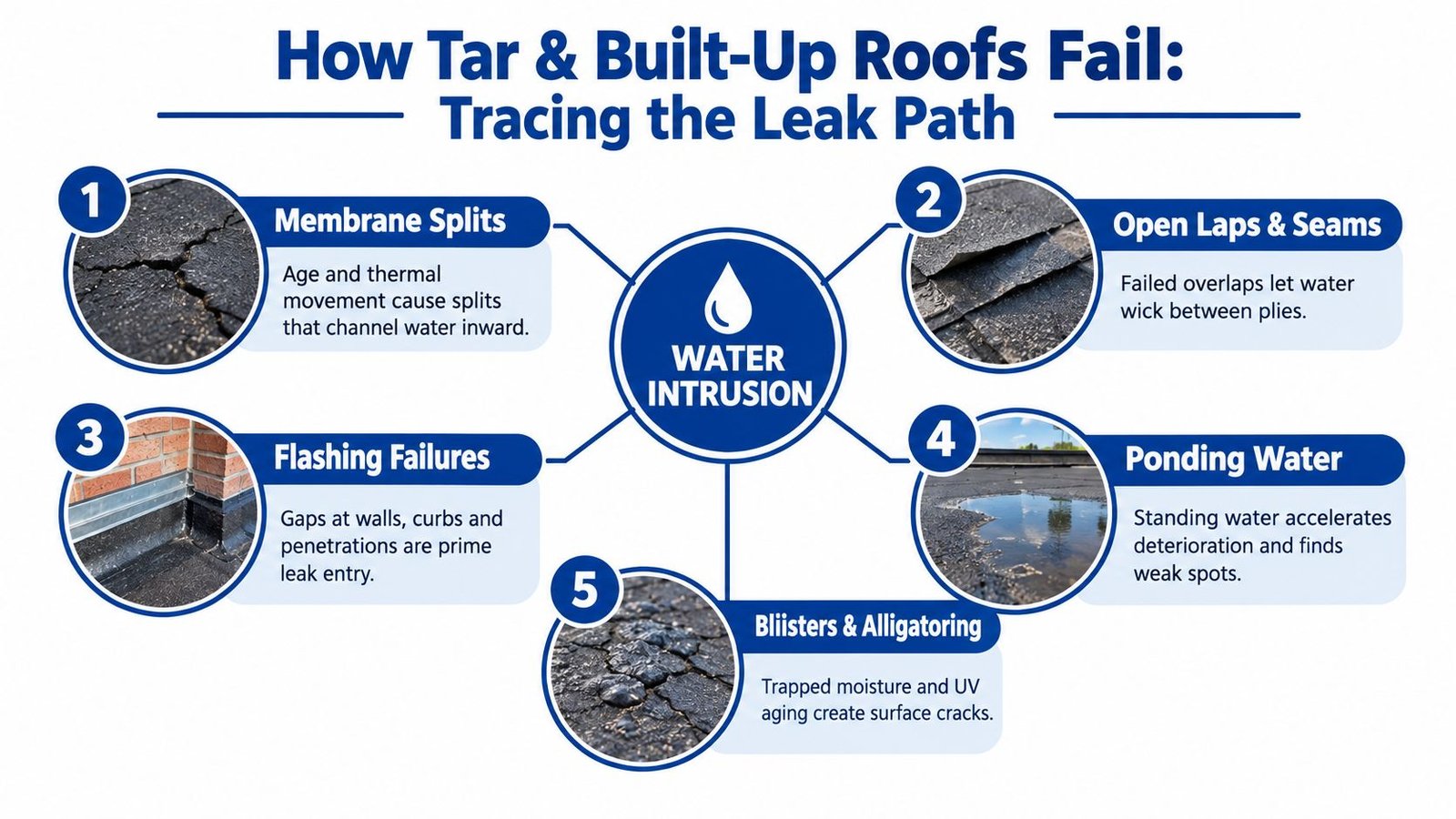
A tar roof usually leaks where movement, separation, or trapped water opens a path. The ceiling stain is the last stop. The repair has to start by tracing that path back through the roof assembly.
The parts that fail first
NIST identifies several flashing failure mechanics that matter on these roofs, including faulty construction, open laps or seams, punctures, separation from the vertical surface, and missing allowance for thermal expansion and contraction NIST report 3994. Wind can also tear flashing loose, and valley flashings that are too narrow can let backed-up water work under the roofing NIST circular 489.
The usual trouble spots are easy to predict:
- Membrane splits at aged or stressed areas.
- Open seams and laps where plies separate.
- Flashing transitions at walls, chimneys, curbs, and penetrations.
- Valleys and drainage points where water stacks up.
- Ponding areas where standing water finds weak spots.
Water does not need a wide opening. It needs one path that stays open.
The Canadian Roofing Reference Manual also warns that wet or damaged insulation, vapour retarder, and deck should be removed and replaced, not just covered Canadian Roofing Reference Manual. That matters because a roof can look patched while the lower layers keep holding moisture.
What the surface clues usually mean
Blisters, soft decking, ponding, and recurring stains point to an assembly that has already lost continuity. A blister can mean trapped voids. A soft spot can mean the deck is no longer carrying load the way it should.
San Antonio heat and storm cycles make that failure easier to miss. Sun bakes the roof, then rain pushes into weak seams, and hail can bruise flashing or reopen an older patch. A quick seal has a place when water is coming in right now. A lasting repair costs more up front, but it preserves the assembly instead of burying a weak spot under another coat.
See our guide to roof flashing repair for the weak points at walls, curbs, and penetrations.
Proven Repair Methods That Last on Flat Tar Roofs
A repair only lasts on a tar roof when the work starts on clean, dry, sound roofing. That sounds plain, but on flat roofs it is where a lot of patches fail. Dirt, loose granules, and trapped moisture keep new material from bonding where it should.
A roof can also be patched the wrong way even when the surface looks ready. A quick seal may stop water for the moment. A repair that reaches sound material and preserves the roof assembly holds up better through San Antonio heat, wind, and the next hard rain.
The repair sequence that holds up
The Canadian Roofing Reference Manual lays out the sequence plainly, remove debris and contaminants, extend the prepared area beyond the defect, stiff-brush loose granules, prime the exposed area, then install a patch that overlaps the defect by at least 150 mm, or 6 in, in all directions. When hot asphalt is used, Type 3 asphalt should be held at a minimum of 204°C, or 400°F, at the point of application Canadian Roofing Reference Manual.
Here's the part that matters in the field:
- Clear and dry the area. Loose gravel, dirt, and water stop adhesion.
- Extend past the visible damage. A repair needs to land on sound material.
- Prime exposed surfaces. Bare repair zones bond better once prepared.
- Cut fishmouths flat. Voids can reopen if they're left folded.
- Overlap the patch fully. A tiny patch on a big problem fails early.
Practical rule: If the repair does not tie into good roofing on all sides, it is a temporary cover, not a repair.
When the substrate has to come out
Some damage cannot be buried. Wet insulation, wet vapour retarder, and damaged deck need removal and replacement instead of a cosmetic overlay. That matters when a leak has been active for a while or when the roof has already been patched several times.
A durable repair also depends on continuity at seams and flashing transitions. If a patch leaves an open edge, a fishmouth, or a thin transition, wind and heat will find it. Quick sealants usually do not hold long on roofs that already have hidden moisture.
The video below is useful if you want to see the repair sequence in motion.
Choosing the Right Materials for Your Repair Situation
Not every tar repair should use the same product. A dry, cleaned roof section can take a different fix than a damp emergency leak after a storm. That's where a lot of rushed repairs go sideways.
Match the material to the roof condition
One recent repair guide notes that standard asphalt cement bonds best in roughly 40 to 70°F dry conditions Los Gatos Roofing repair guide. That's useful because San Antonio rooftops can get hot fast, and heat changes how a repair lays down and bonds. A quick seal on a wet or overheated surface can trap water instead of solving the leak.
Here's a practical comparison.
| Repair Option | Best Surface Condition | Key Limitation |
|---|---|---|
| Cold-applied asphalt cement | Clean, dry, prepared surfaces | Poor choice if moisture is trapped below the repair |
| Hot-applied bitumen | Sound roof area with good access and trained crew | Requires strict heat control and safety precautions |
| Reinforcing fabric with patch material | Localized defects that need added strength | Still needs proper overlap and sound substrate |
| Moisture-tolerant emergency product | Short-term stabilization when conditions aren't ideal | Often temporary, not a full assembly repair |
A good roof tech chooses the material based on what the roof is doing, not just on what's convenient to carry. If the lower layers are wet, a surface seal may quiet the drip for a while and still leave the damaged assembly active underneath.
For readers comparing repair strategy with coating strategy, a coatings discussion becomes relevant, because a coating can help protect a sound surface but won't fix saturated layers or failed seams roof coating pros and cons.
Emergency stop and lasting repair are not the same thing
A temporary seal can buy time during active weather. It's useful when a roof is leaking right now and conditions won't allow a full repair. But that same emergency product shouldn't be mistaken for a final fix.
That's also where a local roofing team has to be clear with the property owner. If the patch is temporary, say so. If the roof needs a dry-out, substrate replacement, or a more complete assembly repair, that should be part of the recommendation. For businesses comparing service options, even contractor marketing guidance like social media marketing for contractors is only useful if the roofer's work itself holds up, because the roof repair still has to solve the leak first.
When Repair Is No Longer the Smart Fix
Some roofs keep taking patches until the roof itself is telling you to stop. At that point, repair turns into a holding pattern, not a fix. In San Antonio, I look at how often the leaks come back, how far the damage has spread, and whether the roof is still dry enough underneath to hold a repair.
Signals that the roof is past patch-only work
A recent tar roof repair report put average repair cost at $4,699 and average replacement cost at $17,631 Tar roof repair report. That gap matters when the same roof keeps needing more patching in new spots. The same report points to soft decking, widespread blistering, standing water, and repeated leaks as signs the roof is no longer a good patch-only candidate Tar roof repair report.
Service life tells the same story from another angle. Guidance for built-up systems says properly installed and maintained tar roofs can run 20 to 30 years, and some coal-tar BUR systems can reach 40+ years with periodic recoating Weather Shield Roofers built-up roofing page. But a performance-prediction study that reviewed roofing membranes found no membrane had more than a 50% probability of lasting 20 years, and it also identifies splitting as a common failure mode CIB study PDF. Service life is possible, but it is never a promise.
If the same roof keeps leaking in different places, the problem is usually bigger than the latest crack.
Repair, recover, or replace
The substrate usually decides the next move. If the deck feels soft, the insulation is wet, or the roof already has several failing patches, another patch just hides the damage. If the damage is isolated and the deck is still sound, a clean repair can make sense.
San Antonio weather makes repeated leaks more serious than a single stain. Heat works on old tar, then hail and storms open weak seams again. Once a roof starts failing after every storm season, the question is no longer whether it can be patched. It is how long the assembly can keep doing its job without throwing good money after bad.
Staying Safe and Getting Lasting Results in San Antonio
Hot tar can burn fast and badly. OSHA says tar at 500°F can cause severe burns if mishandled, and roofing jobs that use flammable or combustible materials need a fire protection program OSHA roofing safety PDF. The same guidance says fire extinguishers rated at least 10B must be within 50 feet when more than 5 gallons of flammable or combustible liquids or 5 pounds of flammable gas are in use.
Fall protection matters just as much. OSHA's roofing guidance requires full-body harnesses for fall arrest systems and does not allow body belts in those systems OSHA roofing safety PDF. That is why hot-applied repairs and rooftop inspections belong with trained, insured crews, not a homeowner stepping onto a slick flat roof during a leak.

For San Antonio roofs, the maintenance rhythm is straightforward. Check the roof after major hail, keep drains clear, and inspect before storm season. Heat hardens old tar, hail opens weak seams, and repeated storm damage means a quick seal may stop water for now while a proper assembly-preserving repair protects the roof longer. Periodic recoating and timely seam work help when the roof is still sound, but they will not rescue wet insulation or a system that keeps failing.
If the same roof keeps leaking in different places, the repair has stopped making economic sense. At that point, the choice is no longer between a patch and a patch. It is whether the roof can still justify more work.