
You hear the last few ice stones hit the patio cover. The rain backs off. Then comes the question every San Antonio homeowner asks after a rough spring storm. Was that just loud, or was it big enough to damage the roof?
That's where most online advice falls short. A simple coin chart helps, but it doesn't tell the whole story. In San Antonio, roof damage depends on hail size, roof material, roof age, and how the storm hit your house. A quarter-size stone can matter on one roof and barely mark another.
Table of Contents
- Walking the Yard After a San Antonio Hailstorm
- Hail Size Benchmarks Every Homeowner Should Know
- How Common San Antonio Roof Materials Respond to Hail
- Cosmetic Marks Versus Real Roof Damage
- What You Can Safely Check From the Ground
- Why Hail Size Alone Does Not Tell the Whole Story
- What to Do in the First 48 Hours After the Storm
- Key Takeaways and Next Steps for San Antonio Homeowners
Walking the Yard After a San Antonio Hailstorm
In a lot of San Antonio neighborhoods, the first inspection starts in wet grass and flip-flops. You step outside, look at the mailbox, glance at the window screens, and listen for dripping from the gutters. The roof looks the same from the driveway, which is exactly why hail damage gets missed.
What homeowners usually notice first
Don't spot roof damage first. Spot the clues around it.
- Dents on soft metal: Mailbox lids, downspouts, and metal patio covers often show hail before shingles do.
- Beaten-up screens: Window screens can tell you the storm had enough force to mark lightweight materials.
- Granules in runoff areas: Dark grit in splash blocks or near downspout exits can mean the shingles took hits.
San Antonio sits in a part of Texas where hailstorms aren't rare background weather. They roll through, pound one block hard, skip another, and leave homeowners guessing whether the roof got tagged or not.
The roof can be damaged even when it looks fine
From the ground, shingles can look normal after a storm that already shortened their life. That's especially true with asphalt roofs. A shingle can lose granules or develop a bruise without looking torn up from the street.
Practical rule: If you can see matching hail evidence on the mailbox, screens, gutters, and AC condenser, the roof deserves a closer look.
If you want a broader walkthrough of how contractors and homeowners think through storm-related roof issues, this hail damage roof repair guide is a useful companion read. It helps frame the difference between visible storm clues and the roof conditions that need repair.
Hail Size Benchmarks Every Homeowner Should Know
The easiest place to start is size. When people ask what size hail damages roofs, they usually want one clean number. Answer starts with a benchmark, then gets more specific.
Here's a quick visual reference many homeowners use after a storm.
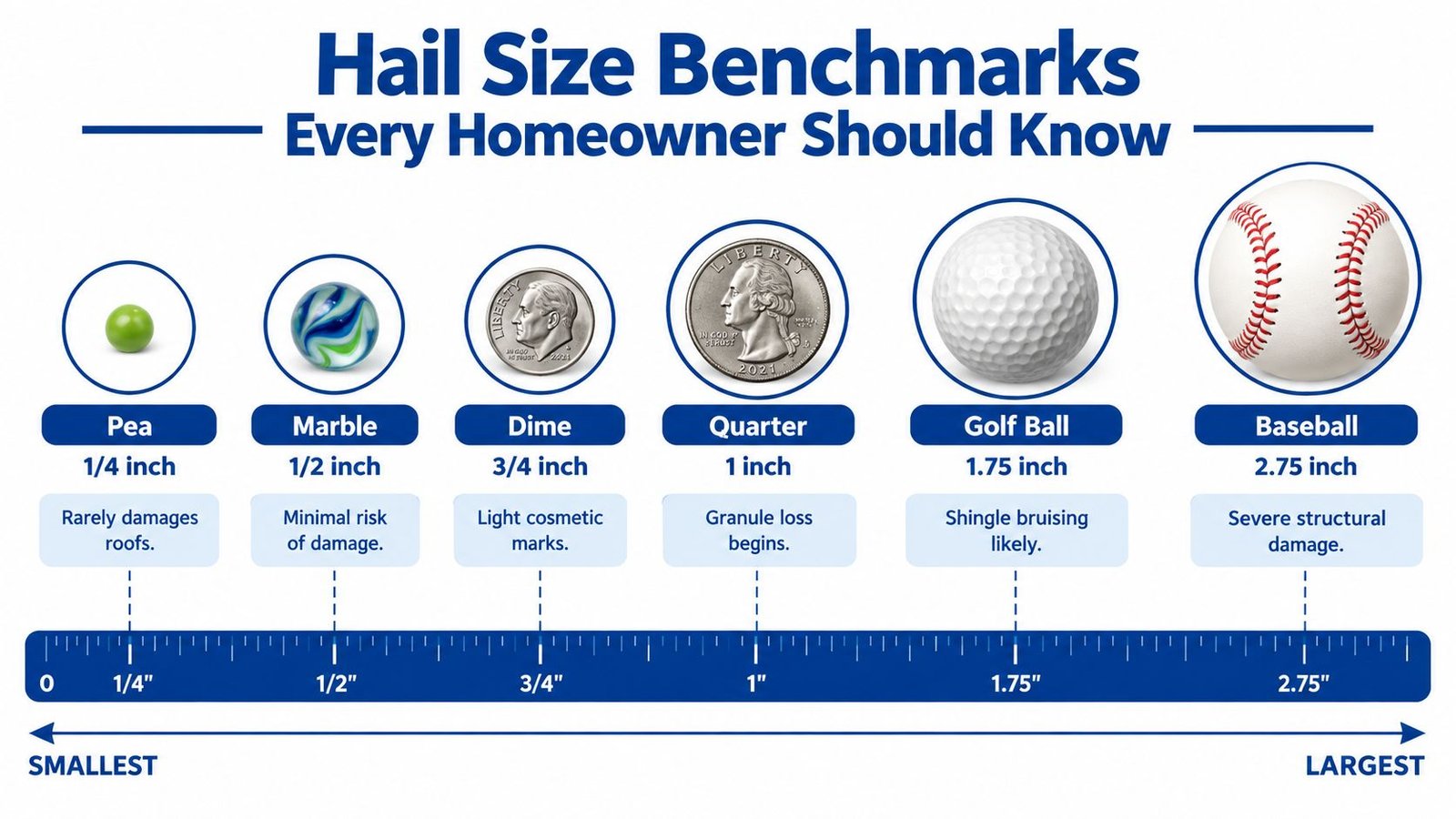
Everyday size comparisons
- Pea hail, 1/4 inch: Usually noisy, usually minor.
- Marble hail, 1/2 inch: Can leave light marks on vulnerable surfaces.
- Dime hail, 3/4 inch: Still often below the common damage threshold for sound roofing.
- Quarter hail, 1 inch: This is the practical screening line for many asphalt roofs. Significant damage to common roofing materials is widely associated with hail at at least 1 inch according to a source citing NOAA guidance in a roofing context, which is why quarter-size hail gets so much attention in storm checks (reference).
- Golf ball hail, 1.75 inch: Severe enough that many roof systems need real scrutiny.
- Tennis ball hail, 2.5 inch: This is major-storm territory.
A good visual helps, but remember that weather reports and inspectors classify hail by the largest stone's diameter, not the average stone in your yard.
After a storm, collect a few stones if it's safe and they haven't melted yet. Put one next to a coin and take a photo.
Later in the same section of your review, video can help make those object comparisons easier to remember:
How Common San Antonio Roof Materials Respond to Hail
A quarter-size benchmark is helpful, but material matters just as much. San Antonio homes commonly have asphalt shingles, metal roofing, tile, and low-slope systems over porches, additions, and commercial spaces. They don't react the same way.
Hail damage thresholds by San Antonio roof material
| Roof Material | Damage Threshold | Typical Damage Type |
|---|---|---|
| Asphalt 3-tab shingles | Around 1 inch | Granule loss, bruising, reduced shingle life |
| Laminated or architectural shingles | Around 1.5 inches for more reliable functional damage | Bruised mat, fractured shingle body |
| Concrete or clay tile | Closer to 2 inches in many references, though vulnerable spots can fail earlier | Chips, cracks, broken corners, body fractures |
| Built-up gravel or some tougher low-slope assemblies | 2 inches is a recognized threshold in inspection guidance | Surface disruption, impact damage, possible assembly compromise |
Industry inspection references place 1 inch as a point where common asphalt roofing materials can begin taking functional damage, while 1.25 inches is a key threshold for fiberglass-mat 3-tab shingles and cedar or flat concrete tile. They also note 1.5-inch hail is associated with damage to heavy cedar shakes and laminated shingles, and 2-inch hail is a recognized threshold for built-up gravel roofing and S-shaped concrete tiles (reference).
What that means on real roofs
Asphalt roofs are the most common across San Antonio, so they get the most attention after hail. Standard shingles can start showing meaningful impact effects around the quarter-size range. If you want a closer look at how this plays out on asphalt systems specifically, this article on hail damage to asphalt roof shingles is worth reading.
Tile roofs often fool homeowners because the field still looks clean from the curb. The problem is usually at ridges, edges, and impact points where a tile body can crack.
Metal is different. It often resists water-entry problems better than shingles after moderate hail, but visible denting can still matter to an owner even if the roof stays watertight.
A loud hailstorm doesn't damage every roof the same way. The same stone that bruises a brittle shingle may only leave a cosmetic ding in metal or no meaningful mark on tile.
Cosmetic Marks Versus Real Roof Damage
A lot of confusion comes from this one issue. Not every hail mark is a roof failure. Some marks affect appearance. Others damage the part of the roof that sheds water.
On asphalt shingles
Quarter-size hail can strip granules and rough up the shingle surface. Several roofing references distinguish that kind of impact from deeper damage. They note that quarter-size hail may mainly remove granules, while impacts around 1.25 to 1.5 inches are more likely to bruise the mat and compromise waterproofing, especially on older or brittle roofs (reference).
That distinction matters because a scuffed shingle and a bruised shingle don't age the same way.
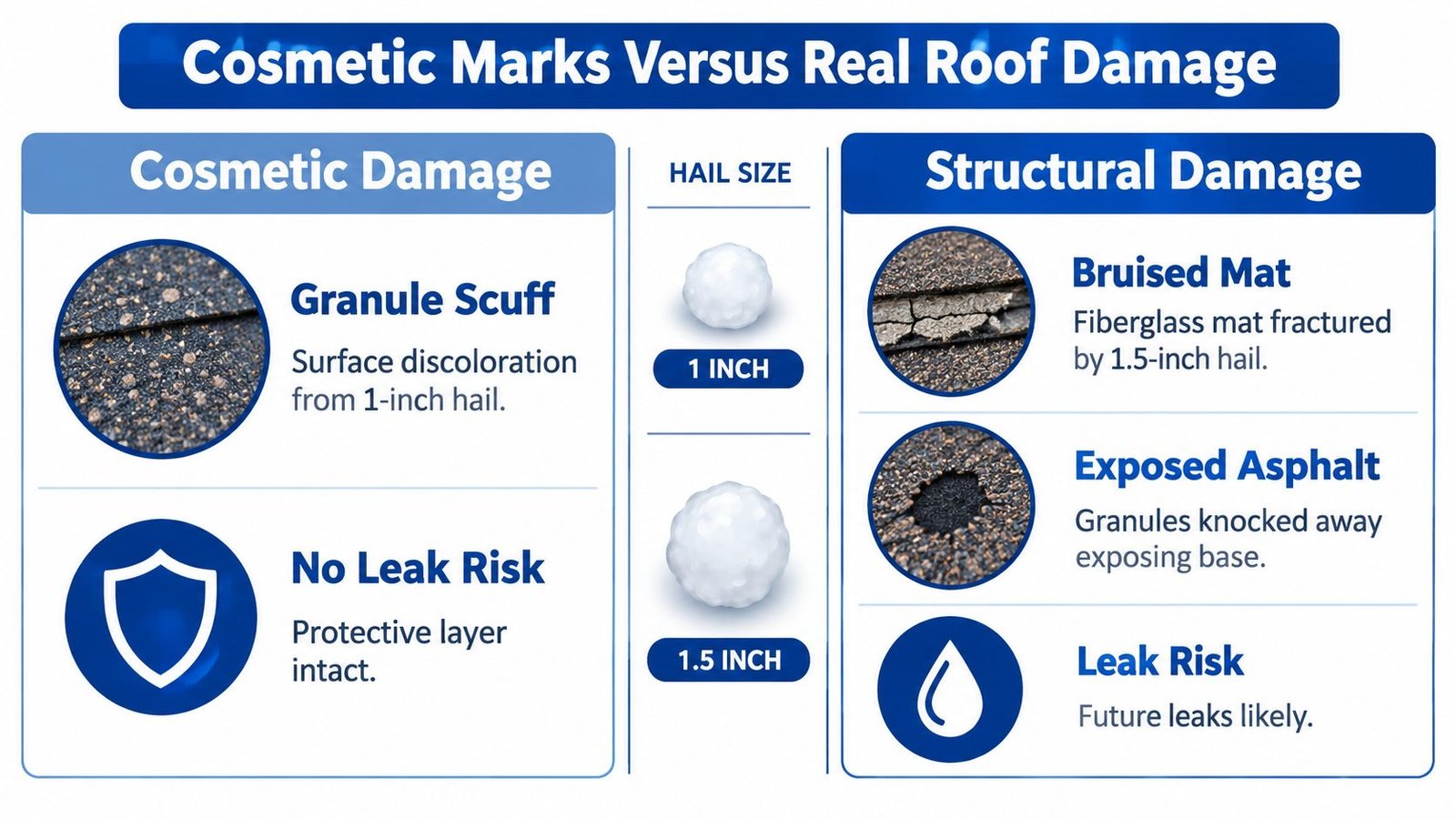
What functional damage looks like
A roofer checking for true hail injury on asphalt shingles is looking for signs like these:
- Soft bruises: A damaged spot may feel spongy or give slightly under pressure.
- Dark circular marks: Granules are gone, and the surface underneath shows through.
- Mat fracture: The fiberglass reinforcement has been compromised, not just scuffed.
- Patterned hits: Repeated impact marks on one slope often tell more than one isolated blemish.
Haag Engineering's assessment protocol says bruises or punctures in asphalt shingles rarely occur with hail smaller than 1 inch unless the shingles are poorly supported or already deteriorated (reference). That's why old roofs in San Antonio often come through a storm worse than newer ones.
On tile and other systems
With tile, a small edge chip may be mostly cosmetic. A crack running through the body of the tile is different. That can allow water intrusion and create a real repair issue, even if only a few tiles are affected.
Don't judge hail damage by color change alone. On many roofs, the serious problem is the bruise beneath the surface, not the spot you can see from the driveway.
What You Can Safely Check From the Ground
You don't need to climb a ladder to gather useful evidence. In fact, after a San Antonio storm, climbing onto a wet roof or leaning a ladder against a gutter is one of the worst choices a homeowner can make. Algae, wet shingles, slick metal, and fragile tile all turn a basic check into a fall risk fast.
Ground-level clues that matter
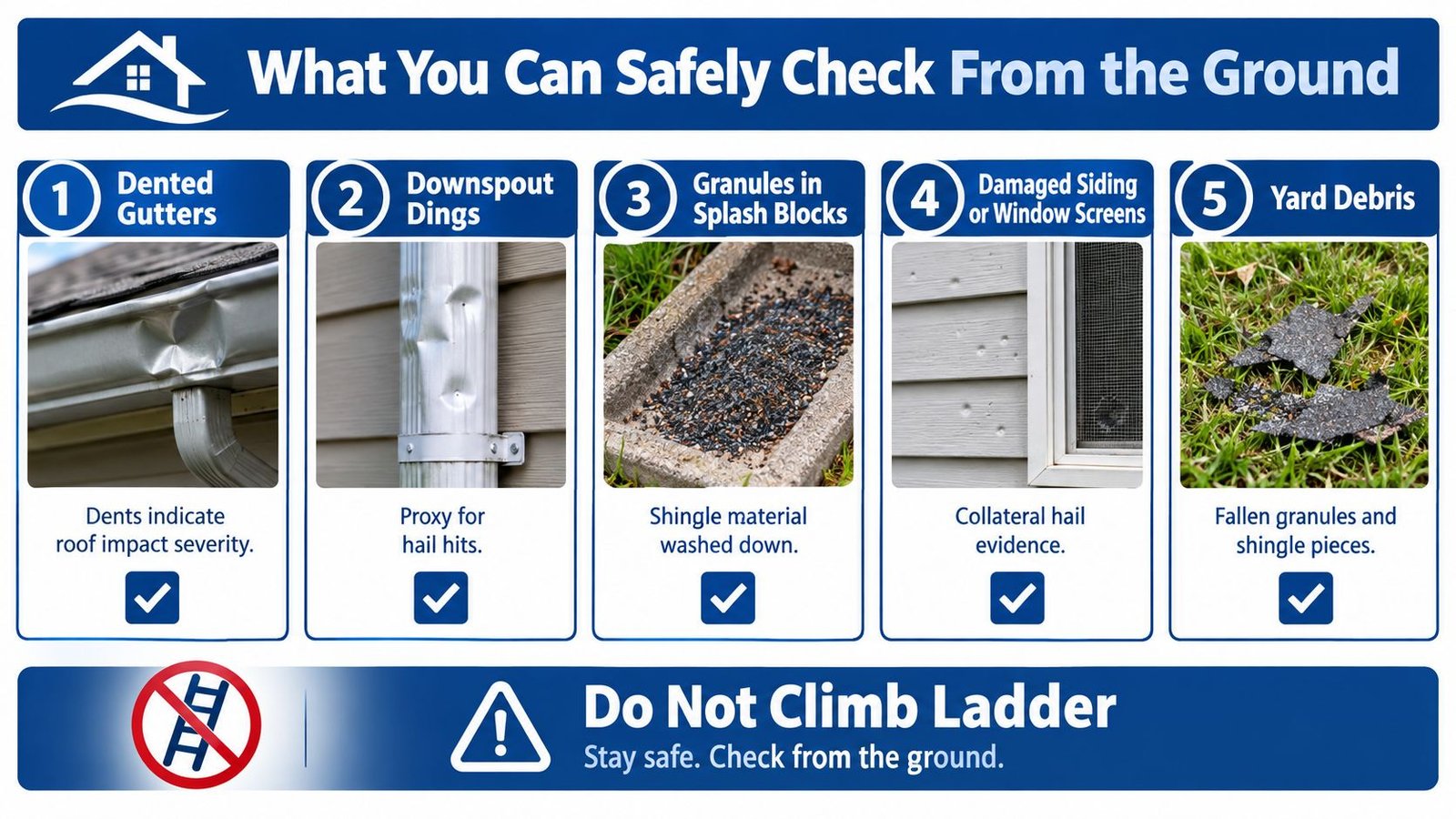
Walk the perimeter and look for these signs:
- Dented gutters and downspouts: Soft metals record hail energy well.
- Granules in splash blocks or puddles: Fresh shingle shedding often shows up where runoff collects.
- Bent window screens: These help confirm direction and force.
- Dings on the AC condenser: Matching impact marks on the condenser fins can support what happened overhead.
- Damage to fence caps, patio furniture, or mailboxes: These give you size context if the hail is already gone.
If you want a more detailed homeowner checklist, this guide on how to tell if a roof has hail damage gives a practical way to organize what you're seeing.
What these clues can't confirm
Ground clues are useful, but they don't prove the shingles are bruised. They also won't tell you whether damage is cosmetic or functional. They help answer the first question. Did the storm have enough force to justify an inspection?
That's the right role for a homeowner walk-around. Gather evidence. Stay safe. Leave the roof-surface diagnosis to someone with the right gear and training.
Why Hail Size Alone Does Not Tell the Whole Story
The internet loves a simple chart. Quarter-size means this. Golf-ball size means that. But real roof failure doesn't happen on a single clean line.
Variables that change hail damage outcomes
| Variable | Effect on Damage Threshold | San Antonio Example |
|---|---|---|
| Roof age | Older roofs usually damage more easily | A sun-baked shingle roof near Downtown San Antonio may bruise sooner than a newer roof in the same storm |
| Impact angle | Side-driven strikes can catch edges and weak points | Wind pushing hail across a front slope can hit tabs and ridges harder |
| Strike density | Repeated hits in the same area increase damage | A concentrated hail core over Alamo Heights can produce more roof injury than scattered stones elsewhere |
| Pre-existing wear | UV and prior weathering lower resilience | Roofs already dried out by Texas heat often have less flexibility during hail impact |
Research on hail hazard modeling treats roof failure as probabilistic, not as something triggered by one exact diameter. That same research also notes that replacement decisions relate to the extent of damage across the roof area, not one magic hail-size cutoff (reference).
Why that matters in the field
Two houses on the same street can come out very differently. One gets peppered on the windward slope and shows clear bruising. The other has mostly cosmetic marks because the impacts were fewer, softer, or hit a tougher material.
That's also why broad storm-recovery resources can help homeowners think beyond the coin chart. A practical example is this storms damage repair guide, which looks at storm effects as a whole property problem, not just a hail-size question.
The better question isn't only what size hail damages roofs. It's whether your specific roof took enough impact, in the way it was built and aged, to justify repair or a claim.
What to Do in the First 48 Hours After the Storm
The first two days matter. Not because every roof problem turns into an emergency, but because the best evidence is easiest to capture right away.
Start with safety and documentation
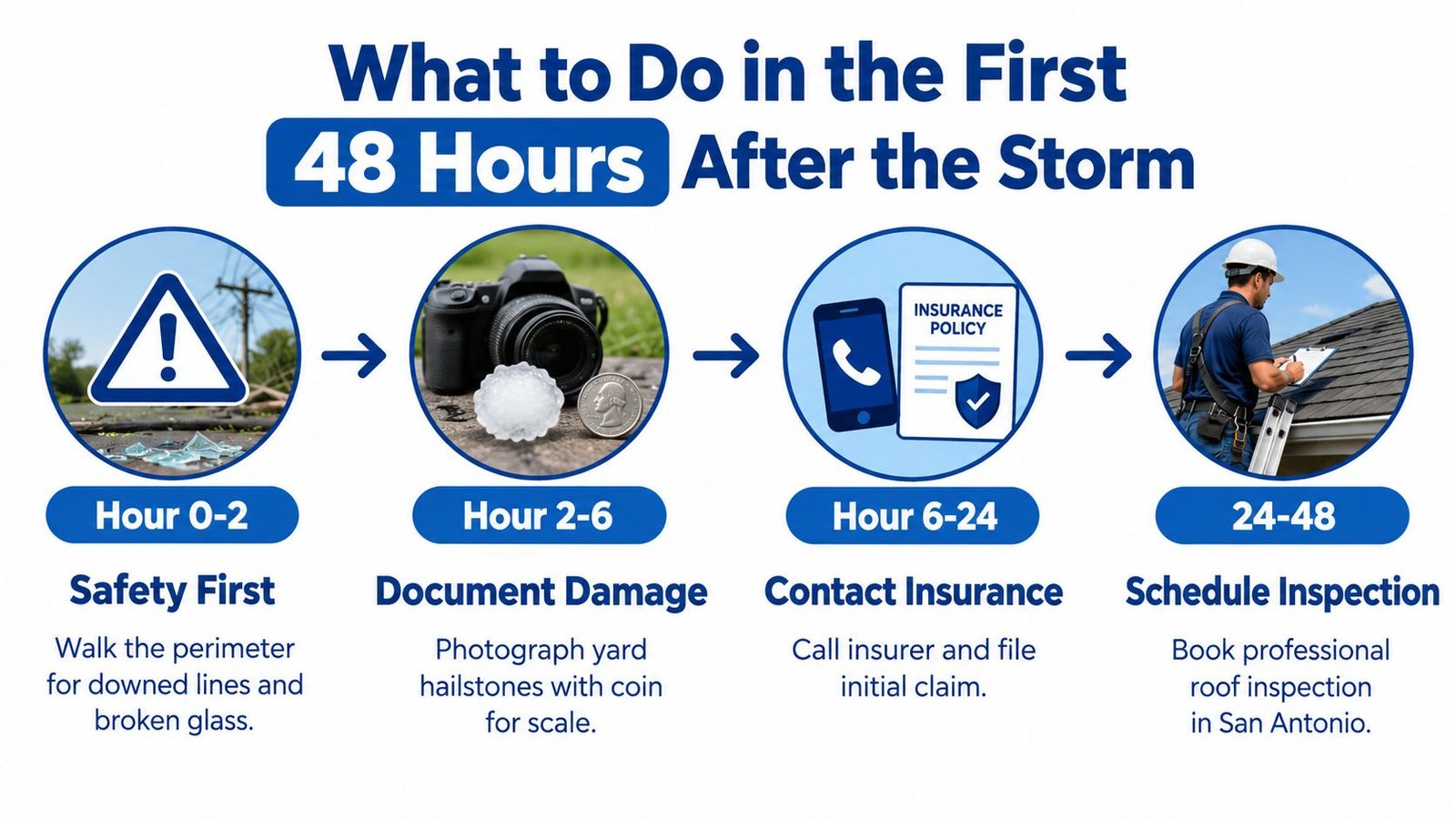
Before you think about claims, think about hazards.
- Check for immediate dangers: Look for broken glass, downed limbs, and power issues around the property.
- Photograph hail before it melts: Put a coin beside any stones you can safely collect.
- Document collateral damage: Gutters, screens, vehicles, AC units, and patio covers all help tell the story of the storm.
Write down the date and time while it's fresh. Save photos in one folder. If neighbors got similar damage, note that too.
Contact the right people in the right order
Pull out your policy and review your storm-damage language. Then contact your insurance carrier if you believe the storm may have caused covered damage. Don't promise yourself a claim result, and don't let any contractor promise one either. No honest roofer can approve coverage on the carrier's behalf.
After that, schedule a roof inspection with a local contractor who can document what's on the roof and explain whether the hits are cosmetic, functional, or mixed.
Avoid the common mistakes
These are the moves that usually create more trouble:
- Climbing onto the roof yourself: Wet shingles, metal panels, and tile are dangerous after hail.
- Letting a door knocker rush you: Storm chasers often show up before homeowners even know the extent of damage.
- Waiting too long to gather evidence: Granules wash away, dents become harder to connect to one event, and memory gets fuzzy.
FM Global's hail hazard framework treats roofs as moving from Moderate Hail to Severe Hail at 1.75 inches, and to Very Severe Hail above 2 inches. Its testing guidance also uses a 2-inch steel ball at about 8 ft-lb (10.8 J) to simulate very severe hail exposure, which is a good reminder that impact energy matters, not diameter alone (reference).
That's why early inspection helps. It ties the storm evidence on the ground to the actual condition of the roof before another round of South Texas weather muddies the picture.
Key Takeaways and Next Steps for San Antonio Homeowners
If you've been trying to pin down what size hail damages roofs, here's the practical answer. Around 1 inch is the common screening line where asphalt roof damage can begin, while tougher systems may hold longer. Laboratory and claims research summarized in meteorological literature also supports that benchmark, noting asphalt shingle damage can begin at about 1 inch (2.54 cm) while more brittle systems like concrete tile may not show comparable damage until around 2 inches (5.08 cm), depending on the material (reference).
The short version homeowners can use
- Pea-size hail: Usually not a major concern for a sound roof.
- Quarter-size hail: Worth paying attention to, especially on asphalt roofs.
- Golf-ball-size hail: Serious enough that functional damage becomes much more likely.
- Very large hail: The risk climbs fast once hail exceeds about 5 cm (2 inches), and engineering research has shown 3-inch hail can even deform metal roofing on impact (reference).
The smarter next step
Don't rely on noise, neighbor stories, or one dented gutter. Look at the clues, document what you can safely see, and get the roof checked if the storm crossed into inspection-worthy territory.
In San Antonio, waiting rarely helps. Small bruises don't announce themselves with a ceiling leak the next morning. They often show up later, after the roof has already lost life.
If your home or commercial property in San Antonio took hail, RRSATX offers free roof inspections, storm-damage documentation, roof repair, roof replacement, and help coordinating with adjusters, backed by family ownership since 2000, over 40 years of personal roofing experience, 80+ years of combined crew expertise, and $2,000,000 in liability insurance. Call 713-504-2341 or schedule a free roof inspection online through RRSATX if you want a local roofer to tell you plainly whether the storm caused real damage or just made a lot of noise.