
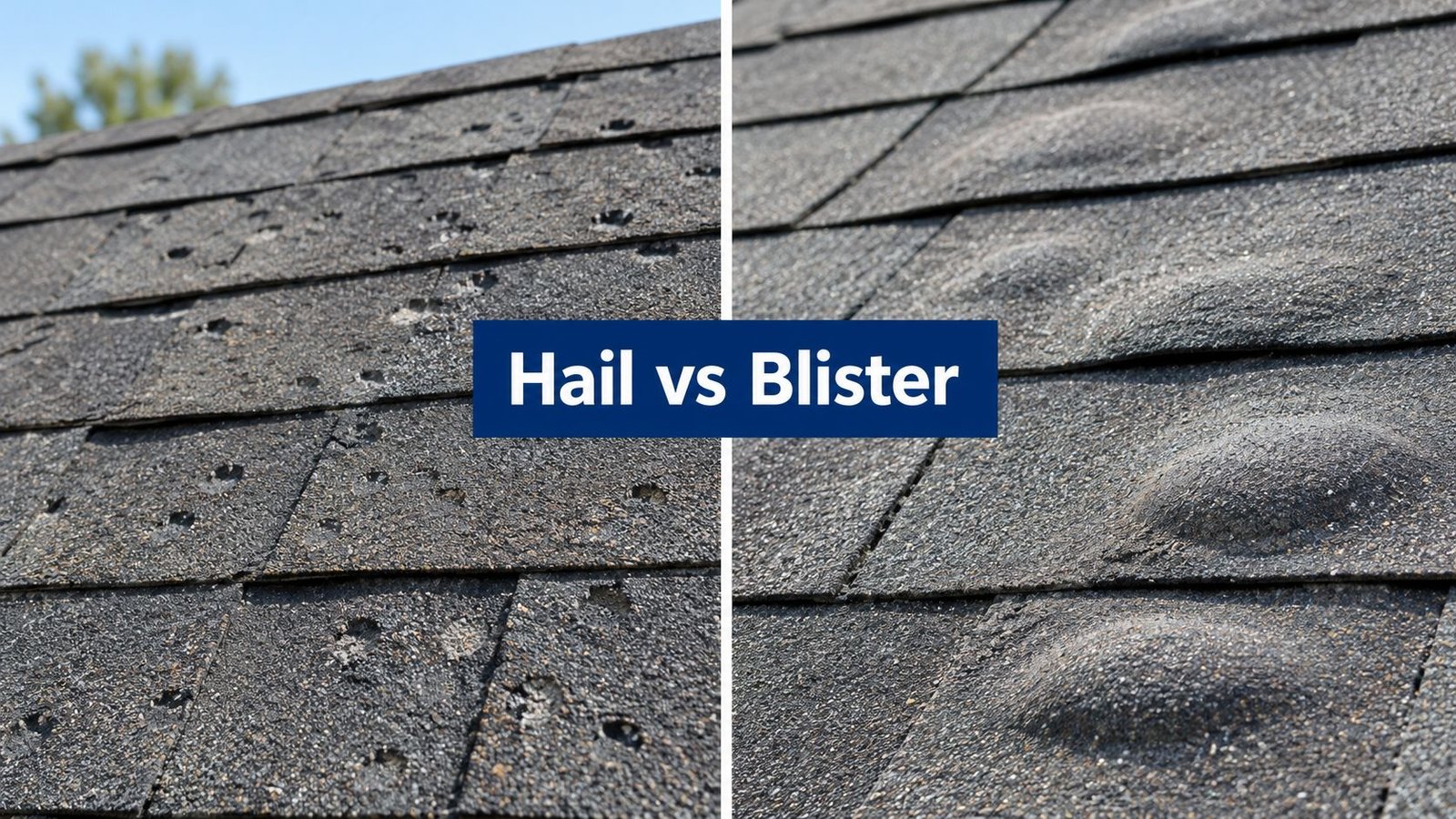
A fast-moving hail cell crosses San Antonio, then leaves almost as quickly as it arrived. After the rain stops, you walk into the yard and notice dark marks on the shingles. Some look like fresh dents. Others look like old bubbles that finally opened. A few are hard to classify from the ground.
That confusion matters. Central Texas roofs take intense sun, sudden hail, heavy rain, and long periods of heat, often on the same aging asphalt-shingle system. The question isn't whether a mark is round. The question is whether a storm caused new damage, or whether it exposed a roof defect that was already developing.
Table of Contents
- When Two Roof Problems Look Alike After a Texas Storm
- What Hail Damage and Roof Blistering Actually Are
- Side by Side Comparison of the Two Conditions
- Why Each Problem Develops and What Happens Next
- The Sequence Question on Mixed-Signature Roofs
- A Practical Inspection Workflow Before You Call Insurance
- Repair Versus Replacement in Real Situations
- What San Antonio Homeowners Should Do Next
When Two Roof Problems Look Alike After a Texas Storm
A San Antonio homeowner may inspect the roof after a storm and see several different signatures on one slope. One shingle has a shallow depression with missing granules. Another has a crater with a raised edge. A third area looks dark but feels impossible to judge from the yard.
Those marks can represent hail damage, blistering, or both. Hail is an acute, storm-driven hazard. Blistering usually develops gradually through trapped moisture, heat, manufacturing conditions, or ventilation problems. A recent storm can also strike a roof that already has blistered shingles, making the final appearance harder to interpret.
The distinction affects more than appearance. Insurance generally evaluates sudden, accidental storm damage differently from wear, aging, or material defects. A homeowner may receive a different repair recommendation depending on whether hail fractured the shingle mat or a blister popped after months of thermal cycling. No inspection can promise an insurance outcome, but accurate documentation gives the adjuster a clearer cause-and-scope record.
Why San Antonio roofs can show mixed signs
South Texas weather creates a difficult setting for roof forensics. Extreme sun can age asphalt shingles and heat the roof surface, while sudden hailstorms can strike before or after a long hot period. Poor attic ventilation may add heat beneath the shingles, and heavy rain can reveal a weakness that wasn't visible from the yard.
The broader loss picture shows why hail deserves prompt attention. The Insurance Institute for Business and Home Safety discussion of hail losses states that hail has accounted for 60% to 80% of insured losses from severe thunderstorms in a given year and has produced more than $10 billion in insured losses annually every year since 2008. That doesn't mean every dark mark is hail, but it does mean storm inspection shouldn't be delayed.
Practical rule: Treat the roof as a timeline, not a collection of isolated circles. Ask what happened before the storm, what changed during it, and what evidence remains afterward.
What Hail Damage and Roof Blistering Actually Are
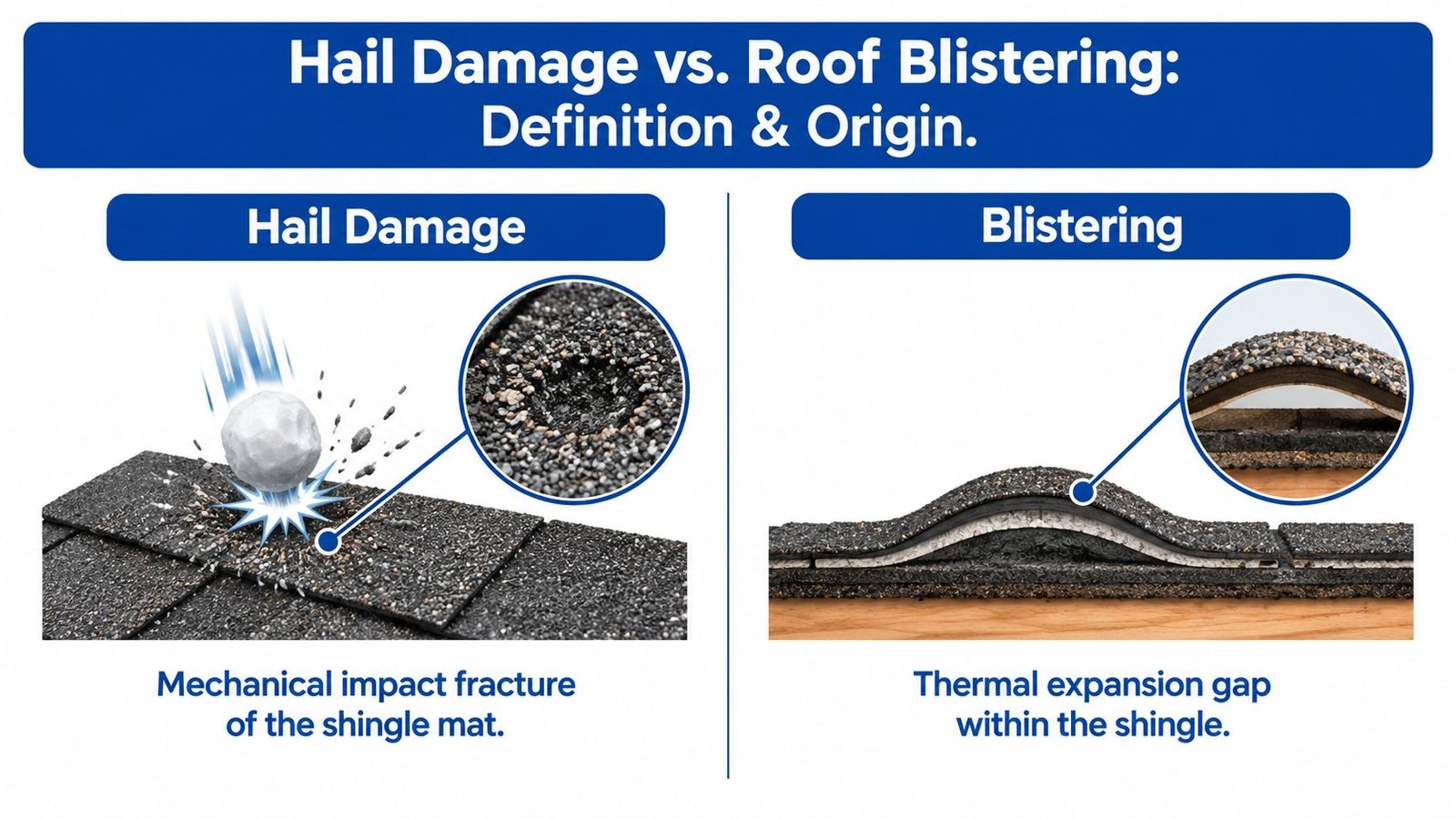
Hail damage begins outside the shingle. A hailstone strikes the surface and can displace ceramic granules, bruise the asphalt mat, fracture the shingle structure, or break the bond between layers. The mark is usually concave, and the damaged area may feel softer than the surrounding shingle when a qualified inspector examines it.
Blistering begins within the shingle. Trapped moisture, gas, or manufacturing-related pockets expand under heat and push the surface upward. When the blister ruptures, it can leave a crater, exposed asphalt, or missing granules that resembles an impact mark.
What you can observe safely
From the ground, use binoculars rather than guessing from a single dark spot. Look for scattered concave marks, irregular granule loss, and a pattern that follows the storm-facing side of the roof. Hail may also leave dents in gutters, vents, flashing, or other soft metal components.
Blistering may appear as a raised bubble before it opens. After it pops, the crater often has a more regular shape, a lifted rim, or a smoother exposed surface. Blisters can cluster on hot, sun-exposed slopes or in areas affected by poor ventilation.
A ladder-edge view can reveal more, but homeowners shouldn't walk a roof after a storm. Wet shingles are slippery, damaged shingles can break underfoot, and a fall can be more serious than the roof problem. A qualified roofer can inspect the mat, check whether the area is soft, and examine the fracture rather than relying on granule loss alone.
The underlying mechanics are opposite. Hail is an outside-in impact. Blistering is an inside-out material failure. That difference guides the repair method and helps determine whether the damage belongs in a storm claim, a warranty discussion, or ordinary roof maintenance.
Side by Side Comparison of the Two Conditions
A single visual clue can mislead you. Missing granules appear in both hail damage and popped blistering, so an inspector should compare shape, distribution, surrounding components, and timing.
Hail Damage vs Blistering at a Glance
| Criterion | Hail Damage | Roof Blistering |
|---|---|---|
| Surface shape | Usually a random concave depression, bruise, or fracture | Raised bubble before rupture, then a crater or pit with a possible raised rim |
| Granule behavior | Granules may be displaced or knocked away at the impact point | Granules may remain on an intact blister, then shed when the blister pops |
| Mark interior | Irregular depth with a sloped or crushed impact surface | More uniform crater, often with a smoother or shiny exposed surface |
| Distribution | Scattered across a slope, often influenced by wind direction | Clustered or slope-specific, often on hot or poorly ventilated areas |
| Collateral evidence | Dents may appear on gutters, vents, flashing, or other soft metals | Usually no matching external impact marks |
| Timing | Sudden and connected to a particular storm | Develops over months or years, then may rupture during heat cycles |
| Main concern | Fractured mat, seal failure, leaks, and accelerated weathering | Material deterioration, exposed mat, shortened service life, or a defect issue |
Read the pattern, not only the mark
Hail typically produces random divots and scuffs. Wind direction can make one slope show more damage than another, particularly when the storm approaches from a consistent direction. A few marks that line up with dents in metal components deserve close attention.
Blistering often looks less storm-driven. You may see several similar bubbles or craters concentrated on a south- or west-facing slope, or above an attic area that holds excessive heat. That pattern doesn't prove blistering by itself, but it raises the probability when there are no dents on adjacent metal.
The fracture surface also matters. Hail can crush or bruise the asphalt mat beneath the granules. A popped blister may expose a thin, shiny asphalt skin around a smoother crater. The distinction becomes less obvious when a later storm scours an older blister, which is why the sequence question deserves its own inspection rather than a quick ground-level label.
Why Each Problem Develops and What Happens Next
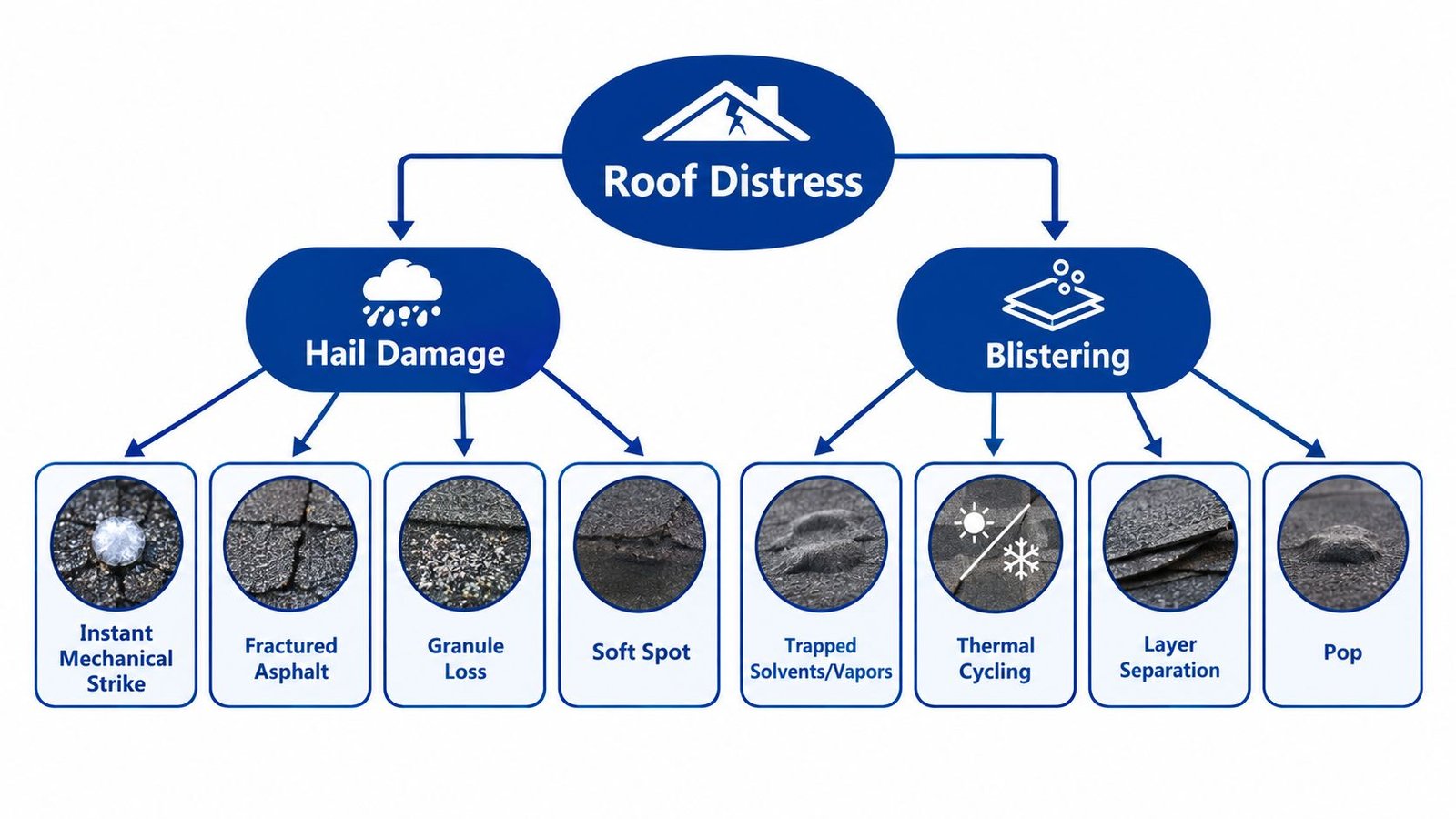
Hail damage occurs in an instant. A frozen stone hits the shingle, knocks granules loose, and can fracture or bruise the asphalt mat. Some damage is easy to see. Other impacts leave a soft or weakened area without a dramatic dent.
The resulting leak may not appear immediately. Once the protective granules and surface seal are compromised, ultraviolet exposure and repeated weather cycles can dry and crack the damaged area. Water can then travel beneath the shingle or enter around a broken seal.
Blistering follows a slower chain. Moisture, gas, or other trapped material expands as the roof heats, separating layers and pushing the surface upward. The bubble may remain intact for a period, then pop and leave a bare crater. San Antonio's heat load can make existing material weaknesses more visible over time, especially where attic ventilation doesn't adequately manage heat.
The repair and coverage consequences
An insurer assessing storm damage looks for a sudden cause, impact evidence, and a reasonable connection to the reported event. A manufacturer or roofer evaluating blistering looks more closely at material condition, installation, ventilation, and how the defect developed. Policies and warranties vary, so neither outcome should be assumed in advance.
Hail can create a repairable injury in an otherwise sound roof. It can also reveal widespread mat fractures across multiple slopes. Blistering may be isolated, but widespread blistering can indicate that replacing one shingle won't address the larger problem.
This video offers another visual reference for roof distress and inspection context.
The key is to document cause before choosing a solution. Granule loss alone isn't enough, and a dark spot alone isn't proof of hail. The inspector should connect the mark to its structure, distribution, timing, and nearby evidence.
The Sequence Question on Mixed-Signature Roofs
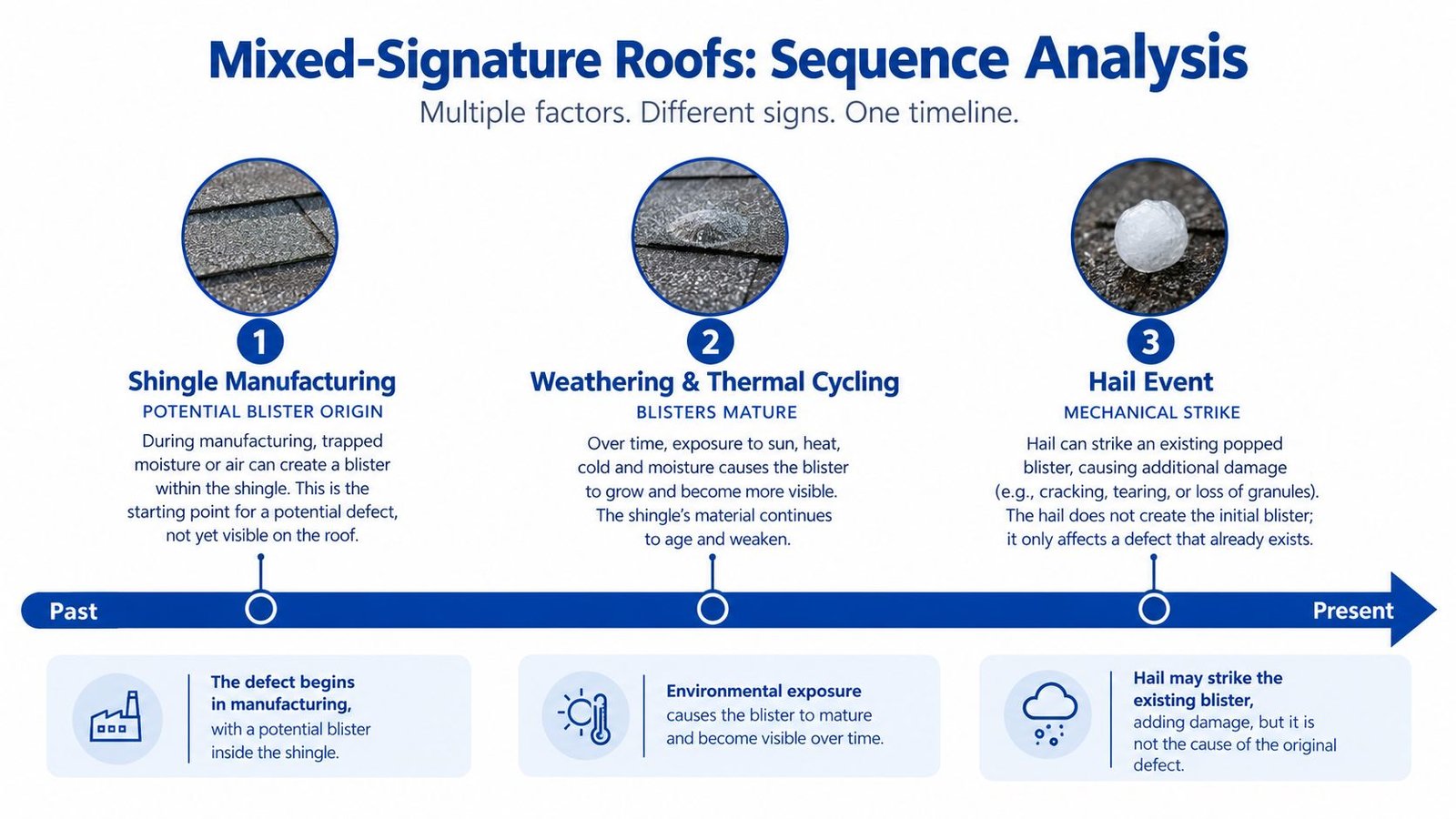
The hardest roof inspections involve both conditions. A roof may have older popped blisters and fresh hail strikes from a recent San Antonio storm. The storm may have created new impact damage, or it may have hit a blister that was already weakened and close to failure.
That sequence changes the scope of work. Storm coverage generally addresses damage caused by the covered event, not the cost of correcting pre-existing deterioration. A mixed roof can therefore receive a recommendation that separates storm-created damage from older material failure.
What an inspector compares
An experienced inspector looks at several clues together:
- Crater weathering: An older exposed blister crater may show oxidation, dirt accumulation, or a weathered surface that doesn't match a recent storm.
- Fresh granule displacement: New scuffing or loose granules inside an older-looking depression may indicate that hail struck the area later.
- Mat fracture direction: External impact can leave crushed or irregular fracture geometry, while a popped blister may show a more uniform opening.
- Storm correlation: The reported storm date should align with local hail information and the change noticed by the homeowner.
- Pattern relationship: Scattered hits across wind-facing slopes support hail, while repeated craters concentrated in sun-baked areas support blistering.
No single observation settles every case. A popped blister can look like hail after it loses its granules, and hail can make a pre-existing blister appear more severe. The useful question is not, “Does this look like hail?” It is, “Which part of this mark did the storm cause?”
Why partial decisions happen
An adjuster may agree that some areas show storm impact while classifying other areas as blistering or wear. That isn't always a contradiction. A roof can have more than one cause of distress, and the report should identify each condition rather than force every mark into one category.
Homeowners improve the record by preserving pre- and post-storm photos, noting when the marks first appeared, photographing damaged metal, and keeping the inspection report specific. An honest report that separates causes is more useful than a broad statement that every defect came from the storm.
A Practical Inspection Workflow Before You Call Insurance
Start from a safe place. Walk around the property and note which roof slopes face the likely storm direction, where granules have collected in gutters, and whether gutters, vents, flashing, siding, or screens show fresh dents.
Use binoculars next. Look for scattered depressions, raised bubbles, exposed mat, and slope patterns. Don't climb onto a wet, steep, or visibly damaged roof, and don't press questionable areas with your hands or shoes.
Build a useful photo record
A phone camera can document the overall pattern, but close-up photographs should show scale and context. Photograph:
- The full slope, including its orientation and surrounding roof area.
- Close marks, with a coin or ruler nearby for scale if you can do so safely.
- Granule distribution, including gutters and downspouts.
- Exposed mat color and texture, without scraping or cutting the shingle.
- Collateral components, such as metal vents, flashing, and gutters.
- Date information, using the phone's original file details and a written storm timeline.
A safe DIY roof inspection guide for after a storm can help with the ground-level portion. It shouldn't replace a hands-on inspection by a qualified roofer when the roof may be damaged.
Most decisive diagnostic move: Compare the exposed surface inside a blister crater. Fresh asphalt and an oxidized, weathered surface tell different stories, but the test should be performed by a qualified inspector without scraping or worsening the damage.
Prepare for the adjuster visit
Keep the storm date, photos, prior repair records, roof age information, and contractor findings together. Ask the roofer to distinguish storm-related impact, pre-existing blistering, active leaks, and recommended repairs in writing.
Don't promise yourself that an insurer will approve the claim, and don't describe every roof mark as hail before an inspection supports that conclusion. Clear evidence helps the carrier evaluate the roof on cause and scope rather than on a confusing collection of close-up circles.
Repair Versus Replacement in Real Situations
Repair makes sense when the problem is isolated and the surrounding roof remains mechanically sound. A small hail-strike cluster with intact seals may need targeted shingle replacement. A few popped blisters may be repairable if they haven't spread and the underlying roof system is otherwise in good condition, although the cause still needs attention.
Replacement becomes more reasonable when the condition is systemic. Scattered fractured mats across multiple slopes, broad granule loss, or blistering across several shingle courses suggests that spot repairs may leave the property with an uneven and aging surface.
Repair vs Replacement Decision Matrix
| Condition | Recommended Action | Why | Insurance Impact |
|---|---|---|---|
| Isolated hail hits on sound shingles | Targeted repair | Restores specific damaged areas without disturbing unaffected roofing | The carrier may evaluate only documented storm-created damage, subject to the policy |
| Widespread hail bruising or fractured mats | Consider roof replacement | Multiple damaged areas can reduce the value of isolated patches | A claim may involve broader scope if the inspection connects the damage to one storm |
| One or a few popped blisters | Repair or monitor after professional review | A limited defect may not justify disturbing a sound roof | Blistering may be treated as wear or a material issue rather than storm loss |
| Blistering across multiple courses | Evaluate replacement and ventilation | Replacing isolated shingles may not solve a repeating material problem | Coverage depends on policy language and cause, and pre-existing defects may be excluded |
| Hail striking an already popped blister | Separate the causes | The storm may have added damage without creating the original crater | Documentation should distinguish the storm contribution from the earlier condition |
Shingle color and profile matter during partial repair. A replacement shingle that doesn't match can leave a visible patch, and different profiles may not seal or interlock the same way. A roofer should also check whether removing surrounding shingles could create more disturbance than the original repair warrants.
For practical guidance on asphalt-shingle storm marks, see RRSATX's hail damage information for asphalt roof shingles. The right choice depends on roof age, the extent of damage, material availability, ventilation, and the sequence of hail and blistering, not on a single crater.
What San Antonio Homeowners Should Do Next
Document the roof as soon as conditions are safe after a hail event. Waiting allows heat, rain, and repeated thermal cycling to change existing blisters, wash away loose granules, and make the original signature harder to read.
A local inspection should include the roof surface, soft metals, attic ventilation, and any interior water entry. Choose a qualified roofing contractor familiar with South Texas heat and hail rather than relying on a generalist who only looks for obvious dents. Ask for a written report that separates storm-related damage from pre-existing wear and identifies which repairs are urgent.
Keep the next call focused
Have your photos, storm date, leak locations, and roof history ready. Avoid climbing onto the slope, walking on damaged shingles, or using a ladder during wind, rain, or poor footing. If water is entering the home, contain it indoors and request emergency stabilization rather than attempting a dangerous roof repair.
When you contact your insurer, describe what you observed and when you observed it. Don't guarantee the cause yourself or assume that every crater belongs in the claim. A professional report can explain whether the roof shows impact bruising, popped blistering, or a mixed signature that needs separate treatment.
San Antonio's next storm may arrive before the current evidence is easy to interpret. A documented inspection now can help you choose between a focused repair, a larger replacement evaluation, a ventilation correction, or a manufacturer discussion without guessing.
RRSATX provides free roof inspections, storm-damage evaluations, repairs, replacements, and written findings for homeowners across San Antonio and nearby communities. Call 713-504-2341 or visit RRSATX to schedule an inspection before hail damage and blistering become harder to separate.