
[et_pb_section fb_built=”1″ admin_label=”section” _builder_version=”4.16″ global_colors_info=”{}”][et_pb_row admin_label=”row” _builder_version=”4.16″ background_size=”initial” background_position=”top_left” background_repeat=”repeat” global_colors_info=”{}”][et_pb_column type=”4_4″ _builder_version=”4.16″ custom_padding=”|||” global_colors_info=”{}” custom_padding__hover=”|||”][et_pb_code _builder_version=”4.27.7″ _module_preset=”default” hover_enabled=”0″ sticky_enabled=”0″]
The shingle you choose determines how long your roof lasts, how much it costs to replace, and how much protection you get from Texas storms. This complete guide covers every difference between 3-tab and architectural shingles so you can make the right call for your home in San Antonio.
If you are getting a new roof or replacing an aging one in San Antonio, the conversation will come around to a choice most homeowners do not feel equipped to make: 3-tab shingles or architectural shingles. Your contractor may recommend one. The neighbor who just replaced their roof may have used the other. And the price difference can seem either compelling or confusing depending on which quote you are looking at.
The honest answer is that both options are legitimate asphalt shingles and both can work on a Texas home. But they are not equal in performance, lifespan, or long-term value. The differences between them affect how well your roof handles San Antonio hailstorms, how long it holds up under the summer heat, how your home looks from the street, and what you will spend when replacement time comes around again.
This guide covers every meaningful difference between 3-tab and architectural shingles, what each option costs in the San Antonio market, how each performs in Texas weather, and which type is the right fit for which situation. By the end, you will have a clear answer for your specific home.
Shingle manufacturers publish warranty numbers that assume ideal installation conditions, moderate climate zones, and proper ventilation. San Antonio does not fit those assumptions. The extreme summer heat, hail exposure, and intense UV radiation in Bexar County shorten real-world shingle lifespans compared to manufacturer estimates. Every lifespan figure in this guide reflects what our crews actually see in the field on San Antonio roofs, not what the product packaging says. Factor that in when your contractor quotes you a 30-year warranty on a 3-tab shingle.

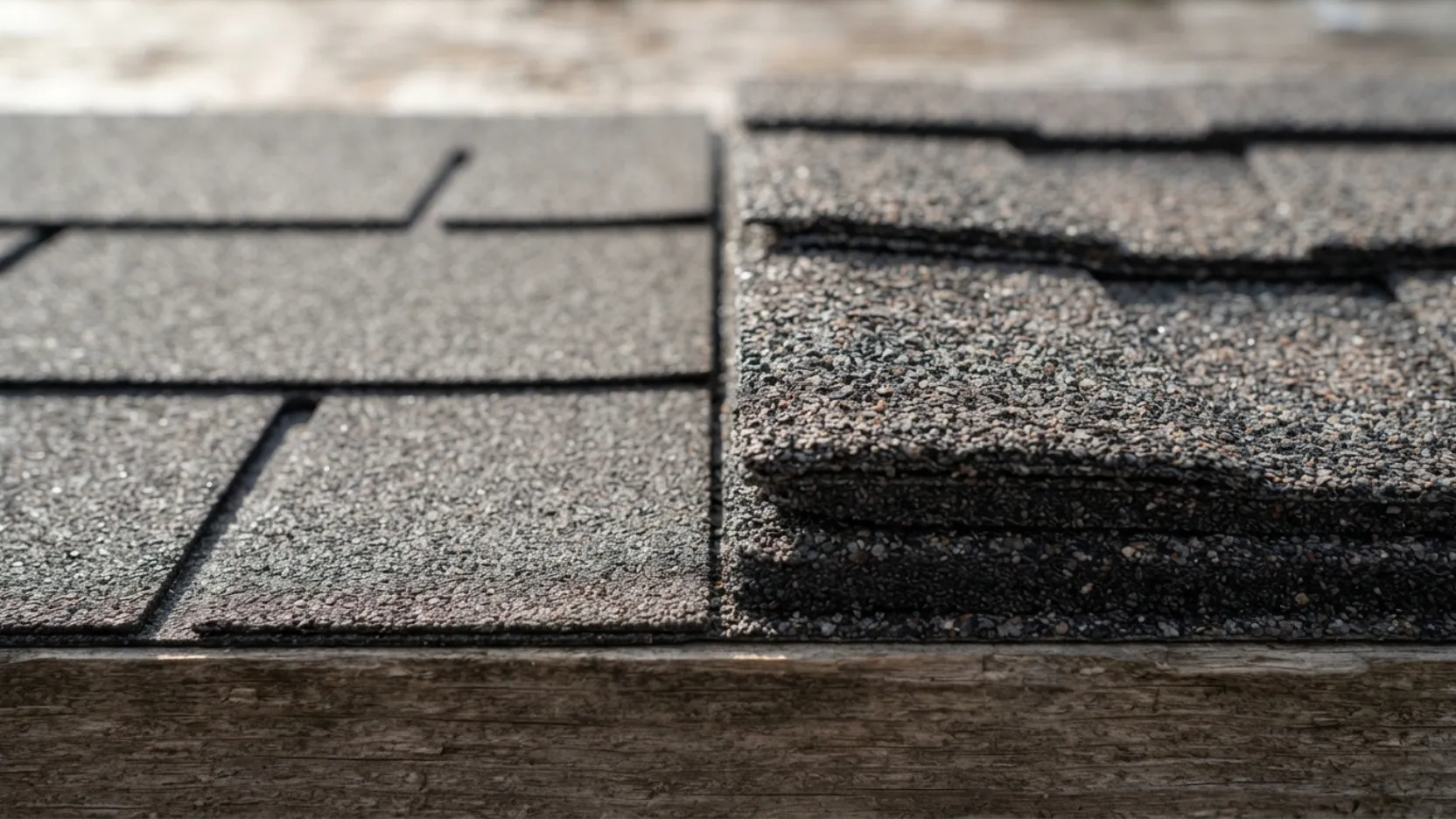
Both 3-tab and architectural shingles are made from the same core materials: a fiberglass mat base, an asphalt coating, and a granule surface layer. The differences between them come down to construction method, thickness, weight, and the way the exposed surface is shaped and finished.
- Single-layer construction with three cutouts (tabs) along the bottom edge
- Flat, uniform appearance with no dimensional variation
- Lighter weight: 200 to 250 pounds per roofing square (100 sq ft)
- Thinner profile: typically 0.14 to 0.16 inches at the tab
- Wind rating: 60 to 70 mph on standard products without upgrades
- Lifespan in San Antonio: 15 to 20 years in real-world conditions
- Lower material cost per square than architectural
- Fewer color and style options in current manufacturer lines
- Laminated two-layer construction bonded together for added thickness
- Dimensional appearance that mimics the look of wood shake or slate
- Heavier weight: 280 to 400 pounds per roofing square
- Thicker profile: 0.20 to 0.25 inches or more at the overlap zone
- Wind rating: 110 to 130 mph on most standard architectural products
- Lifespan in San Antonio: 25 to 35 years in real-world conditions
- Higher material cost per square, but lower lifetime replacement cost
- Wide range of colors, textures, and profiles across all major brands
The term “architectural” comes from the fact that these shingles were originally developed to mimic premium roofing materials like wood shake and natural slate at a fraction of the cost. The laminated construction gives them a three-dimensional shadow line that is visually distinctive from the flat, uniform look of 3-tab products. You will also hear them called “dimensional shingles” or “laminated shingles” these all refer to the same product category.
Cost
The cost difference between 3-tab and architectural shingles is real, but smaller than most homeowners expect on a full project. The material price gap is the primary driver. Installation labor is essentially the same for both shingle types because the installation method is very similar. What changes is the cost of the shingles themselves and any adjustments to starter strip and hip and ridge cap requirements for the thicker product.
Ask your insurance agent about Class 4 impact-resistant architectural shingles before you finalize your product selection. In Texas, many homeowners insurance carriers offer premium discounts of 15 to 30 percent for roofs installed with Class 4 impact-resistant shingles. On a policy with a $2,400 annual premium, a 20 percent discount saves $480 per year, or $14,400 over a 30-year roof life. That more than pays for the premium cost of the impact-resistant shingle upgrade in most cases. Get the discount amount in writing from your insurer before selecting your product.
- 3-tab shingles cost less upfront, but require replacement sooner, making lifetime cost higher in most scenarios
- Architectural shingles cost $1,000 to $2,500 more on a typical San Antonio installation
- Class 4 impact-resistant architectural shingles may qualify for insurance discounts that offset or exceed the cost premium
- Always compare fully installed quotes on the same scope, not just material costs per square
Durability
Manufacturer warranty periods on shingles are marketing tools as much as they are performance guarantees. A “30-year shingle” carries a prorated warranty that pays out less the older the shingle gets, and many warranty exclusions apply in practice. What matters in San Antonio is how long the shingle holds up physically in the actual conditions it faces: heat, UV, hail, and thermal cycling that can swing roof surface temperatures by 130 degrees or more between winter night and summer afternoon.

3-tab durability in Texas: The single-layer construction and thinner profile make 3-tab shingles more vulnerable to granule loss from UV exposure and heavy rainfall. As granules wash off, the asphalt layer underneath is exposed to accelerating UV degradation. In San Antonio’s climate, this process produces curling, cracking, and brittleness well before the 25 or 30 years the warranty might suggest. Real-world service life in Bexar County is typically 15 to 20 years for standard 3-tab products.
Architectural durability in Texas: The laminated two-layer construction retains granules better, resists thermal splitting more effectively, and distributes stress from expansion and contraction across a thicker cross-section. The heavier product also lies flatter and is less prone to wind-driven tab lifting. Real-world service life in San Antonio is typically 25 to 35 years for standard architectural products from major brands.
- Architectural shingles last 25 to 35 years in San Antonio versus 15 to 20 years for 3-tab products
- Heavier asphalt coating in architectural shingles provides better granule retention over time
- Laminated construction handles San Antonio’s extreme thermal cycling better than single-layer 3-tab
- Manufacturer warranty years do not reflect real-world San Antonio performance for either product type

Weather
Bexar County is in a part of Texas that sees severe thunderstorms, hail events, and high straight-line winds as a regular feature of the weather calendar. The Spring season alone typically produces multiple storm events with hail stones above 1 inch. The shingle type you choose affects how well your roof comes through those events, what your insurance pays for repairs, and whether you are calling a roofer two years after installation or twenty.

Wind performance: Standard 3-tab shingles carry a wind rating of 60 to 70 mph. That falls short of the gusts produced by many San Antonio severe thunderstorm events, which commonly exceed 70 mph. Tabs on 3-tab shingles can lift and break off at those wind speeds, especially as the shingles age and the self-sealing strip loses effectiveness. Standard architectural shingles are rated for 110 to 130 mph wind speeds, which provides meaningful protection in all but the most extreme Texas weather events.
Hail performance: Standard 3-tab shingles are not rated for significant hail impact resistance. Standard architectural shingles perform better due to their thicker construction, but the real upgrade in hail territory is the Class 4 impact-resistant architectural shingle, which is tested to withstand 2-inch steel ball impacts at 90 mph simulating large hail. In Bexar County, Class 4 shingles are worth the additional cost for most homeowners.
| Weather threat | 3-Tab performance | Architectural performance | Class 4 architectural |
|---|---|---|---|
| Wind (60 to 90 mph) | At or near limit for standard products. Tab lift and loss common above 70 mph | Rated 110 to 130 mph. Handles most Texas severe thunderstorm events well | Same as standard architectural; wind rating unchanged by impact rating |
| Hail (1″ to 1.5″ diameter) | Granule loss and bruising common. Accelerates aging significantly | Better than 3-tab due to thicker construction, but not impact-rated | Class 4 rated. Designed to survive large hail with minimal damage |
| Heavy rain and driving rain | Adequate when tabs are intact and sealed | Better seal due to heavier adhesive strip and more overlap coverage | Same as standard architectural |
| UV exposure (Texas summer) | Granule loss accelerates UV damage after 10 to 12 years in this climate | Better granule retention extends effective UV protection period | Same as standard architectural; some lines include enhanced UV coatings |
| Thermal cycling | Tab cracking and curling more common as shingles age in Texas heat | Laminated construction more resistant to thermal stress cracking | Same as standard architectural |
Bexar County averages 1 to 2 significant hail events per year with stone sizes above 1 inch. Over a 30-year roof lifespan, that means your roof will face 30 to 60 meaningful hail impacts. Standard shingles accumulate granule loss, bruising, and accelerated aging with each event. Class 4 shingles are designed to absorb those impacts without significant damage. The cost premium over standard architectural shingles is typically $1,500 to $3,000 on a full replacement. Many Texas insurance carriers offer annual premium discounts that recover that investment in 3 to 5 years. Ask your agent before you make a final product decision.
- Standard 3-tab shingles are rated to 60 to 70 mph below the gusts common in San Antonio storms
- Architectural shingles are rated to 110 to 130 mph and handle most Texas severe weather events
- Class 4 impact-resistant architectural shingles are the best choice for hail protection in Bexar County
- Insurance premium discounts for Class 4 shingles in Texas can recover the upgrade cost within 3 to 5 years
Appearance
Roofing is one of the largest visible surfaces on a home. In a neighborhood where most houses have similar footprints and landscaping, the roof is often the most distinctive feature. The shingle you choose affects how the home reads from the street, what buyers notice when they pull up for a showing, and what appraisers consider when valuing the property.
3-tab appearance: The defining visual characteristic of 3-tab shingles is a flat, uniform look with evenly spaced cutouts that create a repeating rectangular pattern across the roof surface. There is no dimensional variation, no shadow line, and no texture. The result is clean and consistent, but it reads as utilitarian rather than premium. In many San Antonio neighborhoods where homes were built in the 1970s through 1990s, 3-tab shingles were the standard, so a 3-tab replacement fits the original design intent of those houses.
Architectural appearance: The laminated construction of architectural shingles creates a dimensional look that adds visual depth to the roof surface. The irregular tab pattern mimics the natural variation of wood shake or slate, and the thicker overlap zones create actual shadows across the roof face that change with the angle of the sun. On a home with architectural details, stone or brick exterior features, or a steeper pitch roof, architectural shingles read as a natural upgrade that elevates the overall appearance of the property.
If you are within 5 years of selling your home, architectural shingles are the correct choice. Real estate agents in San Antonio consistently report that buyers respond negatively to aging 3-tab roofs and that a new architectural shingle roof is a strong selling point, particularly in the $300,000 to $600,000 price range where buyers are comparing homes closely. A new roof in architectural shingles is often called out in listing marketing. A new roof in 3-tab is rarely mentioned. The perception gap between the two products is real in the resale market.
- Architectural shingles provide a dimensional, premium appearance that 3-tab products cannot replicate
- 3-tab shingles are appropriate for homes where the original design used flat shingles and no premium look is needed
- Color selection is significantly wider for architectural products across all major brands
- If resale value is a factor, architectural shingles are the correct choice in virtually every San Antonio neighborhood

Installation
The installation process for 3-tab and architectural shingles is similar enough that most experienced roofing crews work with both. The key differences come down to weight, nailing patterns, and the starter strip and hip-and-ridge products required for each type. None of these differences require special equipment or significantly different labor, but they are worth understanding when comparing quotes and verifying that your contractor is installing each product correctly.
Weight on the structure: Architectural shingles weigh 280 to 400 pounds per square (100 square feet). 3-tab shingles weigh 200 to 250 pounds per square. The heavier weight of architectural shingles is rarely a structural concern for modern home construction, but it can be worth confirming on older San Antonio homes with aging roof framing or if you are adding a layer over existing shingles rather than doing a full tear-off. In most cases, the weight difference is not a limiting factor in the shingle selection decision.
Installation method differences: 3-tab shingles have specific cutout alignment requirements that take more care to install correctly because the visible tabs must line up in a straight pattern across the roof. Misaligned tabs are noticeable and are a common quality issue with crews who rush the job. Architectural shingles are more forgiving of minor offset variations because the irregular tab pattern naturally disguises small alignment inconsistencies. This does not mean architectural shingles are harder to install incorrectly it means the errors are less visible, which is actually a quality-control risk if your crew is not experienced.
- Both shingle types install similarly; labor cost difference is minimal on a full replacement
- Confirm that architectural starter strip and ridge cap products are specified not 3-tab cutoffs used as substitutes
- Verify 6-nail pattern for San Antonio’s wind zone, not the 4-nail standard used in lower wind areas
- Architectural shingles should always go on a clean deck surface after full tear-off for maximum service life
Best Use
The straightforward answer is that architectural shingles are the better product for most San Antonio homeowners in 2026. But “better” does not mean 3-tab shingles are never the right answer. There are situations where the lower upfront cost and simpler product are appropriate, and knowing the difference protects you from overspending where it is not necessary and underspending where it will cost you more in the long run.
A growing number of homeowners associations in San Antonio and surrounding communities have updated their community standards to require dimensional or architectural shingles on all new installations and replacements. If your home is in an HOA-governed community, verify the shingle requirements before your contractor orders materials. Installing 3-tab shingles in a community that requires architectural shingles will result in an HOA violation notice and a required replacement at your cost. Your contractor should check permit and HOA requirements as part of the pre-job process, but confirming it yourself takes five minutes and prevents a costly mistake.
- Architectural shingles are the right choice for the overwhelming majority of San Antonio homeowners
- 3-tab is appropriate for investment properties, flips, and situations where the roof will be replaced again within 10 to 12 years
- Verify HOA requirements before specifying a shingle type many San Antonio communities require dimensional shingles
- Never downgrade from architectural to 3-tab when replacing an existing architectural shingle roof
Use this table when comparing contractor quotes or walking through the decision with a spouse, partner, or property manager. Every factor covered in this guide is listed here.
| Factor | 3-Tab Shingles | Architectural Shingles | Winner |
|---|---|---|---|
| Construction | Single layer with three cutout tabs | Laminated two-layer with irregular tab pattern | Architectural (thicker, stronger) |
| Weight per square | 200 to 250 pounds | 280 to 400 pounds | 3-tab (lighter on structure) |
| Wind rating | 60 to 70 mph standard | 110 to 130 mph standard | Architectural |
| Hail resistance | Not rated; granule loss common from 1″ hail | Better; Class 4 option available for maximum protection | Architectural (Class 4 = best available) |
| Lifespan in San Antonio | 15 to 20 years real-world | 25 to 35 years real-world | Architectural |
| Material cost per square | $80 to $120 | $110 to $180 | 3-tab (lower upfront) |
| Full installation cost (typical SA home) | $8,500 to $13,000 | $9,500 to $15,500 | 3-tab (lower upfront) |
| Lifetime value | Higher long-term cost across replacement cycles | Lower long-term cost; fewer replacements in same period | Architectural |
| Appearance | Flat, uniform, utilitarian look | Dimensional shadow line; mimics shake or slate | Architectural |
| Color options | Limited; 8 to 12 colors in most current lines | Extensive; 30 to 50+ colors across major brands | Architectural |
| Resale value impact | Neutral to slightly negative in premium market segments | Positive; noted by agents and appraisers in most price ranges | Architectural |
| Insurance discount eligibility | Not eligible for Class 4 impact discount | Class 4 option qualifies for 15 to 30% premium discount in Texas | Architectural |
| HOA compliance | May not meet requirements in newer San Antonio communities | Meets requirements in virtually all San Antonio HOA communities | Architectural |
| Best application | Rental properties, flips, emergency repairs, strict budgets | Owner-occupied homes, long-term ownership, resale preparation | Depends on situation |

- Determine your planned ownership period more than 10 years strongly favors architectural shingles
- Check your HOA rules if applicable many San Antonio communities require dimensional shingles
- Call your insurance agent and ask about Class 4 impact-resistant shingle discounts on your policy before selecting a product
- Assess your existing roof: if it has architectural shingles, always replace with architectural or better
- Know your roof’s square footage so you can verify material quantities in contractor quotes
- Confirm shingle type and product line are specified in writing not just “architectural shingles”
- Ask for the specific manufacturer, product name, and warranty period
- Verify the nailing pattern: 6 nails per shingle is the correct standard for San Antonio’s wind zone
- Confirm the quote includes appropriate starter strip for the shingle type selected
- Ask what hip and ridge cap product is included architectural installations require matching architectural ridge cap
- Confirm full tear-off of existing shingles is included, not a second-layer overlay
- Verify synthetic underlayment is specified rather than felt paper for better moisture protection
- Check that flashings (pipe boots, valley, drip edge) are included and specified as new material
- Verify shingle product matches what was quoted by checking the package labels during delivery
- Inspect starter strip installation at eaves before main shingle field begins
- Check nailing pattern on a sample course if possible confirm 6-nail pattern, not 4
- Confirm all penetrations (pipes, vents, HVAC curbs) have new boots and seals installed
- Inspect ridge cap installation at job completion should use dedicated ridge cap product, not cut shingles
- Verify job site cleanup includes magnetic sweep for nails in the driveway and yard
- Get manufacturer warranty registration documents and workmanship warranty in writing at job close
Are 3-tab shingles still available in San Antonio in 2026?
How much more do architectural shingles cost than 3-tab in San Antonio?
Do architectural shingles hold up better to hail in San Antonio?
Can I put architectural shingles over existing 3-tab shingles?
How long do architectural shingles actually last in San Antonio, Texas?
Will my homeowners insurance pay more for an architectural shingle replacement versus 3-tab?
What shingle brands do you recommend for San Antonio homes?

Get a free shingle roof estimate in San Antonio
Tell us about your home and your goals and we will give you a clear written estimate that compares your shingle options so you can make the right call with confidence.
[/et_pb_code][/et_pb_column][/et_pb_row][/et_pb_section]