
[et_pb_section fb_built=”1″ admin_label=”section” _builder_version=”4.16″ global_colors_info=”{}”][et_pb_row admin_label=”row” _builder_version=”4.16″ background_size=”initial” background_position=”top_left” background_repeat=”repeat” global_colors_info=”{}”][et_pb_column type=”4_4″ _builder_version=”4.16″ custom_padding=”|||” global_colors_info=”{}” custom_padding__hover=”|||”][et_pb_code _builder_version=”4.27.7″ _module_preset=”default” hover_enabled=”0″ sticky_enabled=”0″]
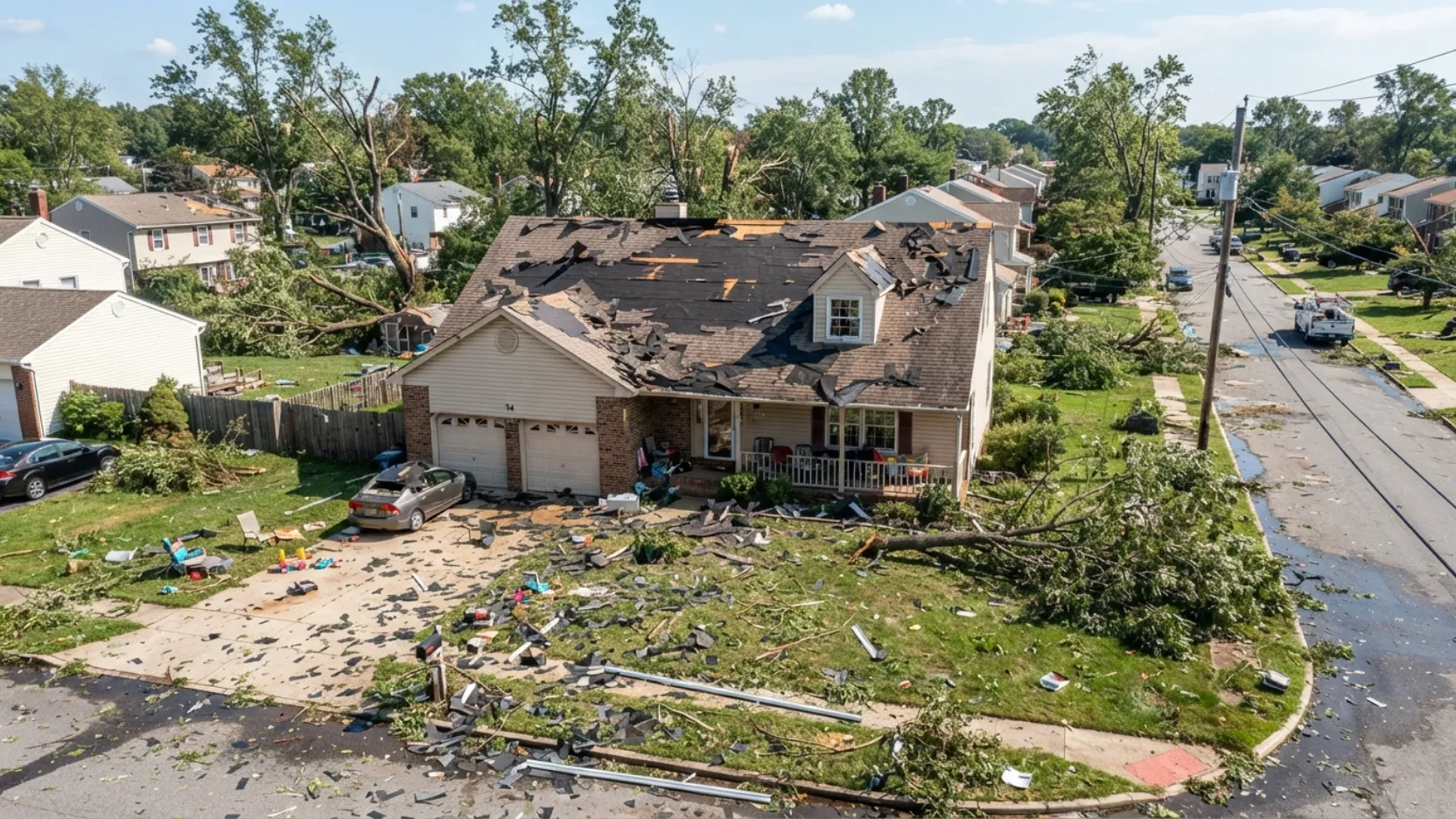
San Antonio sits in one of the most active hail corridors in the United States, and storm damage is rarely as obvious as a tree through your living room. This guide shows you exactly what to look for after a severe weather event, what different types of damage look like from the ground and from the attic, and what to do before you call your insurance company or a roofing contractor.
After every major storm in San Antonio, the same scenario plays out across thousands of homes. The storm passes. Everything looks fine from the street. The homeowner assumes the roof made it through intact. Then three months later a water stain appears on the ceiling during the next big rain, the drywall is ruined, and what would have been a $400 shingle repair has turned into a $4,000 interior job.
The problem is not that the damage was invisible. It is that most homeowners do not know what post-storm damage looks like or where to find it. Hail damage on asphalt shingles can look almost exactly like normal granule wear if you do not know the difference. Wind damage often shows up as a single lifted tab rather than a missing shingle. And the most damaging impact of a severe storm is almost always at the flashings and penetrations, not the broad field of shingles that is easy to see from the ground.
This guide covers exactly what to look for after a San Antonio storm event, organized by damage type and by where on the roof to find it.
Before calling your insurance company, before calling a roofing contractor, before anything else walk the perimeter of your home and photograph every piece of exterior damage you can see from the ground. Gutters, soffits, window screens, AC unit fins, wood fencing, and vehicles all serve as secondary evidence of hail size and impact force when an insurance adjuster arrives. Once a contractor starts work, or the next rain washes away debris, that contextual evidence is gone. Dated photos taken within 24 hours of the storm are the most powerful documentation tool you have.

Hail Damage
Hail damage on asphalt shingles is the number one reason San Antonio homeowners file roof insurance claims, and it is also the damage type that gets missed most often during a self-inspection. Unlike a puncture or a missing shingle, hail impact damage is subtle. What you are looking for is not a hole it is a bruise. A hailstone hitting an asphalt shingle knocks loose the granules that protect the asphalt mat from UV degradation. The impact leaves a dark, circular or irregular spot where the granules have been displaced and the underlying asphalt or mat is now exposed.

What a real hail impact looks like up close: A fresh hail impact on an asphalt shingle creates a soft, dark spot with a slightly indented center where the granules are missing. When you press on a recent impact with your thumb, the spot feels slightly softer or spongier than the surrounding shingle surface because the mat beneath has been bruised. This is different from normal granule wear, which produces a more gradual, blotchy pattern without the distinct circular shape of an impact point.
How hail size determines damage severity: Quarter-sized hail (about 1 inch) is generally the threshold for filing a valid insurance claim in Texas. Marble-sized hail (about 0.5 inches) typically causes minor granule disturbance without the mat bruising that constitutes functional damage. Golf-ball-sized hail (1.75 inches) causes visible denting on metal surfaces and significant granule loss across the entire shingle field. Anything larger than golf-ball size can crack shingles outright and puncture older, brittler material.
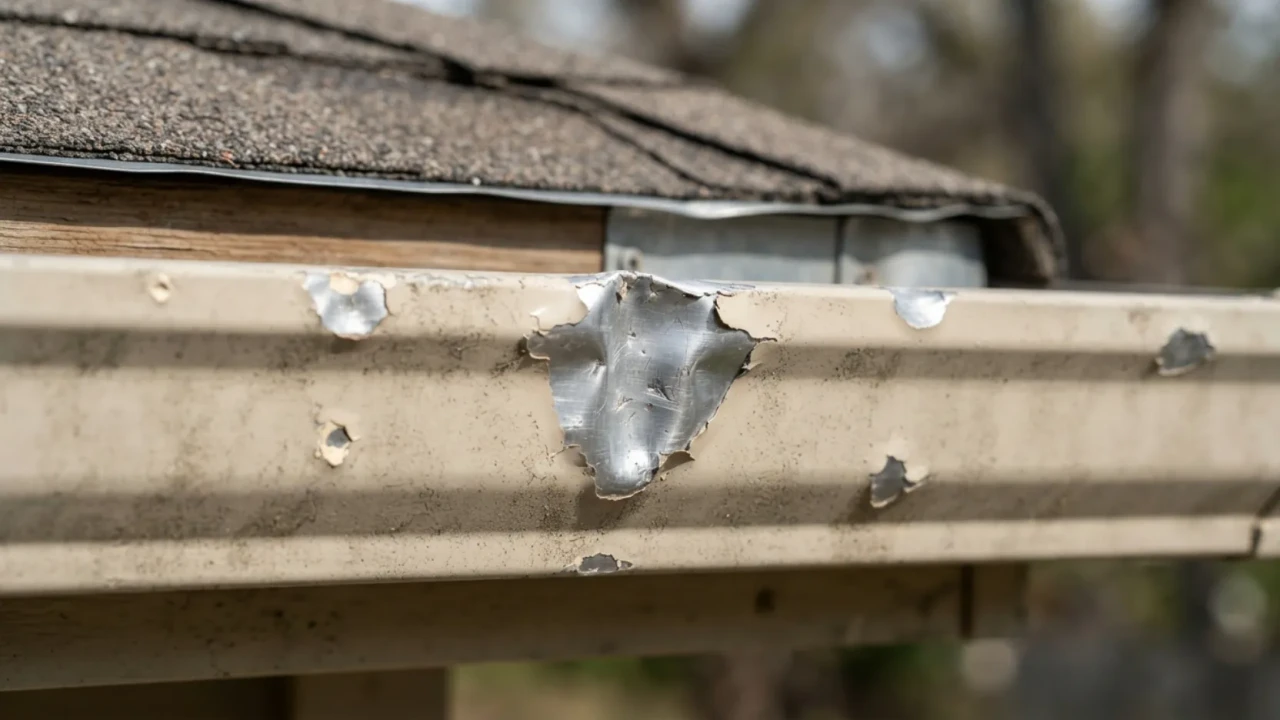
The secondary indicators of hail are often more visible from the ground than the shingles themselves. Check your aluminum gutters and downspouts for round dents each dent corresponds to a hail impact and gives you a clear visual record of hail size. Check window screens for pockmarks or tears. Check painted wood surfaces like fascia and window sills for fresh paint chipping or circular impact marks. Check the fins on your outdoor AC condenser unit, which dent easily and are often the clearest hail-size evidence on the property. If hail has left marks on all of these surfaces, the roof almost certainly sustained granule damage even if you cannot see it from the street.
- Aluminum gutters and downspouts checked for round dents each one represents a hail impact point
- Outdoor AC condenser fins inspected easily dented by hail and give a clear size reference
- Window screens checked for pockmarks, tears, or deformation from impact
- Painted wood surfaces (fascia, sills) checked for fresh circular chipping or impact marks
- Shingle surface scanned from the ground for dark, circular spots in the granule field
- Professional on-roof inspection scheduled within 30 days to document mat bruising before it weathers
Wind Damage
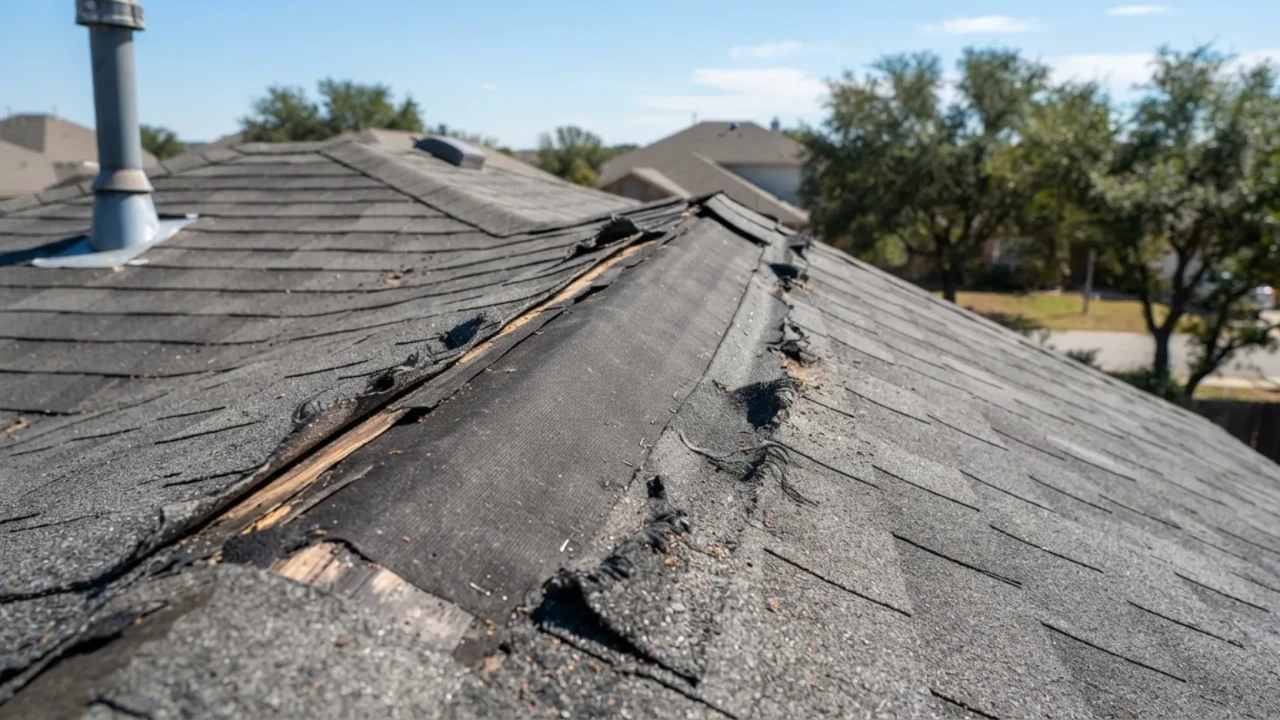
Wind damage on residential roofs follows a predictable pattern. Wind forces work under the edges of shingles, prying up the sealed tabs and breaking the adhesive strip that holds each shingle down. Once that seal breaks, the shingle is vulnerable to the next high-wind event even if it stays in place for months. The danger is that a shingle with a broken seal does not look visibly damaged from the ground. It lies flat. It does not leak. But it is one 60-mile-per-hour gust away from becoming a flying projectile and leaving bare decking exposed to the next rain.

Where wind damage shows up first: The most vulnerable locations on any pitched roof are the edges, the ridge, the rake (the sloped edge), and any corner where two roof planes meet. These are the areas where wind gets the best mechanical advantage. After any storm with winds above 45 miles per hour, focus your ground-level inspection on these locations first using binoculars.
What lifted versus missing looks like: A fully missing shingle leaves a rectangular bare patch of dark felt paper or decking visible from the ground. A lifted or partially missing shingle shows as a tab curled upward or a shingle that appears to be sitting slightly higher or at a different angle than its neighbors. In direct sunlight, the shadow line across the shingle field will be inconsistent where a tab has lifted, which makes it easier to spot.
After any wind event, check your yard and your neighbors’ yards for shingle debris before you look at the roof. A shingle tab in the grass or driveway is hard evidence that something blew off the roof. The color and material will usually match your roofing, but the tab could also have come from a neighboring property. Either way, finding shingle debris is the signal to schedule a professional inspection within the week. Do not wait for the next rain to tell you whether the decking is exposed.
Ridge cap shingles are the single most common wind casualty on San Antonio homes. They sit at the peak of the roof where wind speeds are highest and they are secured with only two nails compared to the four nails on a standard field shingle. When a ridge cap shingle blows off, it exposes the ridge board and the overlapping top edges of the field shingles on both sides of the ridge to direct water entry. Check the ridgeline from every angle during your ground-level inspection after any wind event above 50 miles per hour.
- Yard and nearby ground inspected for shingle tabs, ridge cap pieces, or flashing debris after the storm
- Ridgeline scanned with binoculars from multiple angles missing or shifted ridge caps are a high-urgency finding
- Eave and rake edges inspected for lifted drip edge or shingle tabs sticking up at irregular angles
- Shadow line across the shingle field checked for inconsistencies that indicate lifted tabs
- Soffit and fascia inspected from the ground for any panels that have pulled away or show impact damage
- Professional hand-tab test scheduled if winds exceeded 60 miles per hour visible inspection is not sufficient
Flashing Damage
Most homeowners look at the broad field of shingles when checking for storm damage. That is the wrong place to start. The locations most likely to leak after a San Antonio storm are the transition points: the step flashing along a chimney, the boot around a vent pipe, the metal in the valleys where two roof planes meet, and the drip edge along the eave and rake edges. These are the points where storm forces are concentrated, where debris impact causes the most damage, and where wind-driven rain gets the best angle to penetrate.
After a storm with significant debris branches, leaves, and wind-carried material valley flashings collect all of it. Debris sitting in a valley traps moisture against the flashing and against the overlapping shingle edges on either side. This accelerates corrosion, works sealant joints open, and creates water dams that back rain under the shingles in heavy rainfall. After every significant storm, clear debris from all valleys as part of your immediate response.
Chimney flashing is the most storm-vulnerable flashing type on most San Antonio homes. Step flashing the individual L-shaped metal pieces that run up the side of the chimney between each shingle course can be pried loose by wind or bent by debris impact. Counterflashing the metal embedded into the mortar joints at the top of the step flashing can separate from the mortar during heavy thermal cycling amplified by storm temperature swings. From the ground, look for any flashing that appears lifted, bent at an irregular angle, or rusted from debris impact through the protective coating.
After any significant storm, spend five minutes in your attic on a sunny day. Turn off any attic lights and look up at the underside of the roof deck. Daylight should not be visible anywhere. Look directly below each penetration vent pipes, chimney, skylights, HVAC curbs for any new water staining that was not there before the storm. Water stains do not always appear during the same storm that caused the damage. A failing flashing may only leak when wind-driven rain hits it from a specific angle, which means the first interior evidence shows up during a later storm. An attic inspection immediately after the first storm event documents the baseline condition before any secondary damage occurs.
- All roof valleys cleared of debris leaves and branches trap moisture and damage flashing sealant
- Chimney flashing inspected from the ground: look for lifted step flashing or separated counterflashing
- Vent pipe boots checked for cracked rubber collars hail impact accelerates failure in UV-degraded rubber
- Skylight frame inspected for debris impact damage and sealant condition at all four corners
- Drip edge confirmed to be tight against fascia along all eave edges wind commonly lifts this during storms
- Attic inspected immediately post-storm for new water staining below any penetration
Damage by Material
The same storm will leave very different evidence on different roofing materials. A homeowner with a metal roof looking for granule loss, or a tile roof owner looking for dented panels, will miss the actual damage entirely. Each material has a specific set of post-storm indicators that are worth understanding before you do your inspection.

Asphalt shingles: Look for granule loss (dark circular spots), mat bruising, cracked or split tabs, missing shingles, and lifted edges with broken seal strips. In gutters, look for heavy granule accumulation immediately after the storm. Algae-covered older shingles can mask hail impacts because the dark surface hides the granule loss these roofs need a professional on-roof inspection after any qualifying hail event.
Metal roofing (standing seam and corrugated): Hail leaves visible denting on softer metals (aluminum and copper) but may leave minimal marks on heavier gauge steel. The real risk on metal roofing is at the seams and fasteners hail impact and wind stress can separate standing seam locks, back out exposed screws on corrugated systems, and crack the sealant at all overlap joints. Look for denting on ridge caps, flashings, and the flat panel faces. Stone-coated steel panels chip at the coating surface, exposing bare metal to future corrosion.
Tile roofing (clay and concrete): Tile is highly resistant to small hail but brittle under impact from larger stones. Cracked or broken tiles are usually visible from the ground as lighter-colored or irregular shapes in the otherwise uniform tile field. The more common post-storm tile issue is that debris and hail force tiles to shift, breaking the mortar at the ridge or hip caps and allowing water under the overlapping tiles. Check the ridge and hip lines first on any tile roof after a storm.
| Roofing material | Primary hail damage indicators | Primary wind damage indicators | Where to look first |
|---|---|---|---|
| Asphalt shingles | Granule loss, dark circular bruise marks, cracked tabs | Lifted tabs, broken seal strips, missing shingles, ridge cap blow-off | Gutters, ridge, eave edges |
| Metal (standing seam) | Denting on panel faces and ridge caps, seam separation | Lifted ridge caps, separated seam locks, screw back-out on exposed fastener systems | Ridge, seams, fastener field |
| Metal (corrugated) | Denting, cracked panel coating, sealant failure at overlaps | Lifted panels, backed-out screws, separated ridge cap sealant | Panel overlaps, ridge, fasteners |
| Stone-coated steel | Chipped coating exposing bare metal, denting under stone surface | Same as corrugated fastener and seam focus | Panel surface, ridges, valleys |
| Clay or concrete tile | Cracked or broken tiles visible as lighter patches in tile field | Shifted or dislodged ridge and hip caps, broken mortar joints | Ridge caps, hip lines, broken tile pattern |
| Flat (TPO, EPDM, modified bitumen) | Punctures from hail debris, seam separation from impact stress | Lifted membrane edges, separated seams, pulled-back flashing at parapet walls | Seams, drains, parapet flashings |
- Asphalt: gutters checked for granule surge immediately after storm heavy accumulation is a strong damage indicator
- Metal (any type): ridge caps and seams inspected first these are the highest-risk points in both hail and wind events
- Stone-coated steel: panel surface scanned for color irregularities where the stone coating has chipped
- Tile: ridge and hip lines scanned for shifted or missing caps broken mortar is the leading post-storm failure on tile roofs
- Flat membrane: parapet wall flashings and drain areas checked these are the most common failure points after storm stress
- All materials: secondary surfaces (gutters, AC fins, screens) inspected as hail-size evidence regardless of roofing type
Hidden Damage
Not all storm damage announces itself immediately. Some of the most costly post-storm scenarios in San Antonio involve damage that was present from the day of the storm but did not cause a visible leak or interior problem until the next significant rain event which might be three months later. By that point, insurance claim windows may have expired, the original damage has been washed by multiple rain cycles, and separating storm damage from normal wear becomes a more complicated conversation with your insurance adjuster.
Hail can punch through the roofing felt underlayment without visibly cracking the shingle above it. The shingle acts as a flexible cushion that absorbs the impact without breaking, but the felt beneath takes the puncture. Water then has a path through a compromised underlayment but not through the shingle surface. This type of damage produces a slow, intermittent leak that only shows up during heavy sustained rainfall when water pools on the roof long enough to find the underlayment breach. It is essentially invisible on a ground-level inspection and requires a professional on-roof assessment to identify.
Do not wait for a leak to file a storm damage insurance claim in Texas. Texas homeowners insurance policies cover functional damage to roofing materials caused by storm events not just active leaks. A shingle field with documented granule loss from a dated hail event is a covered loss even if no water has entered the home yet. Filing promptly after the storm event, before the damage weathers further and before the claim window closes, is always the right approach. Most Texas homeowners policies allow one year from the date of the storm to file a claim. Do not use that full year as a grace period file within 30 days whenever possible.
Water that enters a roof deck and saturates the plywood or OSB sheathing can cause structural damage to the decking that does not produce an interior leak immediately. The decking absorbs the moisture, begins to delaminate or develop mold, and only shows interior evidence when the saturation level is high enough to drip through the insulation. By that point, a decking repair that would have cost $500 at the time of the storm has become a $3,000 to $6,000 decking replacement with mold remediation. This is the scenario that makes a 30-day post-storm professional inspection genuinely important not just recommended.
- Professional on-roof inspection scheduled within 30 days ground-level assessment cannot find underlayment breaches or broken seal strips
- Insurance claim filed promptly after the storm do not wait for a visible leak to appear before contacting your insurer
- Attic inspected within one week of the storm for new moisture on the underside of the roof deck
- Attic re-inspected 30 and 60 days after the storm delayed leaks often appear on the second or third rain cycle after the event
- All inspection findings photographed and dated building a timestamped file protects your claim if the insurer questions the damage origin
- Any soft or spongy spots on the roof deck reported to the contractor before work begins deck replacement should be in the repair scope

Use this table after any significant weather event in San Antonio to prioritize your ground-level inspection. The damage indicators are listed from most visible to least visible, with the ones most likely to cause a valid insurance claim marked accordingly.
| Storm type | First place to check | Key damage indicators | Insurance claim likely? |
|---|---|---|---|
| Hail (1″ or larger) | Gutters, AC fins, window screens | Dented gutters, granule surge in gutters, dark circular spots on shingles, dented ridge caps | Yes file within 30 days |
| Hail (under 1″) | AC fins and window screens only | Light surface marks on soft metals, minor granule disturbance | Typically below threshold document and monitor |
| High wind (60+ mph) | Ridge, eave edges, yard for debris | Missing or shifted ridge caps, shingle tabs in the yard, lifted drip edge, separated soffits | Yes if shingles are missing or shifted |
| Severe thunderstorm (combined hail and wind) | All surfaces gutters, ridge, valleys, flashings | Combination of all hail and wind indicators above | Yes highest-severity storm claim scenario |
| Heavy rain only (no hail or severe wind) | Gutters, valleys, attic immediately after | Debris accumulation in valleys, gutter overflow, new water stains in attic | Rarely reveals pre-existing maintenance issues rather than storm damage |
| Falling tree or branch | Point of impact and surrounding area | Physical damage to shingles, decking, or structural framing obvious and localized | Yes document the tree and the damage before removal begins |
- Walk the full perimeter of the home and photograph all exterior surfaces from every angle
- Check aluminum gutters for round dents each dent is evidence of hail size and impact force
- Check AC condenser fins for denting or bending the most reliable hail size indicator on most properties
- Check window screens for pockmarks, tears, or deformation from hail impact
- Check yard and neighboring properties for shingle debris, flashing pieces, or ridge cap fragments
- Scan the ridgeline from multiple angles with binoculars shifted or missing ridge caps are a high-urgency finding
- Check the eave and rake edges for lifted drip edge or shingle tabs sticking up at irregular angles
- Scan the valley lines and chimney flashings for lifted or bent metal
- Check fascia and soffit panels for detachment or impact damage
- Turn off attic lights and look upward for any daylight coming through the decking
- Inspect the underside of the roof deck below every penetration for new water staining
- Check insulation for wet or compressed areas that indicate water intrusion
- Document the attic condition with photos dated immediately after the storm this is your baseline
- Repeat attic inspection at 30 and 60 days after the storm to catch delayed leaks
- All exterior photos taken within 24 hours and confirmed to have accurate date and time stamps
- Storm event details recorded: date, time, approximate wind speed, hail size if observed
- Insurance company notified within 48 hours if hail exceeded 1 inch or wind damage is visible
- Licensed San Antonio roofing contractor contacted for independent on-roof assessment within 30 days
- Emergency tarping arranged immediately if any roof sections are open or actively leaking
- No repair contracts signed with door-to-door contractors within 72 hours of the storm always get multiple bids
How can I tell if my roof has hail damage without getting on it?
What hail size causes roof damage in San Antonio?
My roof is not leaking after the storm. Do I still need an inspection?
How do I know if my roof damage is from the recent storm or from normal wear?
Should I call my insurance company or a roofing contractor first after a storm?
How long do I have to file a roof damage insurance claim in Texas after a storm?
Get a free post-storm roof inspection in San Antonio
Not sure if your roof took damage in the last storm? We will inspect it for free, document everything we find, and give you a clear written report at no cost whether you end up needing repairs or not.
[/et_pb_code][/et_pb_column][/et_pb_row][/et_pb_section]