
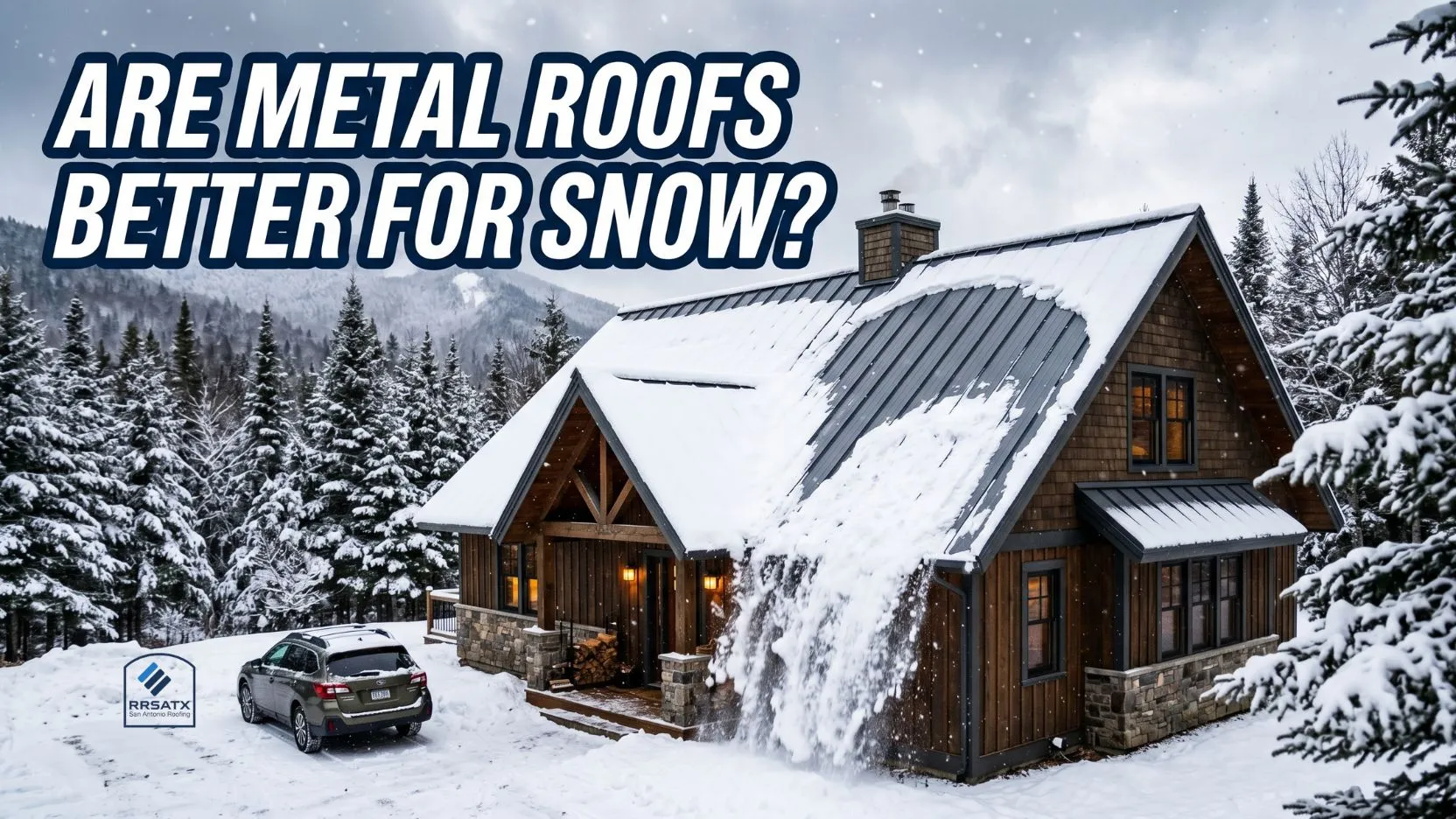
Yes—metal roofs are better for snow than asphalt shingles. Smooth panels shed snow faster, ice bonds less at the eaves, and a well-installed standing seam system outlasts asphalt in freeze-thaw climates by decades. The short answer is easy; the useful answer is how the system is built.
Snow performance is not just “metal vs. asphalt.” Pitch, attic ventilation, insulation, underlayment, and snow guards matter as much as the panel itself. A standing seam roof with weak attic air sealing can still ice-dam. A mid-pitch metal roof with the right guards can shed safely where asphalt packs and hangs.
San Antonio does not see deep winter snow, but many local homeowners keep mountain cabins, northern rentals, or plan a move. The same physics that help snow country—low friction, low dead load, freeze-thaw durability—also explain why metal handles Texas hail and heat cycling so well.
By the end of this guide, you’ll know why metal sheds snow faster, how ice dams form and how metal reduces them, what snow load and snow guards require, which panel types perform best, and how cost compares to asphalt over a snow-climate lifespan.
Table of Contents
- Why Metal Sheds Snow Faster
- Ice Dams: Where Metal Changes the Equation
- Snow Load and Structural Weight
- Metal vs Asphalt in Snow
- Best Metal Types for Snow
- Cost in Snow Climates
- Common Questions About Metal Roofs and Snow
- Next Steps for San Antonio Homeowners
Why Metal Sheds Snow Faster
Metal panels have a smooth, low-friction surface. Asphalt granules grip snow crystals and let packs bond. On a pitched metal roof, snow often slides within hours after a storm—sometimes while it is still falling.
Thermal conductivity helps too. Heat from the building reaches the underside of the snowpack faster on metal, creating a thin melt layer that lubricates release. Asphalt holds heat differently, so snow can sit for days without that even melt film.
Practical rule: the roof system matters as much as the metal—pitch, ventilation, and snow guards decide real-world snow performance.
Pitch note: a standing seam roof at about 3:12 sheds snow far better than asphalt at the same slope. On asphalt, 3:12 is marginal in snow country; on metal, it is often workable.
Snow guards are not optional above walkways, doors, or driveways. The same smooth surface that sheds well can release a whole slab at once. Guards control release so people, gutters, and landscaping stay safe.
Ice Dams: Where Metal Changes the Equation
Ice dams form when attic heat melts upper-roof snow, meltwater runs to a cold eave, and refreezes into a dam. Water then backs under the roofing. On asphalt, ice grips granules and finds paths between shingles into the deck.
Metal cuts risk two ways: ice bonds weakly to a smooth panel, and faster shedding leaves less snowpack to melt and refreeze. Paired with air sealing, insulation, and ridge/soffit ventilation, many homes that fought dams every winter see few or none after a metal install.
Metal does not fix a bad attic by itself. Warm roof surfaces from poor insulation still create melt-freeze conditions. If you have ice-dam history, evaluate the attic at the same time as the roof.
Practical rule: standing seam plus attic air sealing commonly eliminates chronic ice dams—metal alone is not the complete fix.
Snow Load and Structural Weight
Snow load is pounds per square foot and varies with density. Wet spring snow can push 20 lbs/sq ft or more. Codes set design loads from local ground-snow data; any system must meet them.
Standing seam metal typically weighs about 1–3 lbs/sq ft. Architectural asphalt is about 2–5 lbs/sq ft. Lighter dead load leaves more structural capacity for live snow load—useful when framing margin is tight. Slate and concrete tile (7–12 lbs/sq ft) need careful structural review in snow country.
Confirm local ground snow load (IBC / ASCE 7), slope factors, panel gauge for span, and snow-guard spacing with the design load and pitch.
Metal vs Asphalt in Snow
| Performance category | Metal roofing | Asphalt shingles | Edge |
|---|---|---|---|
| Snow shedding | Fast; low friction | Slow; granules hold snow | Metal |
| Ice dam resistance | High; weak ice bond | Low; ice grips granules | Metal |
| Dead load | 1–3 lbs/sq ft | 2–5 lbs/sq ft | Metal |
| Freeze-thaw durability | Excellent | Fair; granule loss accelerates | Metal |
| Lifespan in snow climates | 40–70 years | 15–25 years | Metal |
| Upfront installed cost | Higher ($5–$18 / sq ft typical range) | Lower ($2–$7 / sq ft) | Asphalt |
| Snow removal | Rarely needed | Often needed after big storms | Metal |
Asphalt wins only on day-one price. Over decades—with fewer replacements and less ice-dam remediation—metal usually wins for owners who stay.
Best Metal Types for Snow
Standing seam is the top snow performer. Raised seams run with the slope; no face fasteners means fewer freeze-thaw leak points; floating clips handle thermal movement. Snow slides across an uninterrupted pan.
Exposed-fastener (corrugated / R-panel) costs less but every screw is a potential water path as washers harden. Fine for light snow; for heavy snow country, standing seam is the safer long-term call.
For most snow-country homes: 26-gauge standing seam steel with a Kynar 500 / PVDF finish, synthetic underlayment (not felt), ice-and-water shield at eaves, and floating clips. Aluminum fits coastal or high-humidity snow zones where rust is a concern. Stone-coated steel works in moderate snow but sheds less smoothly than standing seam.
Cost in Snow Climates
Rough installed ranges (snow-climate residential):
- Exposed-fastener metal: about $5–$9 / sq ft
- Standing seam: about $10–$18 / sq ft
- Architectural asphalt: about $3–$7 / sq ft
Asphalt in heavy snow often lasts 15–20 years; standing seam commonly 50+. Add ice-dam costs many owners pay every winter—often $200–$800 / year for raking, cables, or contractor removal. Over 20 years that is $4,000–$16,000 managing a problem metal frequently eliminates.
Practical rule: put annual ice-dam costs into the comparison before you call asphalt “cheaper.”
Common Questions About Metal Roofs and Snow
Do metal roofs dump snow dangerously?
They can without snow guards. Proper guards release snow gradually instead of in one avalanche. Any snow-country metal quote that skips guard design is incomplete.
Is snow sliding noisier than rain on metal?
You hear a brief rush when a pack releases—not continuous drumming. Good sheathing, underlayment, and attic insulation cut transmission; most owners stop noticing it quickly.
Can metal go over existing asphalt in snow country?
Often code allows one overlay, but uneven shingles affect drainage, and trapped moisture under metal can worsen deck rot. Inspect the deck; if it is soft or wet, tear off.
Does metal help insurance rates in snow regions?
Many carriers discount metal for fire, hail, and wind. Ice-dam risk reduction helps some policies too. Ask your carrier; some owners see 20–30% dwelling-coverage reductions with qualifying systems—document material and class rating.
Does extreme cold make metal brittle?
Not at residential U.S. temperatures. Steel and aluminum stay ductile. What matters is thermal contraction—hence floating clips on standing seam. Exposed fasteners see more fatigue from expansion cycles in cold climates.
How long does metal last vs asphalt in snow?
Asphalt: often 15–20 years under freeze-thaw and UV. Quality standing seam steel or aluminum: 50+ years with inspections every 3–5 years and sealant touch-ups at penetrations. Two or three asphalt replacements usually cost more than one metal roof over that span.
Next Steps for San Antonio Homeowners
If you are specifying a metal roof for a snow property—or simply want the same standing-seam quality standards locally—confirm ground snow load, attic sealing/ventilation, pitch, panel gauge/coating, and snow-guard layout in writing before you sign.
San Antonio projects still need the same fundamentals: licensed install, synthetic underlayment, proper flashings, and a crew that understands thermal movement in our 100°F+ seasonal swings.
If you want a San Antonio metal roof consult or a snow-country-ready standing seam plan—RRSATX can help. Call 713-504-2341 or schedule online.