
[et_pb_section fb_built=”1″ admin_label=”section” _builder_version=”4.16″ global_colors_info=”{}”][et_pb_row admin_label=”row” _builder_version=”4.16″ background_size=”initial” background_position=”top_left” background_repeat=”repeat” global_colors_info=”{}”][et_pb_column type=”4_4″ _builder_version=”4.16″ custom_padding=”|||” global_colors_info=”{}” custom_padding__hover=”|||”][et_pb_code _builder_version=”4.27.6″ _module_preset=”default” hover_enabled=”0″ global_colors_info=”{}” admin_label=”Code” sticky_enabled=”0″]
Metal roofs are the most hail-resistant roofing system available to San Antonio homeowners, but they are not indestructible. This guide explains exactly what Class 4 impact resistance means, how different metal panel types handle hail, what damage looks like after a storm, and what steps to take to protect your roof and your insurance claim.
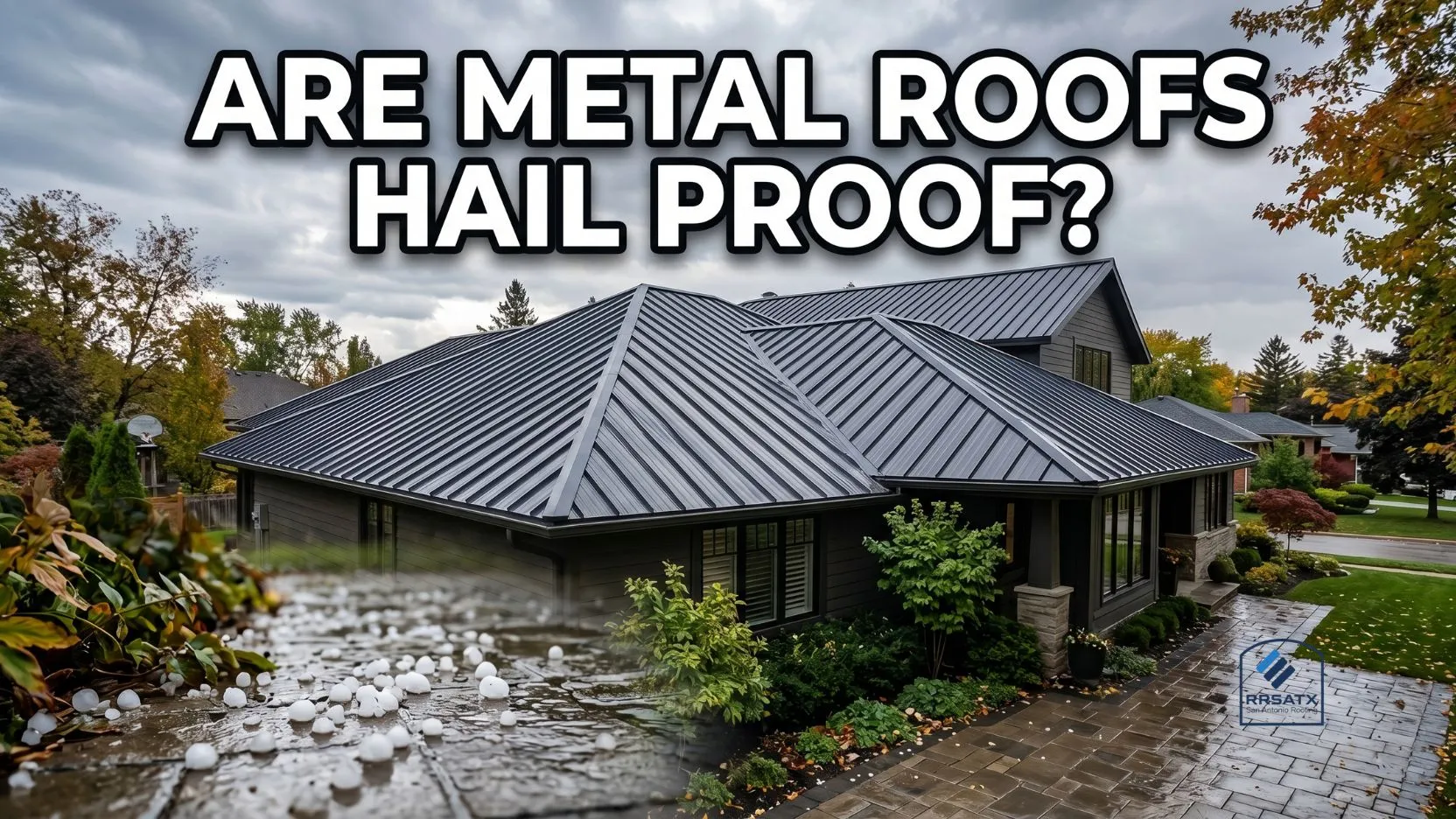
The short answer is no. Metal roofs are not hail proof. But that is not the right question for San Antonio homeowners to be asking. The better question is: how well does a metal roof handle hail compared to every other roofing material available, and what does the damage actually look like when hail does hit?
The honest answer puts metal in a category of its own. Metal roofs certified to Class 4 under UL 2218 are the highest-rated impact-resistant roofing product available to residential and commercial property owners. They resist penetration and structural failure far better than asphalt shingles, clay tile, and wood shake under the kind of hail that regularly hits Bexar County. But large enough hail will dent them, chip their coating, and in extreme cases separate their seams. Understanding what that damage means, and what it does not mean, is what this guide covers in detail.
Hail resistant and hail proof are not the same thing. A Class 4 rated metal roof resists penetration, cracking, and structural failure under a two-inch steel ball drop from 20 feet in both single and repeated impact tests. That is the UL 2218 test standard. What the test does not guarantee is zero denting, zero coating loss, or zero aesthetic impact. Metal roofs in San Antonio will take cosmetic hits from large hail. What they will not do is let water into your home the way a shingle roof that has just been stripped of its granule coating will. That distinction is the reason metal roofs consistently outperform every other material in Texas hail country.
Impact Ratings
The UL 2218 impact resistance standard classifies roofing materials from Class 1 through Class 4 based on how well they withstand a steel ball drop test that simulates real hail impact. Class 4 is the highest rating and requires a roofing sample to survive repeated two-inch steel ball drops from 20 feet without cracking, splitting, or allowing water penetration. Most quality metal roofing products, including 26-gauge and heavier steel panels, stone-coated steel, and aluminum standing seam systems, meet or exceed the Class 4 threshold.
Class 1 and 2 (standard asphalt shingles): Most standard three-tab and architectural shingles carry a Class 1 or Class 2 rating. Under hail conditions common in San Antonio, these roofs suffer granule loss that exposes the underlying mat, shortening the roof’s remaining life significantly even if the shingles do not crack outright.
Class 3 (impact-resistant shingles): A meaningful step up from standard shingles, but still limited by the material properties of asphalt. The protective granule layer can still be displaced by large hail even on a Class 3 product.
Class 4 (qualifying metal roofing): The standard most quality metal panels achieve. Texas Department of Insurance recognizes Class 4 products as eligible for premium discounts, which is why the rating has real financial value in a state as hail-active as Texas.