
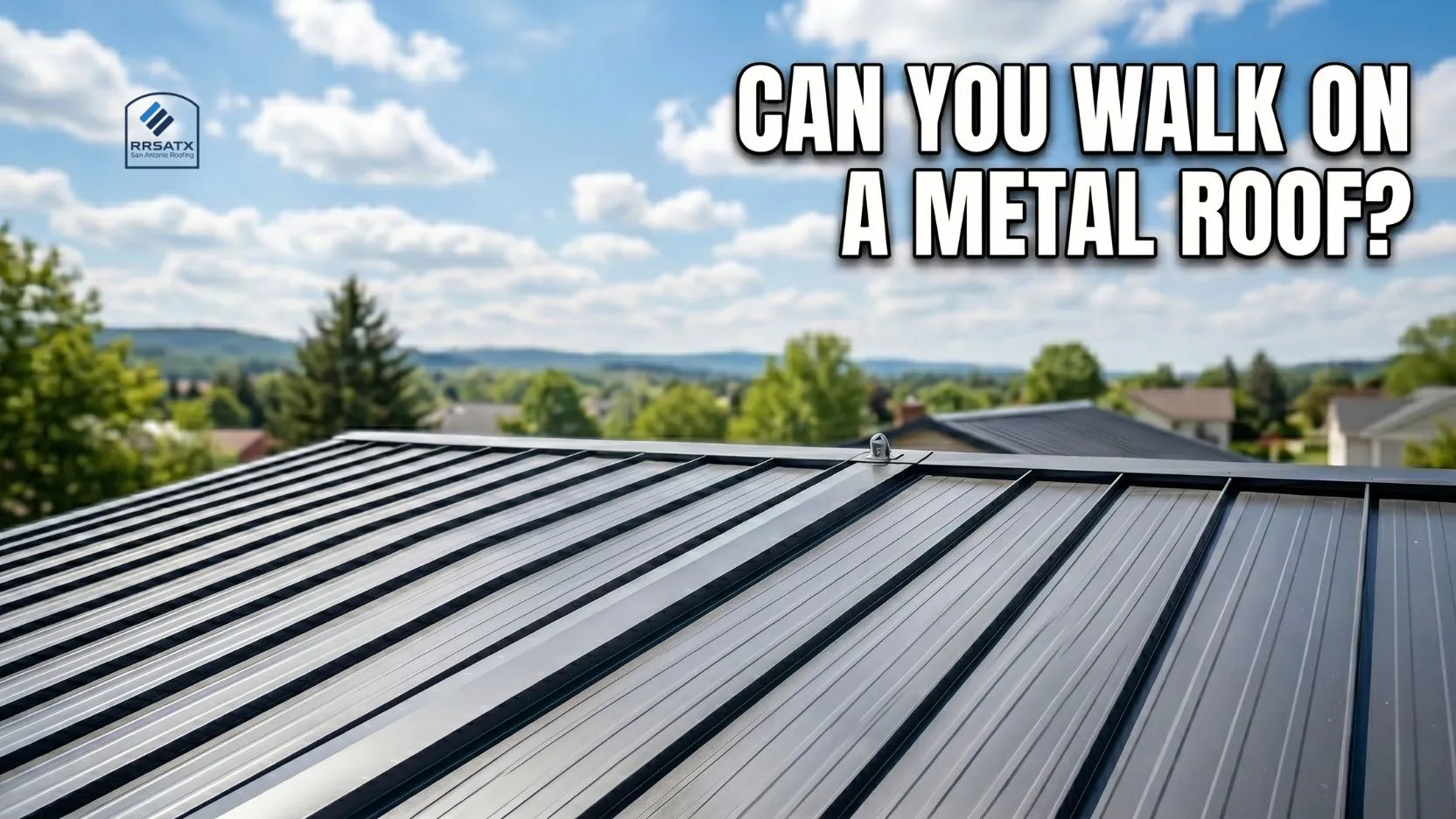
Yes—you can walk on most metal roofs—but the safe answer depends on panel type, pitch, coating condition, footwear, and time of day. The wrong step dents pans, cracks coatings, and can void finish warranty language even when the roof stays watertight.
For exposed-fastener and corrugated systems, weight belongs on the structural rib over a rafter or purlin—not on the flat face that spans open air. Standing seam has its own seam-based path. Know your profile before you climb.
San Antonio summers add a heat rule: dark panels can exceed 160°F by afternoon. Walk early, on a dry surface only. If pitch is steep or condition is unknown, hire a licensed crew with fall protection instead of improvising.
By the end of this guide, you’ll know where to step on common local panel types, which pitches are DIY vs pro-only, what footwear and conditions matter, and when to call for an inspection instead of going up yourself.
Table of Contents
- The Foot-Traffic Rule
- Walking by Panel Type
- Pitch Limits and When to Call a Pro
- Footwear, Weather, and Gear
- Safety Checklist
- Common Questions About Walking on Metal Roofs
- Next Steps for San Antonio Homeowners
The Foot-Traffic Rule
Always load the structure, not the span. On ribbed panels, that means the raised rib over framing. On standing seam, walk on or beside the raised seam—not across the flat pan. Heel strikes and flat-pan steps cause most DIY dents.
Never step on exposed screw heads (they puncture soles and crush washers). Never drag feet on stone-coated surfaces (granules dislodge). If you see rust, lifted seams, or unknown damage from the ground, stay off and call a pro.
Practical rule: if you cannot name your panel type and the correct step zone, do not walk the roof.
Walking by Panel Type
Standing seam and corrugated
Standing seam is usually the most walkable. Seams about 1.5–2 inches tall give a clear path. Prefer 24-gauge over 26-gauge for foot traffic. Keep weight on or next to the seam; place feet parallel to the seam and avoid heel dumps on the pan. Soft rubber soles only. Above about 6:12, use brackets or hire a pro.
Corrugated is walkable if you stay on the raised rib over support—not in the valley. 26-gauge and thicker is safer; 29-gauge on wide purlin spacing dents easily. Older Bexar County corrugated may hide coating cracks—binocular check first. Over-driven fasteners (washer imprinted into the valley) are leak risks; do not load that zone.
R-panel and stone-coated steel
R-panel / PBR (common local exposed-fastener): walk only the major rib—the taller one with the fastener line that marks the purlin. Minor stiffening ribs and flat pans between 5-foot (or wider) purlin spacing flex and dent. Lift each step; do not scuff coatings. Use a foam-padded walk board for longer work.
Stone-coated steel: structural denting is less the issue than granule loss. Manufacturers often specify the lower third of each panel near the overlap. Lift and place every step—no shuffle, drag, or pivot. Some warranties require licensed access only; read yours first. Never walk when wet, dewy, or rainy—granules get slick in Texas humidity.
Pitch Limits and When to Call a Pro
| Roof pitch | Walking assessment | San Antonio guidance |
|---|---|---|
| 1:12–3:12 | Most accessible | Walkable with soft soles; watch standing water / algae slip |
| 4:12 | Walkable with caution | Common residential pitch; rope anchor wise beyond a quick look |
| 5:12–6:12 | Intermediate risk | Use roof bracket or anchor line; slide distance grows |
| 7:12–9:12 | Pro recommended | Fall protection is the right call for most homeowners |
| 10:12+ | Professional only | Harness, anchors, fall arrest—do not DIY |
Rough rule of thumb: above about 4:12, most homeowners should stop and call a professional rather than improvise.
Footwear, Weather, and Gear
| Factor | Right choice | Avoid |
|---|---|---|
| Footwear | Clean soft rubber / crepe soles | Hard-heel boots, flip-flops, bare feet, deep lug soles |
| Time of day | Early morning (before ~9 AM in summer) | Midday / afternoon 150°F+ panel surfaces |
| Weather | Dry, clear, no dew | Rain, wet granules, wind above ~15 mph |
| Fall protection | Anchor/rope above 4:12; harness above 6:12 | Shoes-alone grip on steep pitches |
| Tools | Lanyard bags; foam walk boards | Loose tools on pans; ladders hard against panel faces |
Safety Checklist
Before you go up
- Identify panel type (standing seam, corrugated, R-panel, stone-coated)
- Check pitch from the ground; above 6:12 means fall gear or a contractor
- Confirm the surface is fully dry
- Choose early morning in San Antonio heat
- Clean soft soles; binocular-scan for rust or lifted panels
On the roof
- Standing seam: seams, not flat pans
- Corrugated: ribs over structure, not valleys
- R-panel: major fastener rib only
- Stone-coated: lower third; lift every step
- Three points of contact above 4:12
- No loose tools on panels; use a ridge standoff for ladders
After
- Scan for dents or bald granules
- Note fastener or sealant issues for the next service visit
- Call a contractor before the next rain if you caused or found damage
Practical rule: a 10-minute visual walk is not the same as an hour of standing in one spot—long tasks need walk boards and usually a pro.
Common Questions About Walking on Metal Roofs
Will walking damage a metal roof?
It can—if you step on flat pans, use hard heels, or drag feet on stone coat. Correct placement and soft soles usually leave no mark on sound panels.
What shoes should I wear?
Clean soft rubber soles with low tread. Skip hard heels, flip-flops, bare feet, and aggressive lug boots.
Can HVAC techs walk on metal?
Yes when they know the panel type and rib/seam path. Brief service trades on your system so they do not park equipment on flat pans.
Is wet metal safe?
No. Wet paint and wet stone coat are serious slip hazards. Morning dew counts. Wait for a fully dry surface.
Does walking void the warranty?
Materials warranties usually survive normal maintenance access, but some stone-coated and premium standing seam finishes require licensed traffic. Damage from bad technique is almost always excluded—read your documents.
When should I call a pro instead?
Pitch steeper than 6:12 without fall gear; visible rust or lifted panels; no inspection in 3+ years; post-storm uncertainty; or any job that needs extended time in one spot. Free or low-friction inspections beat a fall or a dented field.
Next Steps for San Antonio Homeowners
Identify your panel profile, check pitch and warranty language, and default to early-morning dry access only. For gutters, HVAC, or post-storm checks on steep or unknown roofs, hire a licensed metal-savvy contractor.
If you want a San Antonio metal roof safety inspection without DIY foot-traffic risk—RRSATX can help. Call 713-504-2341 or schedule online.