
In 2026, the cost to install a flat roof typically runs about $4 to $15 per square foot installed, depending on the system and project scope. For a San Antonio property, the final bill is shaped just as much by membrane choice, tear-off, insulation, drainage, and local labor as by roof size.
You may be looking at two quotes that seem close until you notice one includes deck repairs, disposal, and parapet flashing while the other leaves them as allowances. That difference can turn a manageable replacement into a much larger bill, especially after a San Antonio hailstorm or a season of heavy rain exposes weak decking and poor drainage.
National averages help set a starting point, but they don't decide what your roof should cost. Published 2026 guidance places many flat roof replacements around $3,331 to $11,558 overall, with national averages commonly near $7,400 to $7,500 and broad unit pricing around $4 to $35 per square foot depending on size, material, and labor complexity (HomeAdvisor's flat roof replacement guide). A local quote needs more detail than that.
Table of Contents
- What a Flat Roof Quote Actually Covers in San Antonio
- The Four Building Blocks of Flat Roof Installation Cost
- Comparing Flat Roof Materials by Price and Lifespan
- Hidden Line Items That Move a Flat Roof Quote
- Sample Price Ranges by Roof Size
- How South Texas Weather Changes the Math
- Budgeting Tips and Questions to Ask Your Contractor
What a Flat Roof Quote Actually Covers in San Antonio
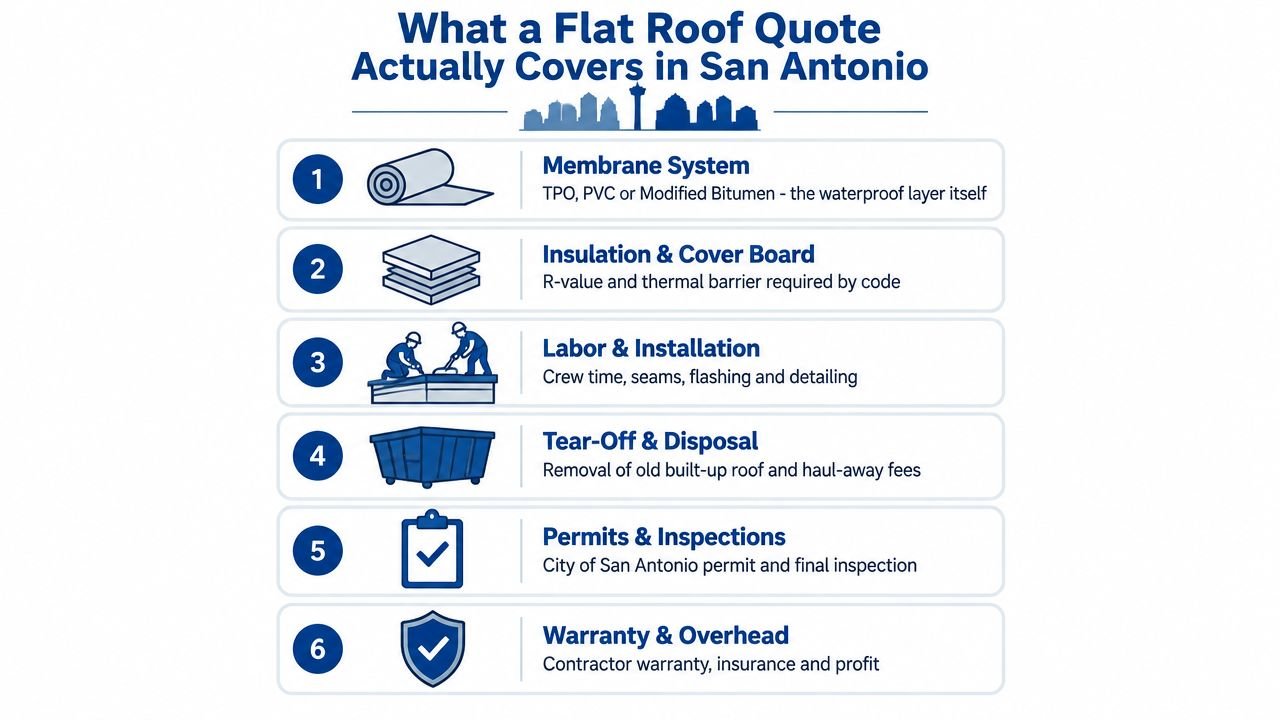
A homeowner in Alamo Heights compares two estimates for the same low-slope addition. One contractor offers a short proposal with a total price. The other identifies the membrane, insulation, tear-off, flashing, drainage work, permits, and cleanup. The second quote is easier to trust because you can see what you're buying.
A legitimate estimate should identify these components in writing:
- Membrane system: The proposal should name TPO, PVC, EPDM, modified bitumen, or another specific system, along with the product details that affect installation.
- Insulation and cover board: Ask for the insulation type, board type, and R-value, rather than accepting “insulation included.”
- Tear-off and disposal: Confirm whether the crew will remove existing roofing layers and haul them away.
- Deck preparation: The quote should explain how damaged plywood or other substrate repairs will be handled if workers find deterioration.
- Flashing and wall details: Parapets, roof edges, penetrations, and HVAC curbs need specific treatment.
- Drainage work: Drains, scuppers, overflow paths, and slope corrections should appear as separate scope items.
Read the scope before comparing totals
Labor shouldn't appear only as one vague line. A useful estimate explains crew work for tear-off, substrate preparation, insulation placement, membrane installation, heat-welded or bonded seams, flashing, cleanup, and final inspection. That detail shows whether the contractor has priced the actual roof or applied a broad allowance.
San Antonio contractors may bundle disposal, permits, and warranty registration into the proposal. Out-of-town estimators or storm crews sometimes leave those responsibilities unclear. That doesn't automatically make a quote wrong, but it makes comparison difficult.
For another perspective on keeping project information organized, WordPress management guides can help property owners maintain records, inspection notes, and contractor documents online. You can also compare your proposal against this guide to what's included in a roof estimate.
Practical rule: If two quotes use different descriptions, don't compare their totals until the scope uses the same language.
Every later cost decision connects to one of these lines. If the price changes, you should be able to identify whether the change came from the membrane, labor, insulation, deck, flashing, drainage, or project administration.
The Four Building Blocks of Flat Roof Installation Cost
A flat roof quote has four main cost blocks, but they don't carry equal weight. Published roofing labor guidance separates flat and built-up systems into labor of about $200 to $450 per square, materials of about $100 to $650 per square, and installed totals of roughly $300 to $1,100 per square, or about $3 to $11 per square foot (HomeGuide's roofing labor cost model).
The most useful way to read that data is to ask what changes the scope.
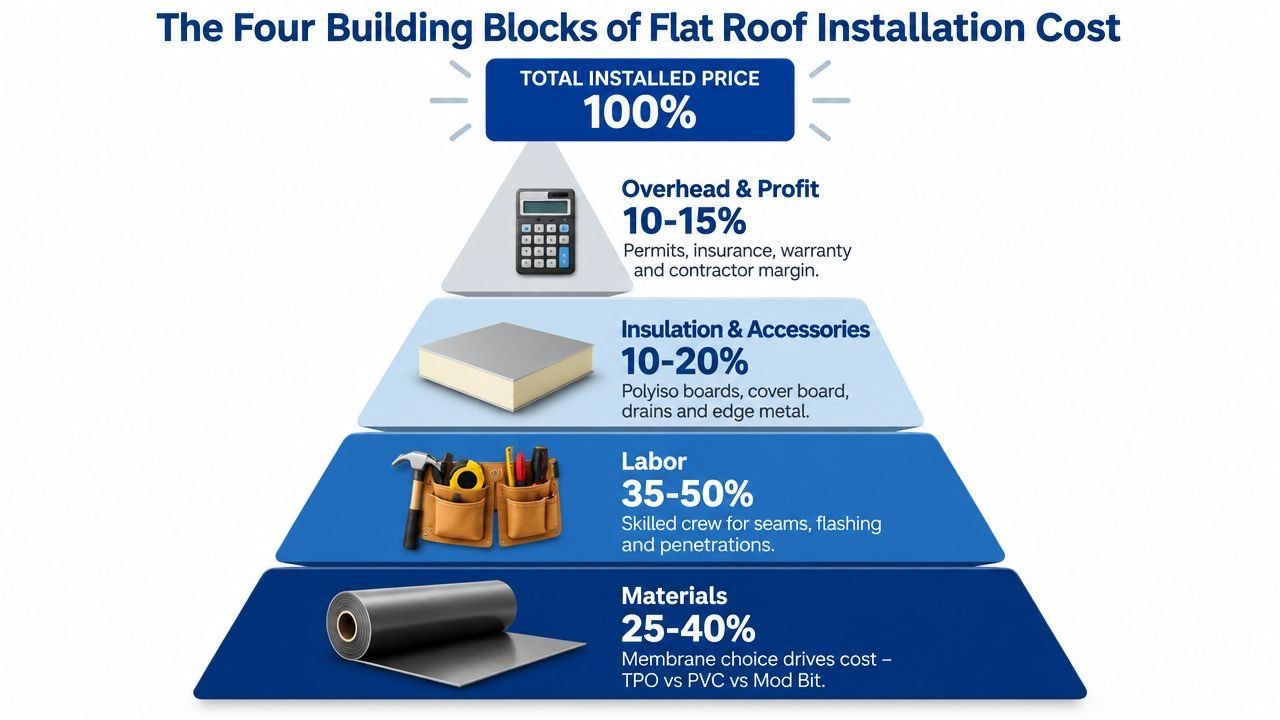
Materials set the system
The membrane is the visible material decision, but the installed system also includes adhesives, fasteners, cover board, edge metal, flashing, and accessories. EPDM often sits toward the lower part of common installed ranges, while PVC and more complex TPO assemblies can move higher. A commercial guide places standard flat roof construction around $4 to $11 per square foot, including labor and materials (HomeGuide's flat roof replacement guide).
Labor follows access and detail
A clean, open roof is faster to work on than a roof crowded with HVAC equipment, skylights, pipes, parapet walls, and electrical conduits. San Antonio crews also spend more time when they must remove multiple old layers or work around occupied commercial space.
Insulation changes performance
Insulation and cover board affect both the quote and the building's comfort. Polyiso is common in commercial assemblies, while tapered insulation can add scope where the deck doesn't direct water properly. Don't treat insulation as a minor add-on. It controls heat transfer and gives the membrane a more stable base.
Deck preparation reveals the unknown
The deck sits below everything, so damage may remain hidden until tear-off begins. Rotten plywood, rusted metal, failed nailers, or wet areas can require additional preparation. This is the line most likely to become vague if a contractor uses a broad “miscellaneous” allowance.
A $10,000 project can shift substantially depending on which block expands. A simple membrane replacement with sound decking keeps more of the budget in the membrane and installation. A difficult tear-off with damaged decking, new insulation, and drainage corrections directs more money toward preparation and accessories. Treat any percentage breakdown as a planning model, not a promise, because the verified national sources support broad ranges rather than a fixed San Antonio formula.
For contractors building repeatable estimating and field processes, the Expressify AI trades playbook offers operational ideas that can improve how teams document work and communicate scope. Your own quote should still stand on its written details, not on a percentage label.
Comparing Flat Roof Materials by Price and Lifespan
San Antonio heat is hard on exposed roofing. UV, repeated expansion and contraction, hail, and sudden rain all punish weak seams and poor flashing. Choose the membrane for the building's use and exposure, not just the first number on the proposal.
Verified 2026 material guidance lists these broad installed ranges and service lives (The Roofing Brief's flat roof materials comparison):
| Membrane | Installed Cost per Sq Ft | Expected Lifespan | Best Fit |
|---|---|---|---|
| EPDM | $5 to $9 | 25 to 30 years | Flexible rubber system for suitable residential and commercial roofs |
| TPO | $7 to $12 | 20 to 30 years | Reflective system for heat-exposed roofs |
| PVC | $9 to $15 | 25 to 30 years | Reflective membrane where chemical and weather resistance matter |
| Modified bitumen | $6 to $11 | 15 to 25 years | Smaller additions, porches, and traditional low-slope applications |
| BUR | $5 to $10 | 20 to 30 years | Multi-layer assemblies and commercial roofs with demanding use |
How I'd sort the choices
TPO is a practical choice for many San Antonio projects because its reflective surface and heat-welded seams suit a hot climate. It still needs careful installation around penetrations and edges.
PVC costs more in the listed range, but it can make sense where reflectivity, chemical resistance, or a more demanding commercial environment matters. Don't pay for PVC because the label sounds premium.
EPDM offers flexibility and a long listed service life. Its dark surface can absorb more heat than a reflective white membrane, so the insulation assembly and building use deserve close review.
Modified bitumen remains useful on smaller roof areas where the crew can complete a traditional assembly efficiently. Its listed lifespan is shorter than several single-ply options, so compare the full replacement cycle rather than the opening quote.
BUR uses layered construction and can suit commercial settings, but its installation may involve more labor and heavier tear-off later.
A lower upfront system isn't automatically lower cost over time. Compare membrane price with expected service life, seam maintenance, heat exposure, and the likelihood of another major tear-off. The flat roof membrane material guide can help you organize that conversation before signing.
Hidden Line Items That Move a Flat Roof Quote
The headline price rarely tells the whole story. A cost guide focused on broader project scope notes that tear-off, insulation upgrades, parapet flashing, and drain retrofits can move a project from roughly $4 to $15 per square foot toward $11 to $18 per square foot when the work becomes more complete and complex (Roofing Calculator USA's flat roof calculator).
Tear-off and disposal
Old built-up roofing and modified bitumen can weigh heavily, especially when multiple layers are present. Ask whether removal is included and how disposal is handled. A quote that excludes haul-away may look attractive until the crew starts loading debris.
Deck repairs create a similar problem. The roofer may not see damaged plywood or rusted decking until the existing system comes off. Have the contractor state the repair allowance, the unit used for additional work, and the approval process before replacement begins.
Drainage and insulation upgrades
Standing water usually points to a design or slope issue, not merely bad luck. Proper flat-roof drainage requires a minimum positive slope of 1/4 inch per foot toward drains, scuppers, or gutters, and one technical source equates that to about a 2% grade while calling for primary and overflow drainage on each drainage area (The Roofing Brief's flat roof drainage design guidance).
Tapered insulation, new drains, scuppers, and overflow paths can change the scope quickly. They may cost more at installation, but ignoring ponding can shorten the system's useful life.
Flashing, curbs, permits, and inspections
Parapet walls need secure flashing and counter-flashing. HVAC curbs may need reflashing once the old membrane is removed. San Antonio permit and inspection requirements should be clear, especially for a replacement that changes drainage or roof assembly.
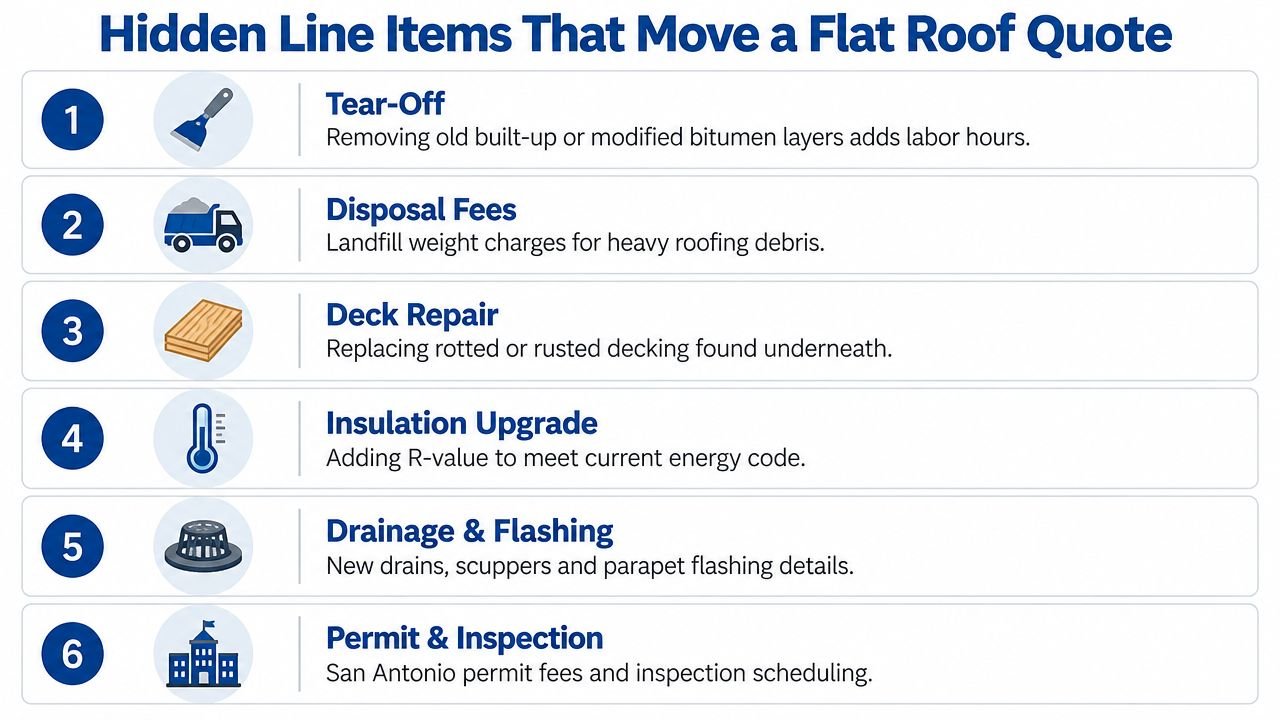
Don't accept invented allowances or unexplained dollar amounts. Ask for each possible change as a separate line so you can approve the work based on evidence. That is your strongest advantage when comparing bids in Bexar County.
Sample Price Ranges by Roof Size
A San Antonio quote starts with roof area, but square footage only sets the opening line. A realistic budget also includes deck preparation, membrane selection, insulation, drainage, tear-off, and labor. Verified market guidance places many installed flat roof projects around $4 to $10 per square foot. For a 1,500-square-foot roof, that produces an estimated $6,000 to $15,000, depending on the system and site conditions (BuildVision AI's flat roof replacement guide).
A second market guide gives the same $6,000 to $15,000 range for a 1,500-square-foot roof and places a 5,000-square-foot commercial TPO roof around $25,000 to $55,000, with system complexity affecting the total (RoofVista's TPO cost guide).
| Roof Size | Verified planning range |
|---|---|
| 1,500 sq ft TPO | About $6,000 to $15,000 |
| 5,000 sq ft commercial TPO | About $25,000 to $55,000 |
These figures are planning references, not a San Antonio promise. A 1,000-square-foot project may fall around $4,000 to $14,000, a 2,000-square-foot project around $8,000 to $28,000, and a 3,000-square-foot project around $12,000 to $42,000, according to broad market guidance (HomeAdvisor's flat roof replacement guide). Treat those ranges as screening tools, then require a written scope for any other roof size or material.
Use this formula:
Roof area × installed price per square foot + clearly approved scope changes = planning total
A larger roof does not always produce a proportionally cleaner quote. Multiple levels, narrow access, heavy HVAC equipment, damaged decking, unusual parapets, and failed drainage can raise the final bill. Ask the contractor to price each item separately, including tear-off, deck repairs, insulation, membrane, flashing, drainage, disposal, permits, and labor.
Metal over a flat deck needs its own system design. Keep it separate from membrane comparisons, and do not accept a single blended allowance that hides the work driving the price.
How South Texas Weather Changes the Math
San Antonio's weather should influence what you buy. A roof that works well in a mild climate may need different detailing here because intense heat, sudden storms, hail, and seasonal temperature changes all stress the assembly in different ways.
Heat and ultraviolet exposure
Roof surfaces face sustained Texas heat, while dark materials absorb more solar energy than reflective membranes. TPO and PVC can make sense where reducing heat absorption is a priority, but reflectivity won't rescue a roof with weak seams, poor insulation, or careless flashing.
The service-life ranges reinforce why material selection matters. One 2026 lifespan guide lists TPO at 20 to 30 years, EPDM at 25 to 35 years, PVC at 25 to 30 years, modified bitumen at 15 to 25 years, and BUR at 20 to 30 years (The Roofing Brief's flat roof lifespan guide). Those are expected ranges, not promises. Installation quality and maintenance still control the outcome.

Rain, hail, and movement
Heavy spring rain finds low spots quickly. If the roof doesn't move water toward drains, scuppers, and overflow routes, ponding can keep the membrane wet and add stress around seams and penetrations.
Hail exposure also changes the buying decision. Ask whether the proposed assembly has an appropriate impact rating for the property and whether the contractor has reinforced vulnerable details. A cheaper membrane can become a poor choice if one storm damages it and the system lacks the protection your building needs.
Freeze events are less common than summer heat, but flashing and sealant still need room to handle movement. Spend on slope correction, durable flashing, and sound detailing before spending on cosmetic upgrades. You can't repair a drainage problem with a new color.
Budgeting Tips and Questions to Ask Your Contractor
Take three written bids, but don't ask contractors to compete on one unexplained total. Ask each one to use the same scope so you can compare membrane, insulation, flashing, drainage, tear-off, disposal, labor, permits, and warranty terms directly.
Use this meeting checklist
- Confirm the membrane: Ask for the manufacturer, product name, thickness, seam method, and expected service life.
- Verify the insulation: Request the board type and R-value, and ask how the assembly responds to San Antonio heat.
- Price the tear-off: Have the contractor state how many existing layers are included and how additional layers will be approved.
- Set deck rules: Ask how damaged decking will be documented, measured, and authorized before replacement.
- Check drainage: Confirm the slope plan, drain sizing, scuppers, overflow protection, and any tapered insulation.
- Clarify flashing: Make sure parapets, walls, curbs, penetrations, and edge metal are included.
- Review administration: Ask who handles permits, inspections, disposal, cleanup, and warranty registration.
- Separate warranties: Understand what the material warranty covers and what labor warranty the contractor provides.
Request photos of hidden damage before approving extra work. A reliable roofer won't need vague language to justify a change. The proposal should show the work, the reason for it, and the price before the crew proceeds.
You can also ask whether the contractor has experience with both residential and commercial low-slope systems. RRSATX provides roof inspections, written estimates, flat roof replacement, commercial roofing, and storm-damage support in San Antonio, with $2,000,000 in liability insurance and owner oversight described by the company.
Don't climb onto the roof to inspect drains or decking yourself. Low-slope roofs still contain trip hazards, weak areas, exposed fasteners, and open edges. Let an insured professional document the condition safely, and remember that no roofer can promise an insurance claim will be approved.
The core budgeting rule is simple: match the membrane and assembly to San Antonio's heat, rain, and hail exposure, not just to the lowest square-foot figure. A clear quote may cost more upfront than a vague one, but it gives you control over the decision.
RRSATX offers free roof inspections, written flat roof estimates, repairs, replacements, and storm-damage support for San Antonio homes and commercial properties. Visit RRSATX to schedule an inspection online, or call 713-504-2341 to discuss your roof's membrane, drainage, insulation, and repair needs.