
Most homeowners searching for fiberglass vs asphalt roof shingles are starting with the wrong choice. In San Antonio, the question usually isn't whether to buy fiberglass or asphalt. Modern fiberglass shingles are asphalt shingles. The decision is which fiberglass shingle, profile, impact rating, installation system, and warranty fit your home and South Texas weather.
That distinction matters after a hailstorm, during a roof replacement, and whenever a contractor presents two samples with confusing labels. You need to know what's under the granules, how the roof handles heat and moisture, and whether the product makes sense for your decking and budget. The short answer from a roofer's kitchen-table perspective is simple: for most San Antonio homes, choose a quality fiberglass-mat asphalt shingle, then spend your attention on installation and storm performance.
Table of Contents
- Why Most Homeowners Are Asking the Wrong Question
- What Fiberglass and Asphalt Shingles Actually Are
- Durability, Fire Rating, and Storm Performance
- Cost, Weight, and Warranty Compared
- How South Texas Heat and Hail Change the Answer
- Matching the Right Shingle to Your Roof and Budget
- Making the Call Without Second-Guessing
Why Most Homeowners Are Asking the Wrong Question
The popular advice treats fiberglass shingles and asphalt shingles as two separate roofing categories. That's misleading. Asphalt shingles have been used since around the turn of the twentieth century, and manufacturers later replaced older paper-based reinforcement with fiberglass mats. By 1982, fiberglass shingles had overtaken organic felt shingles in use, and industry sources describe fiberglass products as the dominant shingle by the mid-1980s, with one trade publication reporting more than 90% of the market at that point. (Asphalt shingle history)
So when a homeowner says, “Should I get fiberglass or asphalt?” I usually clarify the question before discussing colors or brands. Asphalt is the umbrella material. Fiberglass and organic felt describe the mat inside the shingle.
The comparison that still matters
Older organic shingles use a paper or felt mat saturated with asphalt. Modern fiberglass shingles use a glass-fiber mat, asphalt, and protective granules. That fiberglass core is thinner, lighter, stronger, less prone to moisture absorption, and better suited to modern fire-performance requirements. The industry transition also reduced shrinkage, rot, and tearing compared with older paper-based products. (National Roofing Museum history of GAF)
Organic-mat shingles still matter when you're inspecting an older San Antonio roof, replacing discontinued material, or reviewing an insurance claim. They're not an equal modern alternative for most new installations. A recent industry source describes the comparison as one that “mostly does not exist anymore,” because nearly every asphalt shingle sold in North America today uses a fiberglass mat. (Fiberglass shingles versus asphalt shingles)
Practical rule: Ask, “Is the asphalt shingle fiberglass-mat or organic-mat?” Then ask about profile, impact rating, ventilation, and installation requirements.
Your real buying decision
For a San Antonio roof, focus on four questions:
- Mat type: New fiberglass-mat asphalt shingles are the normal starting point.
- Profile: Three-tab and architectural shingles differ in appearance, layering, and weight.
- Storm fit: Hail performance depends heavily on the shingle assembly and its impact classification.
- Installation: Fastener placement, flashing, ventilation, and deck condition can matter as much as the label on the bundle.
The argument over fiberglass versus asphalt has largely been settled by the market. Your job is to avoid buying a vague “asphalt roof” without learning what product is being installed.
What Fiberglass and Asphalt Shingles Actually Are
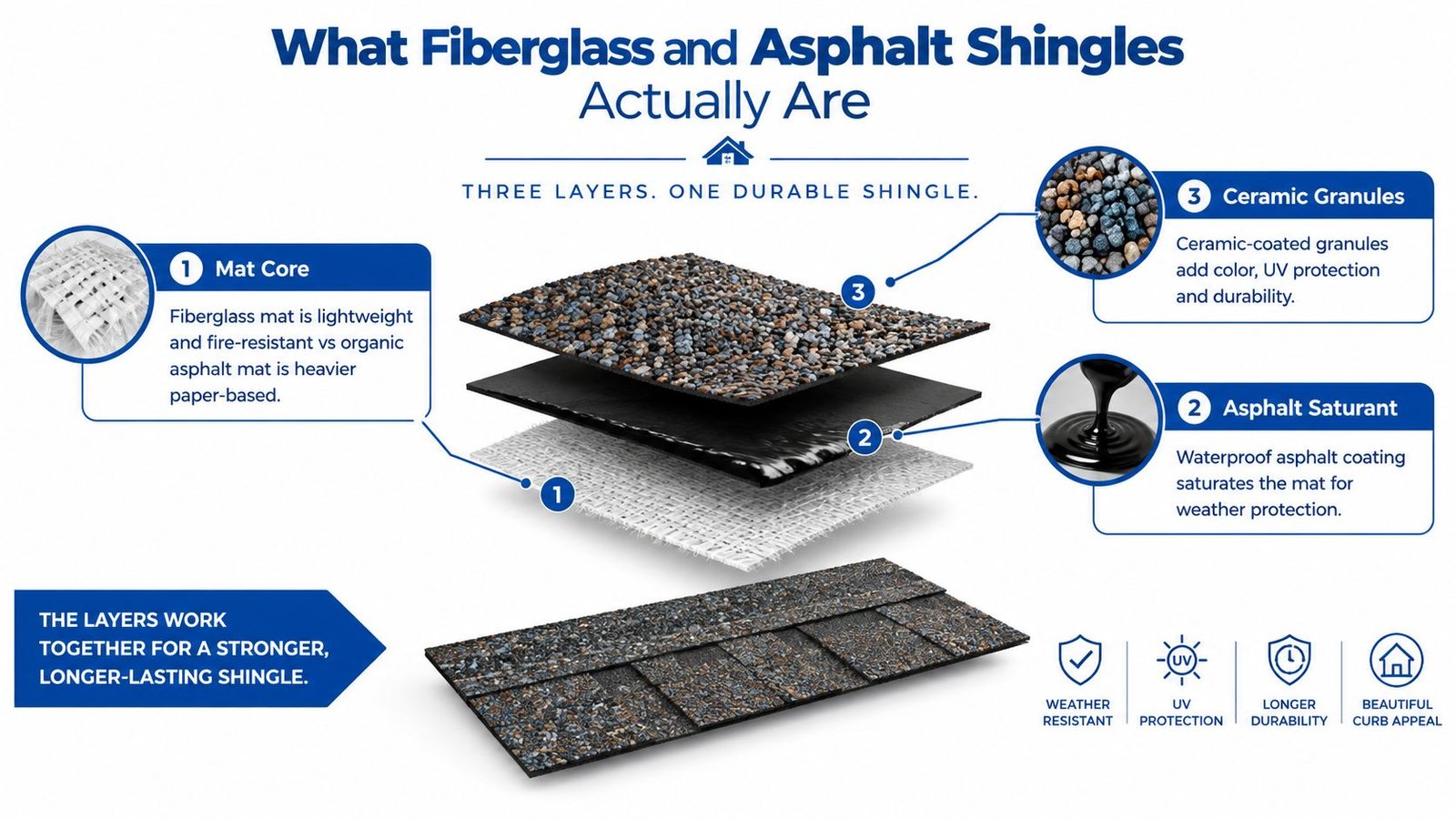
A shingle is easier to understand if you think of it as a layered sandwich. The bottom layer gives the product structure, the middle layer helps resist water, and the top layer protects the surface from sunlight and weather.
Start with the mat
The mat is the internal base. A fiberglass mat is made from woven glass fibers. It provides dimensional stability and strength without adding the weight of a thick paper base. Fiberglass also doesn't absorb moisture the way an organic paper or felt mat does.
An organic mat is paper-based material saturated with asphalt. It's heavier and can be more vulnerable to moisture-related distortion over time. That doesn't mean every old organic roof failed quickly, but it does explain why modern manufacturers and roofing standards moved toward fiberglass.
The history of asphalt roofing makes the terminology easier to remember. Fiberglass shingles aren't a different species from asphalt shingles. They're asphalt shingles with a fiberglass reinforcement layer.
Add the asphalt coating
Manufacturers coat the mat with waterproof asphalt. The asphalt binds the layers together and helps protect the roof deck from water moving beneath the surface. Fiberglass construction allows manufacturers to use less asphalt than older organic designs, which helps produce a lighter, thinner shingle. (Dallas asphalt shingles guide)
The mat isn't the waterproofing by itself. The full roof system also relies on underlayment, flashing, ventilation, proper overlaps, and correctly driven fasteners. A strong shingle installed carelessly can still leave a homeowner with leaks.
Finish with mineral granules
The visible surface contains ceramic or mineral granules. They provide color and shield the asphalt from ultraviolet exposure. In a San Antonio summer, that surface protection takes a steady beating from intense sun, heat, and temperature swings.
Three-tab shingles use a flatter, more uniform design. Architectural shingles use laminated layers to create more depth and shadow lines. A thicker or heavier profile doesn't automatically mean the mat is organic or fiberglass. Profile and mat are separate choices, so read the product specification instead of guessing from appearance.
For fiberglass-mat asphalt shingles, NRCA identifies ASTM D3462 as the applicable standard, while ASTM D225 applies to organic felt-based asphalt shingles. (NRCA roofing guidelines)
Durability, Fire Rating, and Storm Performance
Fiberglass wins the basic mat comparison. It stays more dimensionally stable, resists moisture absorption, and supports stronger test outcomes than older organic felt. The practical question is not whether fiberglass is automatically indestructible. It isn't. The question is whether the entire shingle and roof assembly can handle wind, fire, fastening stress, thermal movement, and hail.
ASTM D3462 is considered more demanding than ASTM D3018 because it includes requirements involving tear strength, asphalt penetration, softening point, mass, granule displacement, and fastener pull-through resistance. Those tests connect more closely to what a roof experiences during installation and service. (Professional Roofing on asphalt-shingle standards)
A practical performance comparison
| Metric | Fiberglass Mat | Organic Felt Mat |
|---|---|---|
| Moisture behavior | Doesn't absorb moisture like paper-based mat | Paper-based mat can absorb moisture and distort |
| Dimensional stability | Better resistance to shrinkage and movement | More vulnerable to shrinkage, rot, and warping |
| Fire classification | Commonly associated with Class A under ASTM E108 | Generally associated with Class C |
| Tear and fastening performance | ASTM D3462 includes added durability requirements | Organic products fall under a different standard |
| Current market position | Modern standard for most asphalt shingles | Older product type, less common in new work |
Fiberglass reinforcement helped raise shingles from a typical Class C fire rating to Class A, the highest rating available, according to industry history. Fiberglass-reinforced products are commonly classified as Class A for exterior fire resistance, while organic-mat shingles are generally Class C. That classification still depends on the tested product and installation system, so ask for the actual documentation rather than relying on a sales phrase.
Wind performance comes down to the whole installation. The shingle, number and placement of nails, starter course, roof slope, edge details, underlayment, and local requirements all matter. Hail performance also depends on the shingle construction and its impact classification, not just on the word fiberglass printed on a package.
If you're sorting out storm damage or insurance documentation, a neutral guide such as Select Insurance Group's windstorm guide can help explain why wind coverage, exclusions, and inspection records deserve careful attention. It won't replace your policy or a roof inspection, and no contractor can promise that an insurer will approve a claim.
Cost, Weight, and Warranty Compared
The material comparison has one measurable cost reference, but homeowners should use it carefully. One consumer pricing source reports fiberglass shingles averaging about $6 per square foot, compared with about $3 per square foot for asphalt shingles, and lists a typical fiberglass shingle roof at 1.8 to 2.3 pounds per square foot. (Angi cost and weight comparison)
That comparison likely reflects how consumers and suppliers label products, because modern fiberglass-mat shingles are themselves asphalt shingles. It shouldn't be treated as a universal San Antonio quote or a substitute for a written estimate. Roof pitch, tear-off layers, decking repairs, flashing, ventilation, access, and product tier can change the final price substantially.
What you're really paying for
| Factor | Fiberglass Shingles | Organic Asphalt Shingles |
|---|---|---|
| Material category | Asphalt shingle with fiberglass mat | Asphalt shingle with organic felt mat |
| Weight | Typically lighter and thinner | Typically heavier |
| Moisture response | Better resistance to water absorption | More vulnerable to moisture-related movement |
| Product availability | Common modern option | Older, less common option |
| Warranty review | Must follow the manufacturer's terms | Must follow the manufacturer's terms |
Don't compare a basic three-tab fiberglass product with a premium architectural or designer shingle and assume the mat explains every price difference. Lamination, appearance, impact classification, algae-resistant granules, accessory products, and warranty conditions can all change the proposal.
Warranty language needs a close read
A manufacturer's material warranty covers the product under stated conditions. It's separate from the roofer's workmanship warranty, which addresses installation. Those warranties may require approved components, correct ventilation, documented installation, or a certified contractor.
Ask for the warranty document, not just the number of years mentioned in a conversation. Look for exclusions involving wind, hail, cosmetic damage, algae, improper ventilation, foot traffic, and repairs by another contractor. In San Antonio, an installation error can show up quickly under strong sun and heavy rain, so workmanship deserves the same scrutiny as the shingle brand.
Ask before signing: What does the manufacturer cover, what does the installer cover, and what must I do to keep either warranty valid?
How South Texas Heat and Hail Change the Answer
A national roofing comparison can miss the conditions that shape a San Antonio roof. Our roofs deal with hard sunlight, long hot seasons, sudden heavy rain, strong wind, and hail. That combination makes moisture stability and storm suitability more useful than choosing the heaviest shingle.
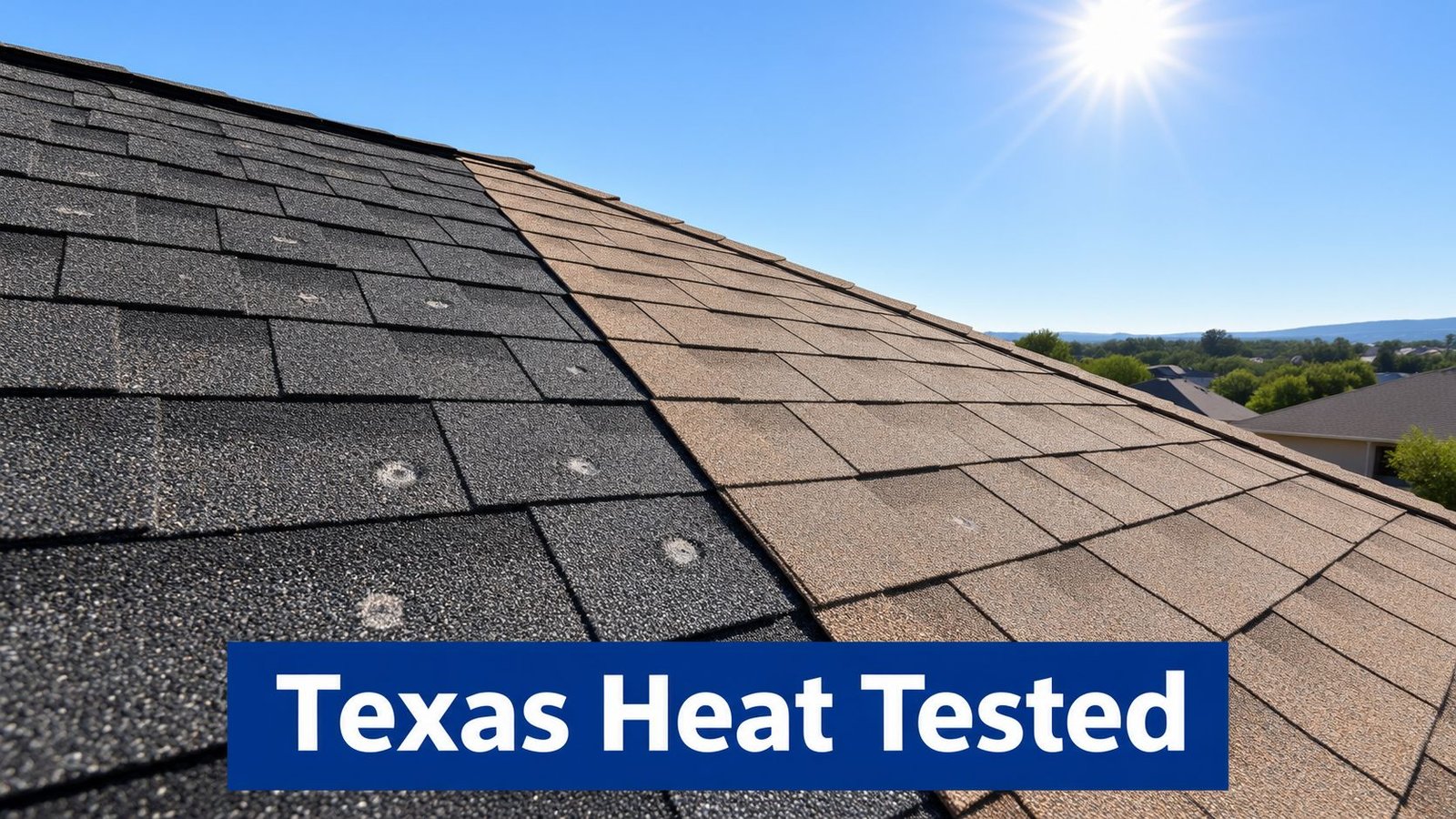
Fiberglass has a clear advantage over organic felt when moisture and dimensional stability are the concern. Paper-based felt can absorb water and become more vulnerable to warping or deterioration. Fiberglass doesn't make a roof immune to leaks, though. Poor flashing, clogged drainage, damaged vents, and installation mistakes can defeat any shingle.
Heat also exposes weak roof systems. Asphalt softens and ages under repeated thermal cycling, while granules protect the surface from ultraviolet exposure. Proper attic ventilation, intact underlayment, and a shingle designed for the local climate all work together. A homeowner considering several roof systems can also review this guide on choosing roof materials by climate.
Hail is where the label stops being enough
Along the I-35 corridor, hail can make impact classification more important than the basic fiberglass-versus-organic question. Class 3 and Class 4 impact ratings come from the tested shingle construction and roof assembly, not from the mat name alone. Ask which exact product carries the rating, what accessories are required, and whether the warranty treats functional and cosmetic damage differently.
A Class 4 product can be a sensible choice after repeated hail losses, but it may cost more and still won't prevent every kind of damage. It also doesn't mean an insurer must provide a premium credit or approve a claim. Check your own policy and ask the carrier for written requirements.
This video offers another visual way to think about shingle construction and weather exposure:
San Antonio wind requirements vary by project and exposure. Don't let a contractor quote a wind number without explaining the product, fastening pattern, and code requirements that support it. The strongest choice is the one that matches the roof deck, slope, ventilation, exposure, and storm history of your property.
Matching the Right Shingle to Your Roof and Budget
The right product changes with the house. A homeowner in Alamo Heights may be repairing an older roof deck, while a newer home in Stone Oak may need a straightforward architectural replacement. Treating both properties as identical is how people overpay in one case and underbuild in the other.
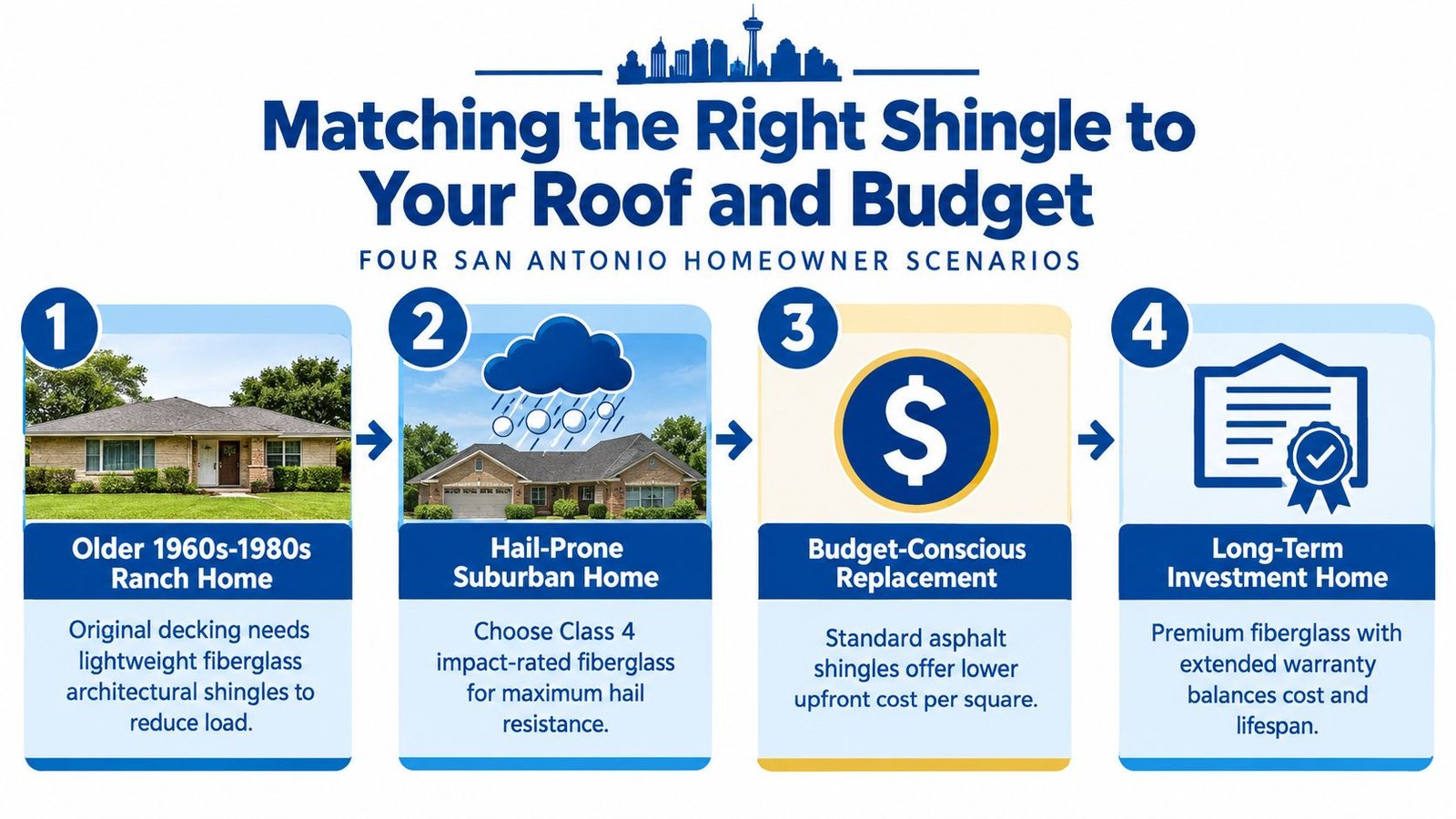
Four common homeowner decisions
| Situation | Sensible starting point | Trade-off |
|---|---|---|
| Older ranch home with aging decking | Lightweight fiberglass architectural shingle, with proper protection at penetrations | Better modern performance, but the deck may need repairs before installation |
| Newer subdivision home | Mid-tier fiberglass architectural shingle | More depth and durability than basic three-tab, with more material cost |
| Roof damaged by hail | Class 4 impact-rated fiberglass product, if appropriate for the roof and policy | Higher product cost, with no automatic insurance approval |
| Rental or budget remodel | Fiberglass three-tab shingle | Lower initial material position, with fewer appearance and performance upgrades |
The older ranch deserves a closer inspection before anyone discusses shingles. If the decking is weakened, the contractor may need to replace sections, improve flashing, and protect vulnerable penetrations. A lightweight architectural fiberglass shingle can be a strong fit, but it won't correct structural or drainage problems underneath.
For a newer home, a mid-tier architectural fiberglass product often gives a sensible balance. You're paying for a more dimensional appearance and a stronger overall product than a basic three-tab, without automatically jumping to a designer line. Ask whether the manufacturer's material coverage requires a specific installation system.
A storm-damaged home needs documentation before product selection. An impact-rated fiberglass shingle may reduce the chance of repeat replacement, but the homeowner should verify the rating and ask the insurer about any policy conditions. For help researching roofing companies and business details, BatchData's roofing industry resource provides a broader business-focused reference, though it can't replace local licensing, insurance, or project verification.
A rental property or budget remodel may justify three-tab fiberglass. The trade-off is straightforward. You control the initial material decision, but you accept a simpler appearance and fewer premium features. Don't choose a product tier without first checking the roof's condition and expected ownership period.
Making the Call Without Second-Guessing
You don't need a dozen roofing terms to make a sound decision. You need a short process that forces the contractor to explain the actual product and the actual roof condition.
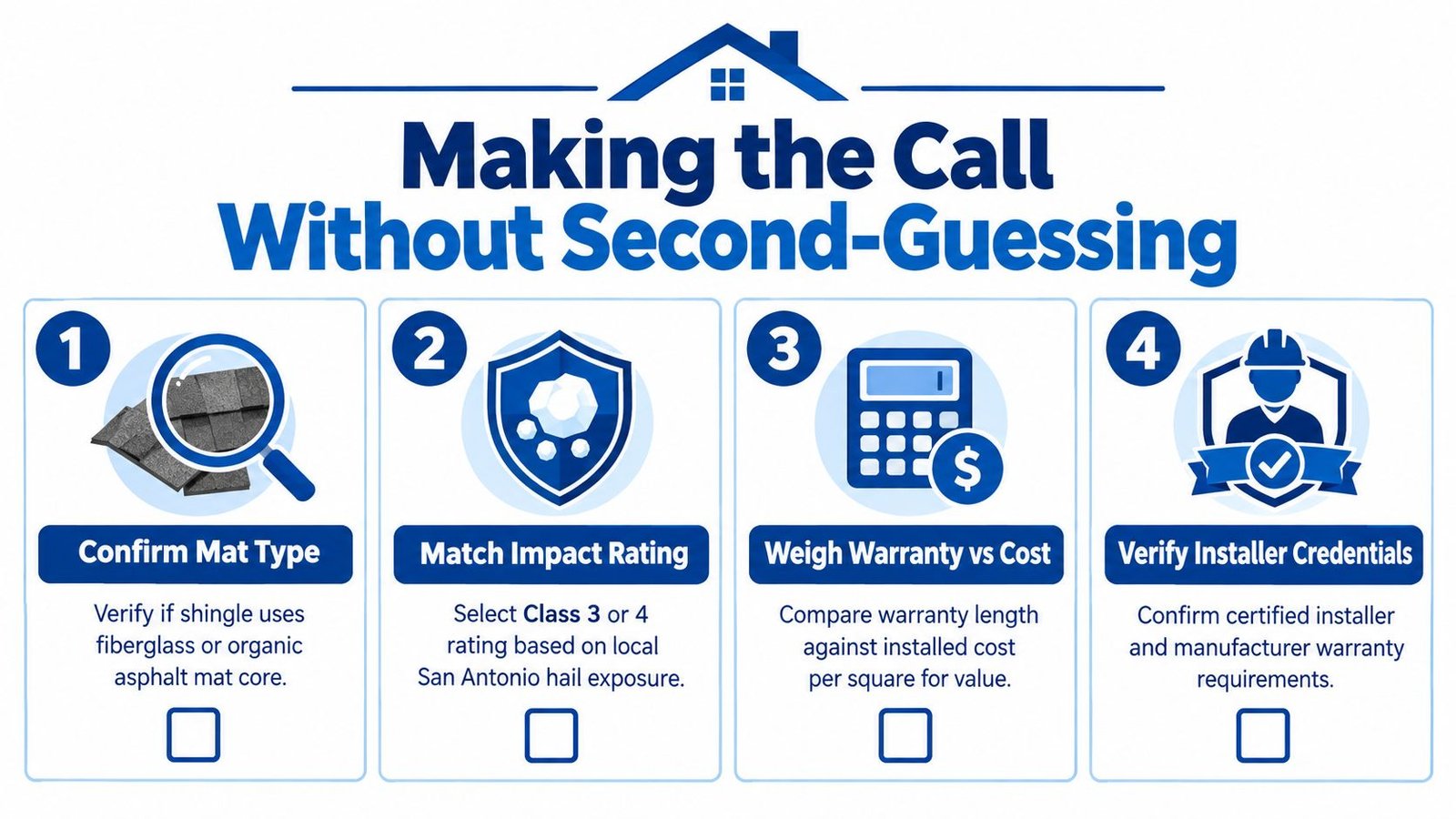
Four questions to put in writing
Confirm the mat type. Ask whether the shingle uses a fiberglass or organic asphalt mat. For a new San Antonio installation, fiberglass is generally the practical modern standard.
Match the impact rating. If hail has damaged your roof before, ask whether a Class 3 or Class 4 product makes sense for your property. Verify the exact product documentation and any installation conditions.
Weigh warranty against the proposal. Separate manufacturer coverage from workmanship coverage. Read exclusions, required accessories, ventilation conditions, and rules for maintaining the warranty.
Verify the installer. Check insurance, licensing where applicable, references, written scope, and whether the crew follows the manufacturer's installation requirements. A product warranty doesn't repair a roof that was installed incorrectly.
The estimate should identify the shingle manufacturer and product line, underlayment, flashing work, ventilation changes, cleanup, deck repairs, and warranty responsibilities. If the proposal only says “asphalt shingles,” it isn't specific enough for a major home improvement.
A sound recommendation fits the roof in front of you, not the leftover inventory in a contractor's truck.
Don't climb onto the roof to inspect hail bruising, soft decking, or loose shingles yourself. Roof surfaces can be steep, hot, and unstable, and a ground-level view won't reveal every problem. Arrange a professional inspection, and remember that no roofer can guarantee an insurance claim approval.
RRSATX provides free San Antonio roof inspections, written estimates, roof repair, replacement, and storm-damage support for residential and commercial properties. Call 713-504-2341 or schedule a free roof inspection online through RRSATX, and ask for a recommendation based on your roof deck, hail exposure, ventilation, and actual budget.