
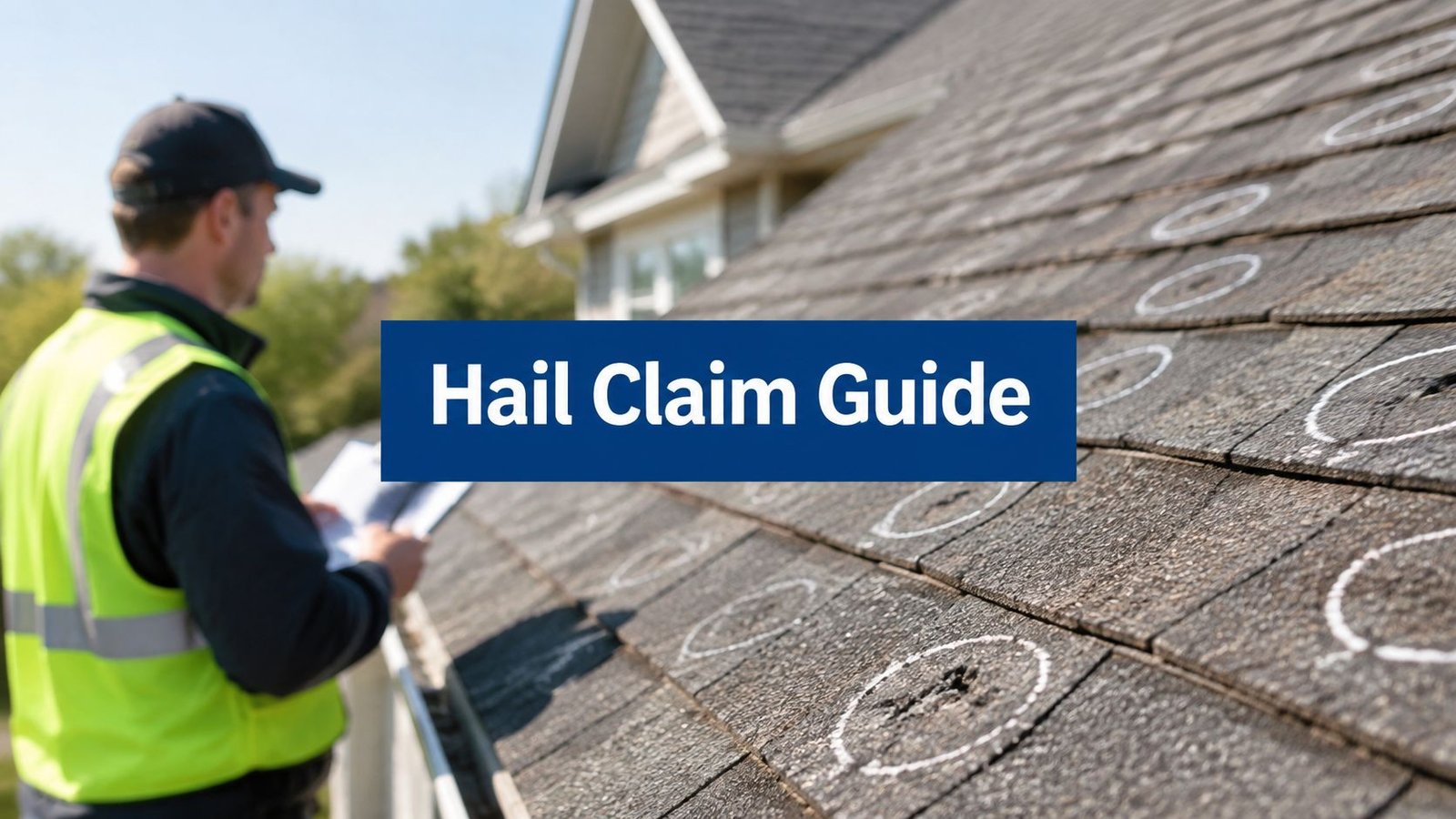
The morning after a hard South Texas hailstorm, most homeowners do the same thing. They walk the driveway, look at the gutters, notice the dented car hood, and hope the roof somehow escaped. That's the dangerous part, because hail damage on shingles usually isn't obvious from the ground, and the insurance fight starts the moment an adjuster asks whether the roof was struck by a storm or just worn out already.
A hail damage roof insurance claim is not just a phone call and a quick estimate. It's a causation case. You need to tie the loss to a real storm, document the roof slope by slope, file inside Texas deadlines, and go into the adjuster meeting with someone who knows how to read the damage, not just look at it. For homeowners around San Antonio, that's the difference between a claim that moves and a claim that gets stuck in “wear and tear” language.
What homeowners should know about insurance claims
Table of Contents
- What a Hail Damage Roof Insurance Claim Really Involves
- Confirming a Qualifying Storm and Recognizing Real Hail Damage
- Building the Photo and Documentation File Adjusters Trust
- Filing the Claim Under Texas Deadlines and Prompt Payment Rules
- Working the Adjuster Visit and Proving Storm Causation
- Your Hail Claim Checklist and Next Steps in San Antonio
What a Hail Damage Roof Insurance Claim Really Involves
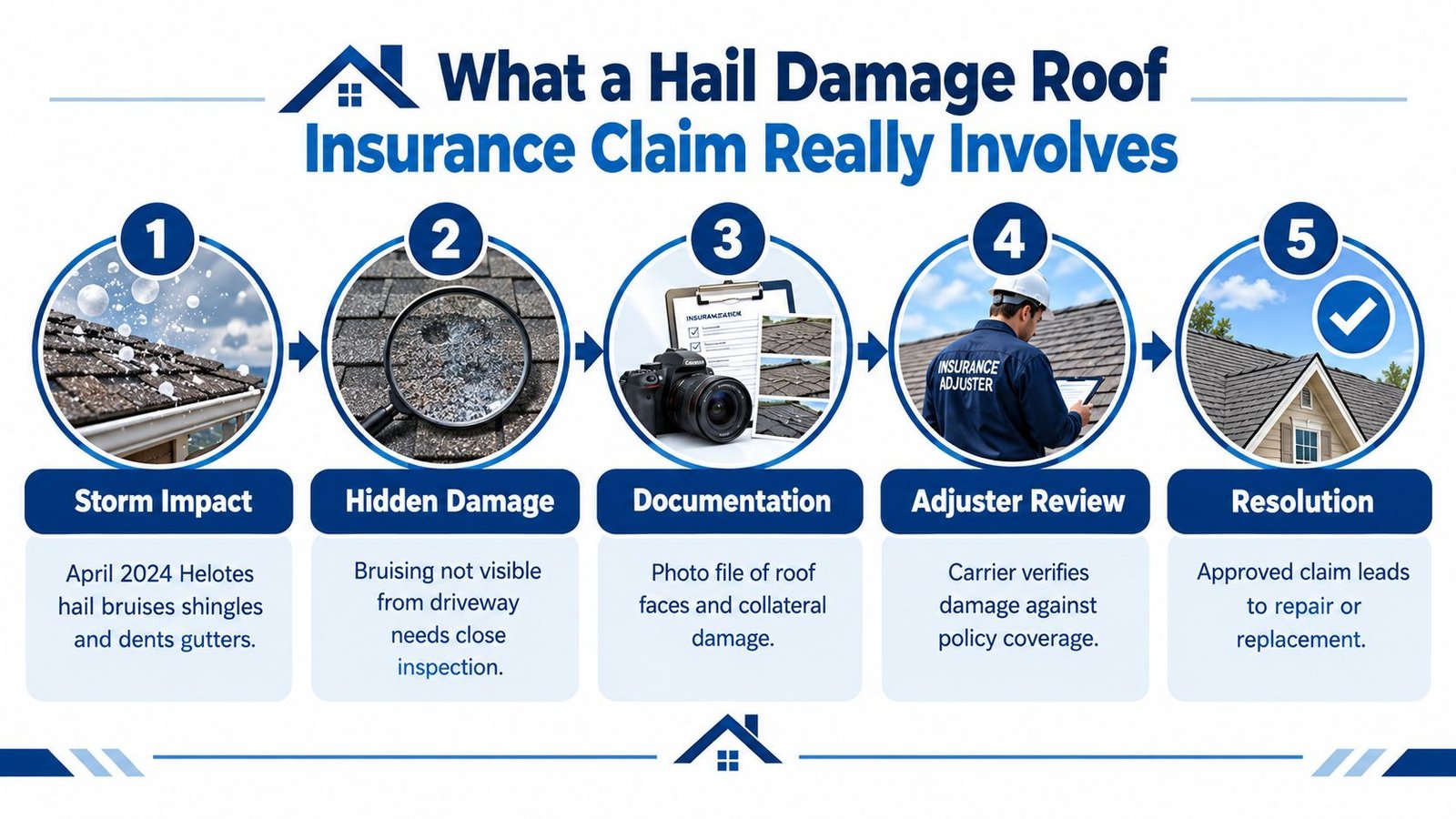
The first mistake homeowners make is treating hail as a simple repair ticket. It isn't. A real hail damage roof insurance claim is a file built to prove that a specific storm caused specific damage, not a vague story about bad weather.
The claim is a causation file
A homeowner in Helotes can have a roof that looks fine from the street and still have bruised shingles, soft-metal dents, and hidden mat fractures. That's why the strongest claims tie together storm verification, roof documentation, and adjuster review instead of relying on memory or a roofer's quick glance. Hail is a major loss driver, with insurers receiving more than 500,000 hail-related property damage claims each year and annual hailstorm losses rising from just over $1 billion in the 1990s to roughly $8 billion to $15 billion today, according to Cape Analytics' summary of hail risk for property insurers. Cape Analytics
Practical rule: If the file can't show the storm date, the roof slope, and the impact pattern, the carrier has room to argue that the damage came from age instead of hail.
This is why homeowners get underpaid in the first week. They wait on a door-knocker, or they let someone talk for them who doesn't build documentation the way an adjuster expects to see it. The claim should be treated like evidence collection from day one, not a casual service call.
What the adjuster actually wants to see
Adjusters want a clean chain, storm event, visible impact, and matching roof documentation. They also want collateral proof from gutters, flashing, vents, and other soft metals because those dents help show storm severity and timing. The faster you build that file, the harder it is for the carrier to dismiss the loss as maintenance.
Confirming a Qualifying Storm and Recognizing Real Hail Damage
Start with the storm itself, not the roof. If hail didn't hit your address hard enough to matter, the claim will stall before it starts. Check the local storm report, neighborhood photos, and weather warnings for your area before you assume the roof qualifies.
Size matters, but damage patterns matter more
Multiple roofing guides use about 1 inch of hail, roughly quarter-size, as a common threshold where shingle bruising starts to show on standard asphalt roofs, and older shingles can be hurt even sooner. The point isn't the number alone, though. The point is whether the roof shows functional damage, meaning bruising, fractured mats, granule loss with mat exposure, or cracked tiles that no longer perform the way they should. Ridgeline Construction
| Hailstone Size vs. Likely Roof Damage in South Texas | |
|---|---|
| Hail Size | Likely Damage |
| Under quarter-size | Often cosmetic on newer shingles, but still worth a close look on aging roofs |
| About quarter-size, roughly 1 inch | Common point where bruising and mat damage start to appear on asphalt shingles |
| Larger than quarter-size | More likely to crack shingles, dent soft metals, and break tile edges |
Soft metals tell a story too. Dented gutters, bruised vent caps, and peppered AC fins are the kind of collateral evidence that helps separate a real hail event from ordinary wear. If you're looking at metal damage on the ground and nothing on the roof, don't assume the roof is safe.
Don't climb the roof yourself after a storm. A ground-level walk-around, safe ladder access if you already know how to use it, and a contractor inspection are the smarter choices.
If you want a quick homeowner screen, check the yard, the gutters, the screens, the car hood, and any exposed AC fins. Then book a roof-level inspection through how to tell if your roof has hail damage, because the visible pattern on the roof is what the carrier will care about next.
Building the Photo and Documentation File Adjusters Trust
The best claims file is boring in the right way. It's organized, date-stamped, and easy for an adjuster to match to the roof in front of them. If your photos are scattered across a phone camera roll, you're making the claim harder than it needs to be.
Shoot the roof in layers
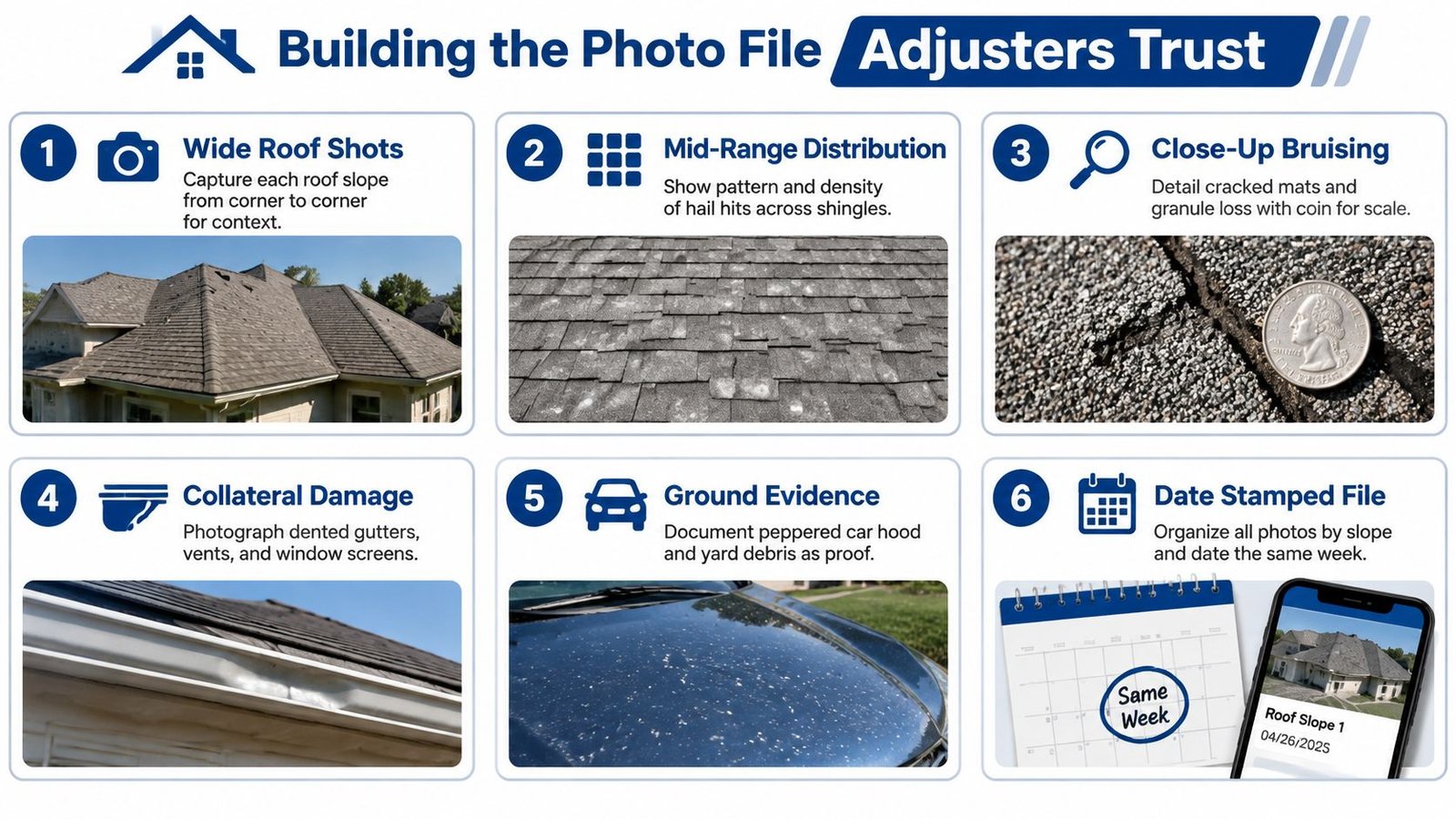
Start wide. Capture the house from the street, all four elevations, and each roof plane so the adjuster can understand the layout before they look at damage. Then move in closer and document the hail pattern slope by slope, not just as random close-ups.
The close-up set matters because it shows bruising, granule displacement, and impact density. Use a chalk circle, a coin, or a tape measure for scale, and take enough photos to show the pattern across the roof face. Independent claim-prep guides recommend 15 to 40 close-up photos per affected area, and the file is stronger when those images keep the original timestamp data intact. Trill Roofing documentation guide
Don't skip collateral damage
A roof claim gets stronger when the same storm leaves marks on the rest of the property. Photograph gutters, downspouts, window screens, patio furniture, vehicles, and AC condenser fins. That outside evidence matters because it helps prove the storm's path and timing, not just the roof's condition.
Keep each slope in its own labeled folder with the date, weather note, and a short description. If the west slope has more damage than the east slope, say so. That kind of simple mapping helps an adjuster line up the photos with the estimate instead of guessing.
Here's the paperwork every homeowner should keep with the images:
- Policy declarations page: Shows the coverage form, deductible, and named insured.
- Prior repair invoices: Helps separate old fixes from new storm damage.
- Contractor slope map: Gives the adjuster a clear visual of where damage sits on the roof.
- Storm-date note: Records the hail event date and basic weather conditions.
A clean photo file doesn't win the claim by itself, but a messy one gives the carrier an excuse to delay.
For homeowners who want a contractor option, RRSATX provides free roof inspections and insurance-ready documentation, which fits this step if you want a local roofer to organize the slope map and photo set before the adjuster ever climbs the ladder.
Filing the Claim Under Texas Deadlines and Prompt Payment Rules
Texas timing rules matter, and they matter fast. For many homeowners, the claim can still be valid long after the storm, but the policy window and the carrier's response clock are separate issues, and both can hurt you if you sit on the file.
File early, then keep the packet complete
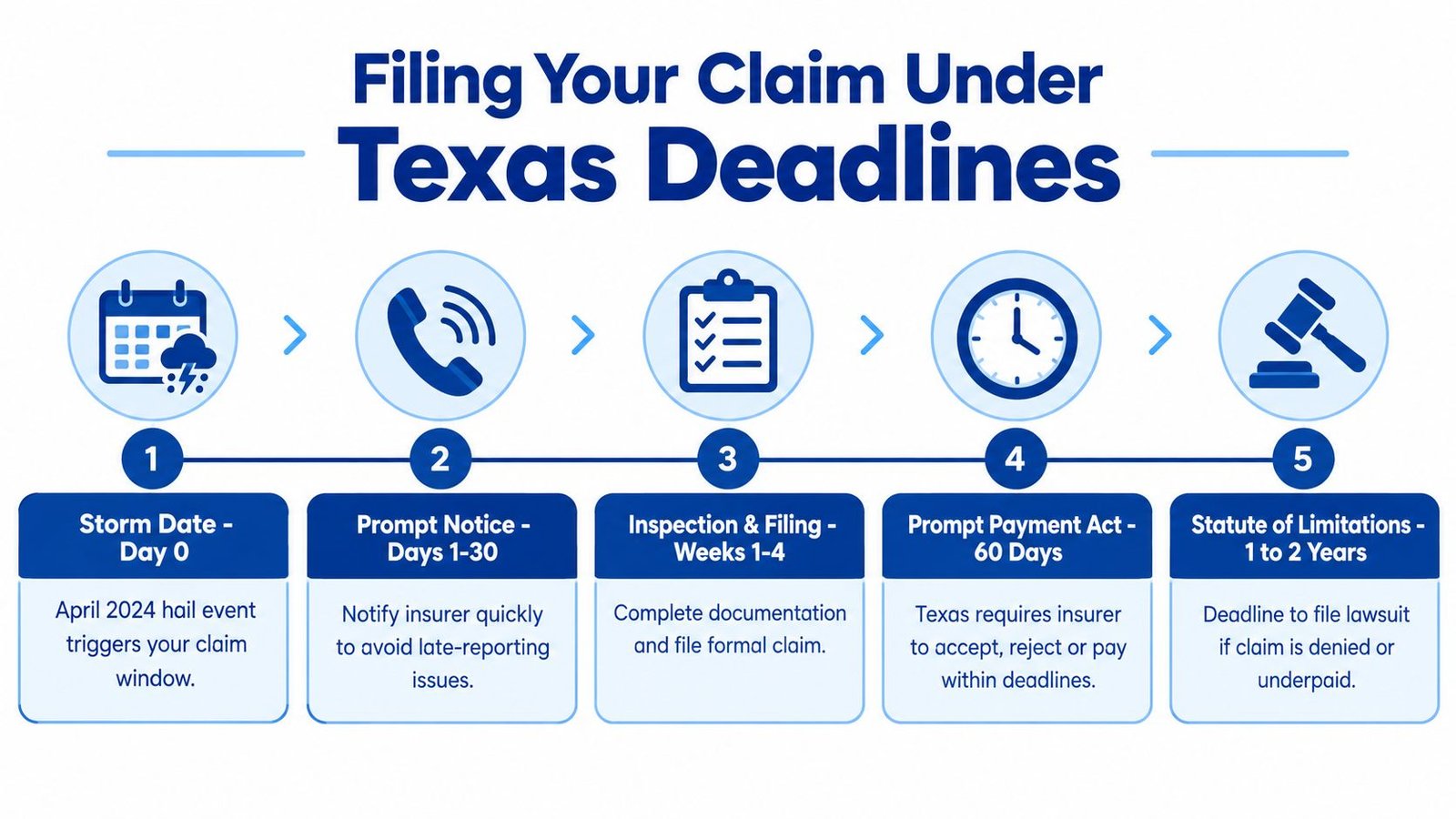
Independent Texas roofing guidance says many homeowners policies require a roof claim to be filed within one year of the date of loss, though some policies extend to two years. That's why same-week filing is the smart move. Don't assume the state law clock protects you if your policy language is tighter. RoofVista Texas guide
Texas Prompt Payment rules also shape the timeline. For hail-related roof claims, the carrier must acknowledge the claim within 15 days, and after receiving all requested information, it must accept or deny the claim within 15 business days. In plain English, once the claim is opened, the paperwork you send early can keep the file from stalling. Texas Prompt Payment timeline
What to send with the first filing
Put the important items in front of the carrier right away:
- Claim number request: Ask for it as soon as the file is opened.
- Date of loss: Use the actual storm date, not a rough guess.
- Declarations page: Shows the policy terms the carrier will use.
- Slope-by-slope photo log: Make it easy to see the damage pattern.
- Contractor inspection report: Gives the carrier a written damage summary.
- Written estimate tied to line items: Keep it matched to the roof scope the contractor found.
ACV and RCV policies don't pay the same way. If the policy uses depreciation, the carrier may hold back part of the money until repair or replacement work is verified, so don't sign a quick settlement without reading the payout structure first.
Open the claim the same week as the storm if you can. After a big South Texas hail event, adjuster calendars clog fast, and the homeowner who files early usually gets the first clean inspection slot.
Working the Adjuster Visit and Proving Storm Causation
This is the most important moment in the whole process. The adjuster is deciding whether the roof shows storm-caused damage or just age-related wear, and that decision usually leans heavily on how the meeting is handled. If nobody brings organized evidence, the carrier gets the first and last word.
What changes the outcome in the field
Modern carriers test causation with more than a glance. They compare storm verification tools, estimate software, and on-roof indicators like granule displacement, mat fracture, soft-metal spatter, and bruise direction that lines up with the storm's wind pattern. When a roofer comes prepared, the conversation shifts from opinions to evidence.
The roofer should bring the slope-by-slope photo set, chalk-circled test squares, soft-metal photos, and the storm verification record. A marked test square shows impact count and pattern in a way that's easy to compare with the roof's estimate. That kind of visual proof matters when an adjuster is trying to separate fresh hail impact from old deterioration.
Practical rule: Never let the inspection turn into a walk-around with no roof-level proof. If the adjuster doesn't see the damage in context, the carrier has room to downplay it.
What to do when the carrier says wear and tear
If the adjuster downgrades the roof to wear and tear, ask for the reasoning in writing and request the engineering report if one was used. Then push for a re-inspection with the contractor present. If the carrier still ignores clear causation evidence, homeowners can escalate through the Texas Department of Insurance complaint process.
Don't do this alone. A homeowner standing on the ground while the adjuster, the carrier, and the estimate software all point in one direction usually loses negotiating power. A roofer on site changes that dynamic because the roofer can point to the exact slope, exact bruises, and exact collateral hits that support the claim.
The right local contractor matters here because the adjuster meeting is where scope gets built or cut. If you want a San Antonio team that handles inspections, written findings, and adjuster walkthrough support, RRSATX is one contractor that offers that kind of claim documentation in the local market.
Your Hail Claim Checklist and Next Steps in San Antonio
A homeowner doesn't need a long theory. You need a short list you can act on before the next rain hits. Save this and use it the same day you notice the damage.
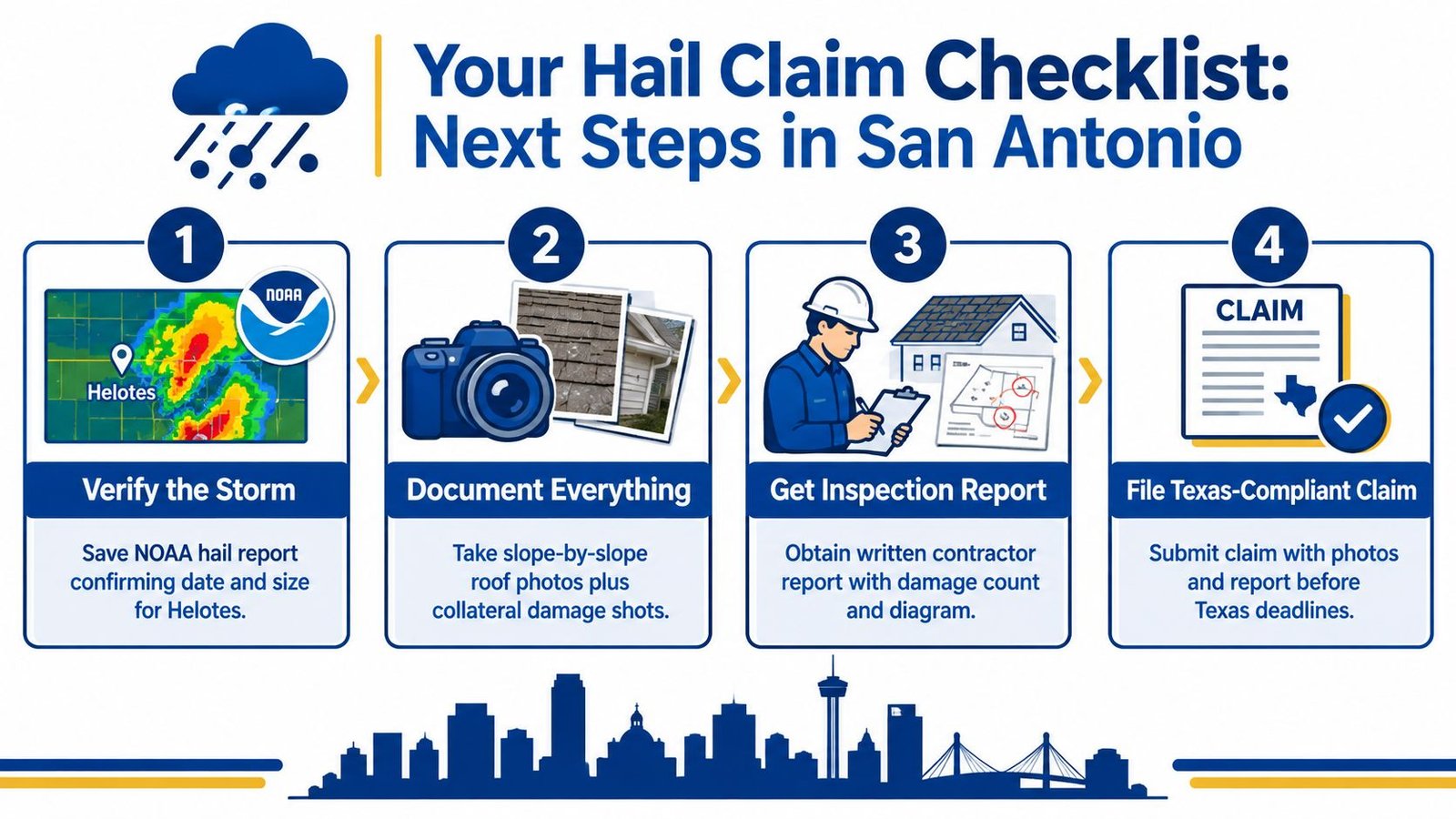
- Verify the storm: Save the hail report or weather record that matches your address.
- Document everything: Take slope-by-slope roof photos plus collateral damage shots.
- Get the inspection report: Use a contractor report with damage counts and a simple diagram.
- File the claim: Send the packet before the policy clock and carrier deadlines get in the way.
The biggest mistakes are easy to avoid. Don't wait more than 30 days to get the file opened if you can help it. Don't sign a carrier estimate before your contractor reviews it. Don't accept an ACV-only payout without understanding whether RCV applies. And don't skip the storm verification step, because a claim without a clear hail event is easier to dispute.
Every claim gets judged on its own facts, and no carrier approval is guaranteed. South Texas roofs are too important and the post-storm footing is too slick to risk climbing up there yourself. If you want help with a hail damage roof insurance claim in San Antonio or the surrounding counties, contact RRSATX for a free hail damage inspection and an adjuster-ready documentation package built around the storm history in this area.
RRSATX handles free roof inspections, storm-damage documentation, and roof repair or replacement work for San Antonio homeowners who need a clean claim file after hail. If your roof took a hit in Helotes, Alamo Heights, Schertz, or nearby areas, visit RRSATX and get a local contractor to inspect the roof before the carrier starts narrowing the scope.