

[et_pb_section fb_built=”1″ admin_label=”section” _builder_version=”4.16″ global_colors_info=”{}”][et_pb_row admin_label=”row” _builder_version=”4.16″ background_size=”initial” background_position=”top_left” background_repeat=”repeat” global_colors_info=”{}”][et_pb_column type=”4_4″ _builder_version=”4.16″ custom_padding=”|||” global_colors_info=”{}” custom_padding__hover=”|||”][et_pb_code _builder_version=”4.27.6″ _module_preset=”default” hover_enabled=”0″ sticky_enabled=”0″]
Metal roofs are low-maintenance, not no-maintenance. This guide covers exactly how often San Antonio homeowners should inspect and service their metal roofs, what each maintenance visit should include, what happens when maintenance is skipped, and how Texas heat, hail, and humidity change the schedule compared to cooler climates.
Metal roofs are marketed as the low-maintenance roofing solution, and compared to asphalt shingles, they genuinely are. You are not replacing them every 15 to 20 years. You are not sweeping up granules from the gutters every fall. You are not watching the edges curl after a bad summer. But low-maintenance does not mean no maintenance, and in San Antonio, the gap between a metal roof that lasts 50 years and one that starts failing at 25 often comes down to whether the owner ever scheduled a professional to look at it.
Texas puts metal roofs through conditions that are harder on the system than what most manufacturers assume when they publish their warranty terms: extreme UV exposure, temperatures that push past 160 degrees on the surface in July, and then violent hailstorms that arrive without much warning. The fasteners, sealants, coatings, and flashings that keep a metal roof watertight all degrade at rates that San Antonio homeowners need to understand. This guide tells you exactly what needs to happen, how often, and what it costs to keep a metal roof performing the way it was designed to perform.
A failed rubber washer on a roofing screw costs a few cents to replace during a maintenance visit. Left alone for five years in San Antonio heat and rain cycles, that single failed washer becomes a rust ring, then a leak, then interior water damage. The most expensive metal roof maintenance mistake San Antonio homeowners make is confusing “it is not leaking right now” with “it does not need to be looked at.” Annual inspections are not about fixing obvious problems. They are about catching the failures that have not shown up inside the house yet.
Annual
An annual professional inspection is the foundation of every metal roof maintenance program. This is not a homeowner walking around the perimeter looking for obvious damage. It is a licensed roofing contractor getting on the roof, checking every fastener zone, every sealant joint, every flashing edge, and every panel seam systematically. What they find in year three tells you what to budget for in year five. What they miss in year three is what causes a leak in year six.
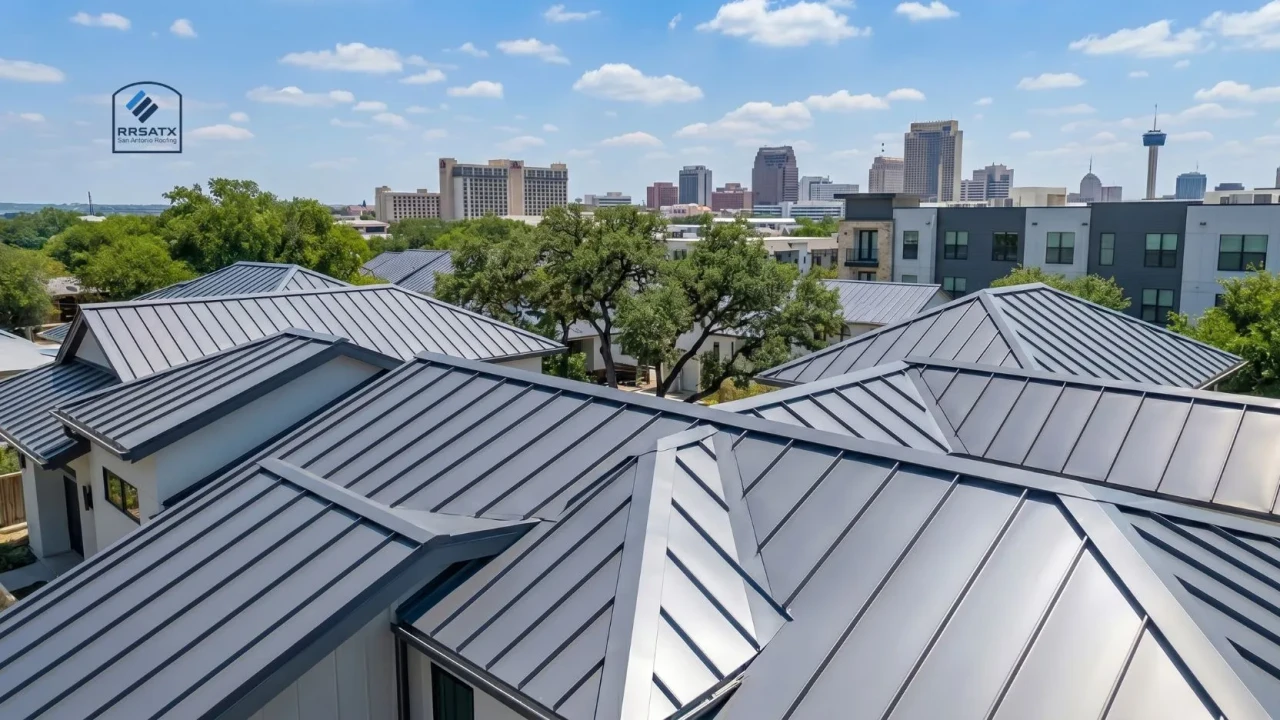
What the contractor checks on every annual visit: Fastener backing and washer condition across the entire panel field, sealant integrity at all ridges, hips, valleys, and penetrations, flashing condition at chimneys, vents, skylights, and HVAC curbs, panel coating condition for early rust or coating breakdown, debris accumulation in valleys and gutters that holds moisture against the metal, and any panel movement or lifting caused by thermal expansion over the prior year.
Why San Antonio specifically calls for once-a-year minimum: The temperature swing between a San Antonio January night and a July afternoon roof surface exceeds 150 degrees Fahrenheit. That thermal stress cycles every single day and works fasteners loose and stresses sealant joints faster than in moderate climates. Once a year is the minimum. After a significant hail event, treat that storm season as an extra inspection cycle regardless of where you are in your regular schedule.
- Contractor physically accesses the roof (ground-only inspections are not sufficient)
- Written inspection report delivered with photos of any flagged conditions
- Fastener field inspected across the full panel area, not just at obvious leak points
- All sealant joints at ridges, hips, valleys, and penetrations evaluated
- Flashing condition checked at every roof-to-wall, roof-to-chimney, and penetration transition
- Gutters and valleys cleared of debris that traps moisture against the metal surface
- Panel coating assessed for early rust, UV chalking, or stone-coat chip loss
- Inspection report kept on file, as it becomes your maintenance history if you ever sell the property
Seasonal
Between your annual professional inspection, there are simple seasonal tasks that any San Antonio homeowner can manage without getting on the roof. These tasks do not replace the annual professional visit. They extend the value of it by catching obvious problems early and keeping the drainage system working the way it should. None of these require roofing experience, and most take less than an hour.
The most useful thing a homeowner can do between professional inspections is pay attention to the inside of the house. Staining on ceilings, moisture in the attic, or rust-colored streaks on exterior walls below any roof penetration are all early signals that something has changed on the roof since the last visit. Do not wait for the next scheduled inspection if you notice any of these inside the house. Call your contractor for a targeted assessment.
Never walk on a metal roof without knowing the panel type and the correct walking zones. Standing seam panels are designed so that foot traffic stays on the flat pan between the seams. Corrugated panels are walked on the lower third of each corrugation, near the fastener point. Walking on the wrong zone of a metal panel can dent the surface, crack sealant joints, and loosen fasteners. If you are not certain about the correct walking path on your specific panel profile, stay off the roof and leave it to a professional. A dent from improper walking is a cosmetic issue at best and a structural failure point at worst.
- Gutters cleared of debris two to four times per year depending on tree cover
- Downspouts flushed and confirmed to be draining freely
- Valley zones visually checked for debris accumulation after leaf fall
- Attic checked for moisture, rust staining on the decking, or daylight coming through panels
- Ceiling and interior walls scanned for new staining after any significant rain event
- Ground-level visual inspection completed within 48 hours of any hail event
- Any overhanging tree branches noted; branches that contact or scrape the panel coating are a maintenance concern
Every 5 Years
Annual inspections catch and address emerging problems. The five-year comprehensive maintenance visit goes deeper. This is where a qualified San Antonio metal roofing contractor works through the entire roof systematically: replacing sealant that has reached the end of its useful life, doing a full fastener pass to check every screw on an exposed-fastener system, resealing all flashings, and giving the coating a thorough assessment to determine whether a roof coating application makes sense before rust or UV degradation advances further.
Many San Antonio metal roofs that have only had annual inspections but no comprehensive service visits reach their second decade with accumulated sealant failures that no single annual visit fully addressed. The five-year mark is the right time to reset the system.
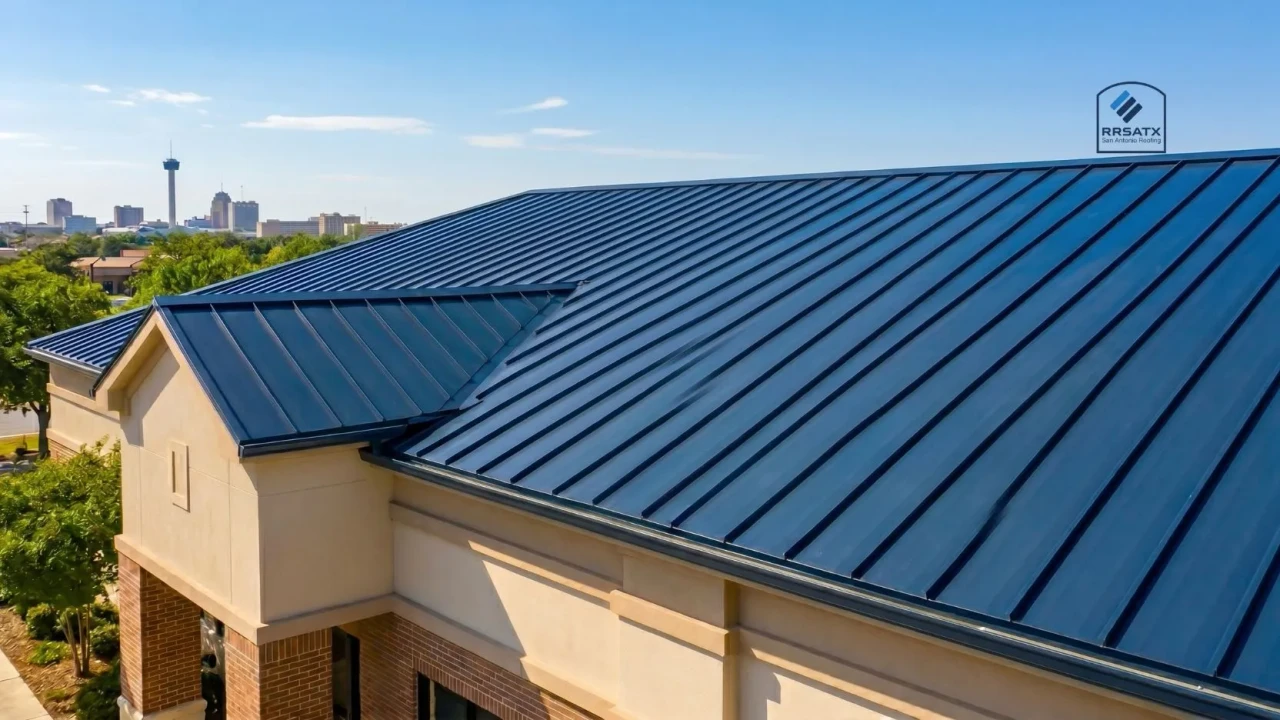
Full fastener inspection and replacement pass: On screw-down metal panel systems, the rubber EPDM washers under each fastener have a service life of roughly 10 to 15 years in San Antonio UV conditions. By year five, the first signs of washer hardening and cracking begin to appear. A systematic fastener pass at the five-year mark identifies which zones are developing failures before they become active leak points.
Complete sealant replacement: Butyl and urethane sealants used at ridges, flashings, penetrations, and panel overlaps typically have a serviceable life of five to ten years under Texas UV and heat exposure. At the five-year comprehensive visit, all sealant is assessed and the joints that show cracking, shrinkage, or separation are fully stripped and re-applied. Applying new sealant over failing old sealant is a common shortcut that leads to premature re-failure.
Coating condition assessment: Galvalume, painted steel, and stone-coated steel panels all have protective layers that degrade with time and UV exposure. The five-year visit is the right time to evaluate whether the coating is performing, whether touch-up is warranted in localized areas, or whether a full elastomeric roof coating application should be planned in the next one to two years.
- Full fastener pass completed on screw-down panel systems, covering every zone, not just visible problem areas
- Old sealant removed before new sealant is applied; no applying over failing material
- All flashings assessed and re-bedded or replaced where corrosion or separation is present
- Coating condition documented with photos and a written assessment of remaining coating life
- Panel-to-panel overlaps checked for separation caused by thermal cycling over five years
- Ridge cap fasteners and sealant comprehensively serviced; ridge caps are the highest-exposure zone on any metal roof
- Written maintenance log updated with all completed work and materials used
10 to 20 Years
Every metal roof panel has a protective coating that keeps moisture off the base metal. On a painted steel panel, that coating is the factory paint finish plus the primer underneath it. On a Galvalume panel, it is the aluminum-zinc alloy layer bonded to the steel. On a stone-coated steel panel, it is the mineral coating adhered over the steel substrate. All of these coatings degrade with time, and in San Antonio, the UV index and summer heat accelerate that degradation significantly compared to what manufacturers assume when they publish coating life estimates written for northern climates.
When the coating fails and bare metal is exposed to moisture, rust begins. And rust in San Antonio does not sit still. The combination of humidity in the wet months and extreme dryness and heat in the summer months creates an aggressive oxidation cycle that advances rust quickly once it gains a foothold.
A full elastomeric roof coating application is the most cost-effective way to extend the life of an aging metal roof in San Antonio by 10 to 15 years. The coating is applied over the entire panel surface after rust treatment, creating a seamless waterproof membrane that bridges minor cracks, covers early rust, and gives the metal a fresh layer of UV protection. It is significantly less expensive than replacement and appropriate for any metal roof where the underlying panel structure is still sound.
Elastomeric roof coatings only work on a clean, prepared surface. A contractor who proposes applying roof coating directly over rust, dirt, and failing old paint will deliver a coating that peels within two to three years. The correct process is rust treatment with a converter product, wire brushing or pressure washing to remove loose material, a rust-inhibiting primer, and then the coating applied in two coats at the manufacturer’s specified mil thickness. Ask your San Antonio contractor for the specific product name, its tested mil thickness per coat, and the warranty the product manufacturer backs for the coating in Texas climate conditions.
- Rust stage assessed before any coating is proposed: surface rust, pitting, or through-panel
- Through-panel corrosion identified and those panels replaced before coating is applied
- Full surface preparation itemized in the written estimate as a separate line item
- Rust converter applied to all affected areas before primer goes down
- Primer product confirmed as compatible with both the panel material and the topcoat being applied
- Coating applied in two coats at the manufacturer’s specified mil thickness
- Product data sheet and manufacturer warranty documentation received before work begins
- Written contractor warranty on the application workmanship separate from the product warranty
Long-Term Cost
The reason to maintain a metal roof is not just to extend its life. It is to protect the building underneath it. A metal roof that has been neglected for a decade does not fail catastrophically overnight. It fails slowly, through dozens of small water intrusion points that each cause a little bit of damage to the decking, the insulation, and the interior. By the time the first ceiling stain appears inside the house, the damage behind the drywall is usually significantly worse than the stain suggests.
This is the part of metal roof maintenance that homeowners underestimate. The annual inspection does not just protect the metal panels. It protects the structural components that the roof sits on. Wood decking that gets wet and dries and gets wet again for years develops mold and rot. Insulation that absorbs moisture loses its R-value. Drywall and framing that experience repeated moisture exposure invite structural repair costs that dwarf whatever the maintenance would have cost.
| Years without maintenance | What typically develops | Likely repair cost |
|---|---|---|
| 0 to 5 years | Fastener washer hardening begins; minor sealant cracking at high-UV zones; early surface rust at coating chips | $150 to $400 caught at annual inspection |
| 5 to 10 years | Multiple failed fastener washers; sealant separation at ridge and penetration joints; surface rust advancing to pitting in low spots and valleys | $600 to $2,000 for fastener pass and sealant replacement |
| 10 to 15 years | Active leak points at multiple locations; through-panel rust beginning in neglected areas; flashing failures at chimney and vent transitions; possible decking moisture damage | $2,000 to $6,000 for repairs plus potential decking replacement |
| 15 to 25 years | Widespread sealant failure; significant panel rust or coating loss; interior water damage; premature end-of-life for a roof that should last 50 years | Full replacement at $8,000 to $20,000+ plus interior repair costs |
- No record of a professional inspection in the past two or more years
- Visible rust streaks running down the exterior wall below any roof penetration or flashing
- Ceiling stains that appeared after rain; active water intrusion is already occurring
- Attic shows rust staining on the decking boards or moisture in the insulation
- Ridge cap edges show visible separation from the panel surface or from each other
- Gutters contain stone-coat granules or rust-colored sediment after rain
- Screw heads are visibly backed out above the panel surface when viewed from the eave
- Any area of the roof shows panel lifting, buckling, or visible seam separation
Use this table as your reference guide for scheduling maintenance on any residential metal roof in the San Antonio area. Roofs over 15 years old, roofs with a history of storm damage, or roofs with no prior maintenance documentation should be treated as a higher-frequency category across every row.
| Maintenance task | Frequency | Who performs it | Typical San Antonio cost |
|---|---|---|---|
| Professional roof inspection | Once per year (twice if 15+ years old or post-hail) | Licensed roofing contractor | $150 to $250 |
| Gutter and valley debris clearing | Two to four times per year | Homeowner or contractor | $0 DIY or $75 to $150 professional |
| After-storm visual inspection | Within 48 hours of any significant hail event | Homeowner (ground level) plus contractor if hail was 1″+ diameter | $0 DIY; $150 to $250 professional |
| Minor sealant touch-up and fastener replacement | As needed, typically found during annual inspection | Licensed roofing contractor | $100 to $400 depending on scope |
| Full sealant replacement (all joints and penetrations) | Every 5 to 10 years | Licensed roofing contractor | $400 to $900 |
| Complete fastener inspection and replacement pass | Every 5 years on screw-down systems | Licensed roofing contractor | $600 to $1,800 |
| Flashing inspection and resealing | Every 5 years or when flagged at annual inspection | Licensed roofing contractor | $300 to $700 depending on flashing count |
| Rust treatment and spot coating | As needed when coating failure is identified | Licensed roofing contractor | $200 to $600 |
| Full elastomeric roof coating application | Every 10 to 20 years based on coating condition | Licensed roofing contractor | $1.50 to $3.50 per square foot |
- Professional inspection scheduled and completed; written report received and filed
- Fastener zones checked across the full panel field for backing-out and washer failure
- All sealant joints at ridges, hips, valleys, and penetrations evaluated and noted
- All flashings checked for corrosion, separation, or lifting
- Panel coating assessed for rust, UV degradation, or stone-coat chip loss
- Any items flagged by the inspection scheduled for repair with a written quote
- Gutters cleared after leaf fall and before wet season
- Downspouts confirmed to be draining freely
- Attic checked for new moisture, rust staining, or daylight through panels
- Interior ceilings and walls scanned for new staining after heavy rain
- Ground-level visual scan within 48 hours of any significant hail event
- Any overhanging branches contacting the roof surface trimmed back
- Full sealant replacement pass; old sealant removed before new sealant applied
- Comprehensive fastener inspection and selective replacement on screw-down systems
- All flashings re-bedded or replaced where corrosion or separation is found
- Coating condition assessment with a written recommendation on timing for next full coating
- Maintenance log updated with all completed work, materials used, and next service date
How often does a metal roof need to be inspected in San Antonio?
Do metal roofs really need maintenance, or is that just a contractor pitch?
How much does it cost to maintain a metal roof in San Antonio?
What is the most important maintenance task for a metal roof in Texas?
Does a standing seam metal roof need less maintenance than a screw-down metal roof?
Can I do my own metal roof maintenance, or does it require a professional?
Schedule a professional metal roof inspection in San Antonio
Whether your roof is due for its annual inspection, overdue for a five-year service visit, or showing signs it has been under-maintained, we will get on the roof, document what we find, and give you a clear written maintenance plan at no charge.
[/et_pb_code][/et_pb_column][/et_pb_row][/et_pb_section]