
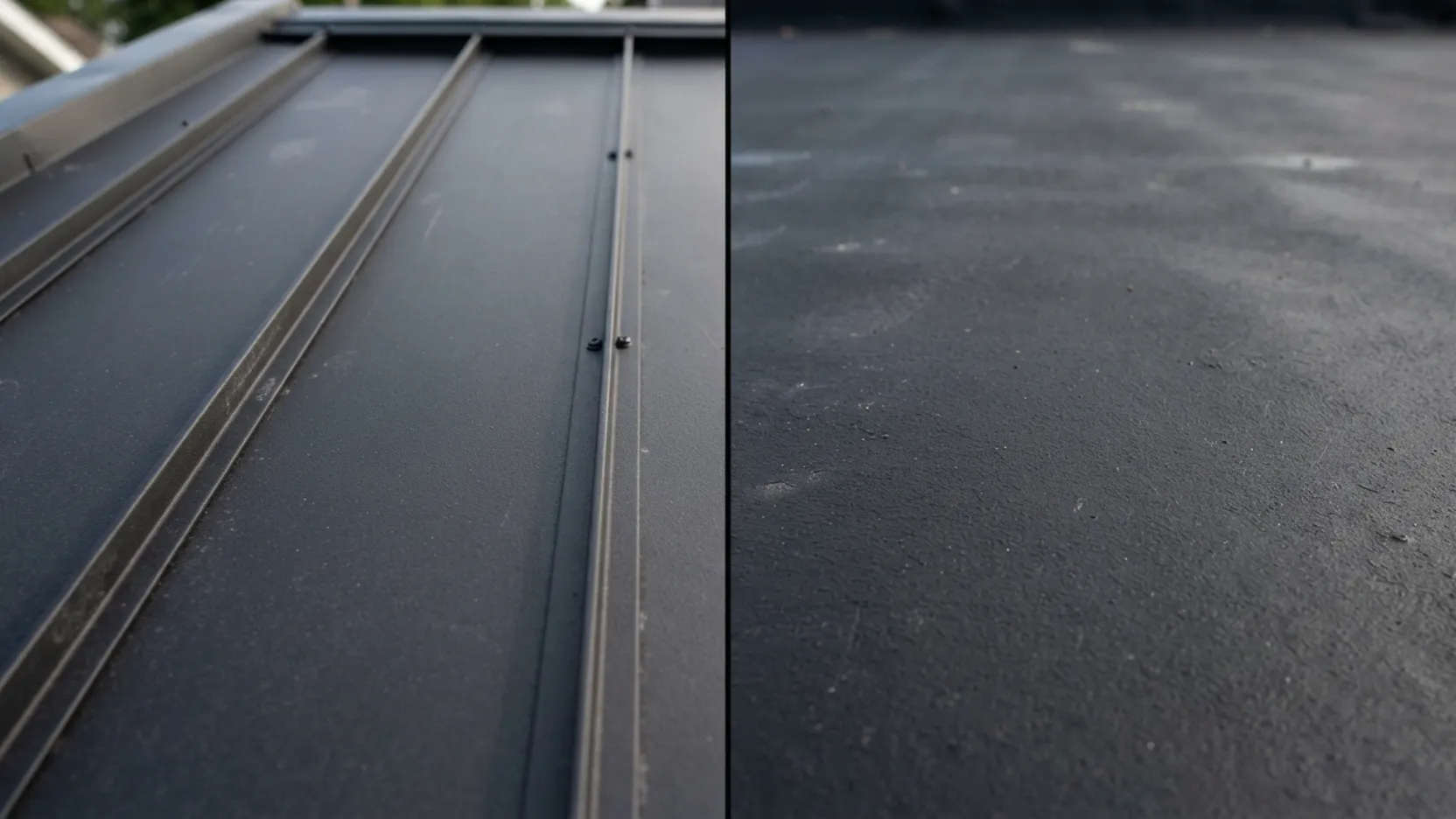
Metal and rubber (EPDM) roofing solve different problems. They carry different price tags and behave differently under the San Antonio sun. Neither is universally “better”—the right call depends on slope, building type, budget, and how long you will own the property.
Metal covers pitched residential roofs, many low-slope commercial decks, and long-life projects. Rubber EPDM is built almost exclusively for flat and very low-slope work. Above about a 2:12 pitch, rubber is not a realistic option and metal wins by default. On flat or near-flat sections, both can be on the table—and the comparison gets interesting.
Upfront, rubber often wins: about $1 to $4 per sq ft installed versus about $3 to $9 for residential metal ranges locally. Over decades, metal’s 40- to 70-year life versus EPDM’s 15- to 25-year clock (often shorter in South Texas UV) frequently flips the total-cost math.
By the end of this guide, you’ll know cost, lifespan, heat, storm, and maintenance differences—and a clear decision framework for San Antonio homes and commercial sections.
Table of Contents
- Upfront Cost vs Lifetime Cost
- Lifespan in San Antonio Heat and UV
- Heat Performance and Energy
- Storm and Hail Resistance
- Maintenance Differences
- Metal vs Rubber Comparison Table
- Which Material Fits Your Situation
- Common Questions About Metal vs Rubber Roofs
- Next Steps for San Antonio Homeowners
Upfront Cost vs Lifetime Cost
EPDM’s appeal is day-one price. Material is inexpensive and flat installs move quickly. A 1,500 sq ft commercial flat section often lands about $1,500 to $6,000 installed on basic single-ply.
Metal spans a wider band: corrugated/exposed-fastener often about $3 to $5 per sq ft; standing seam and stone-coated commonly about $6 to $9+. That same 1,500 sq ft can run about $4,500 to $13,500; full residential standing seam frequently reaches $15,000 to $30,000+.
Over 20 to 40 years, rubber usually needs a full replacement before metal reaches mid-life. If you will hold the property 30+ years, metal often wins total cost of ownership even when the first check is larger. If you only need a watertight flat deck as cheaply as possible today, EPDM remains a legitimate short-horizon tool.
Practical rule: decide whether you are optimizing lowest check this year or lowest spend over 30 years. Those two goals pick different materials.
Lifespan in San Antonio Heat and UV
Correctly installed metal here commonly lasts 40 to 70 years—standing seam toward the top, maintained exposed-fastener and stone-coated often 40 to 50. EPDM typically lasts 15 to 25 years before shrinkage, cracking, and seam pull-away; reinforced sheets may stretch toward 20 to 30 in favorable conditions.
National EPDM averages often assume cooler, lower-UV climates. San Antonio roof surfaces regularly hit about 150°F to 170°F in July. That heat and UV oxidize rubber faster—especially at seams and flashings. If a bid quotes a full 25-year EPDM life here, ask how that number was localized for South Texas.
Metal material warranties often run 30 to 50 years; rubber warranties commonly 10 to 20. Factor one full rubber replacement into any 40-year cost comparison.
Heat Performance and Energy
San Antonio averages 220+ sunny days a year. Roof surface temperatures above 150°F are routine. Material choice shows up on the AC bill.
- Metal with cool-roof coating: roughly 60% to 70% solar reflectance
- Unpainted / standard metal: roughly 40% to 60%
- White EPDM or TPO: roughly 70% to 80%
- Black EPDM: roughly 3% to 10%—absorbs most incoming heat
Metal can also be detailed with an air gap over the deck for an extra thermal break. Black EPDM on a San Antonio flat roof is one of the weaker heat choices available. White EPDM/TPO fixes reflectivity—but raises cost and erodes rubber’s price advantage. Light metal or cool-coated metal is usually the stronger all-around heat package.
Storm and Hail Resistance
Bexar County sits in an active hail corridor. Large hail is a yearly planning risk, not a theoretical one.
Metal—especially standing seam—usually keeps waterproofing after impacts that only dent panels. Stone-coated and exposed-fastener systems can show more cosmetic damage; underlayment and panel integrity often remain. EPDM flexes, but large hail (about 1.5″+) can puncture membrane or micro-tear seams and flashings. Wind that lifts membrane edges creates immediate intrusion with little warning.
Class 4 impact-rated metal may qualify for Texas insurance discounts of about 20% to 30%. EPDM typically does not. Over 20 years that discount can outweigh a large share of the upfront metal premium on many homes.
Maintenance Differences
Neither system is maintenance-free.
Metal: inspect every 2 to 3 years; focus on fastener washers (screw-down), sealants, flashings, and coating. Typical inspection visits about $150 to $400.
EPDM: inspect annually in this climate; focus on seam adhesion, flashings, membrane cracking, and ponding. Inspections about $100 to $300; seam repairs about $150 to $500 depending on length. Recoats every 5 to 10 years (about $500 to $1,500) are common life-extension steps metal does not need on the same cycle.
Ponding on flat rubber adds UV stress and deck load—drainage design matters as much as membrane brand.
Metal vs Rubber Comparison Table
| Category | Metal roofing | Rubber EPDM | Advantage |
|---|---|---|---|
| Upfront cost | $3–$9 / sq ft installed | $1–$4 / sq ft installed | Rubber |
| Lifespan (San Antonio) | 40–70 years | 15–25 years | Metal |
| Heat performance | Excellent with cool coating | Poor (black); good (white) | Metal |
| Hail / storm | Excellent (esp. standing seam) | Fair; seam risk in wind | Metal |
| Maintenance | Low–moderate (every 2–3 yrs) | Moderate (annual in TX) | Metal |
| Flat / low-slope | Yes (specialty systems) | Yes (primary use) | Situation-dependent |
| Pitched residential (>2:12) | Yes | Not suitable | Metal |
| Texas insurance discounts | Yes (Class 4) | Generally no | Metal |
| 30-year total cost | Often lower | Often higher (replacement) | Metal |
| Resale / curb appeal | Strong positive | Minimal / neutral | Metal |
Which Material Fits Your Situation
- Pitched residential above ~2:12: metal
- Flat commercial, lowest upfront cost: EPDM (budget a replacement in 15 to 20 years)
- Flat / low-slope, 25+ year ownership: metal or TPO over black EPDM
- Active hail exposure / insurance discounts: metal
- Energy priority in SA summers: metal with cool-roof coating (avoid black EPDM)
- Lowest-maintenance commercial: standing seam metal
- Rental, minimize cash today: EPDM on flat; corrugated metal on pitched
TPO sits between classic black EPDM and metal on many flat decks: usually white, better reflectance, somewhat higher cost than EPDM, still below most metal systems.
Common Questions About Metal vs Rubber Roofs
Is metal better than rubber for a San Antonio home?
For most pitched homes, yes. Rubber mainly competes on flat/low-slope sections when upfront cost dominates.
How long does rubber last here?
Plan on about 15 to 20 years in real San Antonio conditions; 25 is optimistic without excellent maintenance and milder exposure than typical.
Can you put metal on a flat roof?
Yes—with low-slope–rated systems (sealed standing seam / structural panels), not standard steep-slope snap-lock residential panels.
Does rubber add home value?
Usually little; aging EPDM can be a disclosure issue. Metal more often helps resale.
EPDM vs TPO?
EPDM is traditional rubber (often black). TPO is typically white single-ply with better reflectivity for Texas heat, usually costing a bit more than EPDM and less than metal.
Next Steps for San Antonio Homeowners
Confirm pitch first—above 2:12, skip rubber. On flat sections, get written quotes for EPDM, TPO, and low-slope metal with membrane thickness or panel type named. Compare 30-year ownership cost and insurance eligibility, not only the install total.
If you want a straight metal-versus-rubber (or TPO) recommendation for your San Antonio roof, RRSATX can inspect the slope and structure and quote the options that actually fit. Call 713-504-2341 or schedule online.