

Roof basics · San Antonio, Texas
Roof Flashing Types: Where Each One Goes on a San Antonio Roof
Flashing often shows up on roofing estimates and inspection reports, sometimes as a line item with little explanation. This guide explains the main kinds of flashing on a San Antonio home, where each one sits, and what failure looks like, so you can read the paperwork with confidence.
The short answer
Flashing is thin material, usually sheet metal, built into the roof wherever a roof plane meets a wall, changes slope or direction, or is cut through for an opening, so water is steered away from the inside of the house. [1] [2] The main roof flashing types are step flashing at sidewalls, continuous (apron) flashing at front walls, counterflashing, chimney flashing with a cricket, valley flashing, pipe boots, drip edge, and the diverter flashing at the bottom of a sidewall. [1] [2]
Where code says roof flashing goes
The residential code names the places on a roof that need flashing.
The International Residential Code says flashings must be installed at wall and roof intersections, wherever there is a change in roof slope or direction, and around roof openings. Where the eave of a sloped roof meets a vertical sidewall, a flashing must divert water away from the wall. Metal flashing must be corrosion resistant. [2]
That diverter piece, sometimes called a kick-out, sits at the bottom of a sidewall where the roof edge runs into the siding. In RRSATX’s experience, when it’s missing, water coming off the roof edge can end up running down the wall behind the siding. Code requirements are adopted and amended locally, so confirm what applies to your home with the City of San Antonio Development Services Department.
Step flashing where a roof meets a sidewall
Step flashing protects the joint where a sloped shingle roof runs alongside a wall.
The Asphalt Roofing Manufacturers Association says shingle roof planes that end against a wall are best protected by sheet-metal step flashing, placed under the shingles as each course goes on. The vertical flange is not nailed to the wall. The wall siding comes down over it and acts as counterflashing. [1]
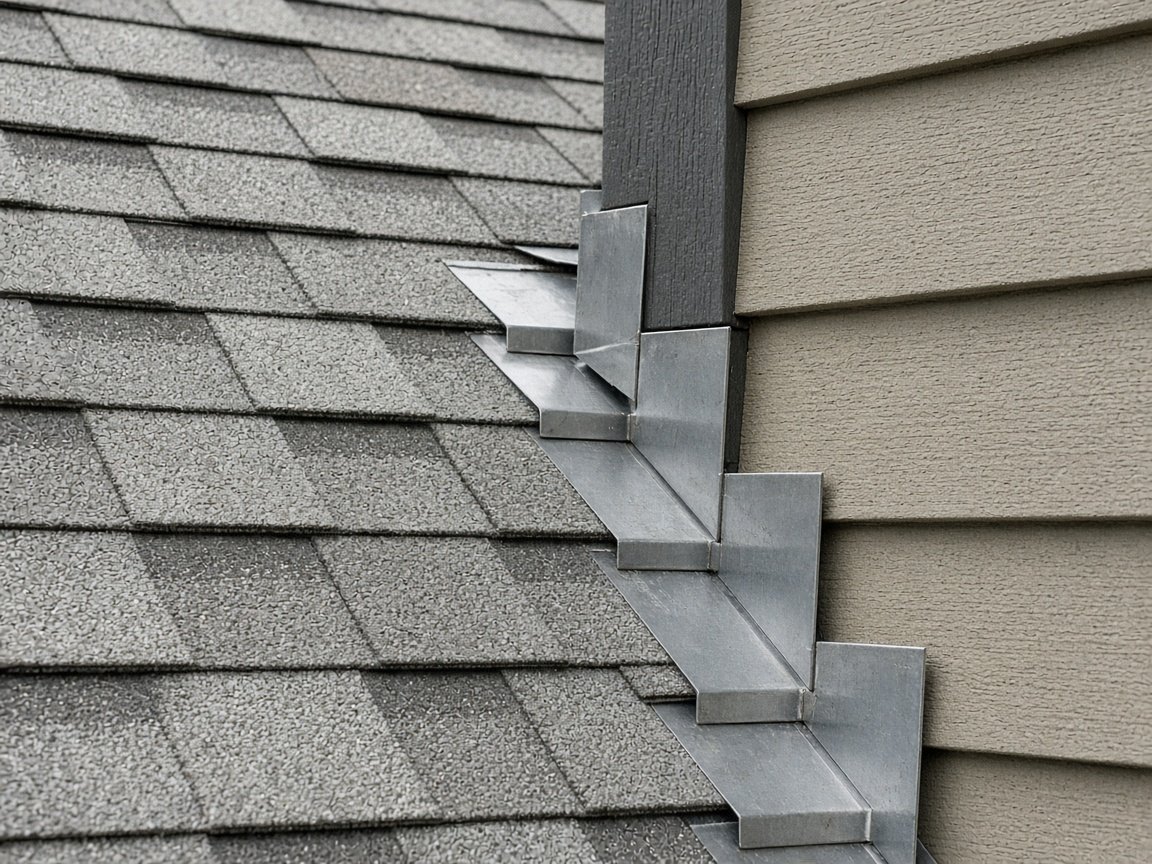
Because each piece overlaps the one below, water that gets past a shingle lands on metal and runs back onto the roof. RRSATX’s asphalt roofing page covers shingle roofs in San Antonio.
Continuous (apron) flashing at a front-facing wall
Where the roof slopes up into a wall head-on, a single continuous strip does the job.
ARMA describes this front-wall flashing as a continuous metal strip laid over the last course of shingles and bent up the wall. Like step flashing, it is not nailed to the wall. [1] You may see it where a lower roof meets the wall of a second story, or along the front of a dormer. The siding or a separate counterflashing covers its top edge.
Counterflashing: the cover over the base flashing
Counterflashing laps over the base flashing so water can’t get behind it.
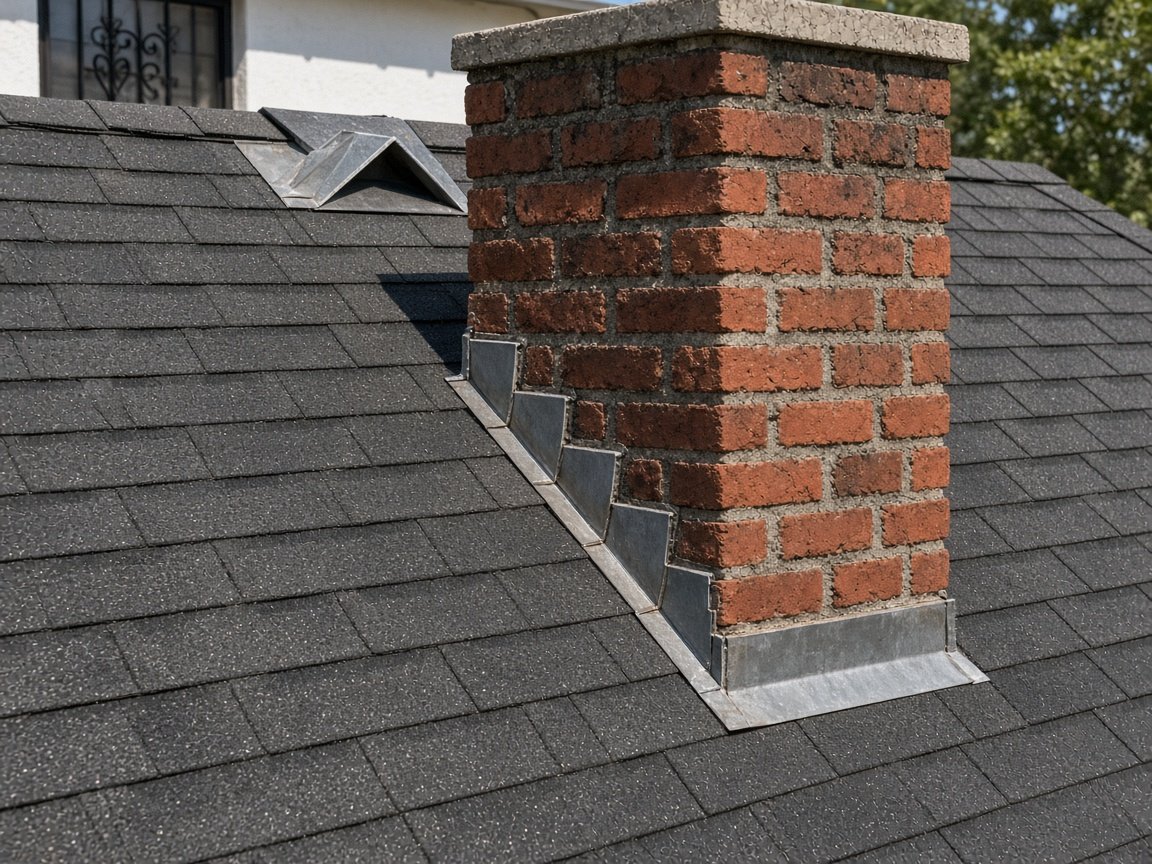
At sidewalls, the siding itself serves as the counterflashing over step flashing. At chimneys, ARMA explains that counter flashings secured to the masonry overlap apron flashings secured to the roof deck. If movement occurs, the counter flashing slides over the apron flashing without affecting water runoff. [1] That’s why the two pieces stay separate instead of one solid piece fastened to both the roof and the brick.
Chimney flashing and the cricket behind it
A chimney combines several roof flashing types in one spot: apron flashing at the base, step flashing along the sides, counterflashing in the masonry, and often a cricket at the back.
A cricket, also called a saddle, is a small peaked section on the upslope side of the chimney. ARMA notes it diverts water around the chimney. [1]
When code calls for a cricket
The IRC requires a cricket or saddle on the ridge side of any chimney or penetration more than 30 inches wide, measured perpendicular to the slope. The cricket must be covered with sheet metal or the same material as the roof covering. [2]
For chimney-specific problems, see our chimney flashing repair guide and roof repair for skylights and chimneys.
Valley flashing where roof planes meet
A valley collects water from the slopes on both sides, so it gets its own lining.
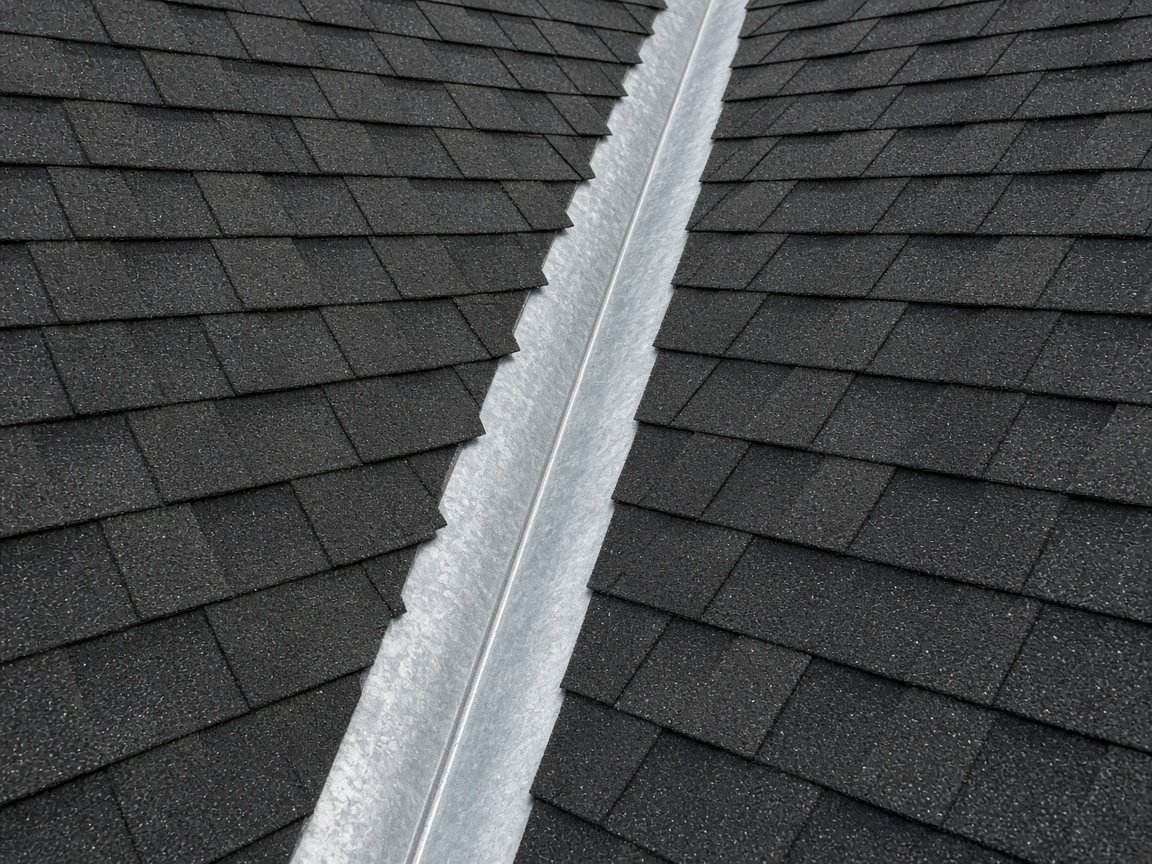
ARMA describes the common valley styles: open, where the metal lining stays exposed down the center; woven, where shingles from both sides interlace across the valley; and closed cut, where shingles from one side run across and the other side is trimmed along the centerline. [1]
The IRC says valley linings are installed per the manufacturer’s instructions before shingles go on, and open valleys may be lined with corrosion-resistant metal or with two plies of mineral-surfaced roll roofing. [2]
If you’re dealing with water at a valley, read what causes valley leaks and valley leaks: causes and damage.
Pipe boots around plumbing pipes
Every plumbing pipe that comes through the roof needs a collar that sheds water around it.
ARMA describes a preformed flashing flange, also called a boot, that fits snugly over a plumbing pipe and lies flat on the roof, with the upper and side shingles overlapping it. ARMA recommends inspecting boots once a year for cracks. [1]

In RRSATX’s experience, the rubber collar is a common place to find cracks on San Antonio roofs. A split collar can let water run straight down the pipe into the ceiling below.
Drip edge along the eaves and rakes
Drip edge is the flashing that finishes the roof’s outer edges.
The IRC requires drip edge at the eaves and rake edges of shingle roofs. [2] ARMA explains that it sheds water at the edges and protects the underlying wood from rotting, and that it should be corrosion resistant. [1]

Our guide to what a drip edge is covers styles and installation in more detail.
Skylight flashing
Skylights are flashed with kits made for the specific unit.
The IRC allows unit skylights flashed per the manufacturer’s instructions to be installed without a cricket. [2] In RRSATX’s experience, skylight flashing kits are product-specific, so the flashing should match the skylight model on your roof. See roof repair for skylights and chimneys for common problems.
Roof flashing types at a glance: where each goes and how it fails
Use this table to match a line item on your estimate or report to a spot on your roof.
| Flashing type | Where it goes | Common failure signs |
|---|---|---|
| Step flashing | Under each shingle course where a roof plane ends against a sidewall | Rust, pieces pushed out of place, stains on walls inside near the sidewall |
| Continuous (apron) flashing | Over the last shingle course and up a front-facing wall | Lifted or loose metal, caulk used in place of metal, ceiling stains below the wall |
| Counterflashing | Over base flashing, secured to the masonry or formed by the siding | Metal pulled out of mortar joints, cracked caulk, gaps at the top edge |
| Chimney flashing and cricket | Around the chimney, with a cricket on the upslope side | Rust, loose apron or counter flashing, stains on ceilings or walls near the chimney |
| Valley flashing | Lining the valley where roof planes meet | Rust or holes in exposed metal, ceiling stains below the valley |
| Pipe boot | Over each plumbing pipe, lapped by the shingles above and at the sides | Cracked boots, a gap around the pipe, stains on the ceiling below |
| Drip edge | Along the eaves and rake edges of shingle roofs | Bent or loose metal, rust, soft or stained wood at the roof edge |
| Diverter (kick-out) flashing | Where the eave of a sloped roof meets a vertical sidewall | Missing piece, stains or soft spots on the wall below |
Locations summarize ARMA’s manual and the IRC. Confirm current code requirements with the City of San Antonio Development Services Department and follow the roofing manufacturer’s instructions.
Flashing on tile and metal roofs
Tile and metal roofs need flashing in the same places, but the details are different.
Walls, chimneys, valleys, pipes and roof edges all still need protection on a clay, concrete tile or metal roof. The pieces are shaped for those materials, though. If you have a tile roof, ask for a crew that works on tile, and see RRSATX’s tile roof repair page. For other roof types, see our roof repair in San Antonio service.
When roof flashing needs attention
When a leak shows up near a wall, chimney, valley or pipe, flashing is a common place to check first.
Stains on a ceiling or wall close to one of those spots, rust you can see from the ground, or metal that looks lifted are all reasons to have the flashing checked. Caulk smeared where metal should be is another warning sign. The RRSATX guide to finding roof leaks fast can help you narrow down the source, and roof flashing repair explains how fixes are done. Our bad roof jobs guide shows flashing shortcuts to watch for.
Questions to ask about flashing on an estimate
Which flashing will be replaced and which will be reused? What material is the new flashing? Is there a cricket behind the chimney, and does it need one? Will you add diverter flashing where a roof edge meets a sidewall? Will I get photos of the flashing before it’s covered? RRSATX offers roof leak repair, a free roof inspection, and roof replacement in San Antonio.
Local roofing service
About Affordable Roofing Contractors San Antonio
Affordable Roofing Contractors San Antonio, also known as RRSATX, provides roof leak repair, roof repair, roof inspections, roof replacement, and asphalt, metal, and tile roofing in San Antonio. When you call, tell us where you’ve seen stains or rust and whether it’s near a wall, chimney, valley or pipe. Photos taken from the ground help.
- Phone
- (713) 504-2341
- sales@affordableroofingcontractorssanantonio.com
- Address
- 4324 Monterey St, San Antonio, TX 78237
- Contact
- Request a free roof inspection
Roof flashing types: questions answered
What is the difference between step flashing and counterflashing?
Step flashing sits under the shingles along a sidewall. Counterflashing laps over it from above, either as the siding itself or as metal secured to masonry at a chimney. [1]
Is drip edge a type of flashing?
Yes. It’s edge flashing that sheds water at the eaves and rakes and protects the wood beneath, and the IRC requires it on shingle roofs. [1] [2]
Does every chimney need a cricket?
The IRC requires one on wider chimneys and penetrations, as explained in the callout above. [2] On narrower chimneys, ask your roofer whether a cricket would help water get around it.
Can flashing be reused during a reroof?
Sometimes, depending on its condition and the new roofing. It’s a good question to ask before you sign, so you know which flashing is being replaced and which is staying.
Is caulk a substitute for flashing?
No. Caulk can seal small joints, but it doesn’t replace metal that laps water away from a wall or opening. Heavy caulk where flashing should be is a sign to have the spot checked.
What should I send RRSATX before an inspection?
Send the property address, photos of any stains inside, photos of the roof from the ground, and where you think the water is coming in. Call (713) 504-2341 or use the contact page.
Explore the roofing topic
More help with flashing and roof edges
Get your roof flashing checked
Ask RRSATX for a free roof inspection and written findings for your San Antonio roof.