

A spring hailstorm moves across Bexar County, and by the next morning you're looking at dented gutters, scattered granules, or a ceiling stain that wasn't there before. You call a roofer, hear the words “insurance claim,” and start wondering whether your policy will pay for a full roof replacement.
The honest answer depends on evidence and policy language. A roof replacement insurance claim isn't a request for a new roof after bad weather. It's a property-loss claim that must connect a covered event to specific damage, then account for deductibles, depreciation, coverage limits, and the work needed.
Table of Contents
- What Insurers Actually Look For in a Roof Claim
- Documenting Storm Damage Before You File
- Understanding Your Policy Before You Sign Anything
- Working With Your Insurance Adjuster
- Common Claim Pitfalls and How to Avoid Them
- Getting Local Support and Next Steps for Your Roof
What Insurers Actually Look For in a Roof Claim
After a hailstorm in San Antonio, homeowners often notice the obvious signs first. Gutters may show round dents, patio furniture may be damaged, and shingles may appear darker or rougher from the ground. Those observations matter, but they don't automatically establish that the insurer owes for an entire replacement.
An adjuster usually has to answer three practical questions:
- Did a covered event occur? The claim needs a clear connection to wind, hail, or another covered cause during the policy period.
- What damage did that event cause? The inspection must separate fresh storm impacts from age, heat exposure, poor maintenance, and earlier deterioration.
- What work is necessary? The payable scope may involve repairs, partial replacement, or a broader roof-system replacement, depending on the policy and the documented condition.
San Antonio roofs face a demanding mix of extreme Texas heat, heavy rain, strong wind, and recurring hailstorms. A roof can have both storm damage and ordinary wear at the same time. That's why a contractor's recommendation alone doesn't decide the claim.
Practical rule: Treat the claim as an evidence file, not as a conversation about whether you “deserve” a new roof.
Wind and hail losses are common enough that homeowners shouldn't treat them as unusual events. About 1 in 36 insured homes has a property-damage claim related to wind or hail in a typical year, and the United States recorded 203 inflation-adjusted billion-dollar severe-storm disasters from 1980 through 2024, including hail outbreaks capable of damaging roofs across entire metropolitan areas, according to NOAA's severe-storm disaster records. Those figures explain why insurers use structured inspections and documentation rather than approving every post-storm replacement request.
The same evidence-first mindset applies to other property losses. Homeowners dealing with fallen branches or damaged landscaping may find the guidance on filing a tree damage claim in NSW useful for understanding how photographs, cause, and repair records support an insurance file. The policy rules differ, but the documentation principle is similar.
Documenting Storm Damage Before You File
Start from the ground. Don't climb onto a roof after a storm, especially when shingles may be loose, surfaces may be wet, or hidden structural damage may be present. A storm-damaged roof can be unsafe even when it looks stable from the driveway.
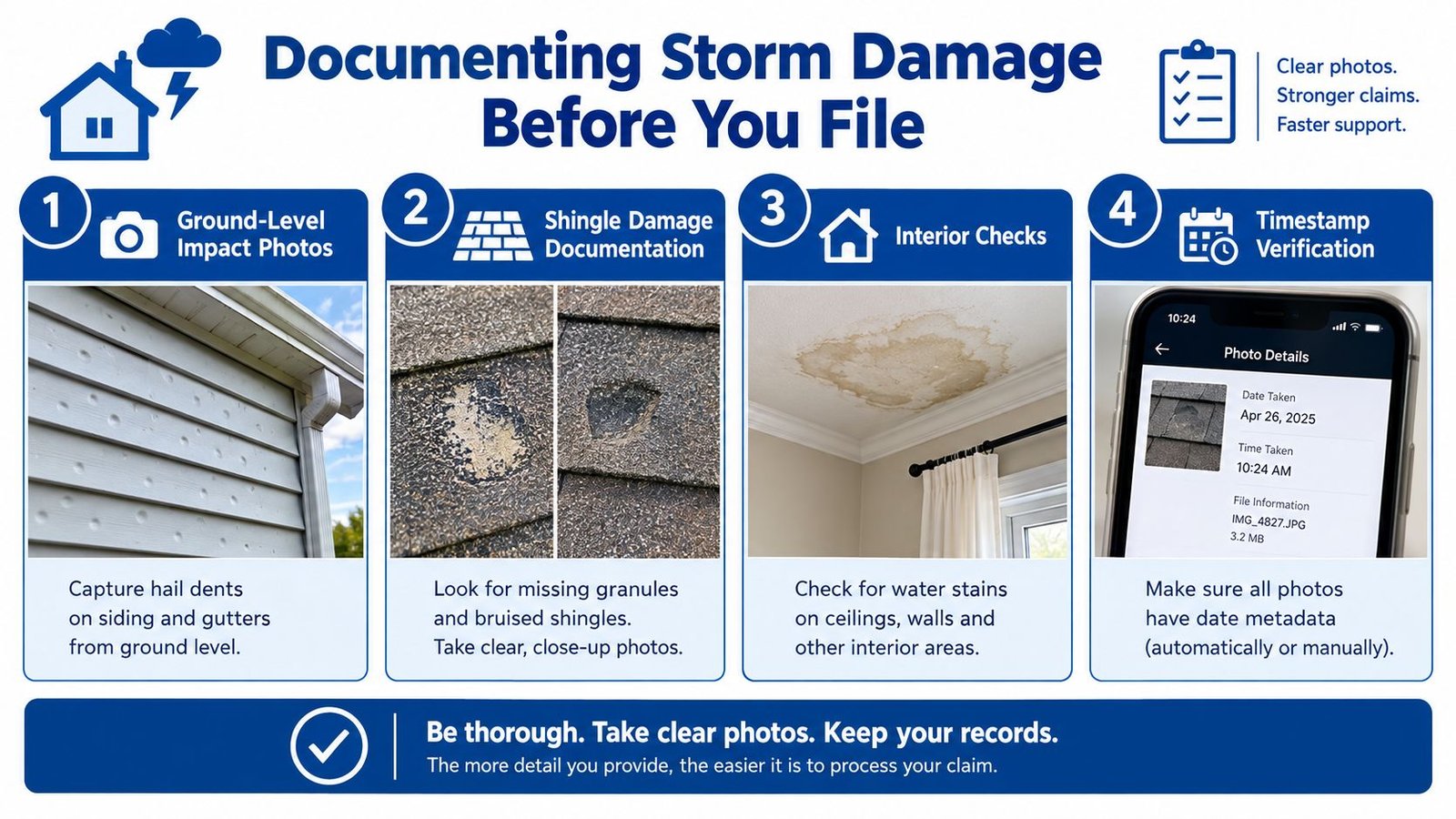
Use your phone to record what you can safely see, then preserve the original files. Avoid editing the images before sending them to your insurer or contractor.
Capture the visible evidence
Walk around the property and photograph the roofline, gutters, downspouts, siding, window screens, vents, fences, and outdoor equipment. Focus on details that show impact or wind movement, such as:
- Hail marks: Photograph dents on soft metal gutters, vents, flashing, and siding from several angles.
- Shingle changes: Record missing shingles, lifted tabs, exposed underlayment, and areas where protective granules have collected.
- Water entry: Photograph ceiling stains, damp drywall, damaged insulation, and any active interior leak.
- Property context: Take wider images showing which roof slope or elevation contains the reported damage.
A dated storm record can help establish timing. Keep the date of the weather event, the date you first noticed damage, and the date of any temporary repair in one place. Evidence that links the loss to a covered event, including dated storm information, photographs, interior-leak records, and an inspection that distinguishes storm damage from pre-existing wear, affects the payable amount, as explained by the National Association of Insurance Commissioners' homeowners guidance.
Turn observations into a professional report
A professional inspection should do more than state that the roof is damaged. It should identify affected slopes and components, record measurements, describe the observed conditions, and explain whether the findings are consistent with hail or wind.
Look for a report that distinguishes storm impacts from age-related wear. For example, bruising on shingles, displaced materials, dented metal, and related interior leakage should be described separately from brittle surfaces, long-term granule loss, failed sealant, or deferred maintenance. That separation gives the adjuster something concrete to evaluate.
You can also review a broader overview of how homeowners file a Miami homeowners insurance claim, but don't apply another state's deadlines or policy rules to Texas. For San Antonio homeowners, the useful part is the discipline of keeping photographs, notices, receipts, and inspection findings together.
A free professional inspection can help identify whether you're looking at a repair, a replacement candidate, or conditions that may not exceed your deductible. You shouldn't sign a replacement contract because a salesperson says the roof has hail damage. No contractor can promise an insurer's decision, and homeowners should never walk a damaged roof themselves.
For more visual guidance on common signs, see how to tell if a roof has hail damage. The most useful next step is a safe inspection that creates a clear record, not a rushed conclusion.
Understanding Your Policy Before You Sign Anything
The declarations page often determines whether an approved claim provides meaningful replacement funds or only a limited initial payment. Before signing a roofing contract, locate the sections describing loss settlement, roof coverage, deductible, and the dwelling coverage limit.
Three policy details deserve close attention:
- Coverage type: Does the policy use replacement cost value, actual cash value, or different treatment for specific roof materials?
- Deductible structure: Is the wind-and-hail deductible a fixed amount or a percentage of the dwelling limit?
- Settlement conditions: Does the policy release recoverable depreciation only after eligible work is completed and documented?
RCV and ACV in plain terms
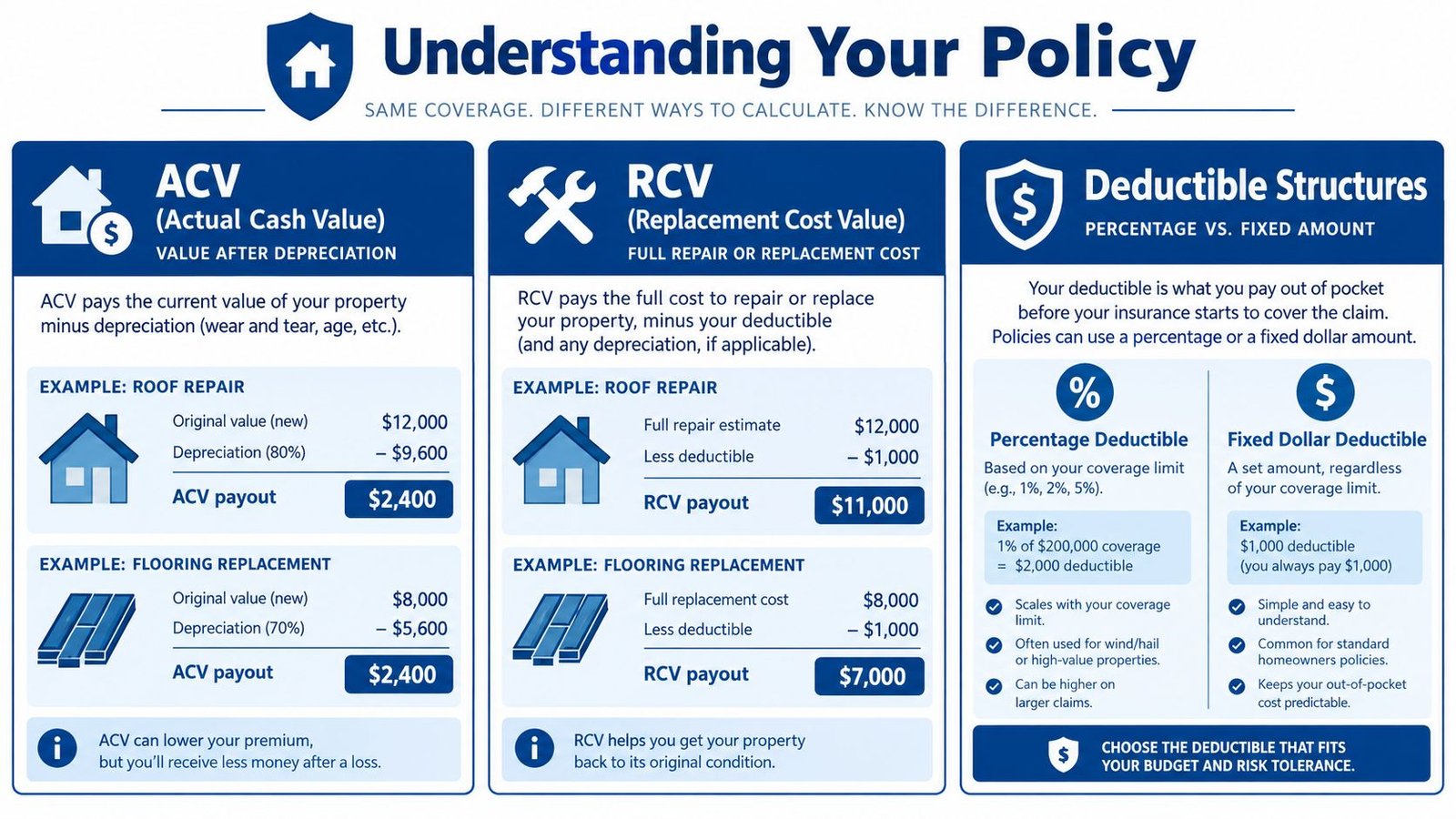
Replacement cost value, or RCV, generally addresses the cost to repair or replace covered damage with materials of like kind and quality, without subtracting depreciation from the covered replacement amount. The deductible still applies, and the policy's limits and conditions still control.
Actual cash value, or ACV, subtracts depreciation based on age, condition, and expected useful life before the deductible is applied. The difference can be substantial. The NAIC explanation of replacement cost and actual cash value gives an example with $15,000 in roof damage, $10,000 in depreciation, and a $1,000 deductible, resulting in a $4,000 ACV payment.
| Settlement Factor | Replacement Cost Value | Actual Cash Value |
|---|---|---|
| Covered roof work | Based on eligible repair or replacement cost | Based on eligible repair or replacement cost |
| Depreciation | Generally not deducted from the replacement-cost settlement, subject to policy terms | Deducted before the payment is calculated |
| Deductible | Still applies | Still applies |
| Practical result | May provide additional funds after qualifying work is completed | May leave the homeowner responsible for a larger share of replacement work |
Texas wind-and-hail deductibles can create another surprise. The Texas Department of Insurance identifies 2% as a common wind-or-hail deductible and 1% as a common deductible for other damage. A percentage deductible is based on the applicable dwelling coverage limit, not the roofer's invoice. With a $300,000 dwelling limit and a 2% wind-and-hail deductible, the deductible is $6,000, as described in Texas consumer insurance guidance.
That calculation changes the decision about whether to file. A documented loss may still be real, but if the covered scope falls near or below the deductible, the claim may not produce a payment. Ask your agent to explain the declarations page before you commit to replacement work.
Compare the estimate with the policy
A contractor's estimate describes the work needed from the roofing side. The insurer's estimate describes what the carrier believes is covered and payable under the policy. Those documents may differ because they use different assumptions about damage, materials, depreciation, code requirements, or repair feasibility.
Read both carefully. Confirm whether the insurer's figure reflects ACV or RCV, whether depreciation is recoverable, and whether the deductible has already been applied. Don't assume that an approved claim means the insurer will fund every line of a full replacement.
Working With Your Insurance Adjuster
The adjuster's inspection is a fact-gathering appointment. Texas consumer guidance explains that the insurer sends an adjuster to inspect the property and estimate the cost to repair or replace it. The initial payment may subtract both the deductible and depreciation, depending on the policy and the settlement method. For that reason, have your records ready before the adjuster arrives.

Prepare for the walkthrough
Keep the following available in a folder, whether printed or digital:
- Storm information: The reported storm date, weather records, and the date you noticed damage.
- Property photographs: Original images of exterior impacts, interior leaks, and any temporary protection.
- Maintenance history: Prior repairs, inspections, invoices, and information about known pre-existing conditions.
- Roofing report: Measurements, photographs, affected components, and a clear distinction between storm damage and wear.
- Questions for the adjuster: Ask how the carrier will handle depreciation, the deductible, code-related work, and any disputed areas.
A roofing contractor can attend the walkthrough when the insurer permits it. The contractor's role should be to point out documented conditions and explain the proposed scope, not to pressure the adjuster or argue that every old defect came from the storm. Calm, specific evidence usually carries more weight than a broad demand for full replacement.
You may find it helpful to watch this overview before the appointment:
Request the decision in writing
After the inspection, request the insurer's written coverage position and a copy of the estimate. You should also ask for the applied deductible, depreciation calculation, and the specific policy provisions supporting any excluded or omitted work.
That paperwork tells you what kind of problem you have. If the carrier agrees that covered damage exists but leaves out a documented component, you may need a supplemental review. If the carrier says the condition is wear, the issue is coverage and causation. If the calculated amount is below the deductible, the issue may be whether additional covered damage can be documented and whether further action makes financial sense.
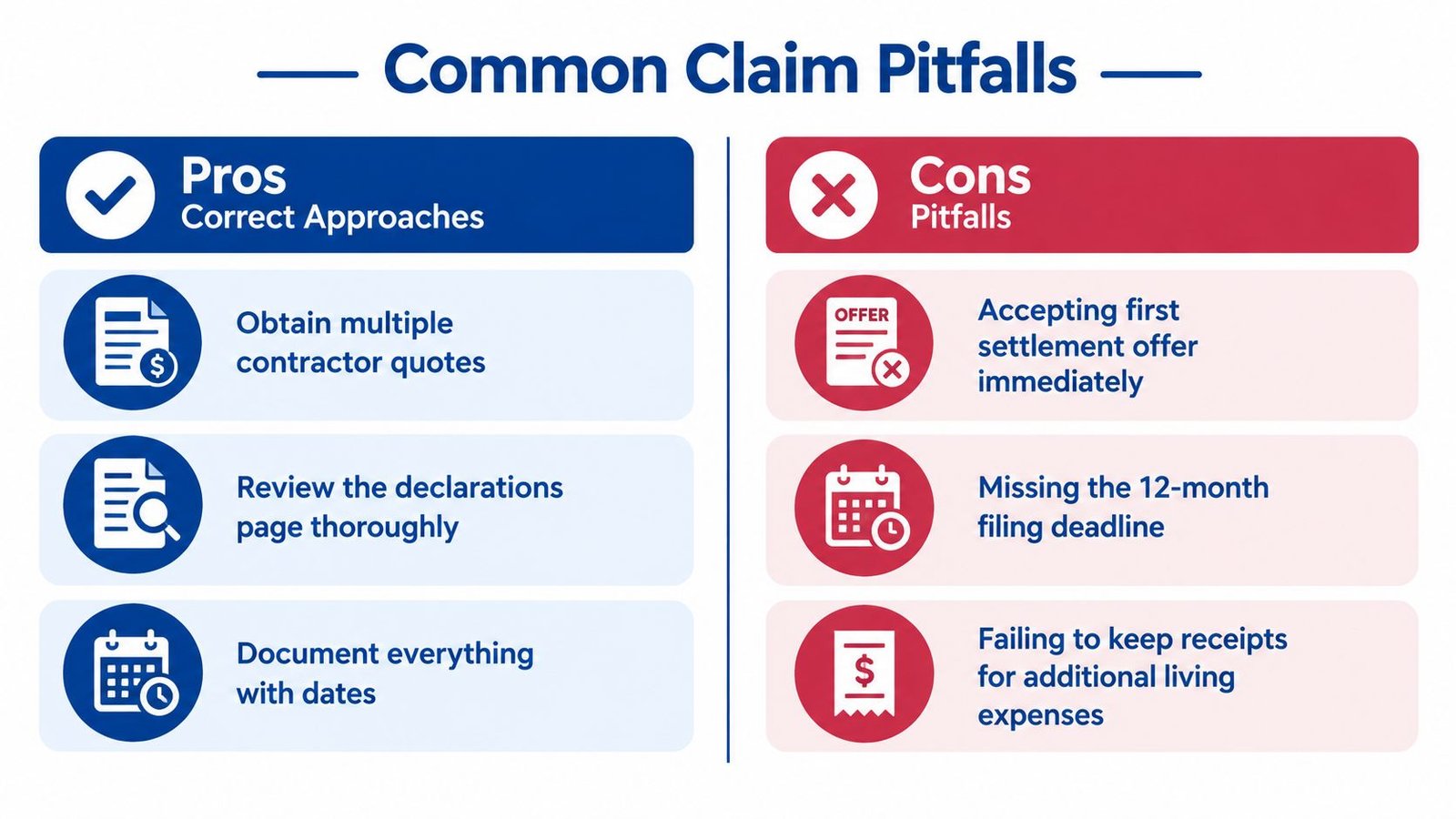
For policies issued through the Texas Windstorm Insurance Association, Texas consumer guidance says the claim must be filed within one year from the date of damage, as explained by the Texas Department of Insurance claim guidance. Other policies may have their own reporting requirements, so check your policy and contact the insurer promptly.
No roofer, adjuster, or article can promise approval. The strongest approach is a timely claim supported by accurate observations, professional documentation, and a clear understanding of what the policy covers.
Common Claim Pitfalls and How to Avoid Them
The phrase “denied claim” gets used too loosely after hailstorms. A file closed without payment may reflect damage below the deductible, an excluded cause such as flood, an incomplete record, or a policyholder who withdrew the claim. Those situations require different responses.
Start by requesting the carrier's written explanation. Ask for the coverage position, estimate, deductible calculation, depreciation calculation, and relevant policy language. If the damage is below the deductible, more arguing won't create coverage. If documentation is incomplete, additional evidence or a reinspection may be appropriate. If the insurer excluded the loss, you need to understand the cited provision before deciding whether to dispute it.
A claim with no payment is a status. It isn't, by itself, an explanation.
Industry commentary reported that insurers closed 7.35 million homeowners claims with payment in 2024, while cautioning that “closed without payment” doesn't equal “denied.” The same discussion reported that non-recoverable depreciation rose to nearly 20% of roofing-claim assignments in 2025, according to Verisk, as summarized in this Texas hail damage insurance resource. That distinction matters because depreciation can affect the result even when storm damage is accepted.
Matching isn't automatic
A common assumption is that an insurer must replace the entire roof if new shingles won't match the old ones. Texas generally doesn't require replacement of undamaged roofing solely to create a visual match. Recovery may depend on the policy's loss-settlement language, matching provisions, material availability, manufacturer limitations, and applicable building requirements.
Document the issue instead of promising an outcome. Identify the existing product if possible, record discontinued or unavailable materials, describe visible profile or color differences, and ask whether repair is technically feasible. Then compare that information with the policy language.
Appraisal has a narrow purpose
Appraisal can address the amount of a covered loss. It doesn't automatically decide whether the policy covers the damage, whether the damage came from hail, or whether undamaged areas must be replaced for appearance.
That's why homeowners should identify the dispute before choosing an escalation path. A scope disagreement may call for a reinspection or supplemental documentation. A coverage dispute requires analysis of the policy and cause of loss. An appraisal process may be relevant to the amount, but it isn't a universal appeal of every coverage decision.
Getting Local Support and Next Steps for Your Roof
A well-managed claim follows a simple order: protect people first, document the visible condition, inspect the roof professionally, review the policy, meet with the adjuster, and approve work only after the scope and payment terms are clear.
Local conditions affect the inspection and the repair plan. In San Antonio, roofing assemblies must handle intense heat, sudden heavy rain, wind-driven water, and hail exposure. A report should consider more than the field shingles. Flashing, vents, gutters, ventilation, underlayment, tile, metal panels, and low-slope details can all affect how the system performs.
For homeowners who want one contractor involved from inspection through installation, RRSATX is a father-son-owned San Antonio roofing company with $2,000,000 in liability insurance. Its services include free roof inspections, roof repair, roof replacement, storm-damage support, asphalt shingle roofing, metal roofing, tile roofing, flat roofing, gutter work, and commercial roofing. The company provides written estimates before work begins and offers on-site oversight from an owner who is a licensed contractor with 40 years of experience.
That support doesn't replace the insurer's decision. It can help keep the technical record organized, provide photographs and measurements, coordinate an adjuster walkthrough, and identify whether a repair or replacement is appropriate. For an active leak, temporary protection may be needed before the claim scope is settled. Keep every receipt and photograph connected to that work.
A realistic timeline starts with the storm and safe documentation, followed by a professional inspection and policy review. The adjuster then evaluates the property, the carrier issues its position and estimate, and the homeowner decides whether the evidence supports repair, supplemental review, or replacement. Work should begin after the scope, deductible responsibility, and written estimate are understood.
Call 713-504-2341 to discuss your San Antonio roof damage and arrange a free inspection with written findings. Visit RRSATX to schedule online, and bring your storm photographs, policy documents, and adjuster paperwork so the inspection starts with a clear record.