
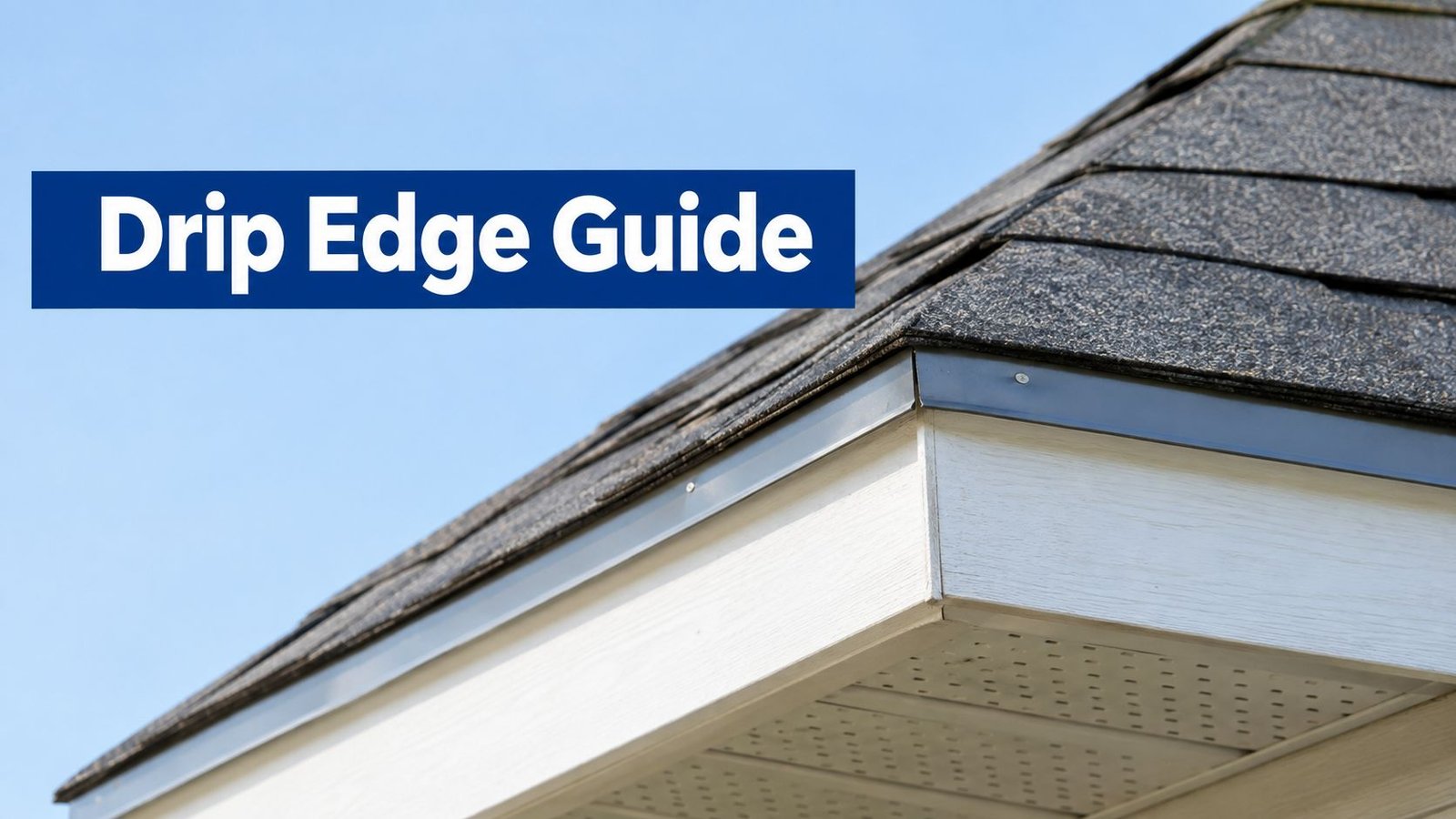
After a hard San Antonio rain, you may notice a brown streak on the fascia, a damp soffit, or water dripping behind the gutter. A recent hailstorm can make the problem harder to spot because damaged shingles draw attention away from the roof edge. Yet that narrow line of metal along the eaves and rakes may decide whether runoff falls into the gutter or works its way behind the roof assembly.
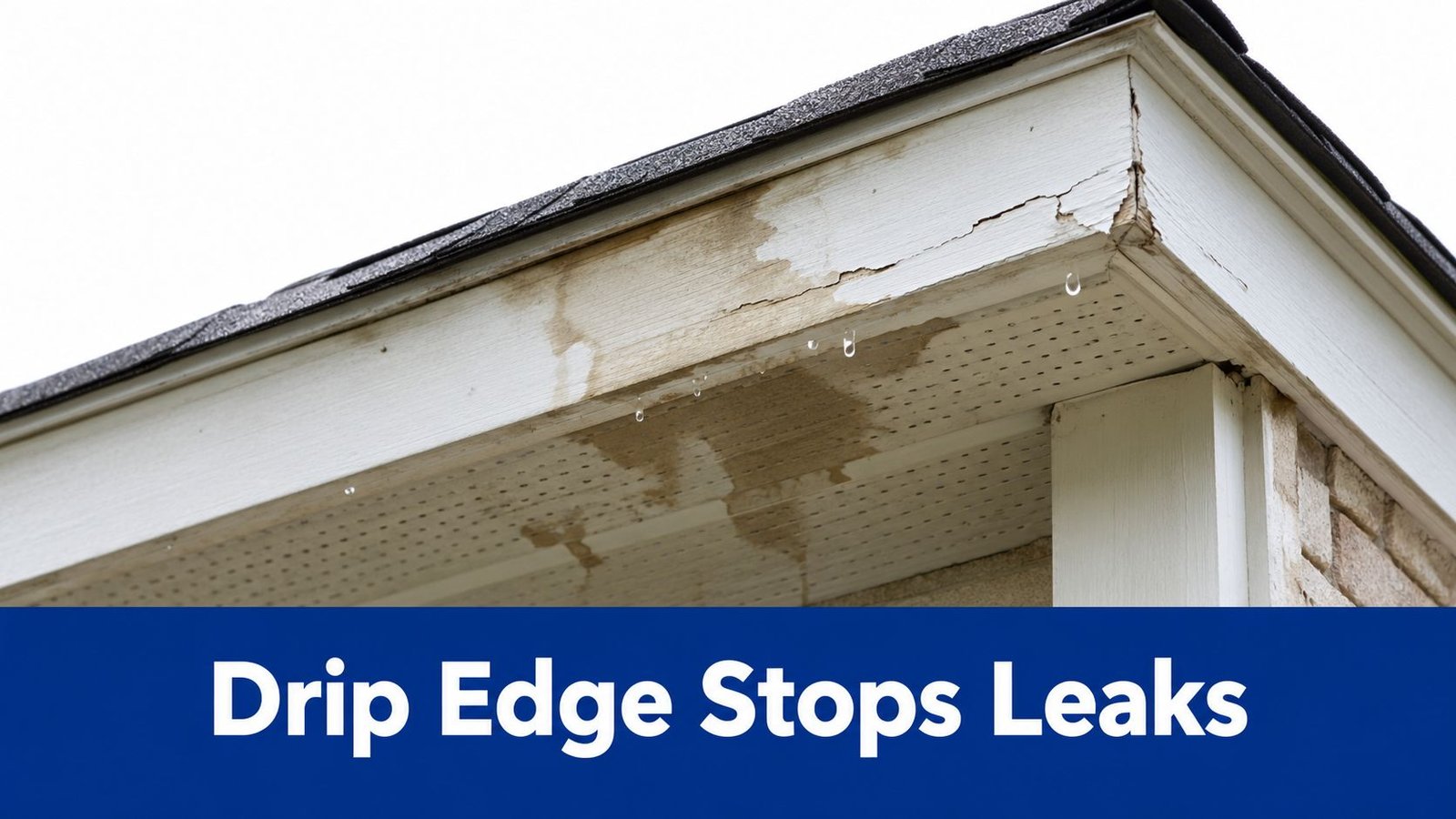
A roof shingle drip edge is easy to overlook from the driveway. It sits beneath or beside other roofing layers, but it has a direct job: guide water outward, protect the edge of the roof deck and fascia, and help shingles shed water during heavy rain and wind. In San Antonio, extreme heat, sudden storms, and wind-driven rainfall give small installation mistakes plenty of chances to become moisture problems.
You don't need to climb onto your roof to understand the basics. You can learn where drip edge belongs, what a sound installation should accomplish, and which ground-level warning signs deserve a professional inspection. Because roof work is hazardous, don't climb onto the roof or rely on a ladder inspection unless you're trained and properly equipped.
Table of Contents
- Introduction Why Roof Edges Leak First in San Antonio
- What a Roof Shingle Drip Edge Is and How It Works
- Why Drip Edge Matters for Water Damage and Roof Life
- Eave Versus Rake and Choosing the Right Material
- How Drip Edge Should Be Installed to Meet Code
- Common Misconceptions That Leave San Antonio Roofs Exposed
- Protecting Your Roof System and Next Steps With RRSATX
Introduction Why Roof Edges Leak First in San Antonio
Roof-edge leaks often show up in places that seem unrelated to the roof. A homeowner may find peeling paint on the fascia, a stain under the eave, or moisture near the soffit after a storm. Water can travel along the edge before it appears indoors, so the visible mark isn't always directly below the damaged shingle.
The roof edge takes repeated punishment. Rain runs down every shingle course, wind pushes water sideways, and intense Texas sunlight dries materials after the storm. When the edge detail doesn't move water cleanly away from the wood, moisture can cling to the shingle edge and reach the fascia or roof decking.
Practical rule: A stain at the fascia deserves attention even when the shingles above look intact.
San Antonio homes also face quick changes in weather. A quiet morning can turn into a heavy downpour, and hail can bruise shingles or bend exposed flashing. The drip edge won't solve every roofing problem, but it forms an important part of the path that carries water from the roof covering to the gutter or ground.
This guide focuses on that path. You'll see how the metal is shaped, why eave and rake installation differ, how code measurements define a proper installation, and what you can check safely from the ground. You'll also learn why caulk, paint, or a visible shingle overhang can't substitute for correctly placed metal.
The goal is simple. When you speak with a roofer about a leak, replacement, or storm damage, you'll know what questions to ask and what the answers mean. A careful inspection can identify whether the edge metal is missing, short, loose, corroded, or directing water behind the gutter.
What a Roof Shingle Drip Edge Is and How It Works
Think of the drip edge as a small metal water slide at the border of the roof. Water reaches the edge, meets the metal's outward bend, and gets directed away from the fascia instead of following the underside of the shingles back toward the wood.
Most residential drip edge has an L-shaped profile. One flange lies on the roof deck, while the vertical leg extends down at the perimeter. The metal runs along the eaves, the lower horizontal roof edges, and the rakes, the sloped edges beside a gable. It works alongside shingles, underlayment, fascia, and gutters rather than replacing any of them.
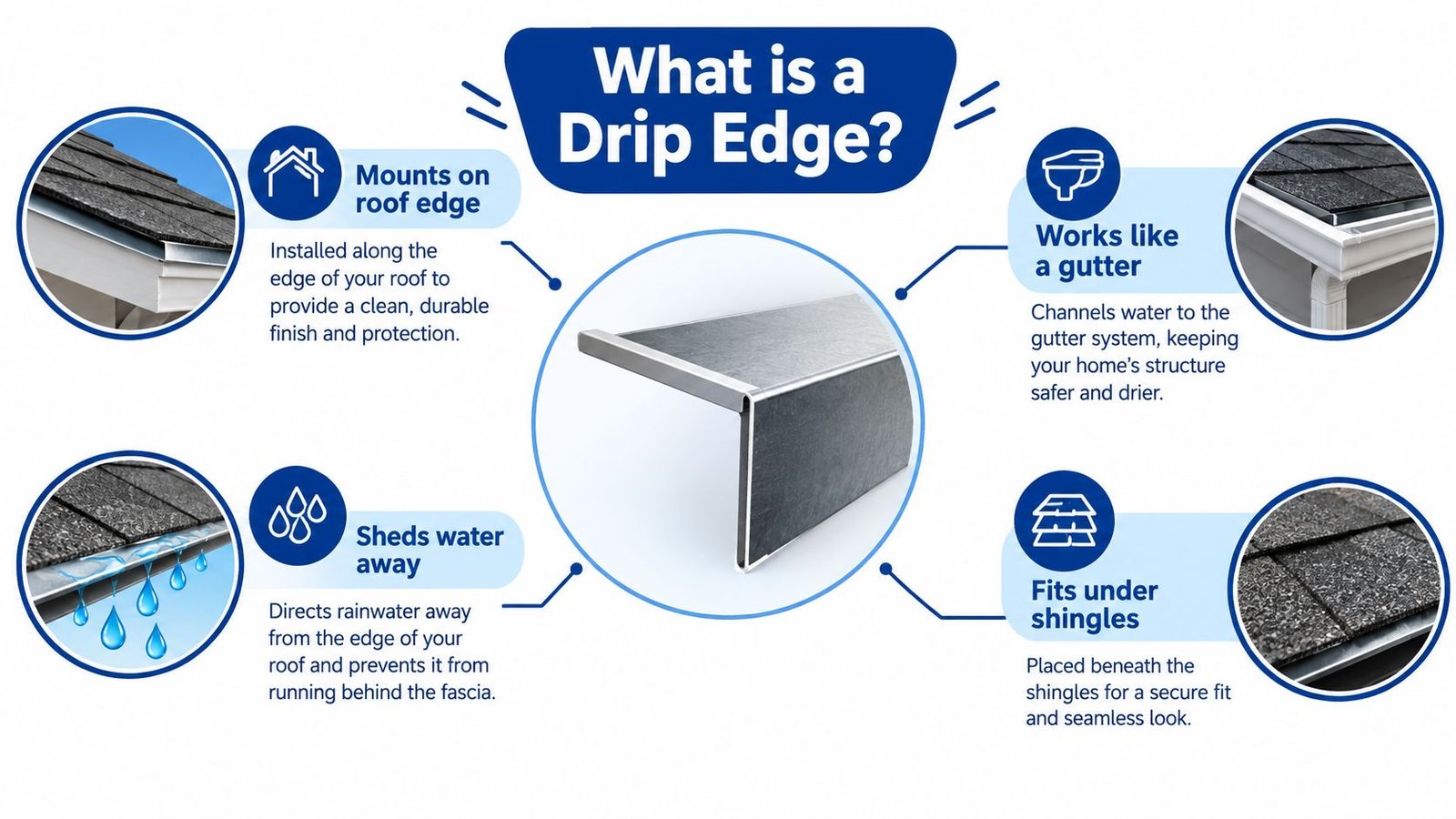
The water path at the roof edge
A shingle roof is designed to shed water in layers. Shingles cover the underlayment, the underlayment covers the deck, and the edge flashing gives runoff a controlled exit. If water gets beneath a shingle, the underlayment should guide it downward until it reaches metal that carries it beyond the roof edge.
Two forces make this detail necessary. Wind-driven rain can move sideways beneath an overhang, while capillary action lets water cling to narrow gaps and surfaces. Instead of dropping straight down, a thin film of water can follow the underside of a shingle or the face of a board. The drip edge creates a break and a projecting path, making it harder for water to turn inward.
Underlayment selection also affects the roof's moisture-management layers. Homeowners comparing felt vs synthetic underlayment can use that resource to understand how these materials differ, while remembering that neither one replaces correctly installed edge flashing.
Drip edge is more than decorative trim
Paint color may help the roofline look finished, but appearance isn't the primary purpose. Drip edge protects vulnerable edges and helps connect the shingle surface to the drainage system. It isn't the same as valley flashing, step flashing, or wall flashing, because those components protect different roof transitions.
For asphalt shingle roofs, code-based guidance calls for drip edge at eaves and rake or gable edges. The flashing should extend at least 2 inches onto the roof deck, project at least 1/4 inch below the sheathing, and use joints lapped at least 2 inches. Building America Solution Center guidance on roof-edge protection also explains the different underlayment relationship at eaves and rakes.
That combination of placement and geometry turns a thin strip of metal into a standardized water-management component. It doesn't just hide the edge. It helps determine where stormwater goes.
Why Drip Edge Matters for Water Damage and Roof Life
A missing or poorly installed drip edge can create a slow moisture route at the exact place where several materials meet. The shingle, underlayment, deck, fascia, and gutter must work together. If the edge metal doesn't bridge those materials correctly, water can move behind the gutter or into the deck edge.
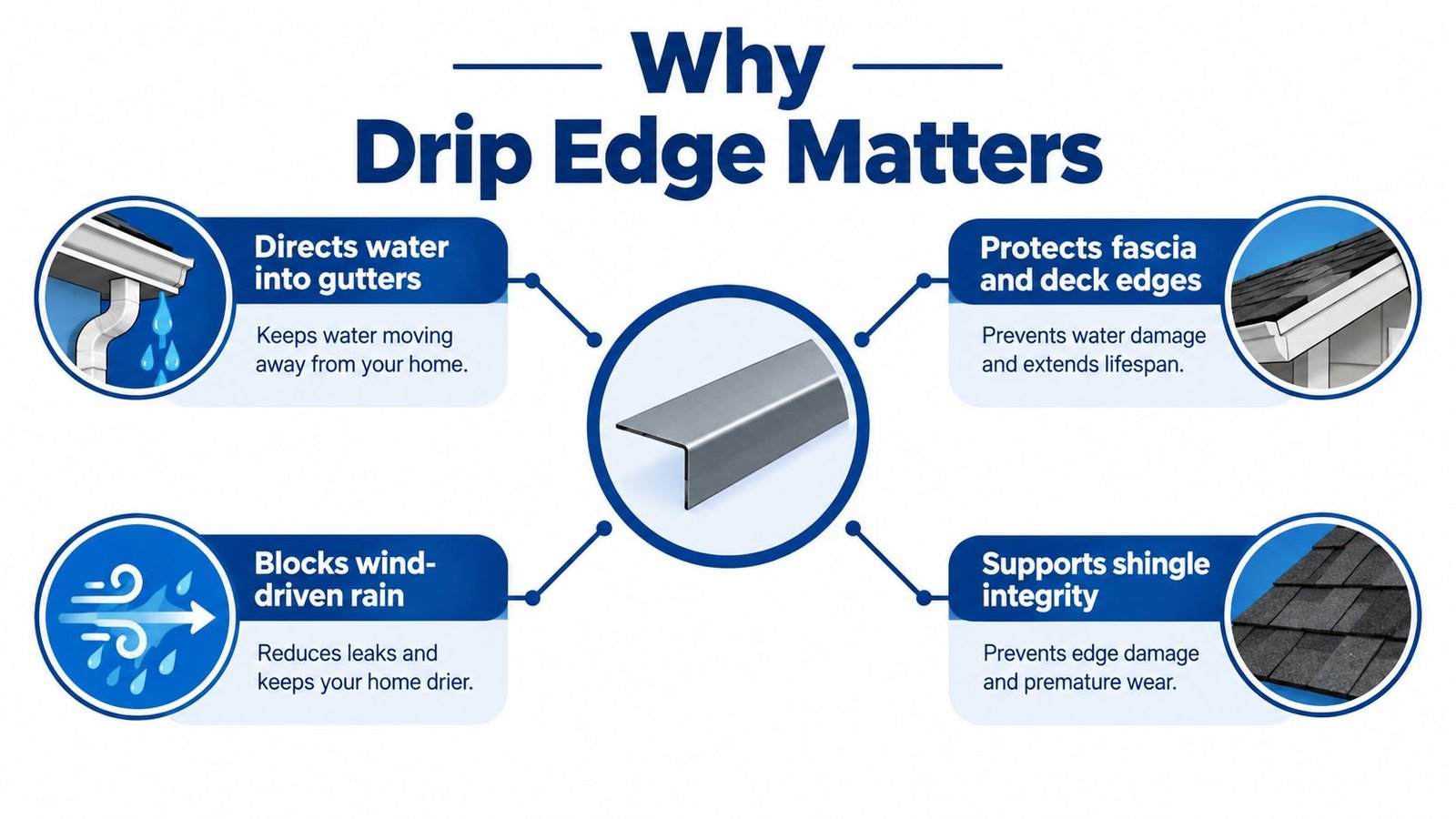
Four jobs performed by the edge detail
It directs runoff. The metal lip helps carry water toward the gutter rather than allowing it to track behind the gutter and wet the fascia. A gutter can be clean and properly pitched, yet still perform poorly if the roof edge sends water to the wrong side.
It protects the fascia and deck edge. The fascia and exposed sheathing edge contain wood or wood-based materials that don't benefit from repeated wetting. Staining, peeling paint, swelling, and soft spots can indicate that water isn't leaving the roof cleanly.
It resists wind-driven intrusion. During a San Antonio storm, rain may strike the roof edge from an angle. Properly positioned flashing gives that water a defined outward route and reduces the openings available beneath the roof covering.
It supports the shingle edge. Shingles need a stable edge relationship with the metal beneath them. If the overhang is too short, runoff may land behind the flashing. If it is poorly supported or exposed to movement, the edge can flutter or curl.
Water management starts at the roof surface, but it ends only when runoff clears the vulnerable wood and enters the intended drainage path.
What failure looks like
A homeowner might first notice a dark fascia mark after a heavy rain. Later, the soffit may show staining, or the gutter may begin pulling away because the wood behind its fasteners has weakened. At the roof edge, moisture can also contribute to shingle curling or lifting, especially when repeated wetting meets strong South Texas heat.
Hail adds another complication. A storm can damage shingles and edge metal at the same time, while wind may loosen a section that previously sat flat. If water begins reaching the deck edge, a small visible defect can become a broader repair area.
Roof drainage also extends beyond the roof itself. If you're evaluating how runoff moves around a property, this guidance on how to choose drainage systems for properties provides useful context for the larger water-management picture.
A roof edge shouldn't be judged in isolation. Gutters, downspouts, underlayment, shingles, fascia, and nearby ground drainage all influence where water ends up. For related underlayment protection at vulnerable roof areas, see this guide to ice and water shield.
Eave Versus Rake and Choosing the Right Material
The most common placement mistake comes from treating every roof edge the same. Eaves and rakes shed water in different directions, so the flashing and underlayment must be layered accordingly.
At the eave, the drip edge goes on the roof deck before the underlayment. The underlayment then covers the upper flange and directs water onto the metal. At the rake, the underlayment is installed first and the drip edge goes over it. That outside layer helps protect the underlayment from wind-driven rain moving across the sloped edge.
A practical comparison
| Location / Material | Placement Rule | Best Use Case |
|---|---|---|
| Eave / galvanized steel | Install on the deck before underlayment | Rigid edge protection where the roof assembly needs a durable metal base |
| Eave / aluminum | Install on the deck before underlayment | Lightweight corrosion-resistant edge flashing for many residential applications |
| Rake / galvanized steel | Install over underlayment | Firm protection along sloped gable edges |
| Rake / aluminum | Install over underlayment | Lightweight edge coverage with corrosion resistance |
| Eave or rake / copper | Match the roof design and adjacent metals | Projects where copper's appearance and material compatibility are part of the specification |
The material should be corrosion-resistant. Approved options include galvanized steel, aluminum, copper, or an equivalent material accepted for the roof system. The National Roofing Contractors Association material guidance identifies a vertical leg at least 1 1/2 inches wide as a concrete requirement.
Matching material to the roof
Galvanized steel offers rigidity and can hold its shape well. Aluminum is lightweight and resists corrosion, but installers must avoid rough handling that can bend the metal. Copper is durable and visually distinctive, though it should be considered with the surrounding metals and the roof's design.
No single material automatically fits every San Antonio home. The roofer should consider the gutter connection, roof edge condition, existing metals, exposure, and the specific shingle system. A material that looks suitable in a bundle may still be the wrong choice if it creates an incompatible transition at the gutter or rake corner.
How Drip Edge Should Be Installed to Meet Code
A sound installation follows a sequence. The crew prepares the edge, places the metal in the correct layer, secures the joints, and then installs the shingles so water meets a continuous shedding surface.
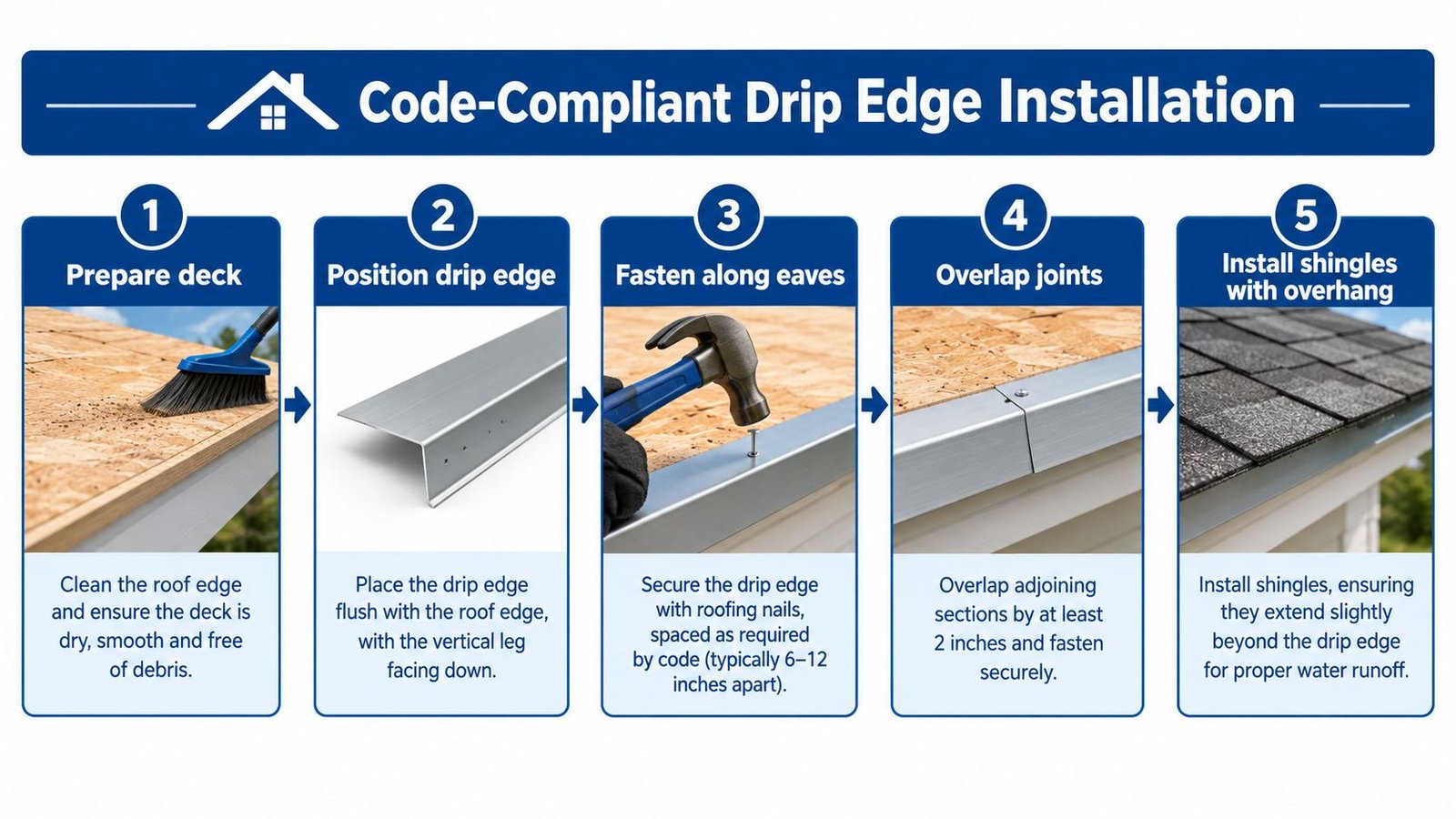
Start with the roof deck
The roof edge should be sound before new flashing covers it. During a replacement, the roofer removes the old roof layers as needed and checks the deck edge for deterioration. Damaged wood may need repair before the metal can provide reliable support.
The flashing should extend at least 2 inches back onto the roof deck and at least 1/4 inch below the roof sheathing. That geometry gives water a surface to follow while shielding the exposed edge.
At eaves, the metal goes beneath the underlayment. At rakes, it goes over the underlayment. This order isn't a cosmetic preference. It keeps water moving from the upper layer onto the next protective layer rather than creating a reverse lap.
Secure the metal and its joints
Adjacent sections should overlap at least 2 inches. The overlap needs to maintain the direction of water flow and remain tight enough that wind-driven rain doesn't find an open seam.
IRC-based guidance calls for fasteners at intervals no greater than 12 inches on center. Some technical guidance recommends mechanical fastening at a maximum of 4 inches on center in certain code-compliant applications, particularly where tighter attachment helps limit movement and flutter. GAF technical guidance on drip edges and shingles also identifies a shingle overlap of at least 3/8 inch at eaves and rakes.
The installer should keep fasteners secure without distorting the metal. Bent flanges, loose sections, and poorly joined corners can interrupt the water path even when the flashing is technically present.
Finish with the shingle overhang
Shingles should extend over the metal by at least 3/8 inch, according to the cited technical guidance. That overhang helps water leave the shingle surface and land on the outward-facing portion of the drip edge.
The International Residential Code's history helps explain why this detail receives so much attention today. The code didn't require metal drip edges along eaves and rake edges until the 2012 edition. Earlier installation was often left to the installer's choice. Later code cycles widely adopted rules covering the 2-inch overlap, 1/4-inch extension below the sheathing, 2-inch deck extension, and fastening no more than 12 inches on center, as described by JLC's overview of drip edge and the IRC.
Don't climb onto your roof to verify these measurements. A licensed roofing professional can inspect the edge, document the layers, and identify whether repair or replacement is appropriate. If you're already dealing with exposed deck, loose flashing, or an active leak, professional roof flashing repair is safer than attempting to lift shingles yourself.
Common Misconceptions That Leave San Antonio Roofs Exposed
“The shingles are enough”
Shingles shed most rainfall, but the roof edge still needs a controlled transition. Water can cling to the shingle edge, move sideways in wind, or travel into a narrow gap through surface tension. The drip edge gives that runoff an outward-facing route and protects the edge where the shingle field ends.
“Caulk can replace flashing”
Caulk may seal a small, appropriate joint, but it can't perform the structural and drainage work of formed metal. Sealant can age under sunlight, separate as materials move, or hide a damaged edge without correcting the water path. A bead of caulk over a missing or undersized drip edge doesn't create the required deck extension, overlap, or mechanical attachment.
“Any overhang is good enough”
An overhang that looks acceptable from the driveway may still leave water landing behind the gutter. The technical guidance cited earlier calls for shingles to overlap the drip edge by at least 3/8 inch, and the metal itself needs the correct projection and deck extension. Short, inconsistent, or curled shingle edges can send water toward the fascia.
Ask for the detail, not just the material name: Find out where the eave metal sits, where the rake metal sits, how joints overlap, and how the edge connects to the gutter.
“Texas heat will dry the problem out”
Heat can dry exposed surfaces, but it doesn't erase repeated wetting inside a protected joint. Water that reaches the deck edge or fascia may remain trapped where airflow is limited. Over time, that wetting and drying cycle can damage wood and loosen the surrounding roof components.
“If it passed before, it must be correct”
Older roofs may predate the 2012 IRC requirement, and a past installation may still contain weak details. A roofer should assess the actual condition, not assume that age or previous approval proves the flashing is sound. Look for fascia staining, peeling paint, loose gutter sections, visible gaps, and exposed or bent metal from a safe ground-level position.
Protecting Your Roof System and Next Steps With RRSATX
Drip edge works best as part of a complete roof system. Shingles shed water, underlayment manages water that gets below the covering, edge metal moves runoff outward, and gutters carry it away from the fascia and foundation. Ventilation and sound decking support the assembly, but none of those parts can compensate for a badly aligned roof edge.
From the ground, check for a continuous metal line above the gutter, dark staining on the fascia, sections that appear pulled away, and water marks below corners. After roofing work, ask for clear photographs of the eaves, rakes, laps, corners, and shingle overhang. You can also ask whether the crew replaced damaged metal or reused sections that were already bent or corroded.
A targeted repair may fit when damage is limited to a small, accessible section and the surrounding deck remains sound. Replacement is more appropriate when the metal is widely separated, corroded, undersized, or missing throughout the perimeter. Storm damage may also require an inspection of shingles, flashing, gutters, and the deck edge rather than a narrow patch.
RRSATX provides free roof inspections, written findings, roof repair, replacement, and storm-damage support in San Antonio and nearby communities. The father-son company has operated since 2000, offers $2,000,000 in liability insurance, and emphasizes owner oversight. Don't climb onto the roof yourself, and remember that no contractor can guarantee an insurance claim approval.
RRSATX can inspect your roof shingle drip edge, fascia, gutters, and related flashing, then explain whether repair or replacement makes sense. Call 713-504-2341 or visit RRSATX to schedule a free roof inspection online.