What Is a Roofing Square? A Complete Guide for San Antonio Homeowners
When you contact a roofing contractor for an estimate, you’ll likely hear them mention “roofing squares.” If you’re wondering what is a roofing square and why it matters for your project, you’re not alone. This industry-standard measurement term confuses most homeowners yet understanding it is essential for evaluating quotes, budgeting accurately, and ensuring you’re not overpaying for materials or labor.
A roofing square isn’t a physical shape or a specific area of your roof. It’s a unit of measurement that professional roofers use to calculate material quantities and estimate project costs. Grasping this concept empowers you to have informed conversations with contractors, compare estimates fairly, and understand exactly what you’re paying for.
This comprehensive guide explains what a roofing square is, how contractors calculate it, why it’s used instead of simple square footage, and how it directly impacts your roofing project’s timeline and budget. Whether you’re planning a repair or full replacement in San Antonio, this article delivers the clarity you need to make confident decisions about your roof.
What Is A Roofing Square? The Definition
A roofing square equals 100 square feet of roof area. This standardized measurement unit simplifies how roofing professionals calculate material needs, estimate labor, and communicate project scope.
For example, if your roof measures 2,000 square feet total, it equals 20 roofing squares (2,000 ÷ 100 = 20). If a contractor says your home has a “25-square roof,” they’re indicating your roof covers 2,500 square feet.
This measurement applies to the actual surface area of the roof not the footprint of your home. Because roofs have slopes, valleys, ridges, and peaks, the roof’s surface area is always larger than the ground-level floor plan. A 1,500-square-foot house might have a 2,000-square-foot roof (20 squares) depending on pitch and architectural complexity.
According to HomeAdvisor’s roofing cost guide, understanding roofing squares is fundamental to interpreting contractor estimates and comparing material prices accurately.
Why 100 Square Feet?
The roofing industry adopted this measurement because most roofing materials, particularly asphalt shingles are packaged and sold in quantities designed to cover approximately one roofing square. A bundle of three-tab asphalt shingles typically contains enough material to cover 33.3 square feet, meaning three bundles equal one roofing square (100 square feet).
This standardization makes ordering materials, calculating waste, and estimating labor significantly more efficient.
Why Roofers Use Squares Instead Of Square Feet
You might wonder why the roofing industry doesn’t simply use square feet like other home improvement projects. The answer lies in efficiency, industry tradition, and material packaging.
Simplified Material Ordering
Roofing materials are manufactured, packaged, and sold based on coverage per square. When a contractor knows your roof is 22 squares, they immediately know they need 22 units of underlayment, approximately 66 bundles of shingles (at 3 bundles per square), and corresponding amounts of ridge caps, starter strips, and flashing.
Using squares eliminates constant conversion calculations and reduces ordering errors.
Faster Project Estimation
Experienced roofers can quickly estimate labor hours and total project cost based on the number of squares. A standard residential roof replacement typically takes 1-2 days per 10 squares, depending on complexity. This rule of thumb wouldn’t work as cleanly with square footage.
Universal Industry Language
Every roofing manufacturer, distributor, and contractor across North America uses roofing squares. This universal standard ensures clear communication and prevents costly misunderstandings when ordering materials or coordinating between teams.
Easier Waste Calculation
Most roofing projects require 10-15% extra material to account for cuts, overlaps, and waste. Calculating this buffer is simpler with squares. If your roof is 20 squares, you order materials for 22-23 squares (20 × 1.10 = 22).
How To Calculate Roofing Squares
Calculating roofing squares requires measuring the total surface area of your roof and dividing by 100. However, the process becomes more complex with roof pitch, dormers, valleys, and architectural features.
Basic Calculation For Simple Roofs
For a basic gable roof (two sloped sides meeting at a ridge):
- Measure the length and width of your home’s footprint
- Calculate the footprint area: Length × Width
- Determine the roof pitch (slope)
- Apply the pitch multiplier to account for slope
- Divide by 100 to get roofing squares
Example:
- Home footprint: 40 feet × 30 feet = 1,200 sq ft
- Roof pitch: 6/12 (rises 6 inches per 12 inches of horizontal run)
- Pitch multiplier for 6/12 roof: 1.12
- Total roof area: 1,200 × 1.12 = 1,344 sq ft
- Roofing squares: 1,344 ÷ 100 = 13.44 squares (round to 14)
Roof Pitch Multipliers
Roof pitch dramatically affects total surface area. Here are standard pitch multipliers:
| Roof Pitch | Multiplier |
| Flat (0/12) | 1.00 |
| 3/12 | 1.03 |
| 4/12 | 1.06 |
| 5/12 | 1.08 |
| 6/12 | 1.12 |
| 7/12 | 1.16 |
| 8/12 | 1.20 |
| 9/12 | 1.25 |
| 10/12 | 1.30 |
| 12/12 | 1.41 |
Steeper roofs require more material and increase labor difficulty, both of which affect total project cost.
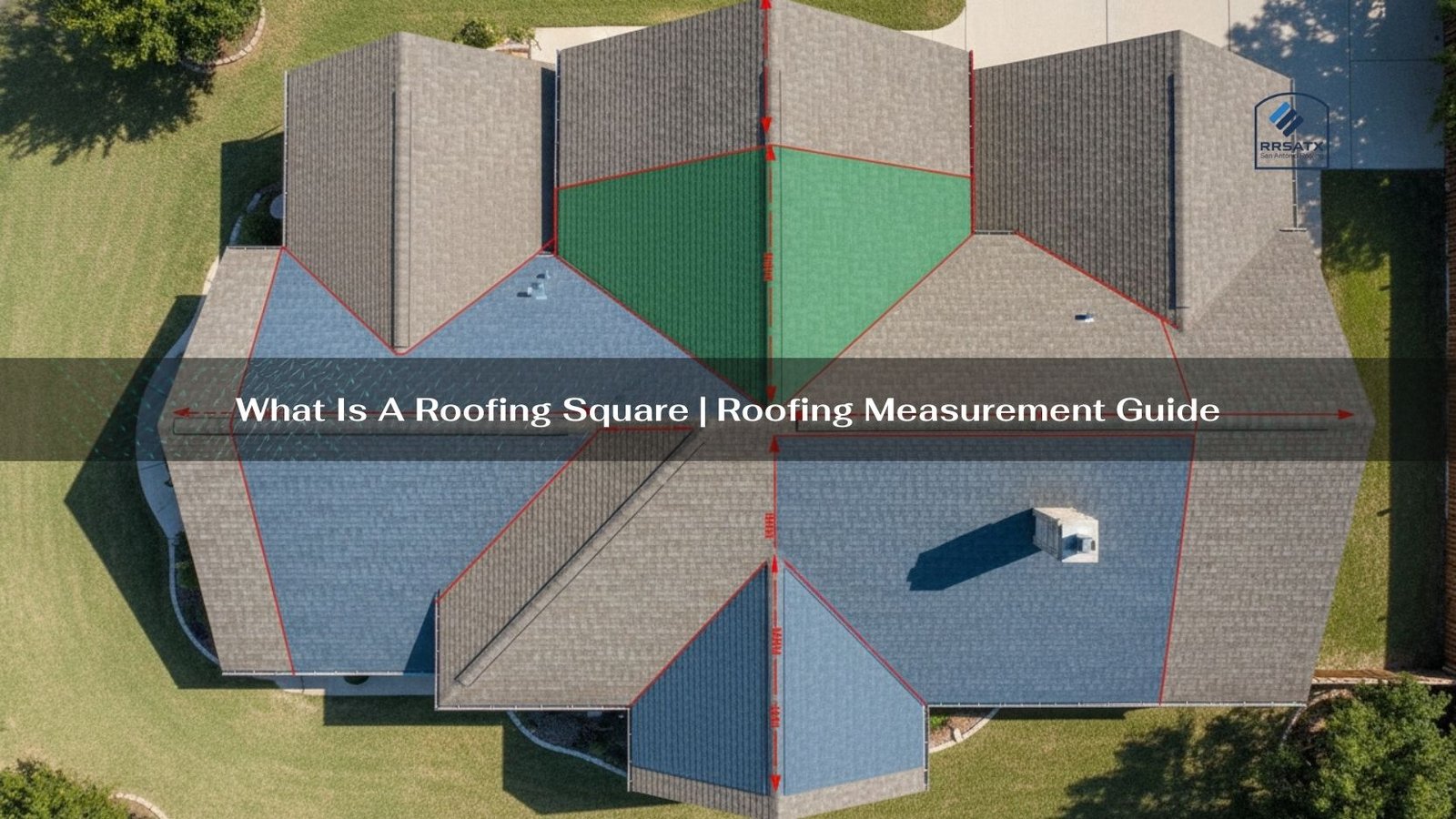
Calculating Complex Roofs
Homes with multiple roof planes, dormers, valleys, or hips require individual measurements for each section. Professional contractors typically:
- Divide the roof into geometric sections (rectangles, triangles)
- Calculate each section’s area separately
- Add all sections together
- Apply appropriate pitch multipliers
- Add 10-15% for waste and cuts
For complex roofs, hiring a professional measurement service or relying on your contractor’s expertise ensures accuracy.
Common Roof Sizes In Roofing Squares
Understanding typical roof sizes helps you gauge whether your contractor’s estimate seems reasonable. Here are average roofing square measurements for common home sizes in San Antonio:
| Home Size | Typical Roof Squares | Roof Area (sq ft) |
| 1,000 sq ft | 12-15 squares | 1,200-1,500 sq ft |
| 1,500 sq ft | 17-20 squares | 1,700-2,000 sq ft |
| 2,000 sq ft | 20-24 squares | 2,000-2,400 sq ft |
| 2,500 sq ft | 25-30 squares | 2,500-3,000 sq ft |
| 3,000 sq ft | 30-35 squares | 3,000-3,500 sq ft |
These are estimates. Actual measurements depend on roof pitch, architectural complexity, and overhangs. A ranch-style home with a low-pitch roof may have fewer squares than a two-story colonial with steep gables and dormers, even if both homes have the same footprint.
How Roofing Squares Affect Your Project Cost
Roofing squares are the foundation of project pricing. Contractors typically quote prices per roofing square for both materials and labor, making it essential to understand this measurement when evaluating estimates.
Material Costs Per Square
Roofing material costs vary significantly by type. Here are typical San Antonio ranges per roofing square:
- Three-tab shingles: $150-$250 per square
- Architectural shingles: $250-$400 per square
- Premium/designer shingles: $400-$600 per square
- Corrugated metal: $300-$500 per square
- Standing seam: $600-$900 per square
- Metal shingles: $700-$1,000 per square
- Concrete tiles: $400-$600 per square
- Clay tiles: $600-$900 per square
- TPO: $350-$550 per square
- EPDM: $300-$500 per square
- Modified bitumen: $250-$450 per square
Labor Costs Per Square
Labor pricing also follows the per-square model. According to data from Angi’s roofing contractor costs, typical labor rates in Texas range from $150-$300 per roofing square, depending on:
- Roof pitch (steeper = more expensive)
- Complexity (multiple valleys, dormers, skylights)
- Accessibility (multi-story homes require more safety equipment)
- Material type (tile and metal installation require specialized skills)
- Tear-off requirements (removing multiple old layers increases labor)
Total Project Cost Example
For a 20-square roof (2,000 sq ft) with architectural shingles in San Antonio:
- Materials: 20 squares × $300 = $6,000
- Labor: 20 squares × $200 = $4,000
- Underlayment, flashing, ventilation: $1,500
- Permit and disposal: $500
- Total: $12,000
This illustrates why understanding roofing squares is crucial; it’s the multiplier that determines your total investment.
Roofing Square VS. Square Foot: Key Differences
Homeowners often confuse roofing squares with square feet. While related, these measurements serve different purposes and can’t be used interchangeably without conversion.
Key Distinctions
Roofing Square:
- Equals 100 square feet
- Used exclusively in roofing industry
- Simplifies material ordering and labor estimation
- Standard unit for contractor quotes
Square Foot:
- Universal measurement for area
- Used across all construction trades
- More granular and precise
- Familiar to most homeowners
When Each Is Used
Contractors measure and quote in roofing squares because it aligns with how materials are packaged and how labor is estimated. However, they calculate the total roof area in square feet first, then convert to squares by dividing by 100.
When comparing estimates, always confirm whether the quote is per square or per square foot. A $300-per-square quote equals $3 per square foot, a significant difference that could lead to budget confusion.
Factors That Complicate Square Calculations
While the basic concept of roofing squares is straightforward, several factors add complexity to accurate measurement and estimation.
Roof Pitch And Steepness
Steeper roofs have significantly more surface area than low-slope roofs covering the same footprint. A 12/12 pitch roof (45-degree angle) has 41% more surface area than a flat roof over the same building.
Steep roofs also require additional safety equipment, longer installation time, and specialized techniques all of which increase per-square labor costs.
Architectural Complexity
Features that increase measurement complexity and project cost include:
- Valleys: Interior angles where two roof planes meet
- Hips: Exterior angles where slopes converge
- Dormers: Vertical windows projecting from the roof
- Skylights: Require precise flashing and cutting
- Chimneys: Demand custom flashing and careful integration
- Multiple roof planes: Each section requires separate measurement
Complex roofs may have 20-30% more material waste due to cuts and overlaps, increasing the total squares needed beyond the calculated surface area.
Overhangs And Eaves
Roof overhangs extend beyond the home’s footprint, adding surface area that must be included in square calculations. Standard overhangs add 6-12 inches on each side, but some homes feature extended eaves that significantly increase total squares.
Existing Roof Layers
If your existing roof has multiple layers of shingles, the tear-off process becomes more labor-intensive. While this doesn’t change the number of roofing squares, it increases per-square labor costs and disposal fees.
Most building codes limit roofs to two layers maximum. If you already have two layers, complete tear-off is mandatory before installing new roofing.
How Contractors Measure Your Roof
Professional roofing contractors use several methods to accurately determine roofing squares, each with varying precision and cost.
Manual Roof Measurement
The traditional approach involves physically climbing onto the roof with a tape measure and calculating each section’s dimensions. While time-consuming, this method provides hands-on assessment of roof condition and allows the contractor to identify hidden damage, structural issues, and ventilation problems.
Process:
- Divide roof into geometric sections
- Measure length and width of each section
- Calculate area for each section
- Sum all sections
- Apply pitch multipliers
- Add waste allowance (10-15%)
Aerial Measurement Technology
Modern contractors increasingly use satellite imagery and drone technology to measure roofs without climbing. Services like EagleView and Hover provide detailed roof reports including:
- Total square footage and roofing squares
- Roof pitch measurements
- 3D diagrams showing all roof planes
- Measurements for ridges, valleys, hips, and eaves
These reports cost $50-$150 but save time and improve accuracy, especially for complex roofs.
Ground-Level Estimation
Experienced contractors can estimate roofing squares from the ground by measuring the home’s footprint, visually assessing pitch, and accounting for visible architectural features. While faster, this method is less accurate and typically used only for preliminary quotes.
At RRSATX: San Antonio Roofing Company, we offer free roof inspections that include precise square calculations, condition assessments, and transparent estimates ensuring you know exactly what you’re paying for.
Questions To Ask Your Roofing Contractor
Armed with knowledge about roofing squares, you can ask informed questions that reveal contractor expertise and estimate accuracy.
Essential Questions
- “How many roofing squares is my roof?” A professional should provide a specific number, not a vague range. This demonstrates they’ve measured accurately.
- “How did you calculate the roofing squares?” Understand their measurement method manual, aerial, or estimation. More precise methods justify confidence in the quote.
- “What’s your price per roofing square for materials and labor?” Breaking down costs per square allows you to compare estimates fairly across contractors. Watch for quotes that seem unusually low; they may indicate poor-quality materials or hidden fees.
- “Does your square calculation include waste allowance?” Reputable contractors build 10-15% waste into material orders. If not included, you may face unexpected costs mid-project.
- “How does my roof pitch affect the per-square cost?” Steep roofs cost more per square due to safety requirements and installation difficulty. Ensure your estimate reflects your specific pitch.
- “What factors could change the final square count?” Honest contractors acknowledge that hidden damage, rotted decking, or structural issues discovered during tear-off may require additional squares of materials.
- “Are permit fees and disposal costs included in the per-square price?” Some contractors quote material and labor per square but list permits and disposal separately. Clarify what’s included to avoid surprise charges.
FAQs
How Many Bundles Of Shingles Are In A Roofing Square?
Typically three bundles of standard asphalt shingles equal one roofing square (100 square feet). However, architectural and premium shingles may require four bundles per square due to thickness and overlap.
Can I Calculate My Own Roofing Squares?
Yes, for simple roofs. Measure your home’s footprint, apply the appropriate pitch multiplier, and divide by 100. However, complex roofs with multiple planes, valleys, and dormers require professional measurement to ensure accuracy.
Why Do Contractors Add Extra Squares To My Estimate?
Material waste from cuts, overlaps, and edge trimming typically requires 10-15% additional material. Contractors order extra squares to prevent mid-project shortages and ensure consistent material batches.
Does A Steeper Roof Have More Squares?
Yes. Steeper roofs cover more surface area than low-slope roofs over the same footprint. A 12/12 pitch roof has 41% more squares than a flat roof on an identical house.
How Long Does It Take To Install One Roofing Square?
On average, professional crews install 1-2 roofing squares per hour for standard asphalt shingle roofs. Complex roofs, steep pitches, or specialty materials slow this rate. A 20-square roof typically takes 1-2 days for a full crew.
Are Roofing Squares The Same As Construction Squares?
No. A “square” in general construction refers to a carpenter’s L-shaped measuring tool. In roofing, “square” specifically means 100 square feet of roof surface area; they’re completely different concepts.
Make Informed Roofing Decisions With RRSATX
Understanding what is a roofing square empowers you to evaluate contractor estimates accurately, budget confidently, and ensure you’re paying fair prices for quality work. This industry-standard measurement directly impacts material costs, labor pricing, and project timelines making it essential knowledge for any homeowner planning a roof repair or replacement.
For San Antonio homeowners seeking transparent, expert roofing services, RRSATX: San Antonio Roofing Company delivers honest assessments and quality workmanship backed by decades of experience. We don’t just measure roofing squares, we build relationships based on integrity, clear communication, and roofs that protect your home for years to come.
Ready For A Free Roof Inspection?
Don’t wait until minor issues become major expenses. Our comprehensive 12-point roof inspection identifies:
- Exact roofing square measurements for accurate project estimates
- Hidden leaks and damage before they compromise your home
- Structural wear that affects roof lifespan
- Storm damage requiring immediate attention
- Transparent cost breakdowns per roofing square
Contact RRSATX: San Antonio Roofing Company today: Call 24/7: 713-504-234, Email: info@roofrepairsanantoniotx.com
Locations: 4324 Monterey St, San Antonio, TX 78237/318 E Nakoma Dr #210, San Antonio, TX 78216
Serving San Antonio, Houston, Katy & surrounding areas
With 100+ five-star reviews, 1,000+ satisfied customers, and 25 years of roofing excellence, we’re the family-owned team San Antonio trusts for quality roofing that lasts. Get your free inspection and transparent estimate today.