
[et_pb_section fb_built=”1″ admin_label=”section” _builder_version=”4.16″ global_colors_info=”{}”][et_pb_row admin_label=”row” _builder_version=”4.16″ background_size=”initial” background_position=”top_left” background_repeat=”repeat” global_colors_info=”{}”][et_pb_column type=”4_4″ _builder_version=”4.16″ custom_padding=”|||” global_colors_info=”{}” custom_padding__hover=”|||”][et_pb_code _builder_version=”4.27.7″ _module_preset=”default” hover_enabled=”0″ sticky_enabled=”0″]
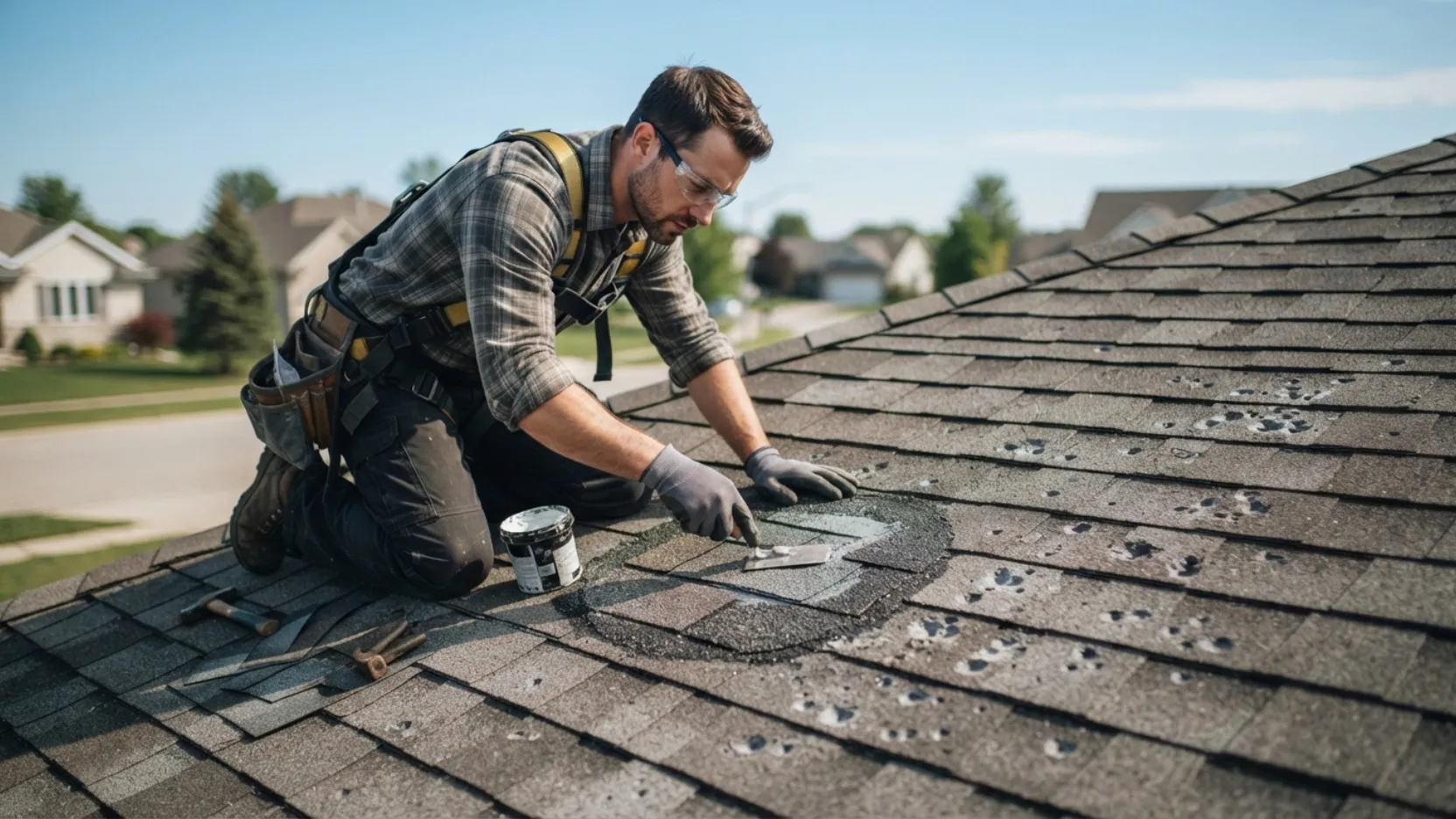
San Antonio sees 3 to 5 significant hail events every year. This guide walks you through every step after a storm: how to spot the damage, what repairs cost, how to file your insurance claim, and how to choose a contractor you can trust.
Hail season in San Antonio runs from March through June, with April and May being the months when the risk of large, fast-moving storms is highest. When Gulf moisture collides with dry western air over the Texas Hill Country, the conditions are right for severe thunderstorms that can drop hailstones the size of golf balls or larger onto rooftops across Bexar County. In some years, those storms can crack windshields, dent gutters, and punch directly through asphalt shingles in a matter of minutes.
What makes hail damage uniquely challenging for San Antonio homeowners is that the worst of it is usually invisible from the ground. You will not see holes or missing sections after most hail events. What you will have instead is subtle, functional damage that weakens your roof system and develops into leaks weeks or months later, often after the insurance filing window has narrowed. This guide gives you the complete picture: how to spot hail damage by roof type, what the repair process looks like, what it costs in 2026, and how to navigate your insurance claim without leaving money on the table.
The most expensive mistake San Antonio homeowners make after a hailstorm is waiting too long to act. Hail bruising on asphalt shingles does not cause an immediate leak. It causes the protective granule layer to fail, the asphalt mat to oxidize under the Texas sun, and a slow crack to develop over six to eighteen months. By the time water is dripping into your living room, the storm that caused it may be outside your insurance filing window. The correct sequence is always the same: get a professional inspection within 30 days of the storm, document the damage, and file your claim before acting on any repairs.
Damage Identification
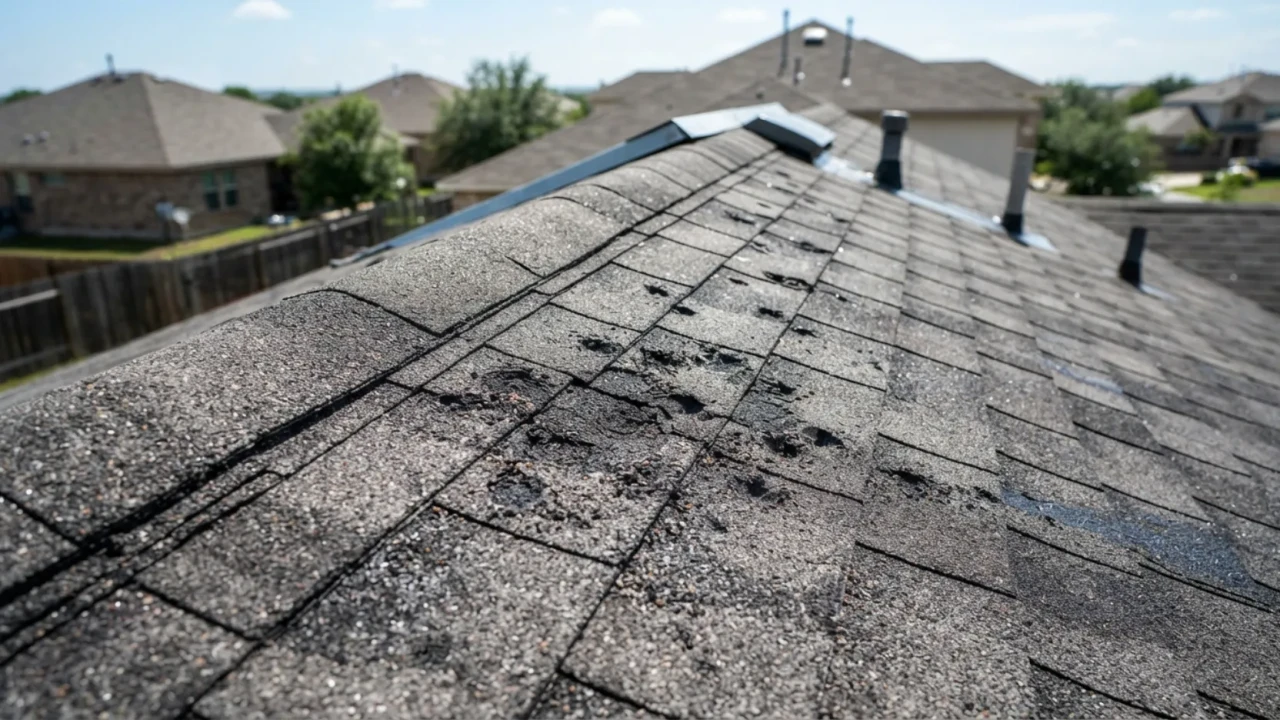
Hail damage is almost never visible from the ground. This is the single fact that catches San Antonio homeowners off guard every storm season. You will not see holes in your shingles or missing sections after most hail events. What you will see from the ground are indirect signs: dents in your gutters or downspouts, damage to patio furniture or window screens, or granules washing out of your downspouts after the first rain. Those are your signal that the roof itself likely took damage, even if everything looks intact from the street.
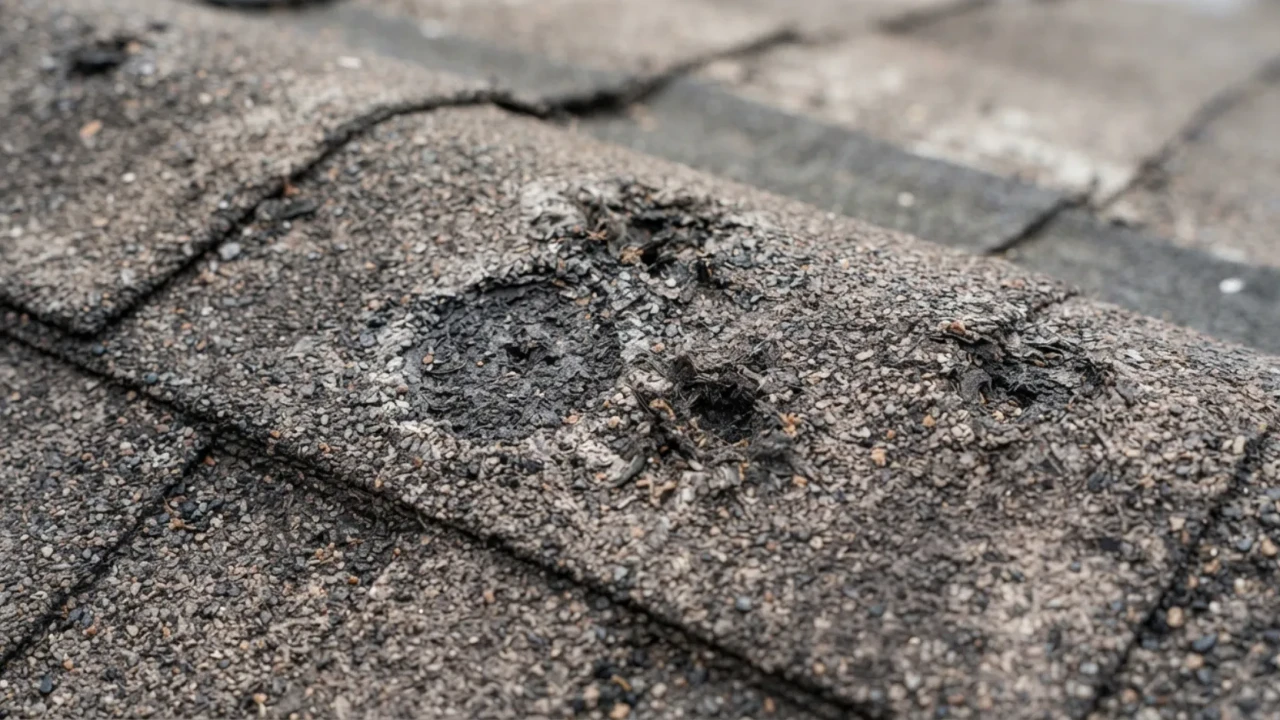
Asphalt shingles are the most common roofing material in San Antonio and the most susceptible to hail damage. When a hailstone strikes an asphalt shingle, it knocks loose the ceramic granules that protect the asphalt mat from UV radiation. The impact creates a circular bruise where the granule coating is thin or completely missing, exposing the black asphalt mat underneath. From the ground, this looks like nothing. On the roof, it looks like a dark spot. When you press on a bruised shingle, it will feel soft or spongy, like an apple that has been dropped on the floor. This “give” means the fiberglass mat inside the shingle has fractured beneath the surface.
The San Antonio sun then does the rest. Exposed asphalt oxidizes, becomes brittle, and cracks with every thermal expansion and contraction cycle. What starts as an invisible bruise in April becomes an active leak by the following summer, often after the insurance filing window has closed.
Metal roofs are significantly more hail-resistant than asphalt, but they are not immune. Large hailstones of 1.75 inches and above can leave visible dents or dimpling on steel or aluminum panels. Cosmetic denting does not typically affect the structural performance of a standing seam metal roof. However, severe impacts can loosen panel seams, crack coatings, or damage flashing at penetrations, creating water entry points that are not immediately obvious. If you have a metal roof and see denting on your gutters, downspouts, or AC condenser fins after a storm, schedule a professional inspection to rule out seam or flashing damage.
Tile roofs (clay or concrete) can crack or chip under direct hail impact. Unlike asphalt shingle bruising, tile cracks are usually visible from the ground. Any cracked tile is a direct path for water infiltration and requires replacement. If you have a tile roof, inspect from the ground with binoculars after every significant hail event before climbing up for a closer look.
Do not climb onto your roof immediately after a storm. Wet roofing surfaces are extremely slippery, and the structural condition of the roof may be compromised after severe impact. Conduct your initial assessment from the ground using binoculars, check your gutters for granule buildup, and look for dents on metal surfaces around your home. A professional roofing inspector with the proper safety equipment should be the first person on your roof after a significant hail event.
- Note the storm date and reported hail size from local weather reports immediately after the event
- Check gutters and downspouts for granule buildup this is your most reliable ground-level indicator for asphalt shingle damage
- Inspect metal surfaces you can see: gutters, downspouts, AC condenser fins, vents, and flashing edges
- Check siding, patio furniture, and window screens for impact marks these confirm the storm intensity
- Look for any visible cracks or missing sections on tile roofs using binoculars from the ground
- Do not climb onto the roof until it is completely dry and a professional has confirmed it is safe to access
Professional Inspection
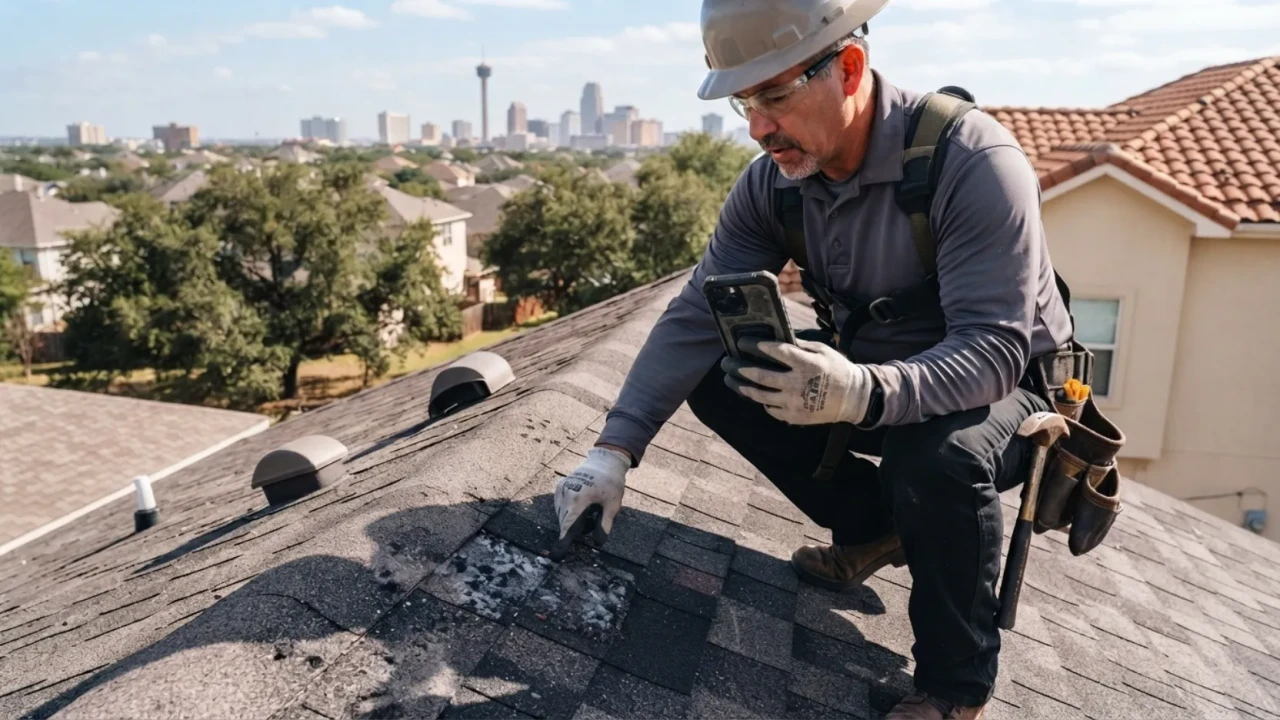
The single most important thing a San Antonio homeowner can do after a hailstorm is schedule a professional roof inspection before contacting the insurance company. This is not about gaming the system. It is about having your own independent, documented assessment of the damage to compare against whatever the insurance adjuster produces. Adjusters are employed by your insurer. A licensed San Antonio roofing contractor works for you.
A proper hail damage inspection covers far more than a visual scan of the shingle surface. A qualified inspector will check for bruising by feel across the entire roof surface, assess the condition of flashing at all penetrations, examine the underlayment where possible, look for soft spots in the roof decking, and document every finding with dated photographs. That documentation package is what separates a smoothly approved insurance claim from one that gets disputed or underpaid.
Have your roofing contractor present when the insurance adjuster arrives to inspect your roof. You are entitled to have a representative present during the adjuster’s inspection. When both parties are on the roof at the same time, damage is less likely to be missed or minimized in the final adjuster’s report. If the adjuster’s scope comes back significantly lower than your contractor’s assessment, you have the right to dispute it or hire a public adjuster to negotiate on your behalf.
- Inspection scheduled within 30 days of the storm event do not wait for visible leaks to appear
- Contractor is licensed in Texas and carries current general liability insurance of at least $1 million
- Inspection includes written documentation with dated photographs of all damage found
- Inspector checks shingle condition by feel across the roof surface, not just a visual scan from the ridge
- Flashing, vents, gutters, and ridge caps are included in the inspection, not just the field of the roof
- Contractor agrees to be present when the insurance adjuster visits
Insurance Claims
Most Texas homeowners insurance policies cover hail damage as a named peril. That means the damage is covered but how much you recover depends heavily on your policy type, your deductible, how quickly you file, and the quality of your documentation. Understanding these variables before you pick up the phone with your insurer puts you in a significantly stronger position.
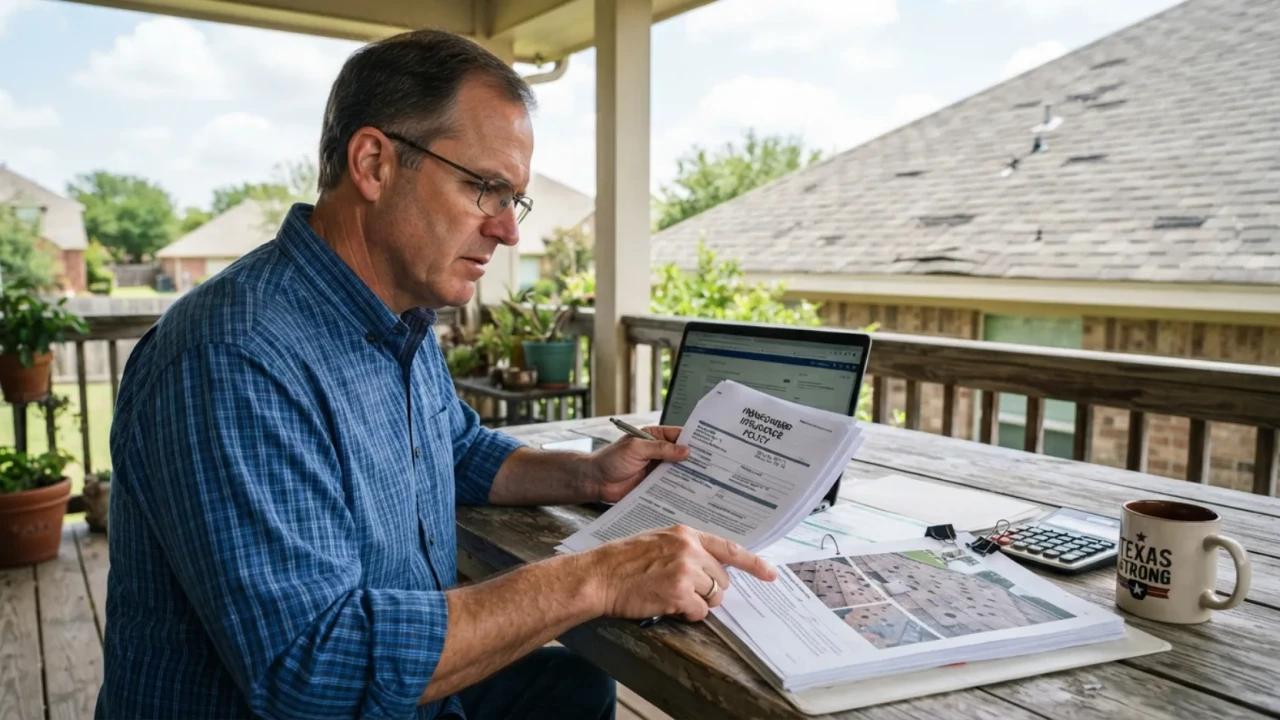
Replacement Cost Value (RCV) vs. Actual Cash Value (ACV): This is the most important policy detail San Antonio homeowners often do not discover until it is too late. An RCV policy pays the full cost to replace your damaged roof with equivalent new material, minus your deductible. An ACV policy depreciates the value of your roof based on its age before writing you a check. A 15-year-old asphalt shingle roof on an ACV policy may receive only a fraction of what the repair or replacement actually costs. Review your policy now, before the next storm season, to understand which type of coverage you carry.
Wind and hail deductibles: Many Texas homeowners insurance policies include a separate wind and hail deductible that is higher than the standard policy deductible. This deductible is often expressed as a percentage of your home’s insured value rather than a flat dollar amount. A 2% wind and hail deductible on a $300,000 home means you pay the first $6,000 out of pocket before insurance contributes. Know your number before a storm hits.
When you file your claim, provide the storm date and reported hail size for your area, your contractor’s written inspection report with photographs, and a description of the damage documented. Do not begin any permanent repairs before your insurance adjuster has inspected the roof doing so can complicate your claim. Emergency tarping to prevent interior water damage is appropriate and will generally not affect your claim, but full repairs should wait for the adjuster’s visit.
If the adjuster’s written estimate is significantly lower than your contractor’s repair quote, you have options. You can ask your insurer to send a second adjuster for a re-inspection. You can have your contractor submit a supplemental claim with additional documentation of items the adjuster missed. Or you can hire a licensed public adjuster to negotiate directly with your insurer on your behalf. Public adjusters in Texas typically charge 10 to 15 percent of the final claim settlement, but on a disputed or underpaid claim, they frequently recover enough additional coverage to more than cover their fee.
- Policy reviewed before storm season: understand whether you have RCV or ACV coverage and your wind/hail deductible amount
- Storm date, time, and hail size documented from local weather reports or the National Weather Service
- Professional inspection completed and written report with photographs obtained before filing the claim
- No permanent repairs begun until the insurance adjuster has completed their inspection
- Emergency tarping approved by your insurer before it is installed if possible
- Roofing contractor present during the adjuster’s inspection to ensure all damage is noted
- Adjuster’s written estimate reviewed and compared to your contractor’s quote before accepting
Repair Costs
Hail damage repair costs in San Antonio in 2026 range widely depending on three main variables: the extent of the damage, the type of roofing material, and whether the repair is a targeted fix or a full section replacement. The majority of post-hail repairs on residential roofs in Bexar County fall into one of three damage categories, each with a distinct cost profile.
| Repair Type | Typical Cost (San Antonio 2026) | When It Applies |
|---|---|---|
| Individual shingle replacement (minor hail) | $400 to $800 | Isolated impacts on a small section of the roof with no underlayment damage |
| Partial section replacement (one slope) | $1,400 to $3,000 | Widespread bruising across one roof slope; underlayment may need replacement |
| Full roof replacement (asphalt shingles) | $8,000 to $15,000 | Severe or widespread damage across the full roof; often the right call when repair costs exceed 50% of replacement |
| Flashing repair or replacement | $300 to $700 | Damaged or lifted flashing at chimney, vents, skylights, or valleys |
| Gutter and downspout repair | $150 to $500 | Dented or separated gutters and downspouts from hail impact |
| Roof decking replacement (water damage) | $2.50 to $4.00 per sq ft added | Soft or rotted decking found during shingle replacement; adds cost to any repair or replacement |
| Emergency tarping | $200 to $600 | Immediate protection against active water intrusion after a storm |
- Written repair estimate received specifying scope of work, materials, and line-item costs
- Emergency tarping installed and approved by insurer if active water intrusion is occurring
- Decking condition assessed as part of the repair scope damaged decking must be replaced, not covered over
- Both repair and replacement costs obtained in writing to make the 50% rule comparison
- At least two or three written quotes obtained for any repair over $1,000
- Repair scope matches what the insurance adjuster has approved before work begins
Repair Process
After a major hail event in San Antonio, roofing contractors arrive from across the state and beyond. Some are excellent. Some are not. The post-storm market is where corner-cutting is most common and where homeowners are most vulnerable because they are stressed, in a hurry, and unfamiliar with what a quality repair actually looks like. The contractors who are already established locally in San Antonio before the storm are almost always a safer choice than those who appear specifically after it.
A proper hail damage repair on an asphalt shingle roof involves more than putting new shingles over the damaged area. It requires removing the damaged shingles and underlayment, inspecting the decking beneath for soft spots or water damage, replacing any compromised decking, installing new ice-and-water shield or synthetic underlayment, and then installing the replacement shingles with the correct nail pattern and fastener placement. Cutting any of these steps produces a repair that may pass an initial visual inspection but will fail within a few years under San Antonio weather conditions.
Walk away from any contractor who pressures you to sign a contract the same day as their first visit, asks for full payment upfront, cannot provide proof of Texas licensing and current insurance, or suggests signing an Assignment of Benefits (AOB) agreement. An AOB transfers your insurance rights to the contractor, removing your ability to dispute the repair scope or payment. Texas law has addressed some AOB abuses, but the arrangement remains a warning sign when pushed aggressively. Take your time, get multiple quotes, and choose a contractor you found through local referrals or with a verifiable history of completed work in Bexar County.
Once a contractor is selected and the insurance claim is approved, the repair process itself typically takes one day for most residential hail damage repairs in San Antonio. A partial section replacement on a 2,000-square-foot home usually runs four to eight hours. A full roof replacement may take one to three days depending on weather and crew size. Ask your contractor for a projected start date and completion date in writing before the work begins.
- Contractor’s Texas license number confirmed and verified through the Texas Department of Insurance or relevant licensing board
- Certificate of insurance received showing current general liability and workers compensation coverage
- Local San Antonio business address confirmed and online reviews verified from multiple sources
- Written contract signed specifying materials by brand and grade, repair scope, start and end dates, and workmanship warranty
- Deposit limited to 30% or less of the total contract amount
- Decking inspection confirmed as part of the repair scope before shingles are installed
- Final inspection completed and signed off before the remaining balance is paid
- Record the storm date, time, and reported hail size from local weather reports or the National Weather Service
- Conduct a ground-level visual inspection: check gutters for granules, look for dents on metal surfaces, and assess siding and outdoor furniture for impact marks
- Photograph any visible damage from the ground while it is still fresh
- Do not climb onto the roof until it is dry and a professional has confirmed it is safe
- If active water intrusion is occurring inside the home, contact a licensed contractor immediately for emergency tarping
- Schedule a professional inspection with a licensed San Antonio roofing contractor
- Obtain a written inspection report with dated photographs covering all damage found
- Contact your insurance company to open a claim and report the storm damage
- Confirm your policy type (RCV or ACV) and your wind/hail deductible before the adjuster’s visit
- Request your contractor be present during the insurance adjuster’s inspection
- Do not begin permanent repairs until the insurance adjuster has completed their inspection
- Obtain at least two to three written repair quotes with itemized scope of work
- Verify each contractor’s Texas license, insurance certificates, and local San Antonio reviews
- Compare the insurance adjuster’s estimate against your contractor’s quote before accepting either
- If the adjuster’s estimate is significantly lower, request a supplemental claim review or consult a public adjuster
- Confirm the contract specifies materials by brand and grade, repair scope, start and end dates, deposit amount, and workmanship warranty
- Inspect the completed work before making the final payment
- Confirm all job site debris including old shingles, nails, and packaging is removed from the property
- Obtain the written workmanship warranty document with the contractor’s contact information and coverage period
- Photograph the completed repair for your own records
- Schedule the next professional roof inspection within two to three years, or before the following hail season
How do I know if my roof has hail damage in San Antonio?
How much does hail damage roof repair cost in San Antonio?
Does homeowners insurance cover hail damage to my roof in San Antonio?
Should I repair or replace my roof after hail damage?
How long do I have to file a hail damage insurance claim in Texas?
How can I prevent future hail damage to my roof?
Get a free hail damage roof inspection in San Antonio
If a recent storm came through your neighborhood, do not wait for a leak to tell you there is damage. We will inspect your roof for free, document everything with photos, and give you a clear written assessment at no cost or obligation.
[/et_pb_code][/et_pb_column][/et_pb_row][/et_pb_section]