
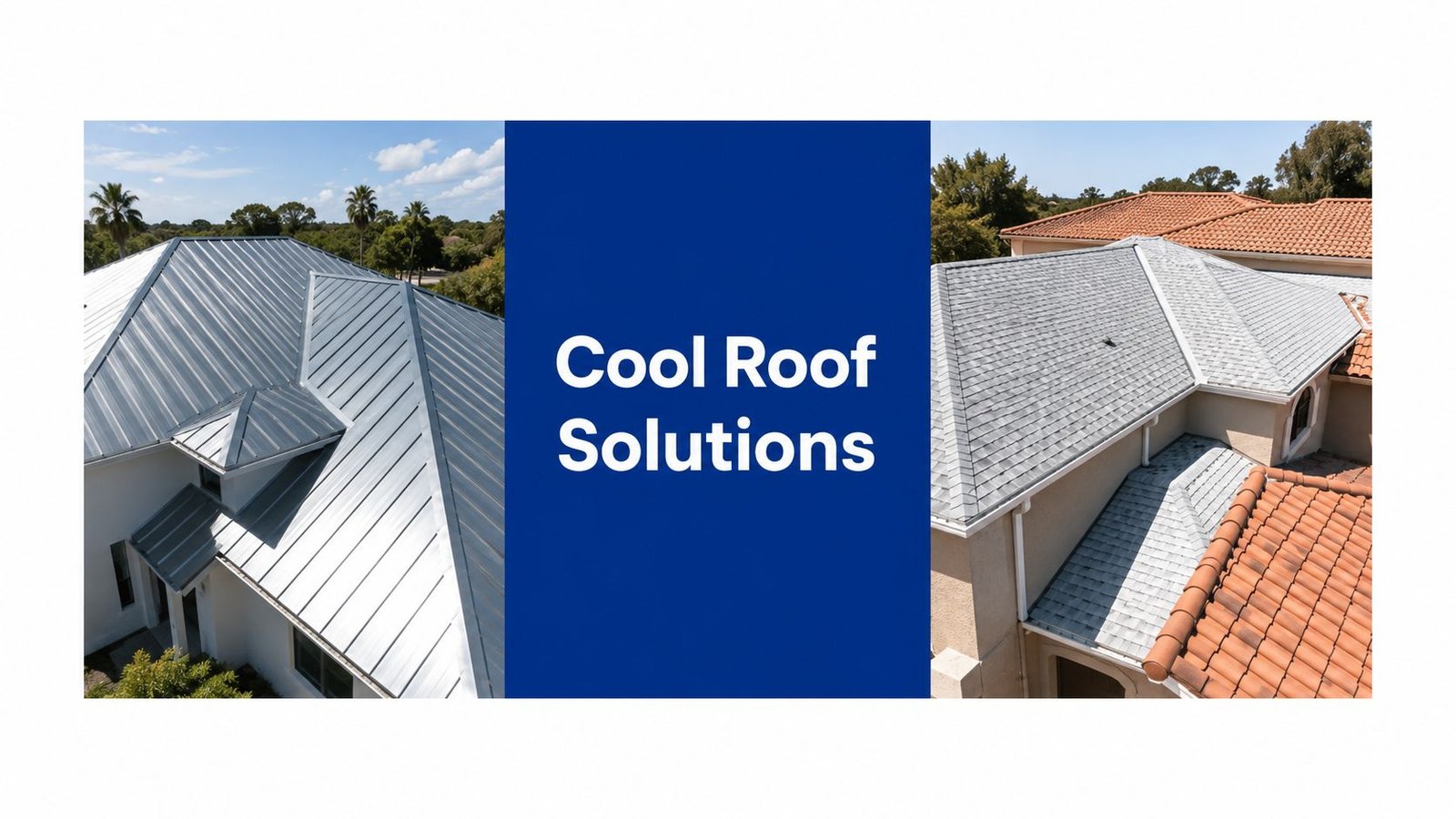
Your upstairs feels hot by lunch. The AC keeps running. You open the attic hatch and get hit with a blast of trapped heat. That's a normal summer problem in San Antonio, and the roof is often a big part of it.
Most folks start by asking one simple question. What's the most energy efficient roof? My straight answer is this: there isn't one best material for every house in San Antonio. The right pick depends on your roof slope, your attic setup, how much direct sun that roof takes, and whether the material will still perform after years of Texas heat, dust, hail, and hard rain.
Color matters, but it's not the whole story. A roof can look light and still underperform if it doesn't hold its reflectance over time. A roof can also have a good surface but still leave you sweating if the attic ventilation is poor or the insulation is lacking. That's why smart homeowners need to think in systems, not just shingles or panels.
Table of Contents
- Introduction Why Energy Efficiency Matters for San Antonio Roofs
- How Roofing Energy Performance Really Works
- Detailed Comparison of Energy Efficient Roofing Options
- Insulation Ventilation and Roof Assembly Interactions
- Best Use Cases for Each Material in San Antonio
- Payback Longevity and Whole Life Considerations
- Choosing Your Energy Efficient Roof With Confidence
Introduction Why Energy Efficiency Matters for San Antonio Roofs
A lot of San Antonio homeowners call about high summer bills when the complaint is comfort. One bedroom won't cool down. The hallway near the attic feels warm late in the day. The house seems fine in the morning, then starts losing the fight by afternoon.
That's South Texas roofing in real life. The sun beats on the roof for hours, and if the roof system takes in too much heat, your attic stores it like an oven. Then your AC has to chase that heat all day.
What counts as an energy efficient roof
A real energy efficient roof isn't just “light colored.” It needs to handle two jobs well:
- Reflect sunlight back away from the roof
- Release absorbed heat instead of holding it
ENERGY STAR defines a cool roof as one with high solar reflectance and high thermal emittance, and says the ideal cool roof combines both properties through its cool roof guidance.
That matters here because San Antonio roofs don't just deal with heat. They also take hail hits, wind-driven rain, humidity swings, and long UV exposure. A roofing material that looks good on paper but ages poorly isn't a smart buy.
Practical rule: In San Antonio, don't choose a roof by color chip alone. Choose it by measured performance, storm fit, and how the whole roof assembly works together.
What homeowners usually get wrong
The biggest mistake is treating energy efficiency like a paint choice. It's not. It's a roof system choice.
You need to look at:
- Roof slope
- Material type
- Aging performance
- Ventilation
- Insulation
- How much maintenance you're willing to deal with
That's where asphalt shingles, metal roofing, tile, flat TPO, and reflective coatings all start to separate. Some are better for steep residential roofs. Some are better for low-slope commercial buildings. Some make sense only if the structure can carry the weight or the owner is willing to keep up with maintenance.
How Roofing Energy Performance Really Works
Step outside in San Antonio at 5 p.m. in August and put your hand on two different roofs. One is still dumping heat into the attic. The other has already shed a good chunk of it. That difference is what energy performance means in real life.
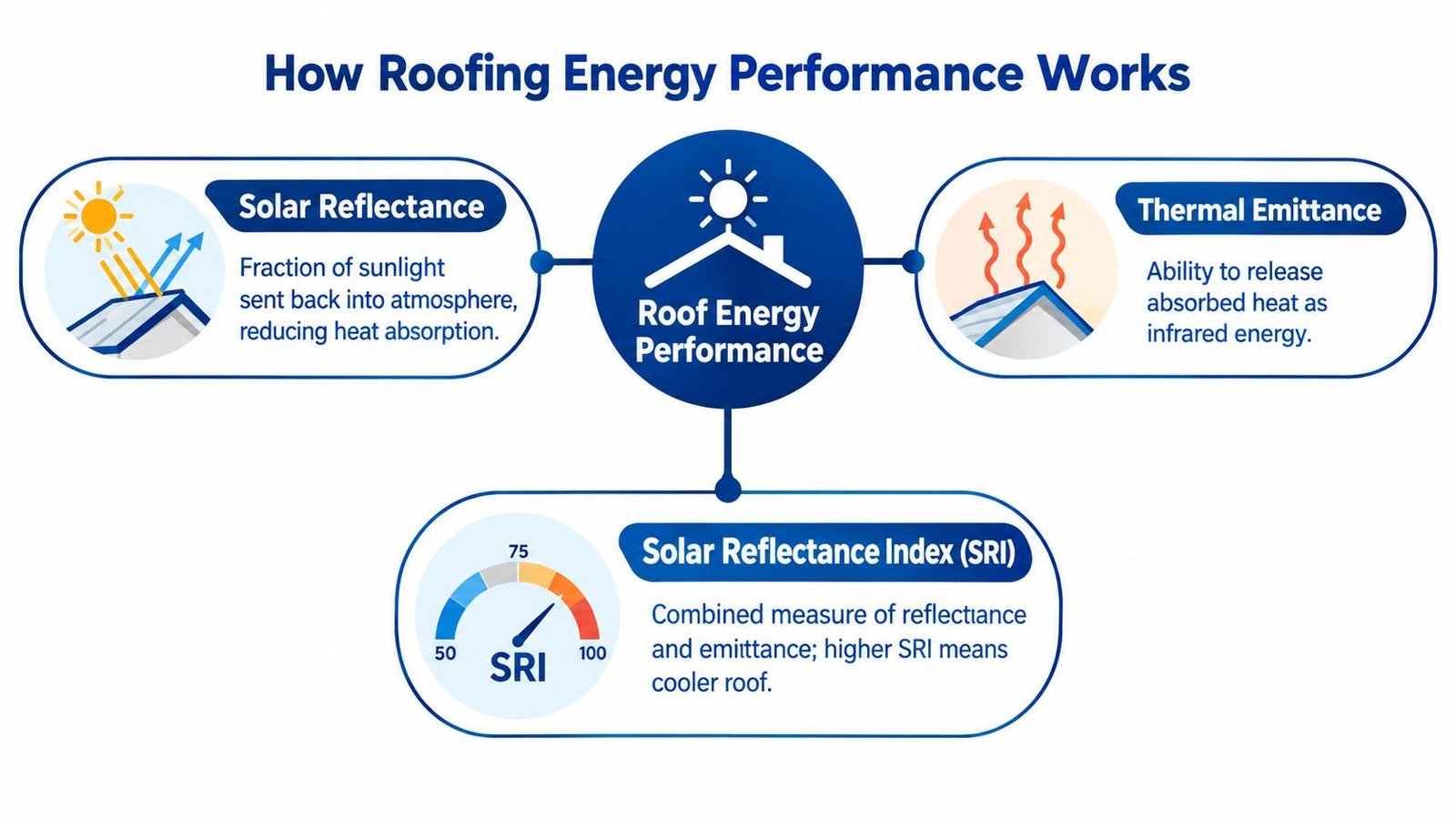
Three measurements matter most, and they work together.
Solar reflectance and thermal emittance
Solar reflectance measures how much sunlight a roof bounces away before that heat ever gets into the material. The EPA explains that the coolest roof products reflect a large share of the sun's energy in its roof performance guidance.
Thermal emittance measures how well the roof releases the heat it does absorb. Both numbers matter. A roof can reflect well and still stay hotter than it should if it does a poor job shedding heat.
The U.S. Department of Energy frames it the right way for homeowners. A good cool roof needs high reflectance, strong heat release, and performance that holds up as the roof ages, as explained in its cool roof product guidance.
In San Antonio, that means you do not judge a roof by color alone. White helps. So does a light finish. But the test is how the material handles sun, dirt, moisture, and years of weather without losing too much of its edge.
Why aged performance matters more than day one shine
Brand-new roofing products almost always look better on paper than they do after a few Texas summers. Dust sticks. UV cooks the surface. Storms beat on it. Humidity and grime do their part too.
That is why aged performance matters more than the sales brochure. ENERGY STAR sets separate initial and 3-year aged reflectance benchmarks for low-slope and steep-slope roofs in its roof specification document.
That point matters here. A roof that starts bright but fades fast can leave you with a hotter attic and less value than you paid for.
Why one number never tells the whole story
Homeowners get tripped up when they chase a single rating. Roof energy performance is a system decision.
Start with the surface. Then look at the roof type, attic ventilation, insulation level, roof slope, and how the material ages. A light asphalt shingle, a painted metal panel, a clay or concrete tile roof, and a coated low-slope membrane all handle heat differently. Some bounce more sun. Some release heat faster. Some create an air gap that helps. Some lose performance sooner if they are not cleaned or maintained.
That is why the best roof for San Antonio is not always the lightest-looking roof. It is the roof assembly that keeps working after years of heat, hail, and hard rain.
What to look for on a product sheet
Keep it simple when you read the specs:
- Check the roof slope category. Steep-slope and low-slope products are rated by different standards.
- Look for both initial and aged reflectance. Day-one numbers are not enough.
- Check thermal emittance if the manufacturer lists it. Better heat release can help roof performance.
- Ignore vague “cool roof” claims without test data.
- Look for recognized test methods. ENERGY STAR references ASTM E 903, ASTM E 1918, and ASTM C 1549 in the same specification, so the claims can be measured and compared.
Here is the plain rule. For San Antonio homes, reflectance matters, but it is only part of the job. Ventilation, insulation, roof design, and how the material ages decide whether that roof still saves energy five or ten years from now.
Detailed Comparison of Energy Efficient Roofing Options
By August in San Antonio, two houses on the same block can feel completely different inside. One attic is baking. The other is manageable. A lot of that starts with the roof choice, but the winner is usually the roof system that still performs after years of sun, hail, and hard rain.
Energy Efficient Roofing Materials Compared for San Antonio Homes
| Material | Solar Reflectance Range | Thermal Emittance | Best San Antonio Use Case |
|---|---|---|---|
| Asphalt shingles | Roughly 0.05 for standard black up to 0.25 to 0.30+ for cool-rated light shingles, depending on brand and color | Usually moderate, varies by product | Steep-slope homes that want a familiar look at a lower upfront cost |
| Metal roofing | Often about 0.25 to 0.70+, depending on paint system and color | Often high, varies by finish | Long-term owners who want strong heat control, good rain shedding, and low upkeep |
| Tile roofing | Usually about 0.20 to 0.60+. Color, profile, and air space under the tile all matter | Usually moderate to high, varies by tile type | Homes that can carry the weight and need durability, style, and strong hot-weather performance |
| White TPO / low-slope membrane | White TPO commonly rates high, and a comparative roofing materials study of membrane temperatures reported 0.83 reflectance for white TPO | Varies by system | Flat and low-slope commercial roofs, additions, patios, and some residential sections |
| Reflective coatings | White coatings commonly start in the 0.70 to 0.85 range on product sheets | Often high on white coatings, commonly around 0.80 to 0.90 | Low-slope roofs that are good candidates for restoration instead of tear-off |
Asphalt shingles
Asphalt shingles are still the default on a lot of San Antonio homes. I recommend cool-rated shingles when the budget is tight and the house needs to keep the traditional look.
Here is the plain truth. Standard dark shingles soak up heat. Light, cool-rated shingles can do better, but they are still shingles sitting right on the deck. That means they depend more on the rest of the roof system than metal, tile, or a bright low-slope membrane. If you choose asphalt, get the lightest color that fits the neighborhood and ask for the manufacturer's tested initial and aged values on the exact shingle.
Metal roofing
Metal is one of the best choices for San Antonio if you plan to stay in the house. A good painted metal roof reflects a lot of sun, sheds rain fast, and usually ages better than cheaper cool-looking products that lose performance once dirt and wear catch up.
Finish matters more than material alone. A light, high-quality painted panel performs a lot differently than a dark bare-looking roof. Fastener details, underlayment, and installer skill matter too. If you want a practical homeowner view before you decide, read this guide on cool roof installation pros and cons for Texas homes.
If solar is part of your long-term plan, decide that early. It helps to compare solar tiles vs panels before you pick a roof system that makes future upgrades harder or more expensive.
Tile roofing
Tile works well in San Antonio heat for one simple reason. The system can do more than just reflect sunlight. The shape of the tile and the air space under it can reduce heat transfer, which helps on long, brutal summer afternoons.
That does not mean every tile roof is a home run. Structure comes first because tile is heavy. Repair work takes the right crew. Broken pieces after hail need attention. Tile makes the most sense on homes built for the weight, owners who want a long service life, and houses where style matters as much as summer performance.
TPO and white low-slope systems
For low-slope roofs, white TPO is hard to beat. It starts with high reflectance, and the membrane temperature study linked above showed white TPO running much cooler than dark membranes under the same conditions.
That is why you see it on so many commercial roofs, additions, and porch or patio covers. On the right low-slope section, it is usually a better energy choice than dark roll roofing or aging black membranes.
Reflective coatings
Coatings have their place. I use them for the right low-slope roof, usually when the existing roof is still sound and the owner wants more life without paying for a full replacement right now.
I do not recommend coatings as a shortcut. If the roof has trapped moisture, bad drainage, split seams, or soft spots, a white coating will not fix the problem. In San Antonio, coatings work best as part of a clear plan: solid substrate, proper prep, regular cleaning, and realistic expectations about recoat cycles.
Insulation Ventilation and Roof Assembly Interactions
You can put great roofing material on a house and still end up disappointed if the attic setup is wrong. That happens all the time.
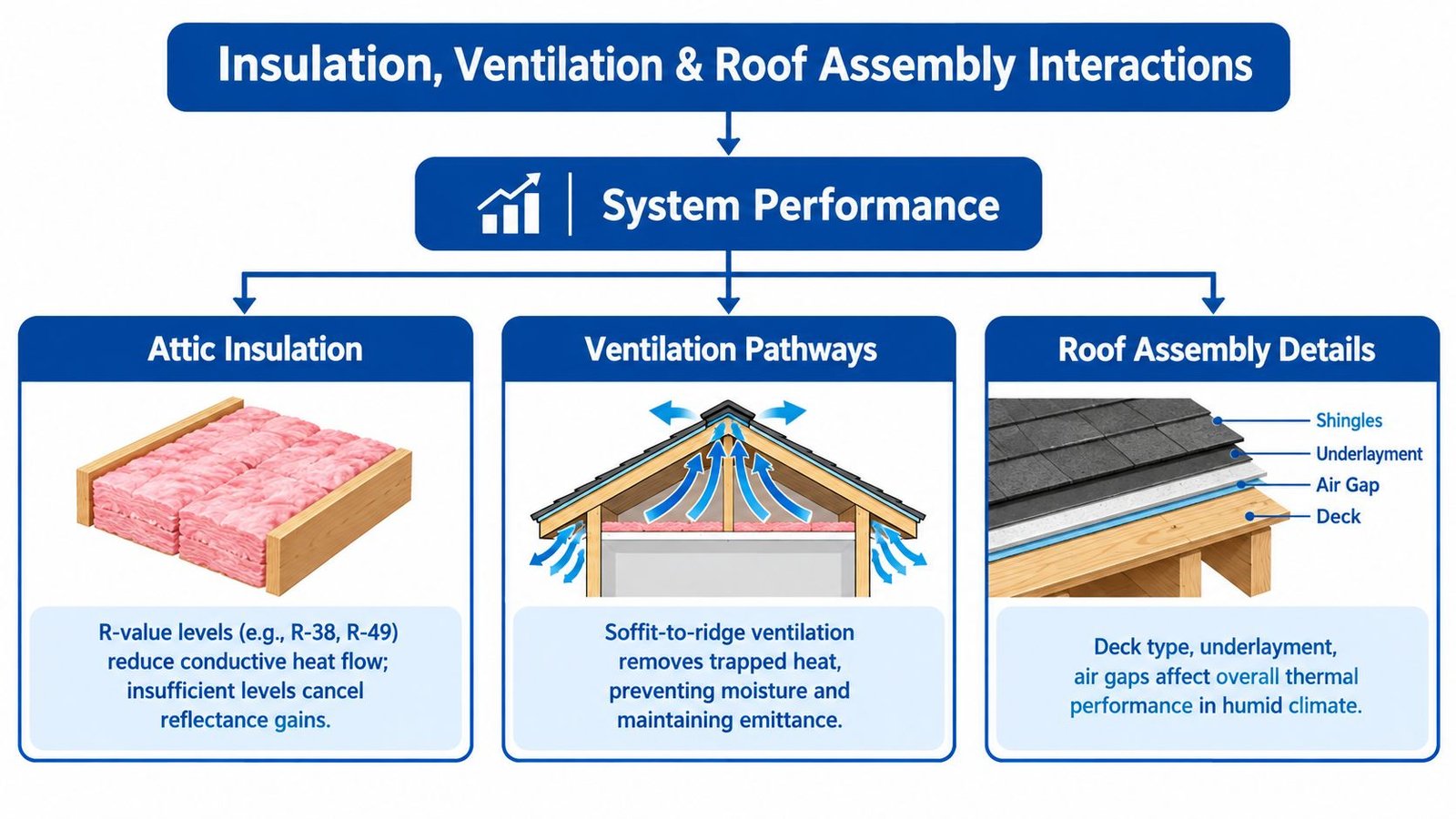
A reflective roof cuts heat at the top. Insulation slows heat flow downward. Ventilation helps move trapped heat and moisture out. Miss one of those, and the whole system underperforms.
Where San Antonio homes lose the plot
In older homes around San Antonio, I often see the same trouble spots:
- Weak intake ventilation at the soffits, so hot air gets trapped
- Poor exhaust flow near the ridge or upper roof
- Ductwork running through a superheated attic
- Insulation that doesn't match the heat load
- Patchwork additions where one roof section performs differently from another
That's why roof replacement shouldn't happen in a vacuum. A good roofing decision includes attic checks, ventilation path review, and drainage review.
If you want a homeowner-friendly look at that relationship, this article on how roofing and insulation work together explains the basics well.
Why the assembly matters as much as the material
A roof system includes more than the top layer. It includes the deck, underlayment, ventilation path, flashing details, and the way the attic or ceiling assembly handles heat.
That same whole-system thinking is easy to see in covered outdoor spaces too. This Outdoor Leisure Living patio guide does a good job showing how insulated roof assemblies affect comfort, even though it's focused on patio covers instead of full homes.
A cool roof over a badly vented attic is like parking a good truck on flat tires. The parts may be fine, but the system still won't work right.
Safety first
Don't climb your own roof to guess at ventilation problems. San Antonio roofs get slick, steep, and dangerous fast, especially after rain or with loose granules underfoot. A visual attic check from inside is one thing. Walking the roof is another.
If you suspect heat buildup, water entry, or storm damage, have a qualified roofer inspect it safely and document what's going on.
Best Use Cases for Each Material in San Antonio
The best roofing choice gets clearer when you stop thinking in categories and start thinking in real houses.
Downtown bungalow with aging shingles
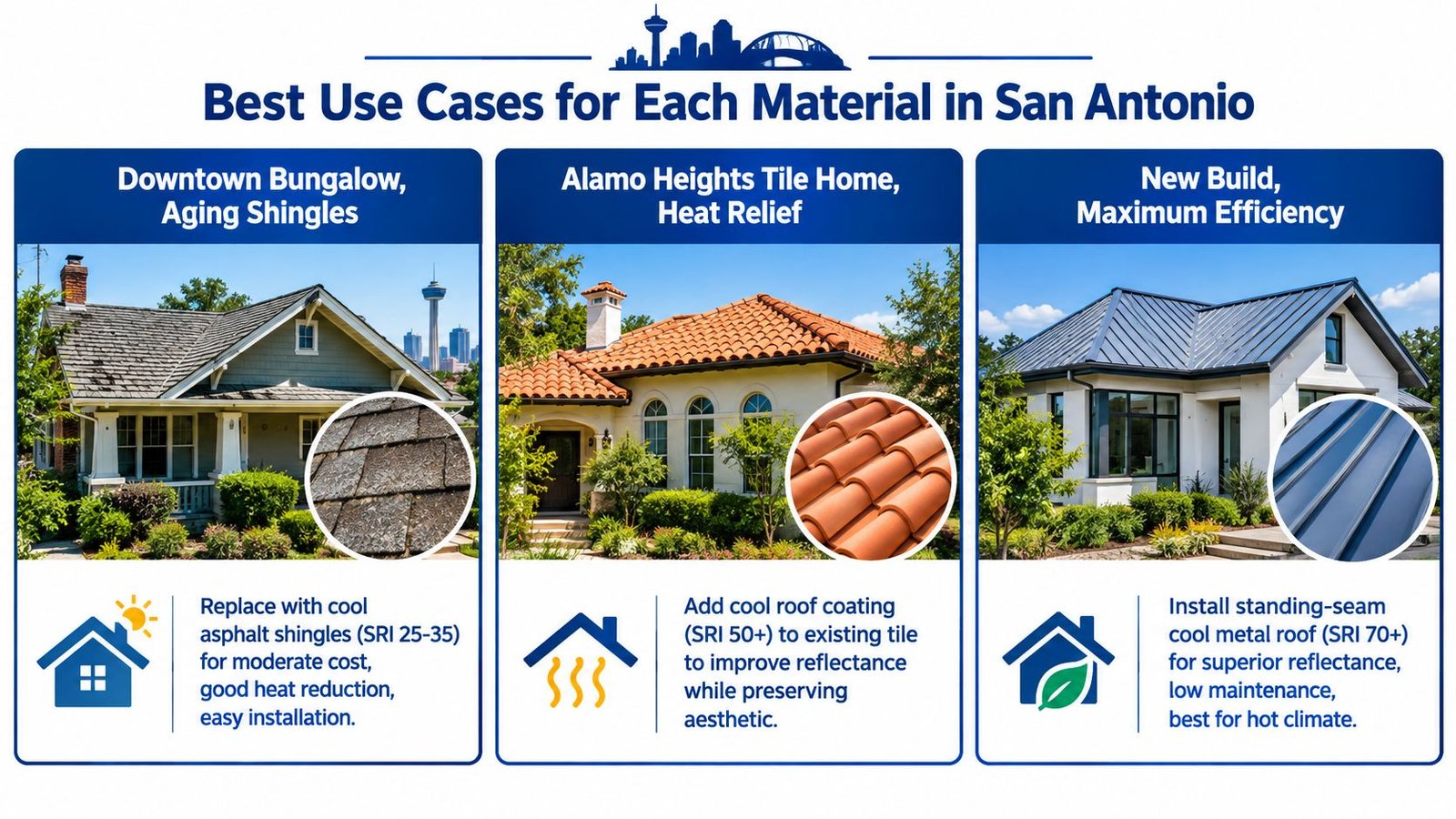
A lot of older San Antonio homes have steep sections, limited attic access, and shingles that have baked for too many summers. In that case, cool-rated asphalt shingles usually make the most sense.
They keep the look appropriate for the house, they're straightforward to replace, and they can improve heat performance without forcing a full design change.
For older bungalow-style homes, a well-chosen cool shingle is often the sensible answer, not the flashy one.
Alamo Heights tile home that runs hot
If the house already has tile and the structure is built for it, staying with tile can be the right move. The style fits. The roof profile fits. The curb appeal stays intact.
If the homeowner mainly wants heat relief, I'd look closely at whether the issue is the tile or the attic assembly below it. Sometimes the smarter fix is ventilation and insulation work paired with selective roof surface improvement, not scrapping a whole tile system.
Helotes homeowner replacing after hail
When a homeowner out in Helotes is already facing a replacement after hail, that's the right time to ask whether metal deserves a serious look. If the roof shape is workable and the owner plans to stay put, metal can be a strong long-term fit for heat, storms, and maintenance.
It's not right for every house. Some owners want the softer look of shingles. Some neighborhoods care more about matching nearby homes. But for a sun-beaten roof with repeated storm exposure, metal belongs on the shortlist.
Small commercial building in Schertz
For small commercial buildings or low-slope properties in Schertz, white membrane systems and coatings usually make more sense than trying to adapt steep-slope ideas to a flat roof.
A bright low-slope roof can cut surface heat, and it also makes inspection and maintenance planning more straightforward. On commercial buildings, practical service access matters just as much as raw efficiency.
Payback Longevity and Whole Life Considerations
Asking about energy efficient roofing materials usually comes down to this: will it be worth it? That's the right question. But you shouldn't measure “worth it” by upfront cost alone.
A roof creates value through durability, performance retention, maintenance needs, and replacement timing. If a material starts strong but loses reflectance fast, the long-term value drops. If a system needs frequent recoating or early replacement, that changes the math too.
Cooling benefit isn't the only measure
A lot of consumer advice stops at summer comfort. That's too shallow.
One building review notes that green roofs can reduce life-cycle CO2 emissions, yet still have higher embodied energy than a conventional roof system, and that roof material choice can materially affect embodied carbon across a building's life in this whole-life carbon review.
That means the better question is often not just “Which roof lowers cooling load?” It's also, “Which roof makes the most sense over a long service life in my climate, with my maintenance habits?”
Watch for retention and maintenance in dirty, humid climates
This matters a lot in South Texas. Dust, humidity, algae risk, and storm grime all affect how a reflective roof ages.
Recent market coverage points to cool-roof coatings being reformulated for high-dust and high-humidity climates, and notes growing local adoption because reflective surfaces can matter during intense summer heat in this cool roofs market overview. I wouldn't use that as a buying signal by itself, but it does highlight the issue homeowners should ask about: how well does this product hold up after years of weather, dirt, and UV?
If you like looking at home upgrades through the lens of long-term utility, this roundup of money-saving energy upgrades for Boise homes is useful for the mindset, even though Boise and San Antonio are different climates.
My advice on value
Here's the plain version:
- Choose shingles if you want balanced performance with a familiar look.
- Choose metal if you want a long-term roof and you're willing to invest in the right system.
- Choose tile if the house is built for it and the style matters.
- Choose coatings carefully and only when the existing roof is a good candidate.
Don't buy the brightest roof and assume you solved the problem. Buy the roof that still makes sense after aging, maintenance, and replacement cycles are part of the conversation.
Choosing Your Energy Efficient Roof With Confidence
If I were helping a neighbor sort this out, I'd keep the decision path simple.
Start with these four questions
- What kind of roof do you have now? Steep-slope homes and low-slope buildings need different solutions.
- How much direct San Antonio sun does the roof take? West and south exposure matter.
- How long do you plan to keep the property? That changes whether long-life materials make sense.
- Will you also address attic performance? If not, don't expect the roof alone to do all the work.
My straight recommendations
For most steep-slope homes in San Antonio, I'd start with cool-rated asphalt shingles or reflective-finish metal. For tile homes, I'd first check whether the problem is really the tile or the ventilation and insulation below it. For commercial and low-slope roofs, white membrane systems usually deserve the first look.
Keep this checklist with you when talking to a contractor:
- Ask for measured reflectance data
- Ask how the product performs after aging
- Ask whether ventilation needs correction
- Ask how the system handles hail and heavy rain
- Ask what maintenance the roof will need over time
RRSATX is family-owned since 2000, with over 40 years of personal roofing experience, over 80 years of combined crew expertise, and $2,000,000 in liability insurance. If you're comparing asphalt, metal, tile, or flat roofing in San Antonio, get written findings from a real inspection and make the decision from facts, not guesses.
For safety, don't get on your own roof to check storm damage, ventilation openings, or failing materials. Let an insured professional inspect it.
If your home or commercial property in San Antonio is running hot, leaking, or showing storm wear, RRSATX can inspect the roof, explain what's helping and what's hurting energy performance, and give you clear written recommendations for repair or replacement. Call 713-504-2341 or schedule a free roof inspection online so you can choose the right roof system for Texas heat, hail, and heavy rain with confidence.