
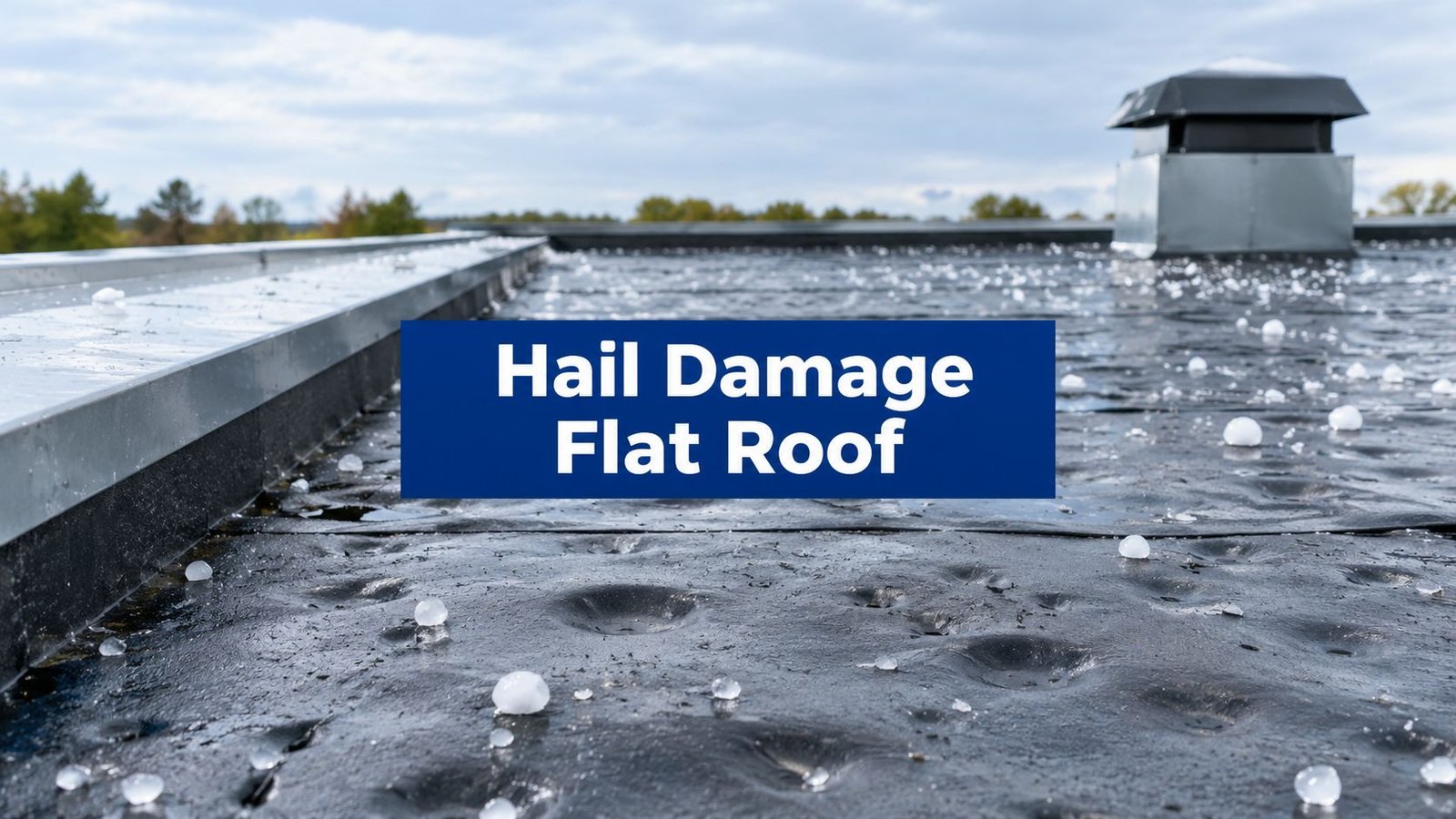
Hail damage on a flat roof is often hidden beneath the membrane surface, and even small hail can bruise insulation or weaken seams in ways that cause costly leaks months later. A proper inspection should look beyond visible punctures, especially after a serious San Antonio storm.
The storm may have passed, the roof may look unchanged, and the ceiling may still be dry. That doesn't mean the roof assembly is sound. In San Antonio, intense Texas heat, heavy rain, and recurring hailstorms can turn a small membrane weakness into an interior leak around a seam, drain, parapet, or rooftop unit.
Flat-roof damage also creates an insurance challenge. Surface photographs may not show bruising below the membrane or compression in the insulation. Property owners need evidence that connects the storm to functional damage, not just a collection of dents.
Table of Contents
- Why Flat Roofs Need a Different Hail Inspection Approach
- How Hail Impacts Flat Roof Membranes and Flashings
- Flat Roof Inspection Checklist After a Hailstorm
- Repair, Restore, or Replace Your Flat Roof After Hail
- How to Document Hail Damage for an Insurance Claim
- When to Call a Local Roofer for a Flat Roof Inspection
Why Flat Roofs Need a Different Hail Inspection Approach
A San Antonio hailstorm can move across a neighborhood quickly. One property may have visible damage to vehicles and shingles, while a nearby flat-roof building appears untouched from the parking lot. That contrast causes many owners to delay an inspection until water reaches a ceiling.
Low-slope systems need a closer look because hail strikes the surface more directly than it does a steeply sloped roof. Impact can affect the membrane, seams, insulation, flashing, drains, scuppers, parapet transitions, and rooftop equipment supports. Some damage shows as a puncture. Some appears as a shallow depression. Some remains hidden until repeated heat, rain, and movement open a failure point.
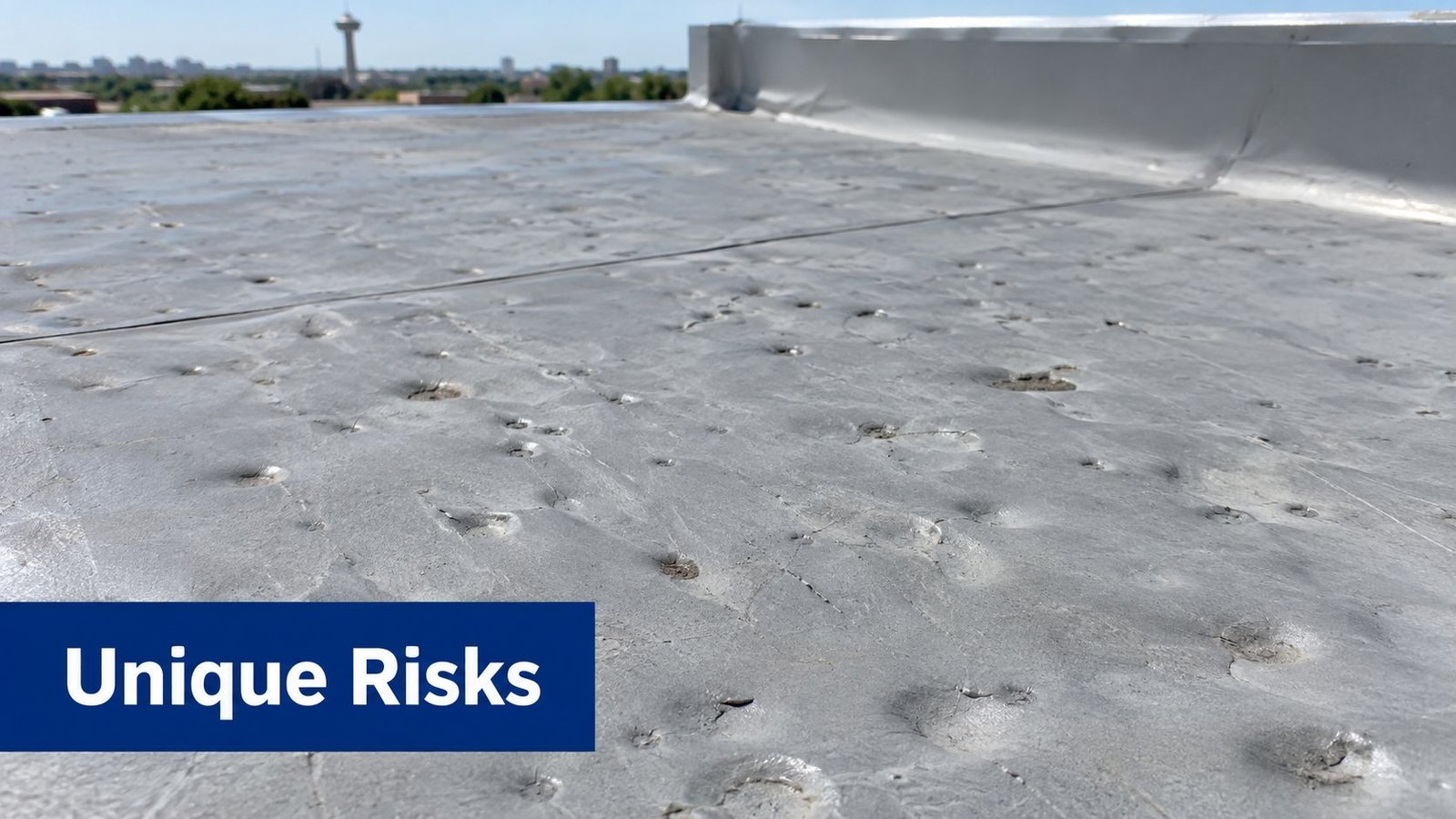
Why a dry ceiling doesn't settle the question
A roof leak is usually a late warning, not the beginning of the problem. Hail can compress insulation or weaken a seam while the upper membrane still sheds water. Later, thermal movement or a heavy rain may push water through the compromised area.
The scale of hail losses explains why owners shouldn't treat this as minor maintenance. A 2024 Verisk report cited by AAA says roof-related items account for 25% of all residential claim value, with wind and hail among the leading drivers of those claims. The same AAA summary of hail and roof damage reports that recent storm and hail roof repairs average just over $12,000, with most projects between $2,600 and $23,000.
Those figures aren't a forecast for your property, and they shouldn't be used as a quote. They do show why a hidden defect deserves prompt documentation before it spreads into wet insulation, interior damage, or a larger restoration project.
Practical rule: Don't wait for a drip to decide whether a flat roof needs inspection. Look for storm evidence while the event is recent and the roof condition is easier to document.
What owners should do after a major storm
Stay off the roof unless you have the training and fall protection to do so. A wet membrane, loose gravel, rooftop equipment, and hidden soft spots create hazards that aren't obvious from the ground.
Instead, record the storm date, photograph visible debris from a safe location, note any ceiling stains, and arrange a professional inspection. In Downtown San Antonio, Alamo Heights, and surrounding communities, the right inspection should examine the full roof assembly rather than only the areas where water has appeared.
How Hail Impacts Flat Roof Membranes and Flashings
Hail damage depends on more than the size of the stone. The membrane type, roof age, substrate condition, impact location, and storm intensity all affect the result.
A newer single-ply membrane over a firm substrate may absorb an impact without an obvious tear. An older roof or softened insulation can transfer more force into the assembly. The visible top layer may remain intact while the material beneath loses support.
Hail size provides a useful warning, not a complete diagnosis
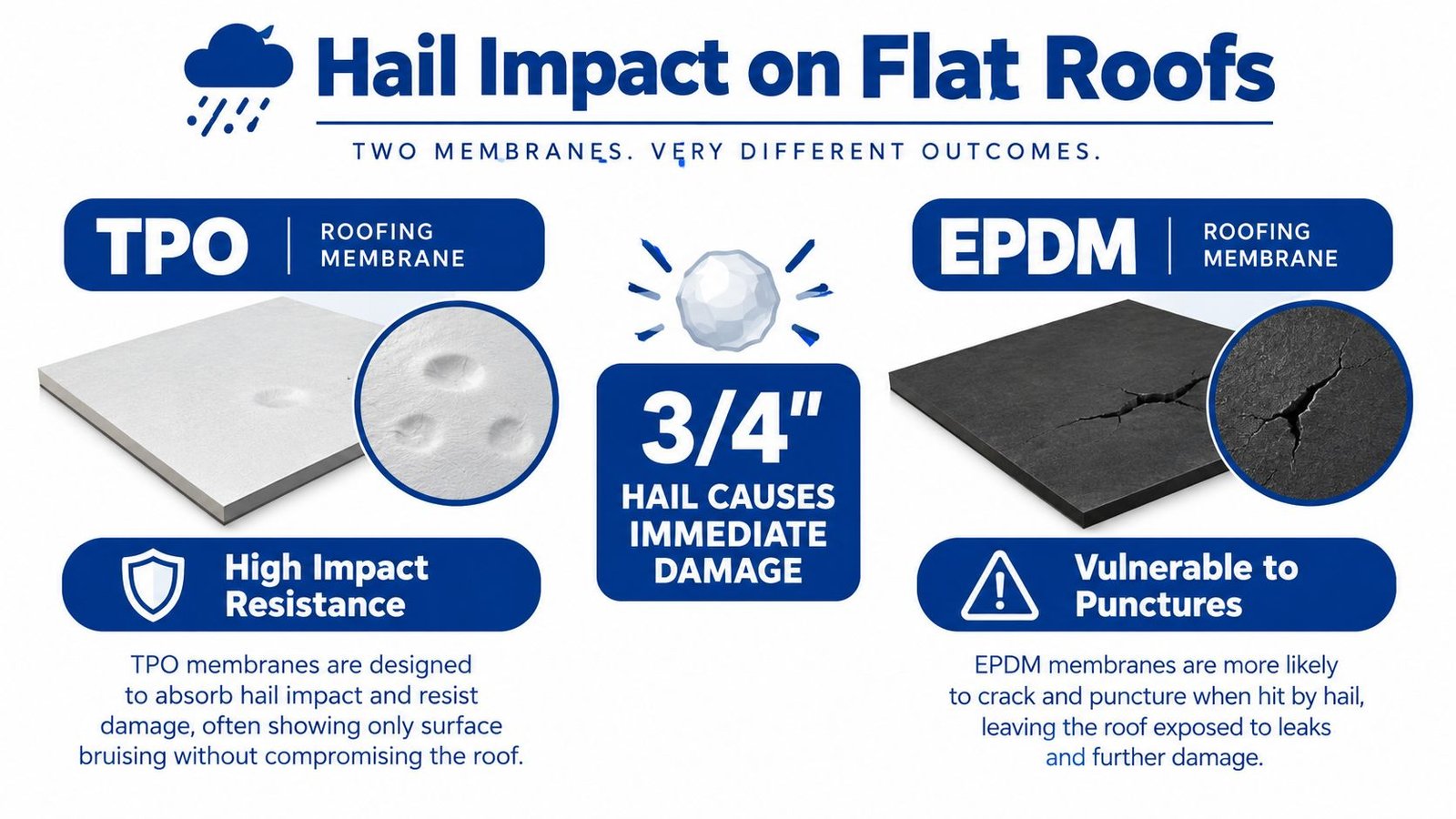
The National Weather Service classifies hail as severe when it exceeds 25.4 mm, or 1 inch, in diameter, as described in this NOAA-based explanation of hail damage. FM Global's roofing risk classification identifies Moderate Hail as less than 1.75 inches, Severe Hail as 1.75 to 2 inches, and Very Severe Hail as greater than 2 inches, according to this technical overview of hail risk for roofing systems.
Those categories help an inspector prioritize a roof. They don't prove that a particular membrane failed. Wind-driven impact, repeated strikes, aging, and a weak substrate can produce damage at lower sizes, while a stronger assembly may withstand a larger stone without immediate leakage.
TPO is cited as resisting hail up to about 1 3/4 inches, while EPDM is cited as resisting up to about 2 1/2 inches in the referenced flat-roof hail damage guidance. Those are material-specific reference points, not promises for every installed roof. Age and substrate softening can make either system more vulnerable.
The weak points aren't always in the middle of the roof
Inspectors pay close attention to heat-welded seams, field laps, perimeter details, pipe penetrations, flashing, drains, scuppers, parapet transitions, curbs, and equipment supports. A hailstone may not tear the field membrane but can stress a transition where two materials meet.
On granule-surfaced membranes, look for displaced granules and exposed areas. On smooth single-ply membranes, impact may appear as circular dimpling, cracks, punctures, or a depression that feels different from the surrounding roof. Built-up systems may show surface disruption, compression, or damage near flashing and drainage details.
For a plain-language comparison of common membrane types, see this guide to membrane roof materials. The useful question isn't which material is present. It's whether the complete roof assembly still has sound membrane integrity, secure details, effective drainage, and dry support beneath the surface.
Flat Roof Inspection Checklist After a Hailstorm
Start with safety. Don't climb onto a flat roof to take close-up photographs unless you have appropriate training, access equipment, and fall protection. From the ground or an accessible interior area, record what you can see and leave close inspection to a qualified professional.
Check the roof in a deliberate order
A useful inspection follows the way water and impact move across the system.
Scan the field membrane. Look for circular impact patterns, dimples, punctures, cracks, exposed substrate, displaced granules, and areas that look different from the surrounding surface.
Study seams and transitions. Hail can stress membrane laps, flashing edges, pipe boots, parapet transitions, HVAC curbs, and equipment supports. A seam that looks slightly lifted or separated deserves documentation.
Inspect drainage points. Check drains, scuppers, gutters, and overflow paths for damage or obstruction. A storm can leave debris in the drainage system or damage the area where the membrane joins the outlet.
Compare representative areas. A professional may use test squares to compare roof conditions across different directions and sections. Haag's protocol uses 100-square-foot test squares, typically 10 by 10 feet, with at least one square in each roof direction, north, south, east, and west, as detailed in its hail-damage assessment protocol.
Test areas help separate hail impact from weathering, rooftop traffic, installation defects, and maintenance damage. They should represent the roof's overall condition and, when possible, avoid areas obstructed by trees.
Document what the camera can't prove
Take wide photographs that show the roof section, followed by closer images of each suspected defect. Include nearby drains, seams, flashings, curbs, and equipment so an adjuster can understand the location and pattern.
A surface photograph may not establish hidden functional damage. Depending on the system, an inspector may recommend close examination, a core sample, or thermal imaging to assess insulation and moisture below the visible membrane.
Use the following video as a visual reminder of the main inspection areas, but don't treat a video as a substitute for a site assessment.
Record the storm date, suspected hail direction, interior symptoms, temporary measures, and every inspection visit. This creates a timeline instead of a folder of disconnected pictures.
Repair, Restore, or Replace Your Flat Roof After Hail
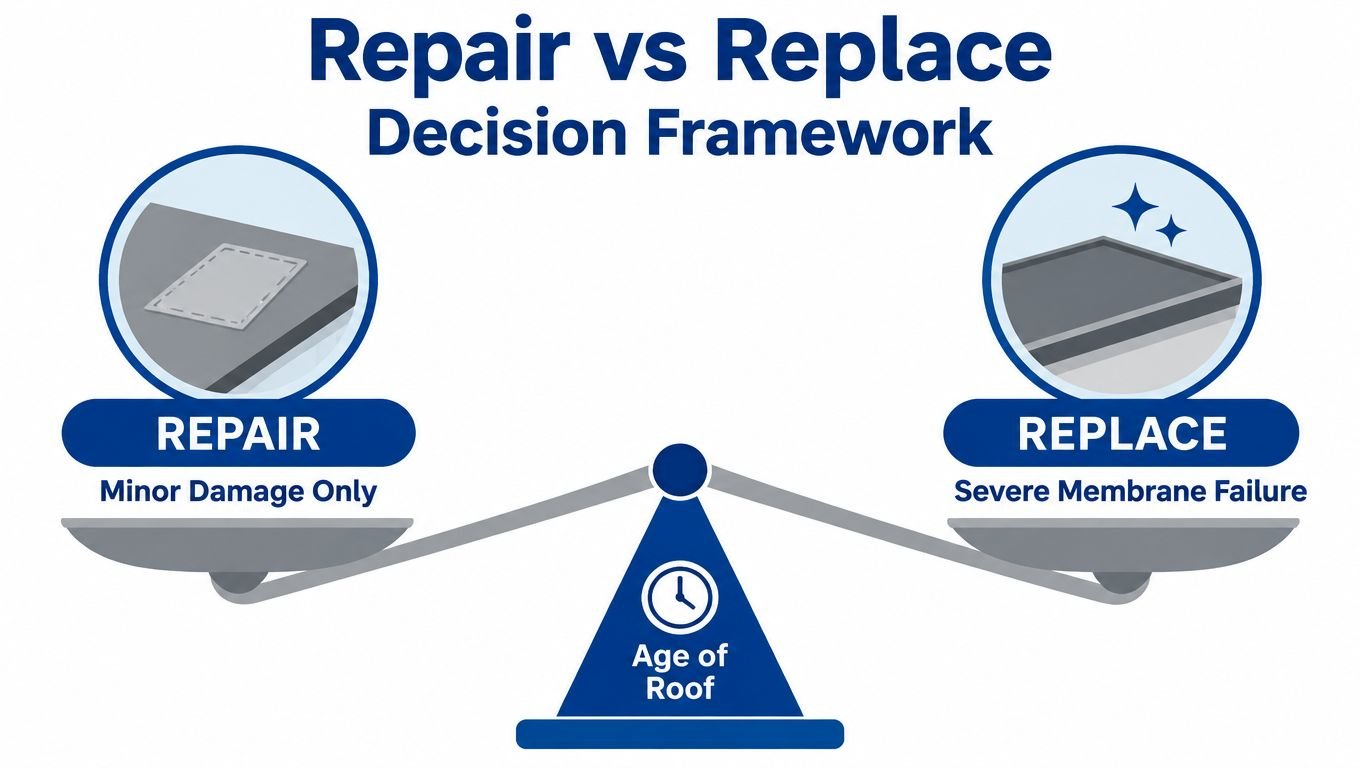
The repair decision should follow the condition of the whole assembly, not one visible mark. A localized puncture in an otherwise sound membrane is a different problem from widespread impact, wet insulation, failed seams, or damaged drainage.
When repair is reasonable
Repair usually makes sense when the damage is limited, the surrounding membrane remains serviceable, the substrate is dry and firm, and the roof drains correctly. The work may involve membrane patches, seam repairs, flashing replacement, or correction around a penetration.
A patch isn't a solution if water has spread below it or if repeated failures show that the roof has broader deterioration. The repair should address the entry path and the supporting materials, not just cover the most obvious mark.
When restoration can work
A coating or restoration system may help a granule-surfaced membrane when granule loss is visible but the membrane and substrate remain undamaged. GAF's repair guidance for granule-surfaced membranes says coating isn't appropriate when impacts create cuts, punctures, or tears, or when damage causes leaks or permits moisture into the assembly.
That distinction matters in South Texas, where coating over a compromised surface can hide the defect while heat and rain continue to stress it. Restoration works best when inspection confirms that the roof still has a sound base.
When replacement is the responsible option
Replacement becomes more defensible when hail has affected broad areas, insulation is wet or compressed, seams fail repeatedly, drainage is compromised, or the existing membrane can't support dependable repairs. Age alone shouldn't decide the outcome, but age combined with widespread storm distress changes the trade-off.
| Option | Appropriate when | Main limitation |
|---|---|---|
| Repair | Damage is localized and the assembly remains sound | May not solve widespread deterioration |
| Restore | Surface wear exists without membrane or substrate failure | Coating won't correct punctures or wet materials |
| Replace | Severe membrane failure or broader assembly damage is present | Requires more planning and disruption |
For a practical record-keeping reference, review this guide to documenting roof damage for insurance. Keep the inspection findings separate from the final coverage decision, because an insurer, not a contractor, determines what a policy covers.
How to Document Hail Damage for an Insurance Claim
A strong claim file connects four things: the storm, the affected roof areas, the type of damage, and the functional consequence. Cosmetic marks alone may not explain why a flat roof needs repair or replacement.
Begin with a simple timeline. Write down when the hailstorm occurred, when you first noticed interior staining or drainage problems, and when temporary protection was installed. Save weather notifications, maintenance records, prior inspection reports, and photographs that show the roof before and after the event when available.
Photograph the full system, not just the impact marks
Use wide, medium, and close views. Photograph each roof section, then show the details that support the finding:
- Field membrane: Capture bruising, dimpling, punctures, cracks, granule loss, and unusual depressions.
- Seams and flashings: Photograph open laps, stressed edges, loose flashing, parapet transitions, and pipe penetrations.
- Drainage: Record drains, scuppers, overflow paths, debris, and any new ponding areas.
- Interior evidence: Photograph ceiling stains, wet insulation access points, damaged finishes, and the location below the suspected entry point.
- Rooftop equipment: Include curbs, supports, screens, and penetrations that may have transferred impact or developed a failed transition.
Don't make unsupported statements about causation. Ask the inspector to distinguish hail damage from weathering, foot traffic, installation defects, and unrelated maintenance conditions.
Support hidden damage with objective testing
Flat-roof damage may require a core sample, moisture investigation, or thermal imaging when the surface looks mostly unchanged. These methods can help identify compromised insulation or moisture patterns, but the inspector should explain what each test shows and preserve the test location afterward.
Keep written findings, marked roof plans, test-square locations, photographs, repair recommendations, and contractor estimates together. Resources such as Closer Innovation Labs Corp. insurance forms can help organize claim paperwork, but forms don't replace technical evidence or policy review.
For additional claim-focused roofing guidance, see this hail damage roof insurance claim resource. No contractor can promise claim approval. Your insurer will apply the policy terms, exclusions, deductibles, and required procedures.
When to Call a Local Roofer for a Flat Roof Inspection
Call a local roofer when hail was severe, the roof has visible impact marks, water appears indoors, a drain or flashing is damaged, or the membrane shows unusual dimpling or seam stress. Stop a do-it-yourself inspection if the surface is wet, access is unsafe, or the roof contains soft areas.
A San Antonio property owner might see no leak after a storm and assume the roof is fine. A closer inspection may find a damaged curb, a bruised section above insulation, or a seam that has lost its seal but hasn't opened during the first rain. That difference can affect whether the owner documents a localized repair or investigates a broader roof assembly problem.
A thorough inspection should identify the membrane type, map roof sections, examine seams and penetrations, check drainage, distinguish hail from normal wear, and explain whether further testing is needed. It should also produce photographs and written findings that an owner can understand before speaking with an adjuster.
RRSATX provides free roof inspections, flat-roof repair, replacement, storm-damage support, and insurance-ready documentation for residential and commercial properties in San Antonio and nearby communities. The company is father-son owned, has operated since 2000, and carries $2,000,000 in liability insurance, but homeowners should still verify the contractor's current credentials and make their own coverage decisions.
Call RRSATX at 713-504-2341 to schedule a free roof inspection after hail damage flat roof concerns, or arrange an inspection online. A documented assessment can help you address hidden membrane damage before the next heavy rain turns it into an interior emergency.