
[et_pb_section fb_built=”1″ admin_label=”section” _builder_version=”4.16″ global_colors_info=”{}”][et_pb_row admin_label=”row” _builder_version=”4.16″ background_size=”initial” background_position=”top_left” background_repeat=”repeat” global_colors_info=”{}”][et_pb_column type=”4_4″ _builder_version=”4.16″ custom_padding=”|||” global_colors_info=”{}” custom_padding__hover=”|||”][et_pb_code _builder_version=”4.27.7″ _module_preset=”default” hover_enabled=”0″ sticky_enabled=”0″]
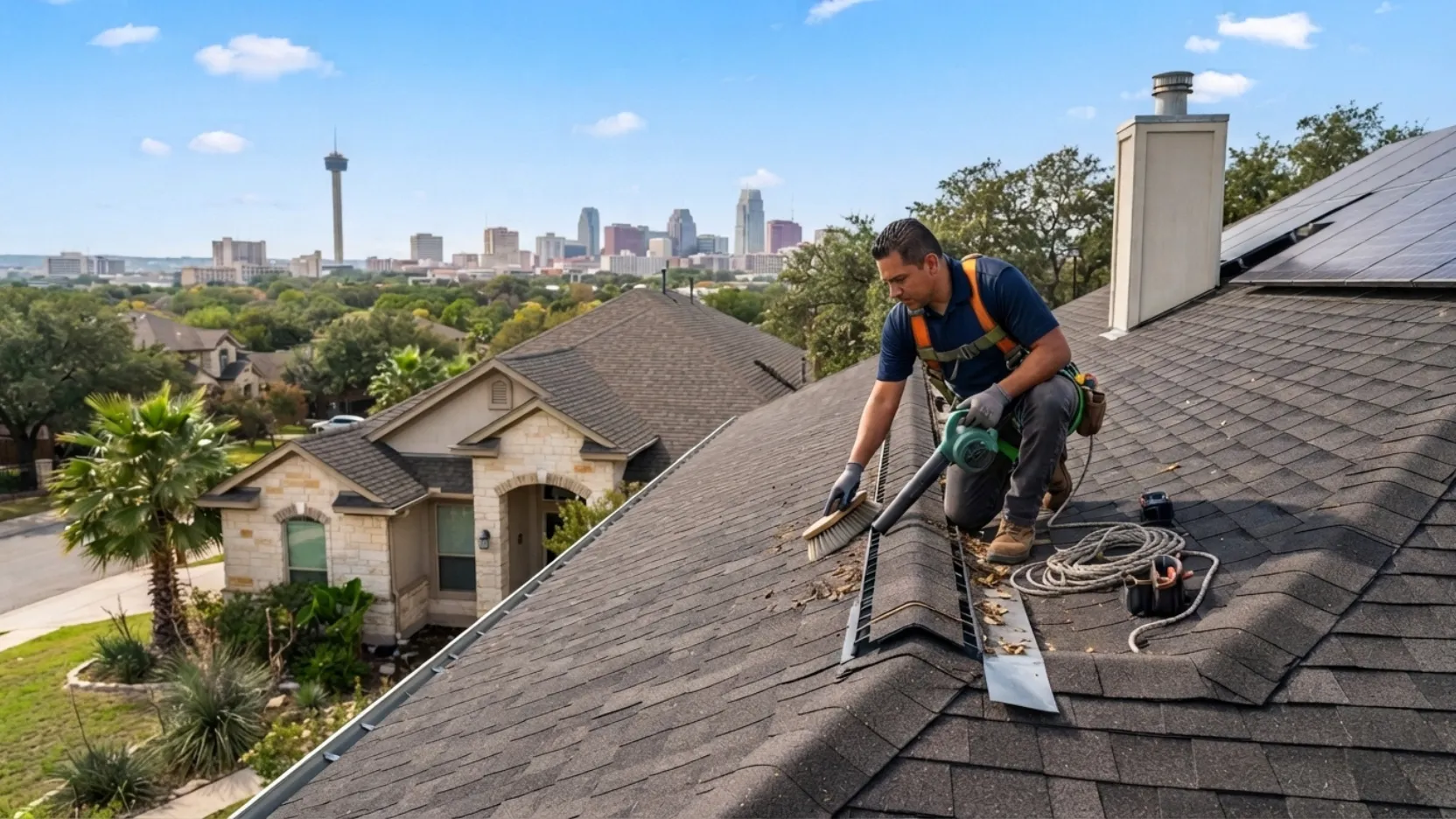
San Antonio’s heat, hailstorms, and unpredictable weather put your roof under constant stress. This complete maintenance guide covers every task you need to keep your roof in peak condition, how often to do it, what it costs, and exactly when to call a professional before a small problem turns into a costly repair.
Your roof is the single most important protective system on your home, and in San Antonio it works harder than almost anywhere else in the country. Summer temperatures push rooftop surface heat past 160 degrees Fahrenheit. Hailstorms roll through Bexar County multiple times a year. UV radiation in South Texas is intense enough to degrade roofing materials noticeably faster than in northern climates. Add the occasional freezing rain event in winter, and you have a roofing environment that demands consistent, scheduled maintenance to get the full value out of your investment.
The good news is that most roof failures are preventable. The damage that causes a roof to fail prematurely almost always starts small: a cracked sealant joint, a clogged valley, a handful of lifted shingles after a windstorm. Catching these issues during routine maintenance costs a fraction of what a repair costs after water has gotten in. This guide covers everything you need to maintain your San Antonio roof correctly, from what to inspect to how often to do it, what it costs, and when the job belongs to a licensed contractor.
Most San Antonio homeowners call a roofer only when they see water inside the house. By that point, water has already been working its way through the roof system for weeks or months. Insulation is saturated, decking may be softening, and mold is often already developing. A twice-yearly inspection, scheduled in spring before hurricane season and in fall after the hottest months, catches problems while they are still inexpensive to fix. Add a post-storm inspection after any hail event with stones larger than a quarter, and you have covered the vast majority of roof damage scenarios in Bexar County.
Inspection
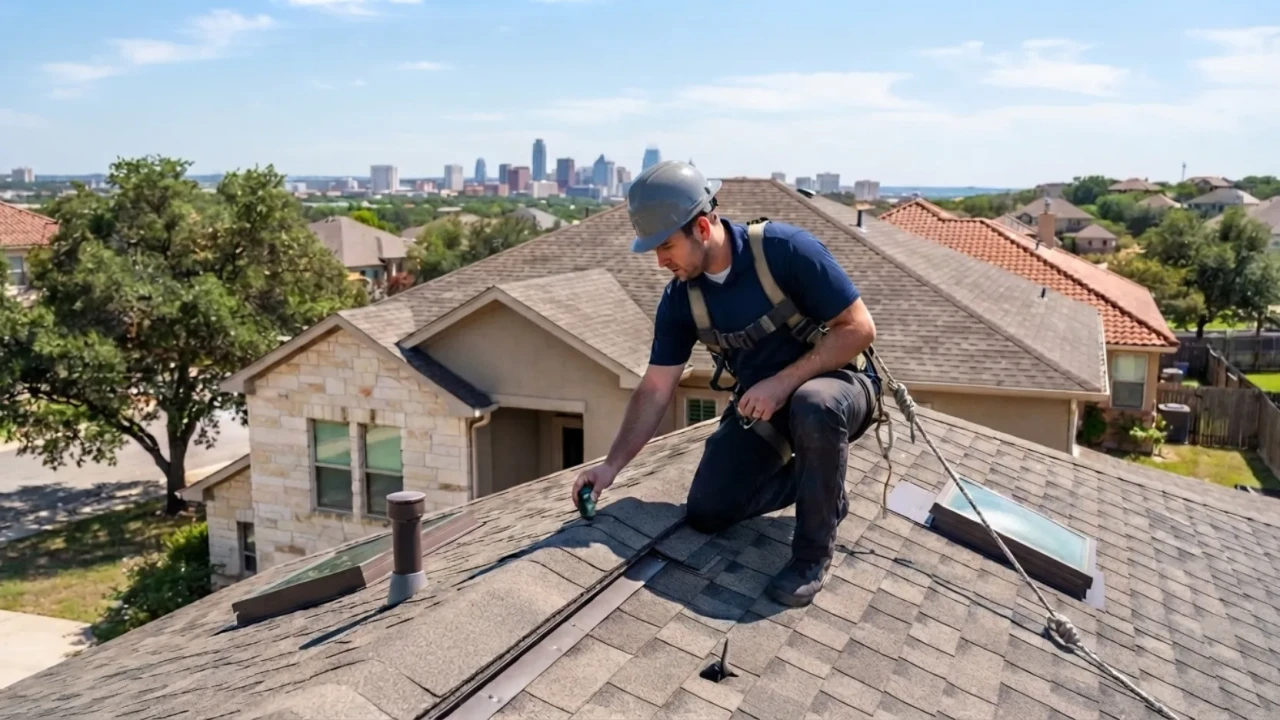
A roof inspection is not the same as walking up to the edge of your roof and looking around. A thorough inspection covers every component of the roofing system: the field of shingles or panels, all flashings at every penetration and transition, the ridge cap, the valleys, the gutters and downspouts, the fascia and soffit, and the condition of any sealants or caulk joints. Missing one of these areas is how small problems get overlooked until they become large ones.
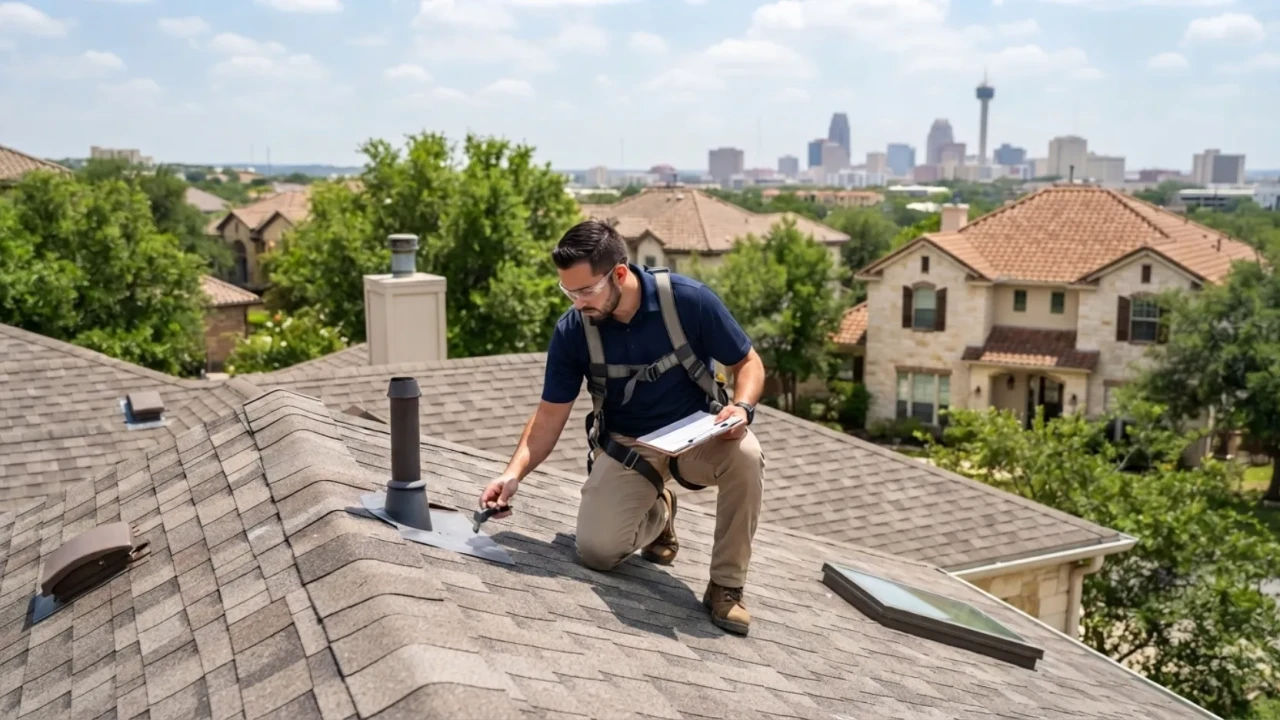
What a proper inspection covers: The shingle field is checked for curling, cracking, cupping, granule loss, and any missing or lifted shingles. Flashings at the chimney, skylights, vent pipes, and wall transitions are checked for separation, corrosion, or failed sealant. The ridge is checked for lifted caps or exposed fasteners. Valleys are checked for debris accumulation and any signs of wear at the center line where water volume is highest.
When to schedule inspections in San Antonio: Spring, before the peak of hurricane season, is the ideal time for the first inspection of the year. This gives you time to address any winter damage and make sure the roof is ready for the heavy rain events of late spring and summer. The second inspection should go in fall, after the hottest months, when UV and heat damage is most likely to have progressed. After any hail event with stones a quarter inch or larger, a post-storm inspection is warranted regardless of where you are in the annual schedule.
- Shingle field inspected for curling, cracking, cupping, and granule loss across all slopes
- All flashings checked at chimney, skylights, vents, pipes, and wall transitions
- Ridge cap condition verified: no lifted caps, no exposed or backed-out fasteners
- Valleys cleared and checked for wear patterns or open seams at the center line
- Gutters inspected for clogs, sagging, and separation from fascia board
- Soffit and fascia checked for rot, staining, or pest entry points
- Attic checked for daylight, moisture staining, or mold on the underside of the decking
- Written inspection report received with photos before any repair work is quoted
Drainage
Gutters exist to move water away from your foundation and your roof edge. When they clog, water backs up under the drip edge, saturates the fascia board, and works its way into the decking and framing. In San Antonio, where afternoon thunderstorms can dump two inches of rain in 30 minutes, a clogged gutter can overflow with enough force to erode the soil at your foundation and push water back onto the roof in a matter of minutes.
The other drainage failure point that San Antonio homeowners consistently overlook is the roof valley. Valleys are the internal angles where two roof planes meet and channel large volumes of water toward the gutters. Leaves, twigs, and debris from nearby oak and pecan trees accumulate in valleys and slow drainage dramatically. Over time, this standing debris traps moisture against the valley flashing or valley liner and accelerates deterioration at exactly the point where the roof sees the most water volume.
Schedule gutter cleaning twice per year in San Antonio: once in late spring after the oak pollen and seed drop, and once in late fall after the pecan and leaf drop. Homes under heavy tree canopy may need a third cleaning in mid-summer when monsoon-pattern storms push debris onto the roof. The most dangerous time for a clogged gutter in San Antonio is during the first major storm of the season when months of debris get pushed toward a blocked downspout all at once.
- Gutters cleaned twice per year minimum: late spring and late fall
- All downspouts flushed to confirm clear flow from top to discharge point
- Downspout extensions in place, directing water at least 4 feet from the foundation
- Roof valleys cleared of debris at the same time gutters are cleaned
- Gutter slope confirmed: gutters should pitch approximately 1 inch per 10 feet toward the downspout
- Any gutter sections pulling away from the fascia re-secured before the next rain season
- Fascia boards behind gutters checked for rot or moisture damage at the same visit
Surface Care
San Antonio’s roofing environment is one of the harshest in the country for roofing materials. Average summer temperatures push surface temperatures on a dark asphalt shingle roof above 160 degrees. UV index values in South Texas are high year-round. This combination accelerates the oxidation and brittleness that eventually causes shingles to crack, curl, and lose granule coverage faster than equivalent products installed in cooler climates. Understanding what normal wear looks like versus damage that needs to be addressed is the key maintenance skill for San Antonio homeowners.
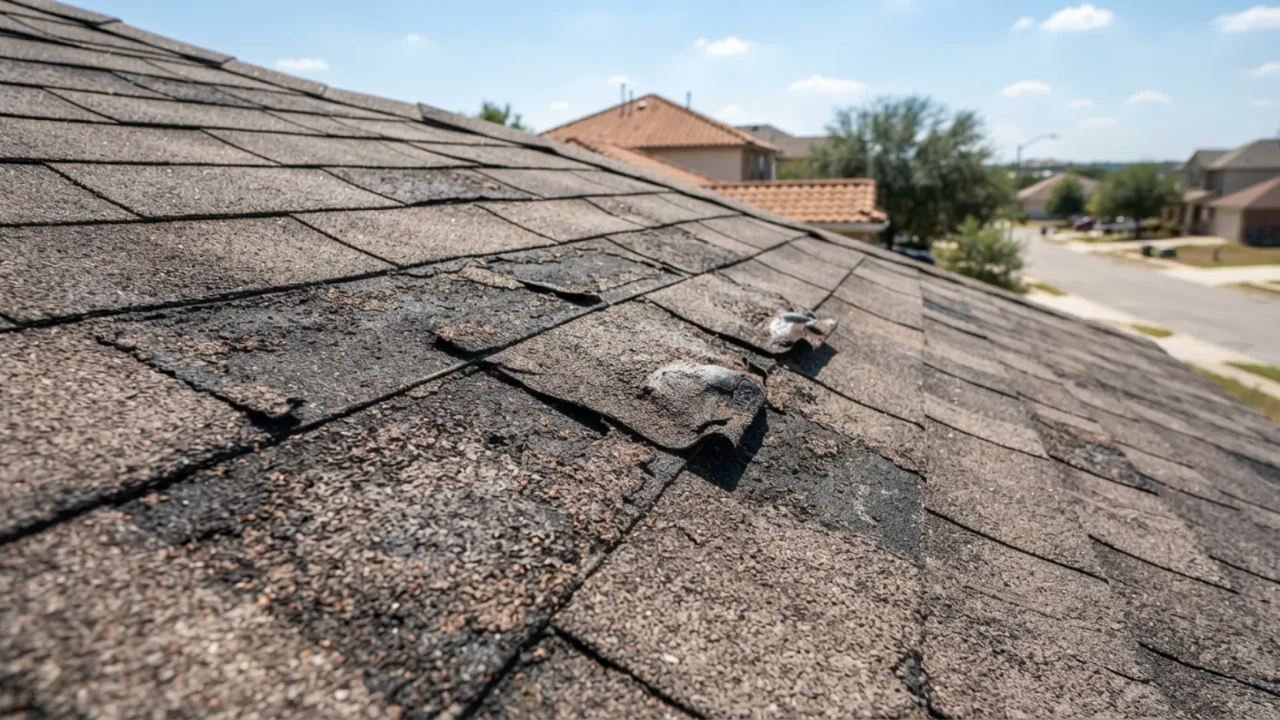
Granule loss: Asphalt shingles use mineral granules as the primary UV protection layer. As shingles age in San Antonio’s sun, these granules loosen and wash into the gutters. Some granule loss after a major hailstorm is a sign of impact damage. Gradual granule loss in gutters over time is a sign of normal aging accelerated by heat and UV. When granule loss exposes the asphalt mat underneath, the shingle’s waterproofing degrades rapidly and replacement becomes urgent.
Algae and moss: Black streaking on asphalt shingles in San Antonio is almost always Gloeocapsa magma, a blue-green algae that thrives in the humidity trapped under tree canopy and north-facing roof slopes. Algae itself does not cause immediate structural damage, but it holds moisture against the shingle surface and accelerates granule loss. Moss is more aggressive and can physically lift shingle tabs as its roots grow under the edges. Both should be treated at the first appearance rather than left to spread.
- Shingle field checked annually for curling, cracking, cupping, and exposed asphalt mat
- Granule accumulation in gutters assessed at each cleaning: heavy accumulation warrants a professional evaluation
- Algae streaking treated at first appearance with a low-pressure, soft-wash approach
- Missing or visibly lifted shingles replaced within one week of discovery
- No pressure washing at high PSI on asphalt shingles: granule loss is irreversible
- Algae-resistant shingles specified for any replacement work on San Antonio homes
Flashing
Flashings are the metal components that seal the transitions and penetrations in your roof: around the chimney, at the base of walls where they meet the roof slope, around skylights, at every vent pipe and HVAC curb, and along the rake edges. Sealant is used to seal the laps and edges of flashings where metal meets masonry, metal meets shingle, or two metal surfaces overlap. Both the metal and the sealant have a service life, and in San Antonio’s thermal cycling environment, that service life is shorter than most homeowners expect.
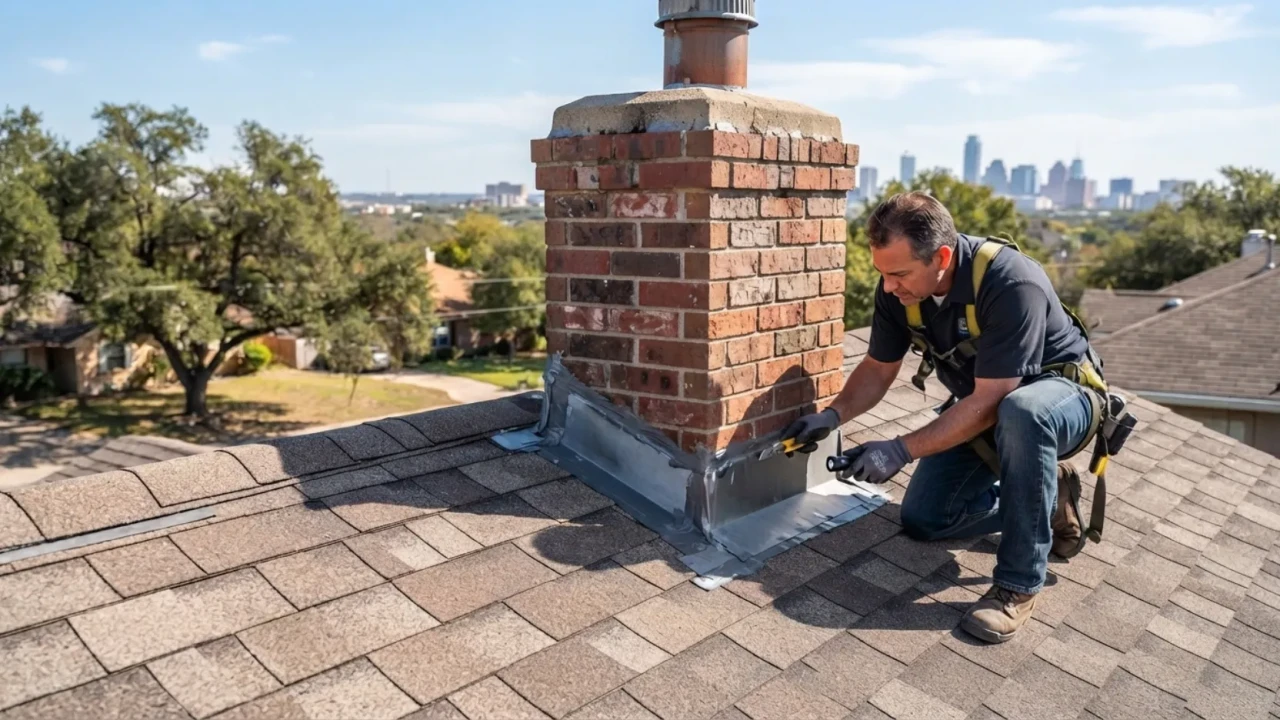
Why flashing fails in San Antonio: The daily and seasonal temperature swings in South Texas cause metal flashings to expand and contract repeatedly. Over years, this movement works the sealant out of the joint, cracks it, and eventually separates it from the surface entirely. A flashing that was properly installed 10 years ago may have a sealant joint that is cracked and pulling away from the masonry or membrane today, even if the surrounding shingles look fine.
The chimney is the highest-risk flashing location: A chimney has step flashings on the sides, counter flashings embedded in the mortar joints, and a saddle or cricket behind it to divert water around the back. Any one of these components can fail independently, and the leak they cause may show up on the ceiling 10 feet away from the chimney itself. Chimney flashing inspection is the single most important flashing task on a San Antonio home with a masonry chimney.
Vent pipe boots are one of the most common sources of slow leaks on San Antonio roofs 10 years and older, and they are inexpensive to replace. The rubber collar on a vent boot degrades in UV light and becomes brittle, cracking at the seam where it grips the pipe. The leak is slow and may not show up as a visible drip inside the house for months. Water instead saturates the insulation and decking below. A competent inspection will check every boot on the roof. If any are more than 12 years old or show visible cracking, replacing them during a maintenance visit is the right call.
- Chimney step and counter flashings checked at each spring and fall inspection
- All vent pipe boots inspected for cracking or UV degradation; replace any boots over 12 years old
- Skylight curb flashing checked at all four corners for sealant separation or gap
- Wall step flashing at dormers and second-floor transitions inspected from the inside of the attic as well as the exterior
- Sealant at all flashing laps stripped and replaced where cracking, peeling, or separation is found
- Drip edge checked at eaves and rakes for corrosion, lifting, or gaps in coverage
Storm Response
San Antonio experiences more significant hail events per year than most major American cities. The hail corridor that runs from Dallas through San Antonio and toward the Texas coast puts Bexar County directly in the path of the same storm systems that produce some of the most damaging hail in North America. A stone the size of a quarter impacts an asphalt shingle roof with enough force to dislodge granules, crack the mat beneath, and create small impact craters that expose the asphalt to UV and moisture. Over the following months, those impact points become the first places leaks develop.
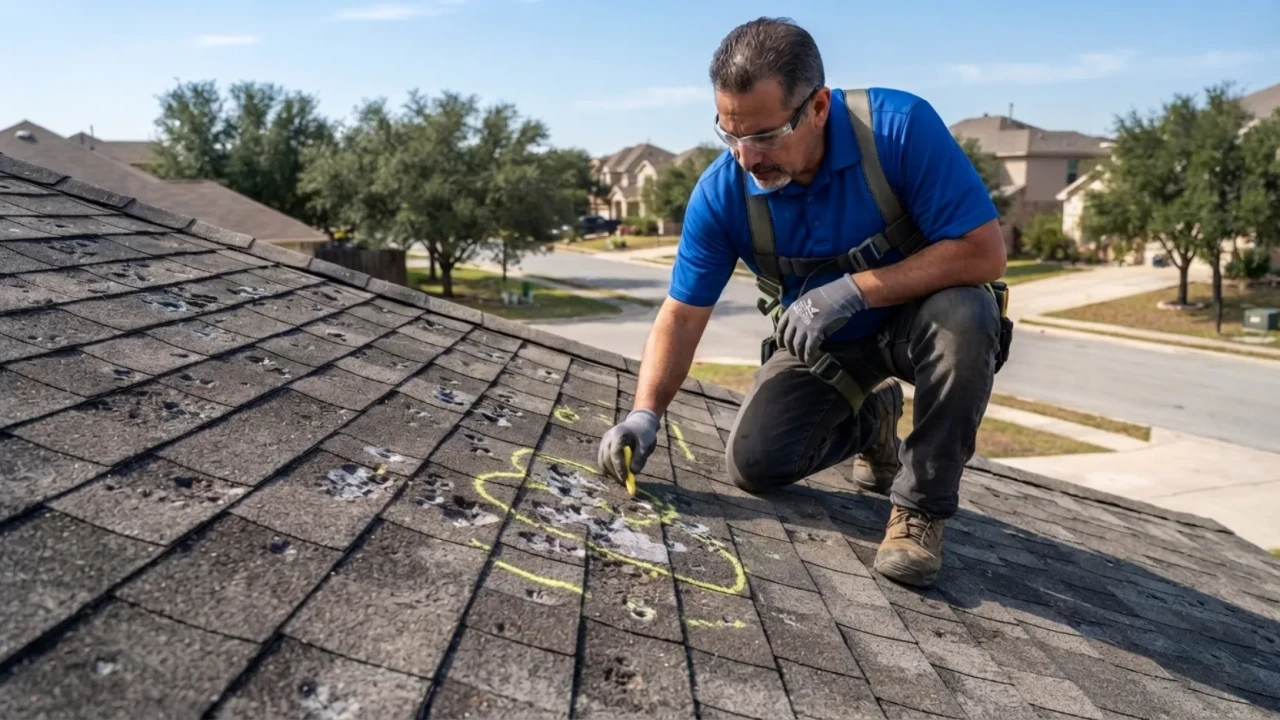
What to do immediately after a hail event in San Antonio: Do a ground-level visual inspection within 24 hours. Look at your gutters and downspouts for granule accumulation that was not there before the storm. Check your AC condenser fins and any metal surfaces at ground level: if they show denting, hail was large enough to cause roof damage. Take dated photos of anything you observe. Do not walk the roof yourself unless you have proper fall protection and roofing footwear.
- Ground-level visual inspection completed within 24 hours of the storm event
- Granule accumulation at downspouts documented with dated photos
- AC condenser fins and metal surfaces at ground level checked for denting as a proxy for hail size
- Professional roof inspection scheduled within 30 days of any storm with quarter-size or larger hail
- Insurance claim filed within one year of the storm event as required under Texas policy terms
- Emergency tarp requested immediately if interior water intrusion is occurring
- Independent contractor estimate obtained before signing any insurance settlement
Vegetation
San Antonio neighborhoods are full of mature live oak, pecan, and cedar elm trees, and many homes have branches that extend directly over the roof. These trees are valuable and worth keeping, but the branches that reach the roof create specific maintenance challenges that shorten roofing material life if they are not managed. The problems come from three directions: physical abrasion from branches rubbing the surface, debris accumulation that retains moisture and promotes algae, and the shading that slows drying after rain and encourages biological growth.
The practical guideline for San Antonio homeowners is to maintain at least six feet of clearance between any branch tip and the roof surface. This clearance prevents abrasion during wind, reduces the debris load on the roof, and eliminates the most direct pest access route from the tree to the structure. Branches that hang directly over the roof also catch water during rain and channel it in concentrated drips onto the shingles rather than allowing it to run off naturally, which accelerates granule erosion at the drip point.
Live oak trees drop a significant amount of pollen, catkins, and small leaves throughout the spring months in San Antonio. This material collects in roof valleys and behind chimney crickets faster than most homeowners expect. A single spring season can deposit enough organic matter in a valley to slow drainage noticeably. Build a valley and gutter cleaning into your late spring maintenance schedule every year, not just when you notice a problem, and you will significantly extend the life of your valley flashing and the shingles on either side of it.
- All branches checked annually for 6-foot clearance from the roof surface; trim anything closer
- Storm-weakened or dead branches over the roofline identified and removed before hurricane season
- Roof debris cleared after major oak pollen season in spring and after leaf drop in fall
- Valleys inspected specifically for acorn and leaf accumulation that is slowing drainage
- Any abrasion marks on shingles from branch contact identified and the branch removed
- Soffit and fascia checked for pest entry points created by branch access routes
This schedule is designed around San Antonio’s specific seasonal patterns: heavy oak pollen and rain in spring, extreme UV and heat through summer, potential late-season hurricane activity through October, and the occasional winter freeze event. Sticking to this schedule catches the overwhelming majority of roof issues before they become costly repairs.
| Time of year | Maintenance task | Who does it | Estimated cost |
|---|---|---|---|
| March to April (Spring) | Professional roof inspection, gutter cleaning, valley clearing, post-winter shingle check | Licensed roofing contractor | $150 to $350 |
| Late April to May | Oak debris and pollen clearing from gutters and valleys after peak drop | Contractor or homeowner from ladder level | $100 to $200 |
| After any major hail event | Post-storm inspection within 30 days, damage documentation, insurance claim if warranted | Licensed roofing contractor | $0 to $150 (often included) |
| July to August (Summer) | Ground-level visual check for lifted shingles or visible damage from summer storm activity | Homeowner from ground level | $0 |
| October to November (Fall) | Professional inspection, full gutter and valley cleaning, flashing sealant check, tree trimming review | Licensed roofing contractor plus arborist if needed | $150 to $500 |
| December to January (Winter) | Check for ice dam risk on low-slope sections and confirm attic ventilation is adequate before freeze events | Homeowner visual plus contractor if concerns found | $0 to $250 |
- Shingle field checked for curling, cracking, cupping, and granule loss across all slopes
- Any missing or visibly lifted shingles identified and replacement scheduled within one week
- Algae streaking or moss growth spotted and treatment scheduled before the next rain season
- Hail impact craters or storm-related granule loss documented with dated photos
- Chimney step and counter flashings checked for sealant separation or corrosion
- All vent pipe boots inspected; any over 12 years old or showing cracking scheduled for replacement
- Skylight curb flashing checked at all four corners for gap or separation
- Drip edge at eaves and rakes checked for corrosion, lifting, or missing sections
- All sealant joints at flashing laps stripped and refreshed where cracking or peeling is found
- All gutters cleaned and flushed to confirm clear flow to downspouts
- Downspout discharge confirmed at least 4 feet from the foundation
- Roof valleys cleared of debris and checked for wear at center line
- Gutter slope confirmed: approximately 1 inch of pitch per 10 feet toward downspout
- Any gutter sections pulling away from the fascia re-secured
- All branches confirmed at 6 feet or more of clearance from the roof surface
- Storm-weakened or dead limbs over the roofline identified for removal before storm season
- Attic inspected for daylight, moisture staining, mold, or inadequate ventilation
- Soffit and fascia checked for rot, pest entry, and moisture staining
- Attic insulation checked for moisture or compression that could indicate a slow leak
How often should I have my roof inspected in San Antonio?
What does roof maintenance cost in San Antonio?
Can I do my own roof maintenance in San Antonio?
How do I know if my San Antonio roof needs repair or full replacement?
Does homeowner’s insurance cover routine roof maintenance in San Antonio?
How long does an asphalt shingle roof last in San Antonio?
Schedule your free roof maintenance inspection in San Antonio
Tell us about your roof’s age, your last inspection, or any concerns you have. We will walk your roof, document what we find, and give you a clear written maintenance plan at no cost.
[/et_pb_code][/et_pb_column][/et_pb_row][/et_pb_section]