
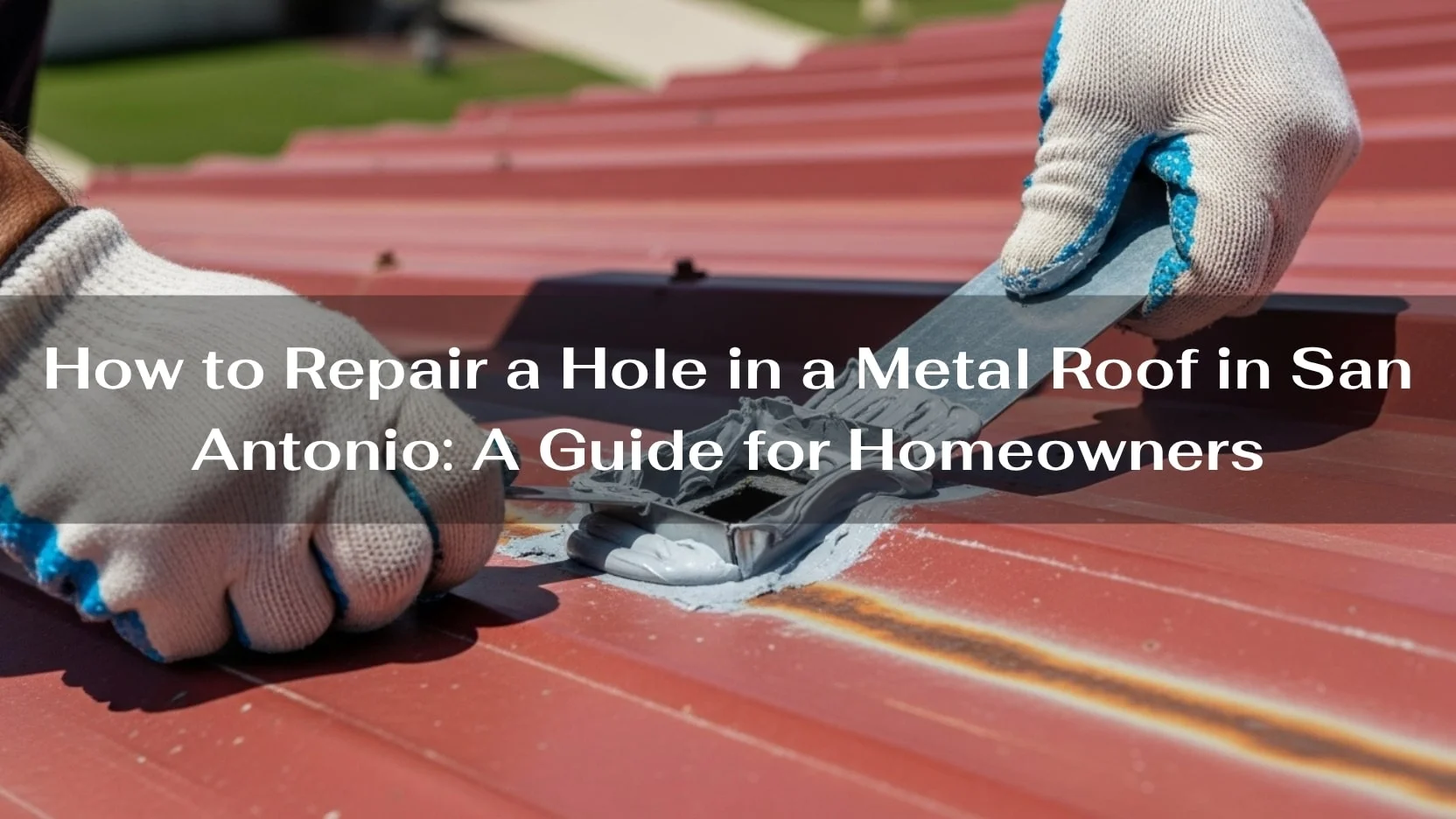
Metal roof repair · San Antonio, Texas
Hole in Your Metal Roof: Do You Patch It or Call a Pro?
Use what you can see from the ground, the extent of the damage, and local rules to decide whether a hole in your metal roof needs a small patch or a professional repair.
The short answer
A hole in a metal roof lets water in, so handle it quickly. From the ground, note the size, any rust, and whether the panel is bent or torn. A small, clean puncture may be patched with matching metal and a compatible sealant, while larger holes, spreading rust, or structural damage call for a professional. In San Antonio, a permit is required to repair or replace a roof. [1]
Judge the damage from the ground first
You can learn a lot about a hole without ever leaving the ground. A hole is an opening for rain, and even a small one can lead to water stains and damage inside the home if it is left alone.
Walk the perimeter of the house and look up at the roof slopes. Use your phone camera to zoom in and take clear photos of the damaged area from several angles. Then step inside and check the ceilings and walls below that part of the roof for fresh stains, dampness, or discoloration. Writing down what you see gives any roofer a useful starting point and helps you compare written estimates later.
Metal roof panels can be slick and steep, and a wrong step can cause a serious fall, so the roof surface is no place to inspect a hole. For more on that risk, see our guide on whether you can walk on a metal roof.
What RRSATX recommends
Keep both feet on the ground or stay indoors while you look. Photograph the hole, note its rough size against a nearby feature, and save the pictures with the date. If you cannot see the damage clearly, ask for a metal roof inspection instead of guessing.
Should you patch it yourself or call a pro?
The size and cause of the hole, and the condition of the panel around it, drive this choice. A single, clean puncture in a flat, sound panel is a different job from a torn panel, a cluster of holes, or rust that is spreading.
Use what you noted from the ground to sort the damage. The table below lines up the signs that may allow a careful patch against the signs that point toward a professional repair. It is a guide, not a promise; when the picture is mixed or unclear, treat it as a reason to get a professional opinion.
| What you see | May allow a careful patch | Points to a professional |
|---|---|---|
| Size | One small, clean puncture | A larger opening or several holes |
| Rust | No rust spreading around the edges | Rust spreading across the panel |
| Panel shape | Panel is flat, fixed, and sound | Panel is bent, torn, or loose |
| Cause | A single minor impact | A fallen limb, age, or structural damage |
| Inside the home | No active staining on ceilings or walls | Water staining or dripping indoors |
If a hole is already letting water into the home, the priority is stopping the water and protecting what is below it, not a permanent fix in the rain. A professional can also tell you whether the panel can be patched or should be replaced. Compare the company process on the metal roof repair and roof leak repair pages.
What RRSATX recommends
If any column on the right applies, treat the hole as a professional repair rather than a do-it-yourself patch. If you are unsure which side it falls on, the safer reading is the professional one. A written inspection removes the guesswork before money is spent.
Why matching metal and sealant matter
The materials used for a patch are not interchangeable. Metal roofing can corrode faster when two different metals touch, so a patch, fasteners, and flashing should be compatible with the panel they sit against.
According to MBCI, a metal roofing manufacturer, lead and copper are among the biggest culprits in shortening the service life of metal roofing due to corrosion, and contact between copper parts and metal roofing can greatly increase the likelihood of corrosion. [2] That is why a quick patch made from whatever metal is on hand can create a slow new problem even after the hole looks sealed.
Sealant choice matters too. A compatible sealant made for metal roofing helps keep water out at the edges of a patch, while the wrong product can fail early or react with the coating. When metals and sealants are uncertain, the conservative move is to match the existing system rather than improvise.
What RRSATX recommends
Before any patch, confirm the roof metal and ask that the patch, fasteners, flashing, and sealant be compatible with it. If you do not know what your panels are made of, have them identified first. Guessing on materials is how a small repair turns into a corrosion problem.
Permits and insurance in Texas
A repair is not only a technical question; local rules and your policy shape it too. Handle these before work starts so there are no surprises.
The City of San Antonio Development Services Department states that a building permit is typically required to build, remodel, or repair a structure, and it provides a re-roof permit path. A homeowner can apply for the permit, or a registered contractor can obtain it on the homeowner’s behalf. [1] Ask who will pull the permit and keep a copy of it with your records.
When you compare companies, the Texas Department of Insurance advises getting bids in writing and at least three of them, on company letterhead with a phone number and address, and reading every document before signing with no blank spaces left in the contract. [3]
If you think the damage may be a claim, remember that the insurer decides coverage. Texas does not allow a roofer who is also doing the work to act as a public insurance adjuster on the claim, and it is illegal for a contractor to offer to waive, rebate, or absorb your deductible. [4] Keep your photos, estimates, and insurer correspondence together, and ask your insurer to explain its decision rather than relying on a contractor’s promise.
Next steps
Split the work into what you can safely do and what needs a roofing professional. The goal is to protect the home and document the problem without taking on roof risk.
You can safely do these from the ground or indoors:
- Look at the roof slopes from the ground and take dated photos of the hole.
- Check the ceilings and walls below for stains, dampness, or drips.
- Move or cover belongings under any active indoor leak.
- Gather your records: roof details if known, past repairs, and your insurance policy.
- Write down the questions you want each roofer to answer.
Leave these to a roofing professional, who has the equipment and training to work at height:
- Getting on the roof to inspect, measure, or test the hole and the panel around it.
- Deciding whether the panel can be patched or should be replaced.
- Selecting matching metal, fasteners, flashing, and sealant for the repair.
- Making the repair and confirming the area is watertight.
If water is actively coming in, read our guide on what to do when a metal roof is leaking, and review the signs you need metal roof repair now so you know what to describe when you call.
Local roofing service
About Affordable Roofing Contractors San Antonio
Affordable Roofing Contractors San Antonio, also known as RRSATX, provides roof repair, roof replacement, and roof inspections in San Antonio. It offers free roof inspections and leak inspections with no fee and no obligation, and a technician walks the roof during the inspection.
You get a free written estimate before any work begins. When you reach out, describe the problem, your roof material if you know it, and any earlier repairs so the visit is focused.
- Phone
- (713) 504-2341
- sales@affordableroofingcontractorssanantonio.com
- Address
- 4324 Monterey St, San Antonio, TX 78237
- Contact
- Request a free roof inspection
Learn more on the about RRSATX page.
Common questions about metal roof holes
Can I patch a hole in my metal roof myself?
A single small, clean puncture in a flat, sound panel with no spreading rust may be a candidate for a patch. Larger holes, several holes, rust, a bent panel, or an active indoor leak point to a professional repair instead.
Do I need a permit to repair a metal roof in San Antonio?
The City of San Antonio Development Services Department says a building permit is typically required to repair a structure and provides a re-roof permit path. A homeowner or a registered contractor can obtain it. [1]
Why does the patch metal need to match the roof?
Different metals in contact can speed up corrosion. MBCI notes that contact between copper and metal roofing can greatly increase the likelihood of corrosion, so a patch, fasteners, and flashing should be compatible with your panels. [2]
Will my insurance pay for the repair?
The insurer decides coverage based on your policy. In Texas, a roofer doing the work cannot act as a public adjuster on the claim, and a contractor cannot waive or absorb your deductible. Ask your insurer to explain its decision. [4]
Should I climb up to look at the hole?
No. Metal panels can be slick and steep, and a fall is a real risk. Look from the ground or indoors, take photos, and leave roof access to a roofing professional.
Explore the roofing topic
Choose your next question
Not sure if that hole needs a pro?
Ask RRSATX for a free roof inspection and a written estimate.