
[et_pb_section fb_built=”1″ admin_label=”section” _builder_version=”4.16″ global_colors_info=”{}”][et_pb_row admin_label=”row” _builder_version=”4.16″ background_size=”initial” background_position=”top_left” background_repeat=”repeat” global_colors_info=”{}”][et_pb_column type=”4_4″ _builder_version=”4.16″ custom_padding=”|||” global_colors_info=”{}” custom_padding__hover=”|||”][et_pb_code _builder_version=”4.27.6″ _module_preset=”default” hover_enabled=”0″ sticky_enabled=”0″]
The honest answer is: it depends on the metal, the coating, and how well the roof has been maintained. Some metal roofing materials will never rust under any conditions. Others can develop surface corrosion within years if the protective coating fails. This guide tells you exactly where your roof stands and what to do about it.
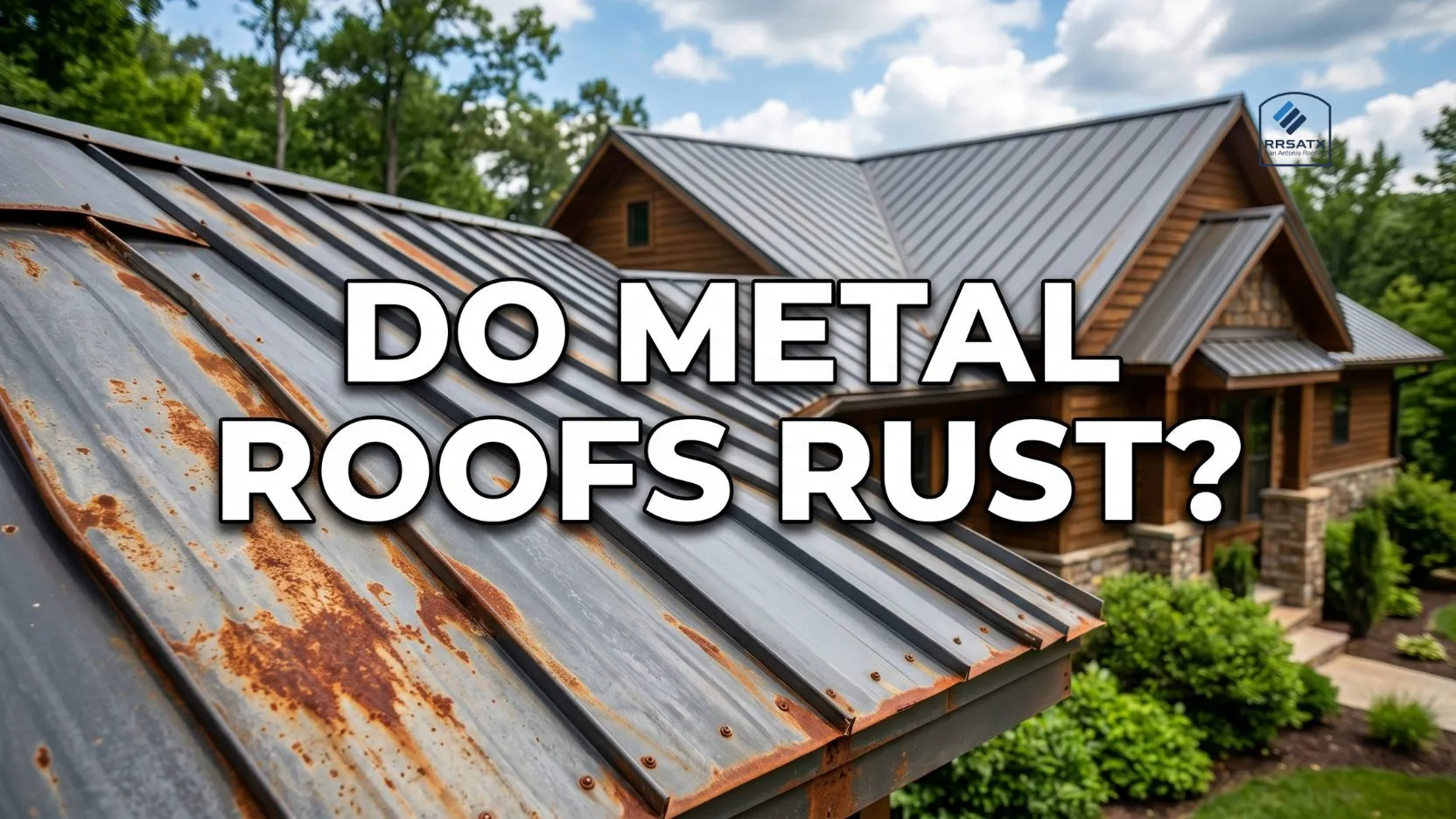
Rust is the most common concern homeowners raise about metal roofing, and it is also the most misunderstood one. The fear usually comes from a mental image of an old barn with a corrugated tin roof turning brown and brittle after years of rain. That image is real, but it is not the full picture of how modern residential and commercial metal roofing performs in a city like San Antonio.
Whether your metal roof rusts, and how quickly, is determined by three factors: the base metal used, the protective coating applied over it, and the maintenance history of the roof since installation. Get all three right and rust is not a realistic concern for several decades. Let one of them slip and surface corrosion can appear within a few years. This guide walks through every factor so you know exactly where your roof stands.
Rust is the result of iron reacting with oxygen and moisture to form iron oxide. Only metals that contain iron can rust. Steel contains iron, so steel roofing can rust if its protective coating fails. Aluminum, copper, and zinc contain no iron, so they cannot rust under any weather conditions. Most homeowners are not told what their metal roof is actually made of when it is installed. Knowing the base material is the first step to understanding your real rust risk in San Antonio’s climate.
Material Guide
The roofing industry uses several different base metals, and they behave very differently when exposed to the South Texas climate over time. Steel is by far the most commonly installed metal roofing material in San Antonio residential and commercial applications. It is affordable, widely available, and strong. It is also the only common roofing metal that contains enough iron to rust if its protective coating is compromised.
Aluminum, copper, and zinc are iron-free and will never rust regardless of coating condition, exposure, or age. They can develop surface oxidation or patina over time, but those processes do not eat through the metal the way iron oxide does to steel. Understanding which category your roof falls into tells you immediately whether rust is a realistic concern for your property.
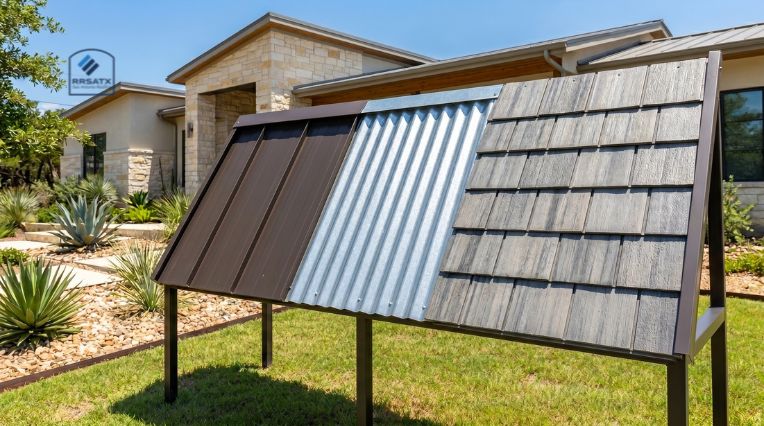
Steel (most common in San Antonio): Can rust if the protective coating fails. Nearly all residential steel roofing sold today is either Galvalume (aluminum-zinc alloy coating over steel) or galvanized (zinc coating over steel), both of which provide strong corrosion protection as long as the coating is intact.
Aluminum: Contains no iron and cannot rust. It may develop a thin white oxide film over time, but this is surface cosmetics only and does not compromise the panel. Premium residential roofing choice for coastal markets and areas with high humidity.
Copper and zinc: Both iron-free and both will outlast any steel roofing system by a wide margin. Copper develops a distinctive green patina. Zinc develops a matte gray self-protecting layer. Neither requires coating maintenance to resist corrosion.
| Metal type | Can it rust? | Common San Antonio use | Expected lifespan |
|---|---|---|---|
| Galvalume steel | Yes, if coating is damaged | Standing seam and corrugated panels, commercial buildings | 40 to 60 years with intact coating |
| Galvanized steel | Yes, faster than Galvalume if coating fails | Older corrugated roofs, agricultural, budget residential | 20 to 40 years depending on coating weight |
| Stone-coated steel | Yes, at chipped coating areas | Residential shingle and tile-profile panels | 40 to 50 years with coating maintained |
| Aluminum | No | Premium residential, coastal applications | 50 years or more |
| Copper | No | Architectural accents, premium residential | 100 years or more |
| Zinc | No | Architectural and high-end residential | 80 to 100 years |
- Check original installation documentation, manufacturer spec sheets, or any warranty paperwork from when the roof was installed
- Look for a mill stamp or embossed marking on an exposed panel edge, which often indicates Galvalume or galvanized grade
- A magnet will stick to steel roofing and will not stick to aluminum or copper, which is a quick field test
- Stone-coated steel panels have a visibly textured surface with a granule finish similar to asphalt shingles
- If in doubt, schedule a professional inspection to identify the material before planning any maintenance or treatment
Rust Causes
Steel roofing does not rust evenly across the surface. It rusts at specific points where the protective zinc or Galvalume coating has been broken, worn through, or was never fully applied. The coating is a sacrificial barrier that keeps iron away from moisture and oxygen. Once that barrier is breached at any point, corrosion begins at that location and spreads outward if left untreated.
In San Antonio’s climate, the factors that accelerate coating failure include intense UV exposure that breaks down paint finishes faster than in cooler northern climates, significant thermal expansion and contraction cycling between winter and summer extremes, and the physical stress of hailstorms that chip or dent surface coatings. Each of these is a known threat that a qualified roofing contractor looks for during a maintenance inspection.
Galvanic corrosion is the rust cause San Antonio homeowners are least likely to know about. When two different metals are in direct contact in the presence of moisture, the more reactive metal corrodes faster than it otherwise would. Copper flashing or copper downspouts installed against a steel panel roof accelerate rust at every contact point. Pressure-treated lumber used in some decking applications contains compounds that react similarly with uncoated steel edges. A qualified inspector will identify any dissimilar metal contacts during a roof assessment and recommend isolation or replacement of the incompatible materials.
- Panel edges at the eave and rake where factory or field cuts were made during installation
- Around every exposed fastener on screw-down panel systems, especially where EPDM washers have hardened
- In roof valleys, behind HVAC units, and in any area where debris collects and holds moisture against the panel surface
- At any penetration point: pipe boots, skylights, chimney bases, and HVAC curb flashings
- Any location where copper or aluminum flashing is in direct contact with a steel panel without an isolation barrier
- On stone-coated steel panels, look in gutters for granule chips after hail events as a sign of coating damage
Rust Stages
Not all rust is the same problem. A small orange stain on the surface of a panel and a hole eaten through the metal from years of unchecked corrosion are both called rust, but they require completely different responses. The three-stage framework is the most practical way to assess what you are dealing with and what the repair options and costs will be.
The most important thing to understand is that rust progresses in one direction. Stage one does not become stage three overnight, but it does not reverse itself either. Every year that surface rust goes untreated is a year that corrosion works its way deeper into the panel. Catching it at stage one is always less expensive than catching it at stage two, and stage two is always less expensive than stage three.
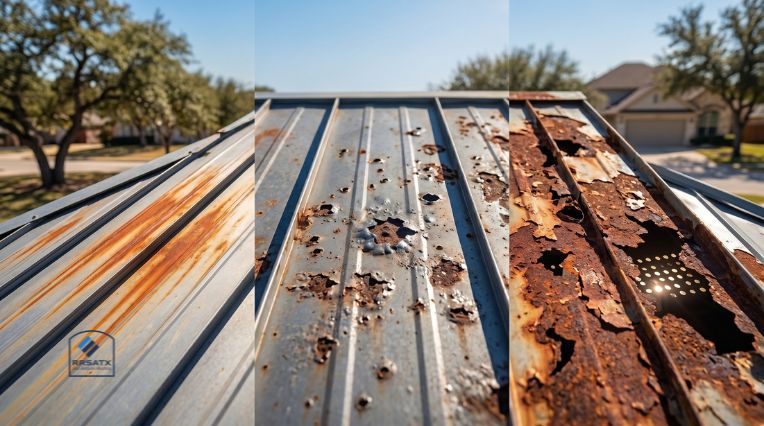
Stage 1 – Surface rust and discoloration: Orange or brown staining on the panel surface with no pitting or texture change in the metal itself. The protective coating has failed in that spot but corrosion has not penetrated significantly into the steel. This is the best possible time to catch rust on a metal roof. Treatment is straightforward and inexpensive, and the panel’s structural integrity is fully intact.
Stage 2 – Active pitting corrosion: The rust has eaten into the surface of the metal, leaving visible pitting or a rough texture when you run your hand across it. The panel is structurally sound but the corrosion is working through the steel from the surface. At this stage, the panel can still be saved with the right treatment, but it requires more aggressive intervention than stage one and the panel will need ongoing monitoring afterward.
Stage 3 – Through-panel corrosion: The rust has eaten completely through the metal, leaving pinholes, perforations, or structurally compromised sections. These panels cannot be repaired with surface treatment. They must be replaced. Stage three on a significant portion of the roof surface is the point where replacement becomes more cost-effective than continued piecemeal panel-by-panel repairs.
- Photograph any discolored or stained panel areas from the ground with a zoom lens before getting on the roof
- On the roof, run a gloved hand across stained areas to feel for pitting or texture change versus smooth discoloration only
- Apply light pressure to any suspected pitting areas to check for soft spots or flex that indicates through-panel loss
- Check the attic interior on a bright day for any pinhole light visible through the decking in areas of surface rust
- Document and photograph all rust locations before calling a contractor so you can compare quotes for the same scope of work
- Do not attempt to sand or wire-brush rust yourself without understanding what stage you are dealing with, since aggressive abrasion on stage 1 can remove remaining protective coating from surrounding areas
Treatment and Repair
A rust treatment job is only as good as the surface preparation that comes before it. The most common rust repair mistake we see on San Antonio metal roofs is a contractor who paints over rust without properly removing the active corrosion first. Paint applied over existing rust will bubble and peel within one to two years because the rust continues to work underneath the new coating. Proper rust treatment always starts with mechanical preparation of the surface, not with a brush and a can of paint.
The correct sequence for any stage of rust treatment is: remove loose rust and debris mechanically, apply a rust converter or rust inhibitor to neutralize any remaining active corrosion, prime the surface with a zinc-rich primer suitable for metal roofing, and finish with a top coat rated for metal roof applications. Skipping any step in that sequence produces a repair that looks right but fails quickly.
Before approving any rust treatment job, ask the contractor to specify the exact products they plan to use and confirm compatibility with your panel type. Not all rust converters work on Galvalume panels the way they work on bare steel. Not all elastomeric coatings adhere properly to every metal panel profile. A contractor who cannot name the specific products being applied or who proposes to skip the primer step is a contractor who is likely to produce a repair that fails within two to three years, at which point the rust damage will be more advanced than it was before they started.
- Mechanical preparation of affected areas: wire brushing, grinding, or power washing before any product is applied
- Rust converter or rust inhibitor applied to neutralize active corrosion before primer goes on
- Zinc-rich primer applied over treated areas before any finish coat, not skipped to save time
- Finish coat specified as rated for metal roofing and compatible with the panel type being treated
- Product names and application rates documented in writing before work begins
- Workmanship warranty provided in writing with a defined coverage period and specific defect conditions
Prevention
San Antonio’s climate is harder on metal roof coatings than most of the country. The combination of intense UV exposure from May through September, significant rainfall during storm season, high humidity, and dramatic temperature swings between seasons creates accelerated coating degradation compared to more temperate climates. A maintenance schedule designed for a metal roof in the Midwest will not keep pace with what Texas weather demands from the same product.
The good news is that a properly maintained steel roof in San Antonio absolutely can reach its full 40 to 60 year lifespan without significant rust problems. The maintenance work required to get there is not complicated or expensive relative to what rust remediation costs at later stages. It is primarily a matter of inspection frequency and catching problems at stage one rather than waiting until they present as active leaks.
| Maintenance task | Recommended frequency in San Antonio | What it prevents |
|---|---|---|
| Professional roof inspection | Every 2 years, plus after any major hail event | Catches coating failure and surface rust at stage 1 before it progresses |
| Gutter and valley cleaning | Twice per year, spring and fall | Eliminates debris pockets that hold moisture against panel surfaces and accelerate corrosion |
| Fastener and sealant inspection | Every 2 to 3 years | Prevents moisture entry at fastener holes that creates localized corrosion in panel substrate |
| Post-hail inspection | After any hail event of 0.75 inches or larger | Identifies stone-coat chip damage and panel surface dents that have broken through the protective coating |
| Surface rust spot treatment | As needed, immediately upon identification | Stops stage 1 rust from progressing to stage 2, which costs significantly more to address |
| Full elastomeric recoating | Every 10 to 15 years on older steel roofs | Resets the surface coating protection across the entire roof, extending service life by one to two decades |
- Spring: clear all debris from valleys, gutters, and any roof-level HVAC equipment that accumulates organic material
- Spring: visually inspect all panel surfaces from the ground with binoculars for any new discoloration or staining
- After storm season: repeat debris clearing and visual inspection; look specifically for granule loss in gutters on stone-coated panels
- Every 2 years: schedule a professional inspection to assess fasteners, sealants, and coating condition across the entire roof surface
- Any time you see orange or brown staining: call a roofing contractor immediately, not at the next scheduled inspection
- Before any new contractor works on the roof: confirm that any copper or pressure-treated wood materials they bring will be isolated from your steel panels
Use this table to quickly identify what you are dealing with, what it is likely to cost, and how urgently you need to act. All cost ranges reflect current San Antonio market rates in 2026.
| What you are seeing | Likely rust stage | Estimated cost | Urgency |
|---|---|---|---|
| Light orange staining, smooth surface | Stage 1 surface rust | $200 to $500 per treated area | Address within 6 months before next wet season |
| Rough or pitted texture when touched | Stage 2 active pitting | $500 to $1,500 per treated section | Address within 30 to 60 days |
| Visible holes, perforations, or soft spots | Stage 3 through-panel corrosion | $800 to $2,500 per replaced section | Immediate – active leak risk |
| Rust at fastener locations only | Stage 1 to 2, localized to fastener field | $250 to $600 for fastener replacement and sealing | Address within 60 days |
| Rust along panel edges at eave or rake | Stage 1 to 2, cut-edge corrosion | $200 to $800 depending on linear footage | Address within 60 to 90 days |
| Granules in gutters after hail | Stone-coat chip damage, pre-rust condition | $200 to $500 for spot treatment and recoating | Address before next rain season |
| Widespread coating degradation across the whole roof | Systemic coating failure, stage 1 risk across the surface | $1,500 to $6,000 for full elastomeric recoating | Plan within the current year |
- Confirm the base metal of your roof: steel (Galvalume or galvanized), aluminum, copper, or zinc – this determines your actual rust risk
- Locate and keep your original installation documentation, which should specify the panel manufacturer, product name, coating type, and any warranty terms
- Note the age of the roof and whether any prior rust treatment or recoating has been done, since that affects how urgently inspection is needed
- Scan all visible panel surfaces from the ground using binoculars for any new orange, brown, or dark staining since the last inspection
- Check gutters and downspouts for granule chips if you have stone-coated steel panels, which signals hail impact damage to the coating
- Look at eave edges, valley areas, and any location where debris accumulates for signs of localized surface staining
- Inspect around all visible fasteners on screw-down panel roofs for rust streaking below the fastener location
- Photograph the rust location and assess it against the three-stage framework before calling a contractor
- Do not wait for your next scheduled inspection if you find active orange staining – call a licensed metal roofing contractor within the week
- Get at least two written quotes that specify the surface preparation method and the exact products to be used
- Confirm that any treatment includes mechanical preparation of the surface, not just painting over existing rust
- Request a written workmanship warranty for the completed rust treatment that specifies the coverage period
- Clear debris from valleys and gutters at least twice per year, spring and fall, and after any major storm event
- Schedule a professional roof inspection every two years even when no visible rust is present
- Replace any copper flashing that is in direct contact with your steel panels with galvanized or stainless steel alternatives
- Address any backed-out or missing fasteners promptly, since each open fastener hole is a moisture entry point that starts localized corrosion
Do metal roofs rust in San Antonio’s climate?
What is the difference between Galvalume and galvanized steel roofing?
Can surface rust on a metal roof be repaired, or does the whole roof need to be replaced?
How do I know if the rust on my metal roof is just surface staining or something more serious?
Does homeowners insurance cover rust damage on a metal roof in Texas?
How often should I inspect my metal roof for rust in San Antonio?
Concerned about rust on your San Antonio metal roof?
We will inspect your metal roof at no cost, assess any rust for stage and severity, and give you a clear written treatment or repair estimate before you commit to anything.
[/et_pb_code][/et_pb_column][/et_pb_row][/et_pb_section]