Is Metal Roofing More Energy Efficient

Is Metal Roofing More Energy Efficient?

Home 9 Metal Roofing San antonio 9 Is Metal Roofing More Energy Efficient?
Is Metal Roofing More Energy Efficient? San Antonio TX Guide | Affordable Roofing Contractors San Antonio
Metal Roofing Energy Efficiency Guide | San Antonio, TX

In a city where summer cooling bills regularly spike past $300 a month, the roofing material over your head has a direct and measurable effect on your energy costs. This guide explains exactly how metal roofing reduces heat gain, what the real savings look like for a San Antonio home, and which metal roof type delivers the best performance in the Texas climate.

Metal roofing energy efficiency San Antonio Cool roof · Solar reflectance · Heat gain Real energy savings · Texas climate Residential · Bexar County · 2026
R
Ted
With over 30 years of residential and commercial metal roofing experience across San Antonio and Bexar County, our crews have installed metal roofs on thousands of Texas homes. Every guide we publish reflects real on-the-ground experience with Texas roofing conditions, not national averages that ignore what 110-degree summers actually do to a roof and an energy bill.
· affordableroofingcontractorssanantonio.com · Licensed and Insured · $2M Liability Coverage · 100+ Five-Star Reviews
Part of our complete stone coated steel roofing cost guide
How Much Does a Stone Coated Steel Roof Cost? Complete San Antonio Pricing Guide
25–40%
Typical reduction in cooling energy costs for San Antonio homes after switching to metal roofing
150+°F
Surface temperature a dark asphalt shingle roof can reach on a typical San Antonio summer afternoon
70%+
Solar reflectance achievable with a cool-coated metal roof, versus 5 to 15% for standard asphalt shingles
$600+
Estimated annual cooling cost savings for an average San Antonio home with a qualifying metal roof

The short answer is yes. Metal roofing is more energy efficient than asphalt shingles in virtually every climate, and in a city like San Antonio the difference is especially significant. The Texas heat is not a minor variable. Bexar County consistently records some of the highest residential cooling loads in the country, and your roof is the single largest surface absorbing or deflecting the solar energy that drives those loads.

The longer answer is that not all metal roofs perform equally. The energy efficiency of a metal roof depends on the specific metal type, the coating or finish applied to the surface, the color, and how the installation integrates with your attic ventilation and insulation. This guide covers all of it, in plain language, with real numbers that apply to the San Antonio market.

The principle that makes every metal roofing energy efficiency conversation start in the right place

Your roof does not cool your house. Your HVAC system does. What a metal roof does is reduce the amount of heat your HVAC system has to fight against. That difference, measured in BTUs your air conditioner never has to remove, is what shows up as a lower electric bill every month from May through October. Understanding this distinction helps you set realistic expectations and ask the right questions when comparing roofing options.

● ● ●
Six things every San Antonio homeowner should understand about metal roofing and energy use
How metal roofing cuts your energy costs and what the real numbers look like
01
Why metal roofing reduces heat gain: solar reflectance and thermal emittance explained
The two measurements that determine how much heat your roof transfers into your home
Energy Science

Every roofing material is measured by two energy performance properties: solar reflectance and thermal emittance. These two numbers, taken together, tell you how much solar energy a roof surface turns away and how effectively it releases whatever heat it does absorb. The higher both numbers are, the cooler the roof runs and the less heat transfers into your attic and living space.
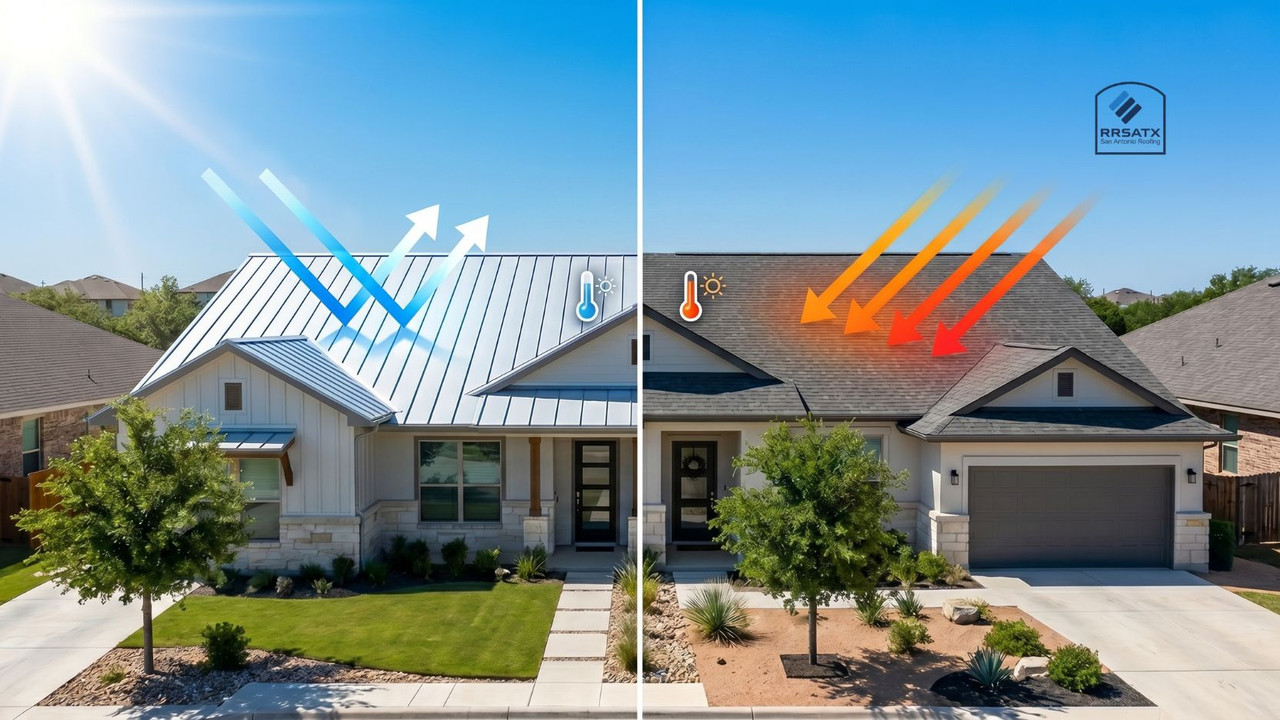
Metal roof solar reflectance vs asphalt shingles San Antonio

Solar reflectance is the percentage of incoming solar energy a surface reflects rather than absorbs. A perfectly reflective surface would score 1.0, or 100 percent. Standard dark asphalt shingles score between 0.05 and 0.15, meaning they absorb 85 to 95 percent of solar radiation. A cool-coated metal roof can score between 0.60 and 0.85, reflecting the majority of that same solar energy back into the atmosphere instead of into your attic.

Thermal emittance is the ability of a surface to release the heat it has absorbed. Metal naturally scores very high here, typically 0.85 or above. Even when metal does absorb some solar energy, it releases that heat quickly as the sun moves and temperatures drop in the evening. Asphalt shingles hold heat far longer and continue radiating it into the attic well into the night.

Standard asphalt (dark): Reflectance 0.05 to 0.15 Cool asphalt (light): Reflectance 0.25 to 0.35 Stone coated steel: Reflectance 0.25 to 0.55 Cool-coated metal: Reflectance 0.60 to 0.85 Standing seam (white): Reflectance 0.65 to 0.85
San Antonio context: on a typical July afternoon with an ambient temperature of 102 degrees Fahrenheit, a standard dark asphalt shingle roof can reach surface temperatures of 150 to 170 degrees. A cool-coated metal roof on the same home, under the same conditions, commonly stays 50 to 80 degrees cooler. That temperature difference at the roof surface is the primary driver of every energy efficiency comparison between roofing materials in the Texas climate.
What to verify about energy performance before you buy
  • Ask your contractor for the solar reflectance index (SRI) rating of the specific panel and color you are considering
  • Confirm whether the product is Energy Star rated for solar reflectance
  • Lighter colors deliver significantly better solar reflectance than darker colors in the same product line
  • Stone chip texture on stone coated steel affects reflectance; ask for the specific rating, not just a general claim
  • Request the thermal emittance rating alongside the reflectance rating for a complete picture
02
Stone coated steel vs standing seam vs painted metal: which performs best in San Antonio?
Not all metal roofing delivers the same energy efficiency; here is how the main options compare
Comparison

Metal roofing is a broad category, and energy performance varies significantly within it. The three types you will encounter most often from San Antonio roofing contractors are stone coated steel, standing seam metal, and exposed-fastener painted steel or aluminum panels. Each has a different energy performance profile based on its surface characteristics, coating technology, and installation method.

Metal Roof Type Solar Reflectance Range Thermal Emittance Energy Star Eligible Best Energy Color Notes
Standing seam (cool coating) 0.65 to 0.85 0.85 to 0.90 Yes (most light colors) White, light gray, beige Highest energy performance of any residential roofing type; concealed fasteners eliminate thermal bridging points
Exposed-fastener painted panel 0.45 to 0.75 0.85 to 0.90 Yes (qualifying colors) White, light gray Good reflectance in lighter colors; exposed fasteners are minor thermal bridges but not a significant concern in residential applications
Stone coated steel (light colors) 0.25 to 0.55 0.85 to 0.90 Some products and colors Tan, light brown, terracotta Stone chip texture and aggregate coating reduce peak reflectance vs bare painted metal but still far outperform asphalt shingles
Stone coated steel (dark colors) 0.10 to 0.25 0.85 to 0.90 Generally no Not applicable Still outperforms dark asphalt on thermal emittance; darker stone coated steel releases absorbed heat more quickly than dark asphalt but reflectance advantage is smaller
Standard asphalt shingles 0.05 to 0.20 0.85 to 0.92 Impact-resistant versions only White or light gray Baseline comparison; absorbs the vast majority of solar radiation and retains heat longer due to mass and low emittance in darker varieties
Pro Tip

If maximum energy efficiency is your primary goal, a standing seam roof with a white or light gray Kynar-based paint finish is the top performer available today. If you want the energy benefits of metal with the aesthetic of tile, shake, or shingles, stone coated steel in a lighter color is still a dramatic improvement over asphalt. Choose the lightest color in your preferred product line that your HOA allows and your personal aesthetic is comfortable with.

03
What the energy savings actually look like for a San Antonio home in real dollars
Running the numbers on cooling costs, monthly savings, and long-term return for Bexar County homeowners
Real Numbers

Energy savings claims for metal roofing are everywhere in marketing materials, and the ranges are wide. The real number for your home depends on several variables: your home's square footage, current insulation levels, HVAC system efficiency, the direction your roof faces, tree shading, and which metal roofing product you install. What follows is a realistic framework built around actual San Antonio energy data.

The average CPS Energy residential customer in San Antonio pays roughly $150 to $180 per month annually, with summer months commonly reaching $250 to $350 or higher for homes over 2,000 square feet. Cooling accounts for approximately 50 to 60 percent of that summer electricity use. A qualified metal roof reducing the cooling load by 25 to 40 percent translates to a meaningful monthly reduction during the months when your bill is highest.

$50–$90
per month
Estimated summer monthly cooling savings (June through September): For an average San Antonio home with 1,800 to 2,400 square feet, switching from standard asphalt shingles to a light-colored metal roof with good reflectance typically reduces summer cooling costs by $50 to $90 per month. Higher savings are more likely in homes with poor attic insulation, where the roof surface temperature has an outsized effect on attic heat load.
$15–$30
per month
Estimated shoulder-season savings (April, May, October): The energy advantage of metal roofing extends into the spring and fall months when San Antonio temperatures are already warming but full air conditioning is cycling on and off. These months contribute smaller but consistent savings on top of the peak summer reductions.
$600–$1,200+
per year
Estimated total annual energy savings: Combining summer peak savings with shoulder-season reductions, most San Antonio homeowners who switch from dark asphalt shingles to a light-colored metal roof with qualifying reflectance report $600 to $1,200 in annual energy savings. Larger homes, older HVAC systems, and minimal attic insulation push toward the higher end of that range.
12–20 yrs
payback
Energy-savings contribution to payback period: On a $28,000 stone coated steel installation generating $1,200 in annual energy savings, the energy benefit alone recovers $12,000 to $24,000 over a 10 to 20 year period. Combined with insurance premium discounts, reduced maintenance costs, and the elimination of a reroof cycle, the total financial picture is considerably more favorable than the sticker price comparison against asphalt alone would suggest.
Important caveat: energy savings estimates are projections, not guarantees. Actual savings depend on your home's current thermal performance, the quality of your attic insulation and ventilation, your HVAC system efficiency, and the specific metal roof product installed. A home with excellent spray foam attic insulation will see smaller additional savings from a metal roof than a home with minimal insulation, because the attic is already thermally isolated. Your contractor should be able to walk you through a realistic estimate based on your home's specific conditions.
04
How a metal roof works with your attic insulation and ventilation as a complete system
A metal roof performs best when it is part of a properly designed attic thermal envelope, not installed in isolation
System Performance

A metal roof is one component of a thermal system that includes your roof deck, attic ventilation, insulation, and the air barrier between your attic and your living space. Installing a metal roof on a poorly ventilated attic with inadequate insulation will still improve your energy performance compared to asphalt shingles, but you will not capture the full benefit. The biggest energy efficiency wins come when the roof, ventilation, and insulation are working together.
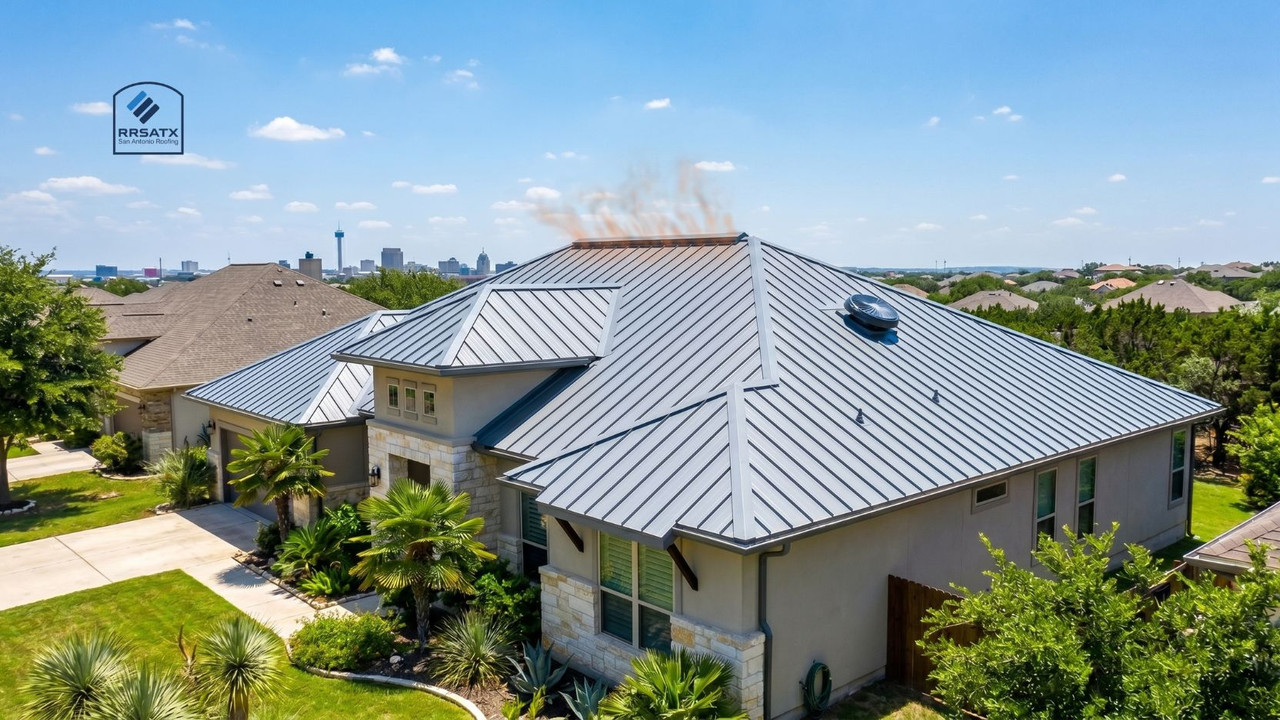
Attic ventilation and metal roof energy performance San Antonio

Attic ventilation: Proper ridge and soffit ventilation allows hot attic air to escape continuously rather than accumulating and transferring heat downward into your living space. Metal roofs work exceptionally well with ridge vents because the concealed or low-profile fastening systems on most quality metal products do not obstruct ventilation pathways. A good San Antonio roofing contractor will assess your current ventilation during the installation process and flag any deficiencies.

Attic insulation: The R-value of your attic insulation determines how much of the heat the roof surface generates actually reaches your living area. Texas building code requires R-38 for new construction; many older San Antonio homes fall short of this. Upgrading insulation at the time of a roof replacement is one of the most cost-effective energy improvements you can make, and the combination of new metal roofing plus upgraded insulation delivers compounding benefits.

Radiant barrier: A foil-faced radiant barrier installed on the attic floor or underside of the roof deck adds another layer of heat rejection on top of metal roofing reflectance Ridge ventilation: Continuous ridge vent works with soffit vents to flush heat out of the attic; metal roof profiles generally accommodate this well Insulation upgrade: Adding blown-in insulation to reach R-38 or higher at the time of roof replacement is the highest-value add-on for energy performance Air sealing: Gaps around recessed lights, attic hatches, and HVAC penetrations allow conditioned air to escape; sealing these multiplies the benefit of both metal roofing and insulation
The attic inspection your contractor should perform before installation begins

A responsible San Antonio roofing contractor doing a metal roof installation will walk your attic before quoting the job. They should note your current insulation R-value, assess whether ridge and soffit ventilation are adequate, and identify any obvious air leakage points around penetrations and HVAC ducts. If a contractor quotes your metal roof job without mentioning attic conditions, that is a sign they are focused on the material sale and not the energy outcome you are paying for.

Whole-system energy checklist
  • Contractor has assessed attic insulation levels and confirmed current R-value
  • Ridge and soffit ventilation are adequate; deficiencies are noted with a correction plan
  • Radiant barrier option has been discussed and priced as an add-on if not already present
  • HVAC duct condition in the attic has been noted; leaky ducts in a hot attic undermine all other energy improvements
  • Insulation upgrade pricing is available if current levels are below R-38
05
Does a metal roof qualify for federal tax credits or Texas energy incentives?
The programs available to San Antonio homeowners and what your metal roof needs to qualify
Incentives

The financial case for metal roofing in San Antonio extends beyond monthly energy savings. Two additional financial benefits are available to qualifying homeowners: a federal tax credit for energy-efficient roofing materials and a potential insurance premium discount for Class 4 impact-rated roofing products. Understanding both helps you build the complete financial picture before making a decision.

30%
federal credit
Federal Energy Efficient Home Improvement Credit (25C): Under the Inflation Reduction Act, homeowners can claim a tax credit of up to 30 percent of the cost of qualifying energy-efficient roofing materials, capped at $600 for roofing. To qualify, the metal roofing product must meet Energy Star requirements for solar reflectance. Ask your contractor to confirm whether the specific product and color being installed carries an Energy Star certification before finalizing your selection.
20–35%
insurance
Homeowners insurance premium discount for Class 4 impact-resistant roofing: Most stone coated steel and many other metal roofing products carry a Class 4 hail impact rating under UL 2218 testing. Texas insurance carriers frequently offer 20 to 35 percent discounts on the wind and hail portion of your premium for Class 4 rated roofs. In San Antonio, where wind and hail coverage represents a meaningful share of your annual premium, this discount can recover $300 to $700 or more per year depending on your policy.
Varies
utility rebates
CPS Energy and utility rebate programs: CPS Energy, San Antonio's primary electric utility, periodically offers rebates for qualifying energy efficiency improvements. Roofing rebates are less common than HVAC or insulation rebates, but cool roof products with high Energy Star ratings have qualified in past program cycles. Check the current CPS Energy rebate portal before your installation to see whether any roofing-related incentives are currently active.
Pro Tip

Before signing a roofing contract, call your homeowners insurance carrier and ask two specific questions: Does my current policy offer a discount for Class 4 impact-resistant roofing? And does my carrier require installation by a specific process or documentation from the installer to activate that discount? Some carriers require a copy of the manufacturer's Class 4 certification and the completed permit before adjusting your premium. Get the documentation requirements in writing before installation day, not after.

06
What to ask your San Antonio roofing contractor about energy performance before you commit
The specific questions that separate contractors who understand energy performance from those who are just selling panels
Buyer's Guide

Energy efficiency claims are easy to make and hard to verify without the right questions. Any San Antonio contractor can tell you that metal roofing is more energy efficient than asphalt. The contractors worth hiring can tell you exactly how efficient, for which specific product and color, with documentation from the manufacturer and an explanation of what your home's current attic conditions mean for your projected savings.

The questions below are the ones you should bring to every roofing consultation if energy performance is part of your decision. A contractor who cannot answer them clearly is not the right partner for this project.

Ask this: What is the solar reflectance index rating for the specific panel and color I am considering? Ask this: Is this product Energy Star certified for solar reflectance in this color? Ask this: What is the thermal emittance rating of this product? Ask this: Did you assess my attic insulation and ventilation during your inspection? Ask this: What improvements to my attic system would maximize the energy benefit of this roof? Ask this: Will this product and color qualify for the federal 25C tax credit? Ask this: Does this product carry a Class 4 UL 2218 impact rating for the insurance discount? Ask this: Can you provide the manufacturer's energy performance documentation for my records?
A warning sign worth knowing: if a contractor responds to any energy efficiency question with "all metal roofs are energy efficient" and cannot give you a specific number, a specific product reference, or a specific certification, that is a signal to press harder or seek a second opinion. Energy performance data for every legitimate metal roofing product exists in published form. There is no reason a knowledgeable contractor cannot provide it.
Energy performance buyer's checklist
  • Solar reflectance index rating confirmed for the specific product and color being installed
  • Energy Star certification status verified for the qualifying federal tax credit
  • Class 4 UL 2218 impact rating confirmed for the insurance premium discount
  • Attic insulation level assessed and any deficiencies addressed in the project scope
  • Ridge and soffit ventilation verified as adequate for the new roof system
  • Manufacturer's energy performance documentation requested and received before installation
  • Insurance carrier contacted to confirm the discount process and documentation required
● ● ●
Complete energy efficiency checklist for your San Antonio metal roof project
Work through this list before signing a contract to make sure you capture every energy and financial benefit available
Before you request quotes
  • Review your last 12 months of CPS Energy bills to establish your current baseline cooling costs
  • Note your current attic insulation level if known; if unknown, ask a contractor to assess it during the inspection
  • Check the Energy Star Cool Roof product database to familiarize yourself with qualifying metal roofing products
  • Contact your homeowners insurance carrier to ask what documentation is required to activate a Class 4 discount
  • Check the CPS Energy rebate portal for any currently active cool roof or energy efficiency incentive programs
During the quoting process
  • Confirm each contractor walked the attic, not just the roof surface, during their inspection
  • Ask each contractor for the SRI rating and Energy Star status of the specific products they are quoting
  • Request that quotes include an attic insulation assessment and upgrade pricing if current levels are below R-38
  • Ask whether a radiant barrier option is available and what it adds to the total project cost
  • Confirm Class 4 UL 2218 impact rating for the panel product and ask for the manufacturer's certification document
After installation
  • Obtain the manufacturer's energy performance documentation and Class 4 certification for your records
  • Submit the required documentation to your insurance carrier to activate the premium discount
  • Consult your tax professional about claiming the federal 25C Energy Efficient Home Improvement Credit
  • Track your CPS Energy bills for the first full cooling season to measure actual savings against your pre-installation baseline
  • Schedule an attic inspection 12 months after installation to confirm ventilation is performing as designed
● ● ●
Common questions answered
FAQs
Q
How much can a metal roof actually reduce my electric bill in San Antonio?
For an average San Antonio home between 1,800 and 2,500 square feet with standard attic insulation, switching from dark asphalt shingles to a light-colored qualifying metal roof typically reduces summer cooling costs by 25 to 40 percent. In dollar terms, that commonly translates to $50 to $90 per month during the peak cooling months of June through September, and $15 to $30 per month in the shoulder seasons of April, May, and October. Annual totals for this average home range from $600 to $1,200 in energy savings. Larger homes with older HVAC systems and minimal attic insulation tend to see savings at or above the higher end of that range.
Q
Does the color of a metal roof make a big difference in energy efficiency?
Yes, significantly. Color is one of the most important variables in the energy performance of a metal roof. Lighter colors have higher solar reflectance than darker colors within the same product line. A white or light gray standing seam roof can reflect 65 to 85 percent of solar radiation. The same roof in a dark charcoal or black finish may reflect only 10 to 25 percent. For stone coated steel, lighter earth tones like tan, beige, and terracotta outperform darker browns and charcoals. If energy performance is a priority, always select the lightest color your HOA allows and your personal aesthetic is comfortable with. The difference in monthly energy savings between a light tan and a dark charcoal stone coated steel roof on the same San Antonio home can easily reach $30 to $50 per month during peak summer.
Q
Is stone coated steel roofing as energy efficient as standing seam metal?
Standing seam metal with a cool roof coating in a light color is the top energy performer in the residential metal roofing category. Stone coated steel, because of its stone chip aggregate surface texture and the nature of the coating, typically achieves lower peak solar reflectance than a bare cool-coated metal panel of the same color. However, stone coated steel still dramatically outperforms asphalt shingles on both reflectance and thermal emittance, particularly in lighter colors. For most San Antonio homeowners, the energy performance difference between the two metal types is meaningful but not decisive on its own. The choice between them usually comes down to aesthetics, budget, and profile preference, with standing seam being the better choice if energy performance is the single most important criterion.
Q
Does a metal roof make a house hotter in winter?
In San Antonio's climate, this is rarely a practical concern. The primary energy benefit of metal roofing runs from April through October, when cooling dominates energy use. During the short San Antonio winter, a reflective metal roof does reflect a small amount of solar gain that an asphalt roof would have absorbed, but the heating load increase is minimal for two reasons. First, San Antonio winters are mild enough that most homes are not heavily dependent on passive solar gain for heating. Second, a properly insulated attic provides the thermal barrier that matters most in both directions. A home with adequate attic insulation loses very little heating load benefit from having a reflective roof because the insulation is already blocking heat transfer between the attic and living space in both directions. In climates like San Antonio, the energy math strongly favors high reflectance throughout the year.
Q
What is the Energy Star cool roof program and does my metal roof qualify?
Energy Star is the U.S. Environmental Protection Agency's voluntary certification program for energy-efficient products. For roofing materials, Energy Star certifies products that meet minimum solar reflectance and thermal emittance thresholds. For steep-slope roofing, the current Energy Star requirement is a minimum initial solar reflectance of 0.25 and a minimum thermal emittance of 0.90. Many light-colored metal roofing products meet or exceed these thresholds, but not all metal roofing qualifies automatically. Darker colors in any product line often fall below the reflectance threshold. Ask your contractor to confirm the Energy Star status of the specific product and color you are selecting. Energy Star certification for the roofing material is also a requirement for the federal 25C tax credit, so this confirmation matters financially as well as for performance verification.
Q
Will a metal roof help my HVAC system last longer?
Yes, and this is one of the underappreciated financial benefits of metal roofing in hot climates. Your air conditioning system's lifespan is directly related to how many hours it runs and how hard it works during those hours. A metal roof that reduces the cooling load on your home means your HVAC system cycles less frequently and for shorter periods during the summer months. Less runtime translates to less wear on the compressor, fan motor, and refrigerant system, which extends service life and reduces the frequency of repairs. In San Antonio, where HVAC systems typically run at high capacity for five to six months per year, the cumulative reduction in runtime from a metal roof can meaningfully extend the time before your next system replacement. This benefit is real but difficult to quantify precisely because equipment lifespan depends on many variables beyond just runtime hours.
Q
Does adding attic insulation at the same time as a metal roof really make a noticeable difference?
Combining a metal roof installation with an attic insulation upgrade is one of the highest-return energy improvement projects available to a San Antonio homeowner. The two improvements work in compounding fashion: the metal roof reduces the heat load entering the attic from above, and the improved insulation reduces the heat that transfers from the attic into your living space below. In a home with an existing R-19 or R-25 attic insulation level, upgrading to R-38 or R-49 blown-in insulation at the time of a metal roof installation routinely delivers total energy reductions of 35 to 50 percent compared to the combination of the old roof and the old insulation level. The incremental cost of adding insulation during a roof project is lower than doing it as a standalone project later, because the roofing crew is already on site and the attic access is already open during the installation process.
Q
How does a metal roof compare to a cool asphalt shingle roof for energy efficiency?
Cool asphalt shingles, which are manufactured with reflective granules to improve solar reflectance, are a meaningfully better performer than standard dark asphalt shingles. A qualifying cool asphalt shingle can reach a solar reflectance of 0.25 to 0.35, compared to 0.05 to 0.15 for standard dark shingles. However, light-colored metal roofing consistently outperforms even the best cool asphalt products on solar reflectance. Standing seam metal reaches 0.65 to 0.85, and even stone coated steel in lighter colors commonly hits 0.35 to 0.55. The thermal emittance advantage of metal is even more decisive: metal releases absorbed heat quickly, while asphalt mass retains it and continues radiating into the attic for hours after the sun has passed. For San Antonio's climate, where the question is not whether to use a cool roofing product but which one, metal consistently outperforms cool asphalt by a measurable margin across the full year.
More from Affordable Roofing Contractors San Antonio
Browse related metal roofing guides from Affordable Roofing Contractors San Antonio to learn about stone-coated steel roof costs, insurance discounts, and energy-saving benefits. Explore expert insights and discover reliable metal roofing repair and installation services in San Antonio, TX.

Find out how much a metal roof can save your San Antonio home

We will inspect your current roof, assess your attic conditions, and give you a clear picture of what a metal roof installation would cost and what it would save on your energy bill every year.