
[et_pb_section fb_built=”1″ admin_label=”section” _builder_version=”4.16″ global_colors_info=”{}”][et_pb_row admin_label=”row” _builder_version=”4.16″ background_size=”initial” background_position=”top_left” background_repeat=”repeat” global_colors_info=”{}”][et_pb_column type=”4_4″ _builder_version=”4.16″ custom_padding=”|||” global_colors_info=”{}” custom_padding__hover=”|||”][et_pb_code _builder_version=”4.27.6″ _module_preset=”default” hover_enabled=”0″ sticky_enabled=”0″]
Metal roofs shed snow faster, handle freeze-thaw cycles better, and outlast asphalt shingles under winter conditions by decades. This complete guide covers how metal roofing handles snow and ice, what types perform best, what it costs, and what every homeowner should know before making the switch.
If you live in a part of the country that sees real winter weather, the question of what roofing material handles snow best is one of the most important decisions you will make about your home. Asphalt shingles are the default for most of the United States, but they were not designed with heavy snow in mind. Metal roofing was. The differences in how these two materials respond to snow load, ice dam formation, and freeze-thaw cycling are significant enough to affect both your roof’s lifespan and your heating bills.
The short answer is yes, metal roofs are better for snow. But the longer answer is more useful. This guide breaks down exactly why metal roofing outperforms asphalt in snow conditions, which types of metal roofs work best, what proper installation requires, what the costs look like, and what questions to ask before choosing a metal roof for a snowy climate.
A standing seam metal roof installed correctly with proper ventilation and appropriate snow guards performs dramatically better than any asphalt shingle alternative. But a metal roof installed without adequate attic ventilation or on an insufficiently pitched surface will still develop ice dams and drainage problems. The metal alone is not the complete answer. The installation system, the pitch, and the ventilation all determine real-world snow performance. Any contractor quoting a metal roof in a snowy climate who does not discuss these three factors before pricing the job is skipping the most important part of the conversation.
Snow Shedding
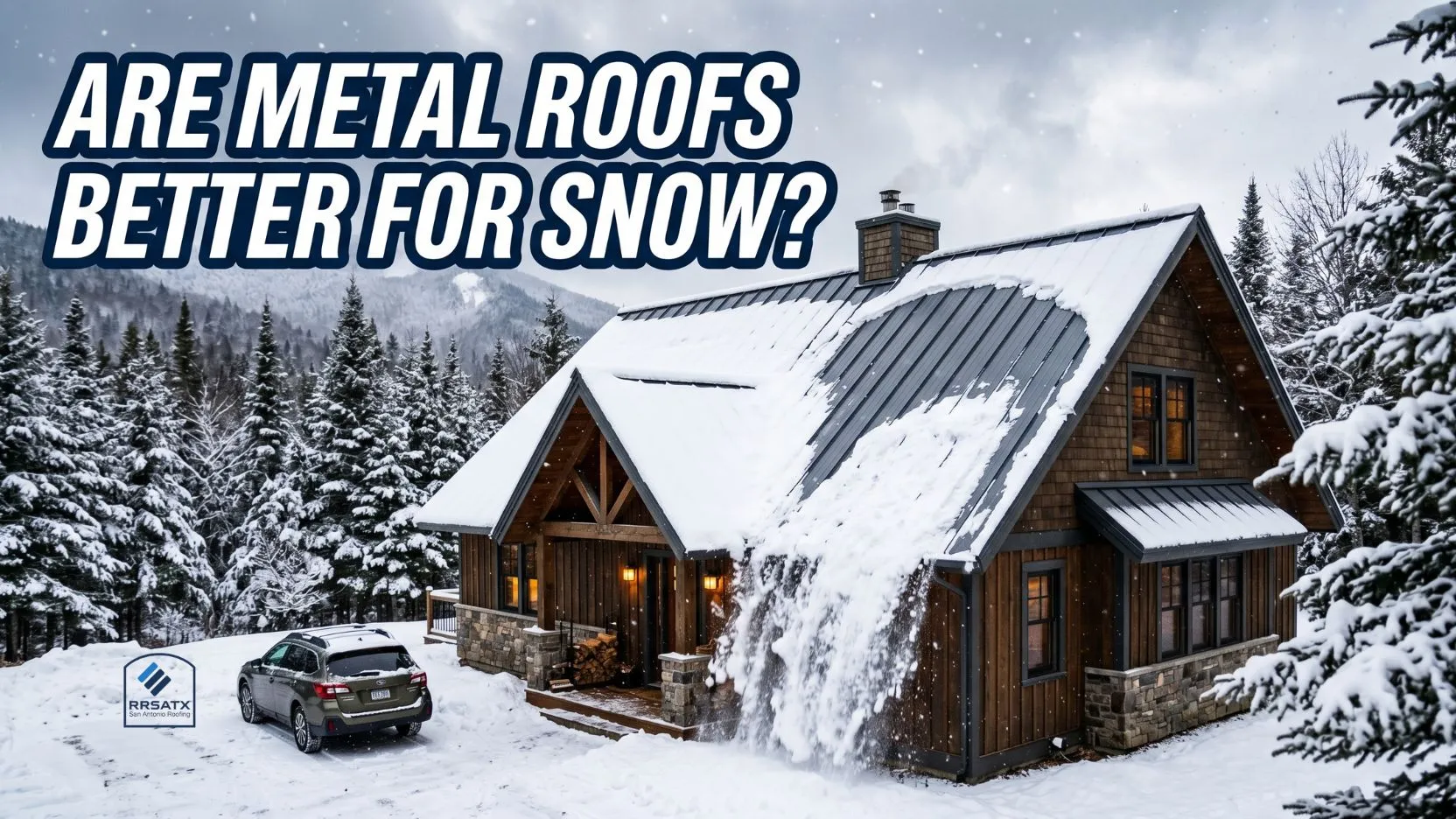
Metal roofing sheds snow faster than asphalt shingles because of two physical properties: surface texture and thermal conductivity. Asphalt shingles have a rough, granular surface that creates friction and allows snow to bond and pack. Metal panels have a smooth surface that offers very little grip for snow crystals. On a pitched metal roof, accumulated snow will often slide off on its own within hours of a storm ending, and sometimes while snow is still falling.
Thermal conductivity plays a secondary but important role. Metal transfers heat from the building below more quickly to the roof surface, which means the underside of the snowpack reaches melting temperature faster. That thin melt layer between the snow and the metal acts as a lubricant, and the snow slides. Asphalt holds heat differently, meaning snow can sit for days without that melt layer developing evenly.
Snow guards are not optional on a residential metal roof above a walkway, door, or driveway. The same smooth surface that makes metal roofs excellent at shedding snow makes that snow release unpredictable. Without snow guards, a large load of snow can slide off all at once in a way that is dangerous to people below and damaging to gutters and landscaping. A good contractor will include snow guard placement in the design of any metal roof installation in a snowy climate.
- Roof pitch confirmed as adequate for metal panel type being installed
- Snow guards specified and placed at all eave locations above pedestrian or vehicle areas
- Panel coating selected with low surface energy to maximize shedding efficiency
- Gutter system sized and anchored to handle rapid snow and water release
- Drainage path from eaves to ground is clear and unobstructed
Ice Dams
Ice dams form when heat escaping from a poorly insulated attic warms the upper portion of the roof, melting snow that then flows down to the colder eave area and refreezes. The ice buildup at the eave blocks further meltwater from draining, forcing water to back up under roofing material and into the structure. On an asphalt shingle roof, that backed-up water finds its way between shingles, through the underlayment, and into the roof deck. The granular texture of shingles makes them particularly susceptible because ice bonds strongly to the surface.
Metal roofing reduces ice dam risk in two ways. First, the smooth surface does not give ice a strong grip, so even if freezing occurs at the eave, the ice layer is less likely to create a solid dam with the capacity to back water up. Second, the faster and more uniform snow shedding means less snowpack is available to melt and refreeze in the first place. Paired with proper attic ventilation and insulation, a metal roof can eliminate ice dams almost entirely on homes that previously dealt with them every winter.
Homeowners who switch to metal roofing after years of ice dam damage sometimes assume the metal alone will solve the problem. It reduces the risk significantly, but an attic that is poorly insulated or ventilated will still produce the warm roof surface conditions that create ice dams. The complete solution combines a metal roof with a properly sealed and ventilated attic. Both elements need to be right. If you are installing a metal roof on a home with ice dam history, have the attic evaluated at the same time. The insulation and ventilation improvements will cost far less than a second bout of interior water damage.
- Attic insulation levels reviewed and brought to current code minimum before installation
- Air sealing completed at all attic penetrations: light fixtures, plumbing vents, ceiling fans
- Attic ventilation confirmed as adequate: intake at soffits, exhaust at ridge
- Ice and water shield underlayment installed at eave edge per local code requirement
- Eave flashings installed with appropriate overhang to direct meltwater into gutters
- Gutters inspected and anchored to handle freeze-thaw cycling without pulling away
Snow Load
Snow load is measured in pounds per square foot and varies significantly based on snow density, which changes between fresh powder, settled pack, and wet heavy snow. Wet spring snow is especially heavy and can impose loads of 20 pounds per square foot or more. Building codes in snow country establish minimum design loads based on historical snowfall data, and any roof system must meet those loads without the structure compromising.
Metal roofing panels are lighter than asphalt shingles, which is actually an advantage. A standing seam metal panel system weighs approximately 1 to 3 pounds per square foot, compared to 2 to 5 pounds per square foot for architectural asphalt shingles. That weight difference means the structural system carries less dead load from the roofing material itself, leaving more capacity available for the live load of accumulated snow. On homes where structural capacity is a consideration, metal roofing is often the preferred solution because it adds less permanent weight while providing superior surface performance.
Know your local ground snow load before choosing any roofing system. The International Building Code and local amendments establish ground snow load values for every region of the country. Your roofing contractor should know the design load for your area and confirm that both the roof structure and the roofing system selection are appropriate for that load. In high-snowfall regions like the Upper Midwest, New England, and the mountain West, this is not a theoretical concern. It is a code and safety requirement.
- Local ground snow load identified from building code or ASCE 7 maps
- Roof slope factored into design snow load calculation per code requirements
- Existing roof structure evaluated for adequacy before metal panel installation
- Panel gauge selected appropriate to span and load requirements
- Snow guard spacing calculated based on panel load capacity and roof pitch
Comparison
Asphalt shingles are the most installed roofing material in the United States, but they were optimized for a broad range of climates, not specifically for heavy snow. Metal roofing has distinct advantages in every category that matters for winter performance. The table below puts the key differences side by side for a clear look at where each material stands.
| Performance Category | Metal Roofing | Asphalt Shingles | Winner |
|---|---|---|---|
| Snow shedding speed | Fast smooth surface, low friction | Slow granular surface holds snow | Metal |
| Ice dam resistance | High smooth surface limits ice bonding | Low granules allow ice to grip strongly | Metal |
| Weight (dead load) | 1 to 3 lbs per square foot | 2 to 5 lbs per square foot | Metal |
| Freeze-thaw durability | Excellent no granule loss, no cracking | Fair granule loss accelerates over time | Metal |
| Lifespan in snow climates | 40 to 70 years with proper maintenance | 15 to 25 years in high-snowfall regions | Metal |
| Upfront material cost | Higher $5 to $15 per square foot installed | Lower $2 to $6 per square foot installed | Asphalt |
| Maintenance requirement | Low inspection every 3 to 5 years | Moderate annual inspection recommended | Metal |
| Snow removal requirement | Rarely needed self-shedding | Often needed after major storms | Metal |
The only category where asphalt shingles come out ahead is upfront cost. For homeowners who plan to stay in their home long-term, the math consistently favors metal roofing in snow climates because the longer lifespan means fewer replacements and the lower maintenance burden reduces ongoing costs.
Panel Types
Metal roofing comes in several configurations, and they do not all perform identically in snow. The two primary distinctions are standing seam systems versus exposed fastener panels, and within those categories, the material choices include steel, aluminum, copper, and zinc. For snow performance, standing seam is consistently the recommended system, and the material choice depends on your local environment and budget.
Standing seam is the top-performing metal roof system for snow climates. The panels interlock at raised seams that run vertically down the roof slope. No fasteners penetrate the face of the panels, which eliminates the most common source of leaks in a freeze-thaw environment. The raised seams also allow snow to slide across a completely uninterrupted panel surface, which maximizes shedding speed. The floating clip attachment system accommodates thermal expansion and contraction without stressing the panels or creating gaps where water can enter.
Corrugated panels and R-panel systems use exposed screws that penetrate the metal face. These are more affordable than standing seam, but each fastener is a potential water entry point under freeze-thaw cycling. The rubber washers on the screws harden and crack over time, and in climates with significant temperature swings, that process accelerates. Exposed fastener metal panels are workable in light snow environments, but for heavy snow country, standing seam is the superior choice by a significant margin.
- Standing seam profile specified rather than exposed fastener for heavy snowfall regions
- Panel gauge confirmed at 26 gauge minimum for residential standing seam applications
- Coating system specified: Kynar 500 or equivalent PVDF-based paint for 40-plus year color and chalk resistance
- Aluminum considered if salt air or coastal moisture is a factor in addition to snow
- Underlayment specified as synthetic, not felt felt deteriorates faster under metal in freeze-thaw conditions
- Clip style confirmed as floating, not fixed, to allow thermal movement without stressing seams
Cost Guide
Metal roofing costs more upfront than asphalt shingles. That is simply true, and any guide that downplays it is not serving the homeowner. But in snow climates, the long-term cost equation often flips in favor of metal when you account for the number of replacements, the reduced maintenance, the elimination of ice dam remediation costs, and in some cases, the reduction in heating bills from improved attic performance after proper installation.
Add up your annual ice dam costs before comparing roofing quotes. Homeowners in heavy snowfall regions often spend $200 to $800 per year on ice dam removal roof raking, heat cables, contractor removal after major storms. Over 20 years, that is $4,000 to $16,000 spent managing a problem that a metal roof installation commonly eliminates entirely. That number belongs in your cost comparison when you are deciding between a metal roof and a third asphalt shingle installation.
- Local ground snow load identified and confirmed with your contractor
- Current roof structure evaluated for metal panel installation weight and attachment compatibility
- Attic insulation and ventilation assessed: plan to address both at time of roofing installation
- Roof pitch confirmed as adequate for the panel type you are considering
- Snow guard requirement evaluated for all eave areas above walkways, doors, or driveways
- Standing seam versus exposed fastener decision made based on snowfall level in your area
- Panel gauge, profile, and coating system specified in writing in the contract
- Snow guard locations and attachment method specified and drawn on a roof plan
- Underlayment type specified: synthetic underlayment, not felt
- Ice and water shield coverage at eaves confirmed to meet local code
- Contractor’s metal roofing installation experience verified with references from completed jobs
- Workmanship warranty period confirmed in writing, separate from the manufacturer’s material warranty
- First winter inspected after the first full snow season to confirm shedding performance
- Snow guard positions checked after first heavy snow event for any displacement
- Gutters cleared after major snow melt events during first two seasons
- Inspection scheduled every three to five years: fasteners, seams, flashings, and sealant at penetrations
- Attic checked after first winter for any signs of condensation or inadequate ventilation
Do metal roofs make snow slide off too fast and become dangerous?
Will a metal roof be noisier than asphalt shingles when snow slides off?
Can you install a metal roof over existing asphalt shingles in a snow climate?
Does a metal roof affect home insurance rates in snow country?
What happens to a metal roof during extreme cold does it crack or become brittle?
How long does a metal roof last compared to asphalt shingles in a snowy climate?
Get a free metal roofing consultation in San Antonio
Have questions about metal roofing, snow performance, or whether your home is a good candidate for a metal roof? We will inspect your current roof, walk through your options, and give you a clear written estimate at no cost.
[/et_pb_code][/et_pb_column][/et_pb_row][/et_pb_section]