
[et_pb_section fb_built=”1″ admin_label=”section” _builder_version=”4.16″ global_colors_info=”{}”][et_pb_row admin_label=”row” _builder_version=”4.16″ background_size=”initial” background_position=”top_left” background_repeat=”repeat” global_colors_info=”{}”][et_pb_column type=”4_4″ _builder_version=”4.16″ custom_padding=”|||” global_colors_info=”{}” custom_padding__hover=”|||”][et_pb_code _builder_version=”4.27.6″ _module_preset=”default” hover_enabled=”0″ sticky_enabled=”0″]
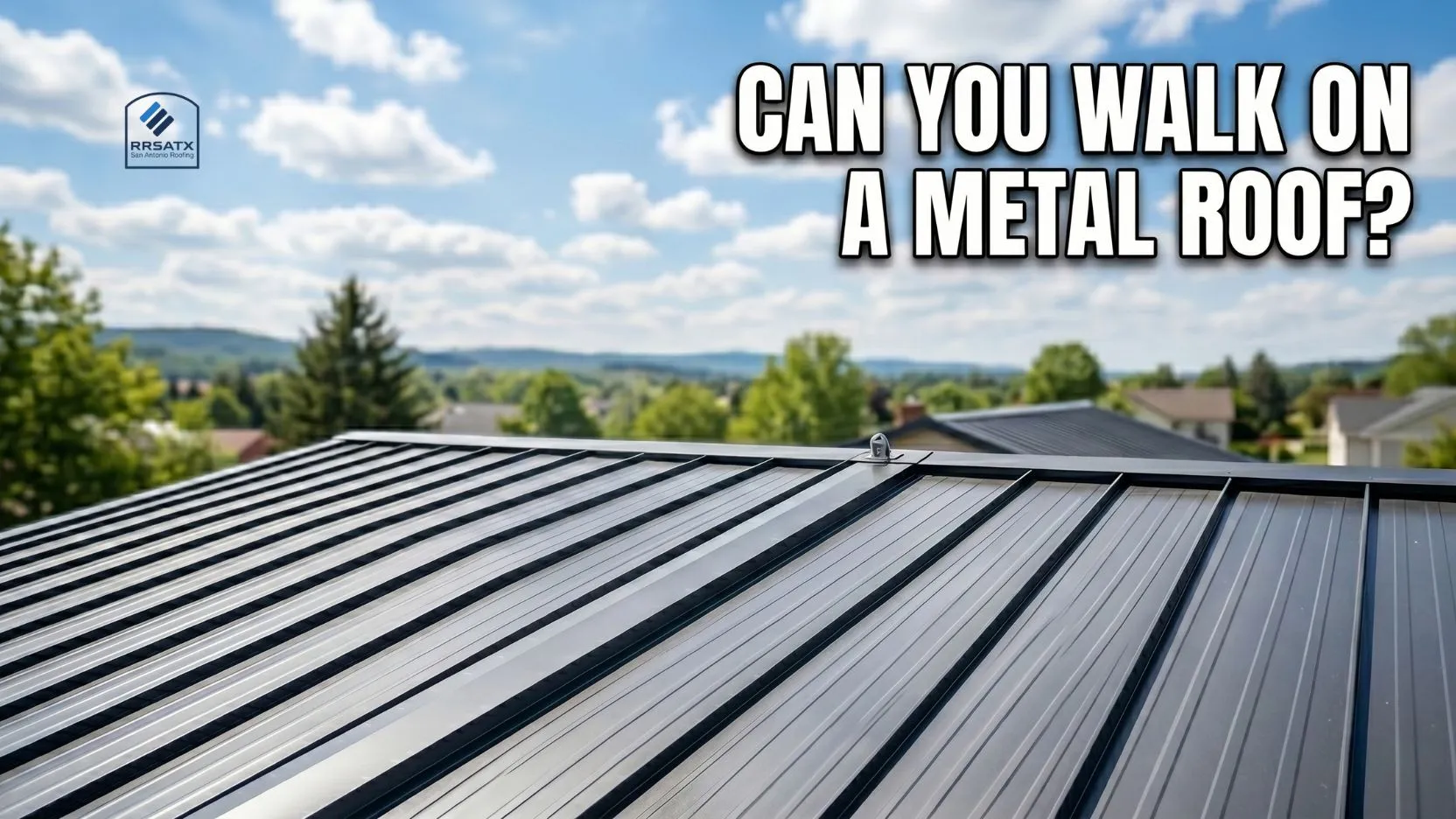
Yes, but the answer is not the same for every roof. The type of metal panel, the pitch, the coating condition, and the footwear you use all determine whether walking on your metal roof is safe and damage-free, or whether it will cost you a repair call and a voided warranty section.
It is one of the most common questions we get from San Antonio homeowners after a metal roof is installed: can I walk on it? The short answer is yes: metal roofs can be walked on. But the longer answer matters a lot more, because walking on a metal roof the wrong way, in the wrong spot, or on the wrong panel type can dent the surface, crack coatings, and void the finish warranty that came with your installation.
This guide covers every metal roof panel type common in San Antonio, where it is safe to step, what footwear to use, when pitch becomes a stopping point, and what mistakes lead to the most costly damage. If you are planning to access your roof for a gutter cleaning, a satellite dish adjustment, an HVAC service call, or a post-storm inspection, read this first.
For most exposed-fastener and corrugated metal panel systems, the raised rib runs directly over a rafter or purlin. That is the load-bearing point. The flat face between the ribs spans open air below and will flex, dent, or dimple under body weight. Standing seam systems have their own rules. Every panel type has a right place to step and a wrong place to step, and knowing the difference before you get on the roof is what separates a clean inspection from a repair bill.
Most Walkable
Standing seam is the most forgiving metal roof panel type for foot traffic. The raised seams that give the system its name run vertically up the roof slope and are typically 1.5 to 2 inches tall. These seams connect directly to the structural deck below and provide a natural walkway that keeps your weight on the strongest part of the panel system.
The flat pan area between the seams is still best avoided. Your goal is to keep feet on or as close to the seam as possible, not because the pan will necessarily collapse, but because seam-to-seam walking distributes weight more safely and leaves no footprints or compression marks on the visible flat surface.
On a standing seam roof, place your feet parallel to the seam and walk with your weight evenly distributed across the ball of your foot, never your heel. Heel strikes are what leave compression marks on the flat pan. A slow, deliberate gait with both feet on or next to a seam at all times is how our San Antonio crews walk standing seam roofs during inspection visits without leaving a mark.
- Walk along the raised seam, not across the flat pan face between seams
- Wear clean, soft-soled rubber shoes; avoid boots, flip-flops, and hard heels
- Keep three points of contact at all times on pitches above 4:12
- Avoid roof access during peak afternoon heat, as surface temperatures can exceed 160 degrees Fahrenheit in San Antonio summers
- Do not walk on a standing seam roof that has any visible rust, lifted seams, or damaged panel faces
- If the pitch exceeds 6:12, use a roof bracket system or hire a licensed San Antonio roofing contractor
Step with Care
Corrugated metal panels are one of the most common roofing systems in the San Antonio area for residential additions, shops, barns, and low-slope commercial buildings. They are walkable, but the rules for foot placement are stricter than on standing seam because the corrugated rib is narrower and the flat valley between ribs is more prone to flexing under weight.
The corrugated rib sits over a structural support, either a rafter or a purlin, and that is exactly where your foot belongs. The valley between ribs spans open air and will flex downward under body weight. On thinner gauge panels (29-gauge is common in budget installations around San Antonio), that flex can leave a permanent flat spot or, on an older roof with any coating degradation, crack the paint layer and open the base metal to rust.
One additional factor on corrugated metal roofs common in San Antonio: many of these systems are older. A corrugated metal roof installed 20 or more years ago may have surface rust, coating degradation, or fastener-area cracking that is not visible from the ground. Walking on a compromised panel can turn a small surface rust spot into a puncture or an open seam. A visual inspection from the ground with binoculars before going up is always the right first step.
- Step only on the raised rib, never in the valley between ribs
- Confirm the rib below your foot aligns with a rafter or purlin before committing full weight
- Check gauge before walking: 29-gauge corrugated on wide purlin spacing requires professional access
- Inspect for surface rust and coating cracks from the ground before roof access
- Never step on or near exposed fastener heads
- Use a roof walk board or plank laid across multiple ribs for extended work sessions
Follow the Rib
R-panel and PBR panel are the most widely used exposed-fastener metal roofing systems in San Antonio for both commercial buildings and residential applications. They feature a major rib at regular intervals (typically every 12 inches) with a flat face between ribs. The major rib sits over the structural purlin or rafter and is where your foot belongs.
The flat face spans between purlins and will flex under body weight. On a standard commercial R-panel installation with purlins spaced 5 feet apart, the flat face between major ribs has very little structural backing. Stepping on that flat face with full body weight on older or thinner gauge panels is the most reliable way to create a dent that cannot be pushed back out.
If you are unsure which rib is the major structural rib versus a minor stiffening rib, look at the fastener pattern from the eave edge. Screws are installed into the major rib because that is where the purlin sits underneath. The rib with the screw line is the rib to walk on. On R-panel, the major rib is also visually taller than the minor ribs. It is the one that stands out when you sight down the panel from the eave.
- Identify the major structural rib by locating the fastener line before stepping on any panel
- Walk only on the major rib; the minor intermediate ribs do not have structural backing beneath them
- Know the purlin spacing: roofs with 5-foot or wider purlin spacing have minimal flat-pan support
- Do not drag feet across the flat panel face; lift each step to avoid coating scuff damage
- Use a foam-padded roof walk board for any work session longer than 10 minutes in one location
- Inspect fastener washers for deterioration while on the roof and mark any replacements needed
Protect the Coating
Stone-coated steel panels are growing in popularity across San Antonio because they offer the look of clay tile or shake shingles with a fraction of the weight and a much longer lifespan. They are walkable, and in fact, most manufacturers provide walking instructions specifically because HVAC technicians, gutter cleaners, and roofing contractors regularly need roof access on these systems.
The risk with stone-coated steel is not structural denting like with corrugated or R-panel. The steel beneath the granule coating is robust. The risk is granule displacement: dragging a foot, stepping with a heel, or sliding on the surface can knock the stone granules loose from the acrylic bonding layer, exposing the base steel and reducing the coating’s weather resistance at that spot. Enough granule loss in one area can eventually lead to coating failure and premature rust.
- Step on the lower third of each panel in the recommended manufacturer walk zone
- Lift and place every step; never drag, shuffle, or pivot your feet on the granule surface
- Review the manufacturer warranty before walking: some brands limit foot traffic to licensed contractors only
- Never walk on a stone-coated steel roof when wet, damp, or dew-covered
- Inspect the granule surface from the ground after any foot traffic for visible bald spots or bare metal exposure
- If granule loss is found after walking, have a contractor apply a compatible granule repair coating before the next rain season
Panel type is only half the equation. The slope of your roof has an equal impact on whether DIY access is reasonable or whether the job needs a licensed San Antonio roofing contractor with fall protection equipment. Here is how pitch affects the decision.
| Roof pitch | Walking assessment | San Antonio homeowner guidance |
|---|---|---|
| 1:12 to 3:12 (low slope) | Most accessible | Low-slope roofs are walkable for most adults with proper footwear. Drainage is slow on these pitches so look for standing water or algae that increases slip risk. |
| 4:12 (standard residential) | Walkable with caution | This is the standard pitch on most San Antonio residential homes. Walkable, but a rope anchor point is a smart precaution for anything beyond a quick visual check. |
| 5:12 to 6:12 | Intermediate risk | At this range, most homeowners should use a roof bracket or anchor line. Foot placement mistakes become more dangerous because sliding distance is greater. |
| 7:12 to 9:12 | Professional access recommended | Steep enough that professional fall protection equipment is the right call for most homeowners. Our San Antonio crews use fixed anchor systems at this pitch range. |
| 10:12 and above | Professional only | Do not walk a 10:12 or steeper metal roof without proper roofing harness, anchor system, and fall arrest equipment. Call a licensed San Antonio contractor. |
The panel type and the pitch tell you whether you can walk on the roof. The footwear, the time of day, and the weather conditions tell you whether the specific walk you are planning is going to go safely.
| Factor | Right choice | What to avoid |
|---|---|---|
| Footwear | Clean soft rubber soles with low tread; dedicated roofing shoes | Work boots with hard heels, flip-flops, bare feet, thick lug soles that catch on panel ribs |
| Time of day | Early morning before 9 AM in San Antonio summers | Midday and afternoon when surface temperatures exceed 150 degrees Fahrenheit on dark metal panels |
| Weather conditions | Dry, clear conditions; no overnight dew on the surface | After rain, during rain, when dew is visible, when wind is above 15 mph |
| Fall protection | Roof anchor and rope on any pitch above 4:12; full harness above 6:12 | No anchor on steep pitches; relying on shoes alone for grip above 5:12 |
| Tools and equipment | Tool bags on a lanyard, foam-padded roof walk boards for extended stays | Loose tools set on the panel face, ladders leaned against the panel surface |
| Roof condition | Confirm dry surface and no visible panel damage or rust before stepping up | Accessing a roof with known rust, lifted panels, or structural damage that has not been assessed |
- Identify your panel type: standing seam, corrugated, R-panel, or stone-coated steel
- Check the pitch from the ground: above 6:12 means you need fall protection equipment before proceeding
- Confirm the roof surface is completely dry, with no overnight dew, no recent rain, and no visible moisture
- Check the time: early morning only in San Antonio summers; midday surface temps on dark metal panels are dangerous
- Put on clean soft-soled rubber shoes; remove any dirt or debris from the sole before stepping on the panel
- Inspect the roof from the ground with binoculars for visible rust, lifted panels, or coating damage before access
- Standing seam: walk on or directly beside the raised seam; avoid the flat pan between seams
- Corrugated: step on the raised rib over the structural support; never in the valley between ribs
- R-panel: step on the major structural rib identified by the fastener line; avoid the flat face and minor ribs
- Stone-coated steel: step in the lower third of each panel; lift and place every step; never drag or shuffle
- Maintain three points of contact on any pitch above 4:12
- Do not set loose tools on the panel surface; use a tool bag on a lanyard or a dedicated roof bucket
- Do not lean ladders against the panel face; use a ladder standoff bracket that hooks over the ridge
- Inspect the roof surface from the ground for any dents, coating damage, or displaced granules caused by the foot traffic
- Check gutters at the next rainfall for granule runoff from stone-coated steel panels that may indicate coating disturbance
- Log what you observed during the access: any fastener issues, sealant cracks, or panel concerns should be recorded for the next inspection
- If any damage was found during the walk, contact a licensed San Antonio metal roofing contractor before the next rain event
Will walking on a metal roof damage it?
What shoes should you wear on a metal roof?
Can HVAC technicians walk on a metal roof to service a unit?
Is it safe to walk on a metal roof in the rain?
Does walking on a metal roof void the warranty?
When should a San Antonio homeowner call a professional instead of walking the roof themselves?
Not sure if your metal roof is safe to walk? We will check it for free.
Tell us your panel type, your roof pitch, or just describe what you need access for. We will inspect the roof, assess the condition, and give you a clear answer on what is safe, at no cost to you.
[/et_pb_code][/et_pb_column][/et_pb_row][/et_pb_section]