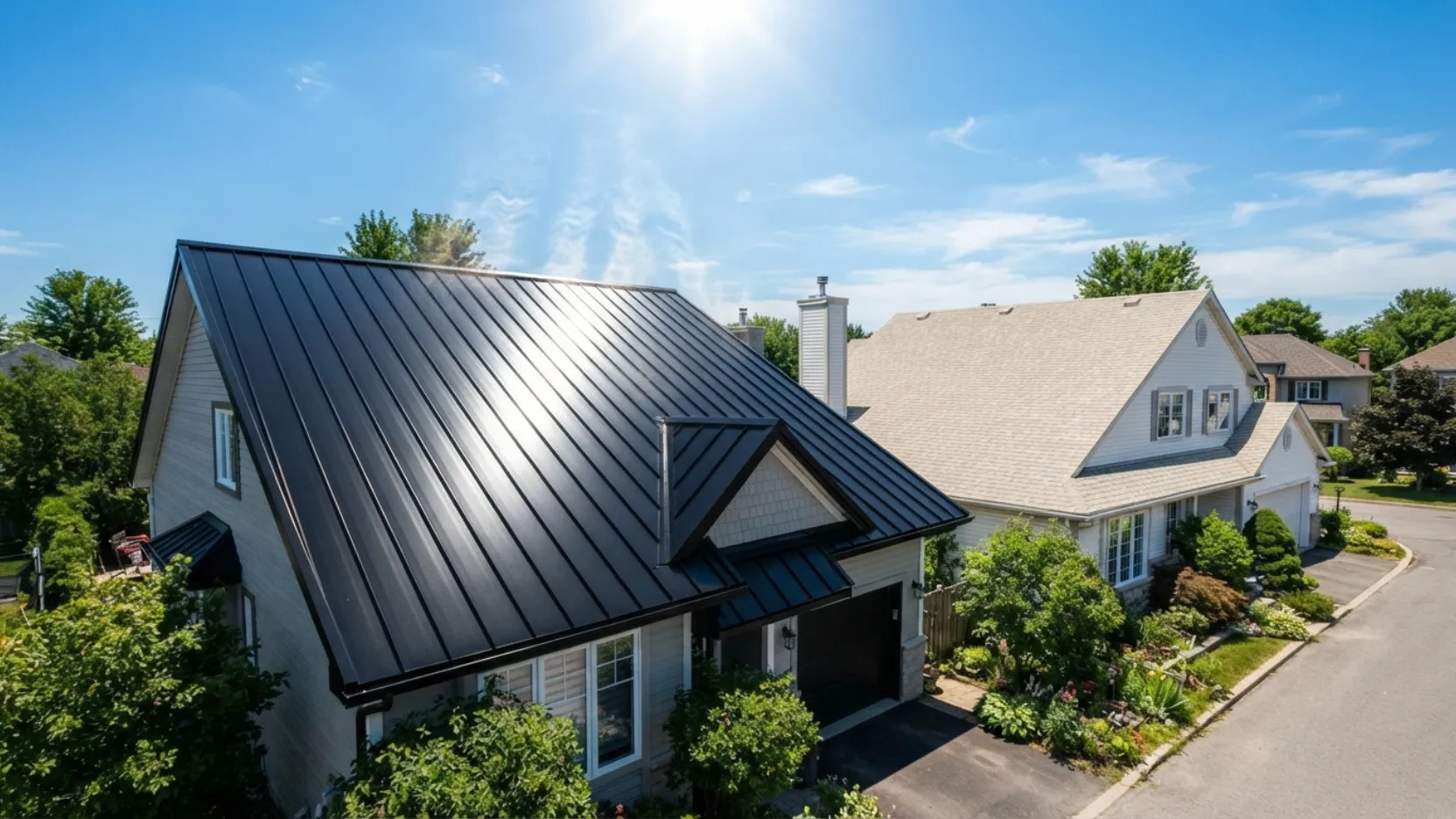
Black metal roofs absorb more solar radiation than light colored panels, but color is only one piece of the heat equation. This guide explains the science of metal roof heat transfer, what really drives your cooling bills in San Antonio, and how to choose or cool a black metal roof without sacrificing the look you want.
Black metal roofs have become one of the most popular choices for San Antonio homeowners who want a modern, bold look that complements dark trim, brick facades, and contemporary exterior designs. But the question almost every homeowner asks before committing is the same one: will a black metal roof cook my house?
The short answer is that a black metal roof will get hotter on the surface than a white or light colored panel. That is physics. The longer answer is that surface temperature and interior home temperature are not the same thing, and the difference between them depends almost entirely on what happens beneath the roof, not just on top of it. With the right insulation, ventilation, and coating technology, a black metal roof in San Antonio does not have to mean higher cooling bills.
A metal roof panel sits above a layer of decking, a ventilated attic space, and inches of insulation before it becomes your ceiling. The heat that a black panel absorbs has to travel through all of those barriers to affect your interior temperature. A black metal roof over a well ventilated attic with R 38 or better insulation performs very close to a light colored roof over a poorly ventilated attic with R 19 insulation. The system matters far more than the color alone.
Black surfaces absorb more solar radiation than light surfaces because dark pigments reflect very little visible and near infrared light. A black metal roof panel can reach surface temperatures of 150 to 170 degrees Fahrenheit on a San Antonio afternoon in July. A white or light gray panel on the same roof under the same conditions might reach 100 to 120 degrees Fahrenheit. That is a real and significant difference in surface temperature.
Solar reflectance (albedo) is the percentage of solar energy a surface bounces back. White roofing panels can have a solar reflectance of 0.65 or higher. Black panels typically fall between 0.03 and 0.10. That difference is why the surface temperature gap is so dramatic.
Thermal emittance is how efficiently a surface radiates absorbed heat back out. Most metal roofs, regardless of color, have high thermal emittance, which means they shed heat quickly once the sun goes down. This is one reason metal roofs in general outperform asphalt shingles, which trap heat in the granule layer and release it slowly into the evening.
- Black metal panels absorb significantly more solar radiation than white or light colored panels
- Metal's high thermal emittance means heat dissipates quickly after dark unlike asphalt shingles
- Surface temperature alone is not a reliable predictor of interior cooling costs
- The attic system below the roof panel is the primary barrier between roof heat and living space
- Cool pigment technology is closing the gap between dark and light metal roof performance
Attic ventilation is the single biggest variable in how much roof color affects your indoor temperature. A well ventilated attic replaces superheated air with cooler outside air continuously, preventing heat from building up and radiating downward through the insulation and ceiling. A poorly ventilated attic traps that heat and turns the attic into an oven sitting directly above your living space, regardless of what color the roof is.
San Antonio's intense summer heat makes this especially important. An unventilated attic beneath a black metal roof can reach 160 to 180 degrees Fahrenheit in July. That level of heat accumulation will eventually overwhelm even good insulation. A properly ventilated attic beneath the same black metal roof will stay 20 to 40 degrees Fahrenheit cooler, and your air conditioning system will see a measurable reduction in load.
If you are installing a black metal roof over an existing home, have the attic ventilation inspected before the metal goes on. Many San Antonio homes built before 2000 have under ventilated attics that never caused visible problems with asphalt shingles but will become a real issue under a black metal panel. Adding ridge vents and soffit vents during the roof installation is far less expensive than adding them later, and it is the single most cost effective upgrade you can make to offset the heat absorption of a dark colored roof.
- Attic ventilation assessed before installation not assumed adequate from prior roof
- Net Free Area (NFA) calculation confirmed: 1 square foot of ventilation per 150 square feet of attic floor
- Continuous ridge vent specified rather than individual static cap vents
- Soffit vents clear and unblocked by insulation at the eave perimeter
- Radiant barrier considered as an add on for black or very dark panel choices
- Powered attic fan evaluated for homes with complex roof geometry that limits natural airflow
Insulation is the physical barrier that slows heat transfer between the attic and the conditioned living space. R value measures that resistance. The higher the R value, the slower heat moves through. The U.S. Department of Energy recommends R 38 to R 60 for attics in San Antonio's climate zone. Many older San Antonio homes have R 19 or less, which is inadequate for any roof color in a Texas summer, let alone a black one.
If your attic insulation is already at R 38 or better, the practical difference in cooling cost between a black and a light colored metal roof is measurable but not dramatic studies suggest a range of 5 to 15 percent in cooling energy depending on the specific home and conditions. If your insulation is inadequate, upgrading it will do far more to reduce your cooling bill than switching from a black panel to a white one.
| Attic insulation level | Impact of black metal roof | Recommended action |
|---|---|---|
| R 19 or less (common in older SA homes) | Significant you will feel the difference year round | Upgrade insulation first; consider lighter roof color or cool pigment panels |
| R 30 (minimum modern code in some areas) | Moderate some added cooling load in peak summer months | Upgrade to R 38 minimum; add radiant barrier for black or dark panels |
| R 38 (DOE recommended for San Antonio) | Minimal color difference is 5 to 10% on cooling bills at most | Black metal roof is a reasonable choice; ensure good ventilation |
| R 49 or higher with radiant barrier | Negligible system performance largely neutralizes color effect | Black metal roof is fully viable from an energy standpoint |
- Current attic insulation R value confirmed before deciding on roof color
- Upgrade to R 38 minimum planned if existing insulation falls below that level
- Spray foam evaluated for homes with complex attic geometry or air sealing issues
- Insulation baffles installed at eave perimeter to maintain soffit ventilation path
- Thermal bridging at rafters and joists assessed insulation R value alone can overstate real world performance
Visible light accounts for only about half of the solar energy that hits a roof. Near infrared (NIR) radiation is responsible for the rest, and it is invisible to the human eye. Cool pigment technology uses specialized pigments that reflect NIR wavelengths even when the visible light color of the panel is dark or black. The roof looks black to the eye but reflects a meaningful portion of the solar heat load that a standard black coating would absorb.
PVDF (polyvinylidene fluoride) coating systems, sold under brand names like Kynar 500, are the benchmark for cool pigment performance in the metal roofing industry. A black or dark charcoal PVDF coated panel can achieve a solar reflectance of 0.20 to 0.35, compared to 0.03 to 0.10 for a standard black paint finish. That gap translates to measurably lower surface temperatures and reduced heat gain into the attic below.
When comparing black metal roofing panels in San Antonio, ask your contractor for the solar reflectance value of the specific panel being quoted. Any reputable metal roofing manufacturer will have this data on file for each color in their line. A standard black paint finish will show a solar reflectance around 0.05. A cool pigment black finish will show 0.20 to 0.35 or higher. That number tells you more about real world heat performance than any marketing language on the product sheet.
- Solar reflectance value requested for the specific black panel being considered not just the product line
- Coating type confirmed: PVDF (Kynar 500 or equivalent) for best performance and longevity
- Energy Star rating verified for black or dark panel selections
- SRI (Solar Reflectance Index) score compared between panel options from different manufacturers
- Coating warranty terms reviewed: PVDF panels should carry a 30 year or better finish warranty
- Cool pigment performance verified for the specific color, not just the general product family
San Antonio's climate is one of the more demanding contexts for dark metal roof performance in the United States. Average high temperatures exceed 95 degrees Fahrenheit for three to four months of the year. Solar intensity is high year round. Cooling loads dominate energy bills in a way that simply does not apply to homes in cooler climates where black metal roofs have been popular for decades without concern.
Based on installations our crews have done across Bexar County, here is what homeowners with black metal roofs and properly upgraded systems consistently report: minimal difference in indoor comfort compared to neighbors with lighter colored roofs, when attic ventilation and insulation are addressed at the time of installation. The homeowners who report problems almost universally have one of two issues: inadequate attic ventilation, or insulation that was not upgraded before or during the roofing project.
One factor that catches some San Antonio homeowners off guard is the first summer after installation. A new black metal roof on a home that had an old asphalt shingle roof may feel noticeably warmer indoors for the first season if the attic system was not addressed at the same time as the roof replacement. The prior asphalt roof may have had a layer of aged insulation and random attic air sealing that was masking ventilation and insulation deficiencies that the new metal roof reveals. This is not a metal roof problem. It is an attic problem that the roof change made visible.
Should you choose a black metal roof in San Antonio? If you want the look and you are willing to address the attic system alongside the roof installation, a black metal roof is a fully viable choice that will not meaningfully increase your long term cooling costs compared to a lighter panel. If you are working with a tight overall budget and cannot upgrade insulation or ventilation at the same time, choose a lighter panel color for now and revisit the darker option when you can do the full system properly. A black metal roof installed over a poor attic system is a real problem. A black metal roof installed over a properly ventilated and insulated attic is not.
- Attic ventilation assessed and upgraded to meet or exceed the 1:150 NFA ratio before or during installation
- Attic insulation confirmed at R 38 or better or upgrade included in the project scope
- Radiant barrier considered, especially for roofs with limited ventilation geometry
- Cool pigment PVDF coated panel specified rather than standard paint finish
- HVAC system capacity reviewed: your AC should not be undersized for your square footage
- Post installation inspection scheduled for the first summer to verify attic temperature performance
This comparison assumes a typical 2,000 square foot San Antonio home with average attic conditions. Performance gaps shrink significantly when attic systems are optimized, and expand when they are not.
| Factor | Black metal roof | Light/white metal roof | Real world gap |
|---|---|---|---|
| Peak surface temperature (July, full sun) | 150 to 170°F | 100 to 120°F | Large surface gap; smaller interior impact |
| Solar reflectance (standard coating) | 0.03 to 0.10 | 0.55 to 0.75 | Significant; partially closed by cool pigment |
| Solar reflectance (PVDF cool pigment) | 0.20 to 0.35 | 0.55 to 0.75 | Moderate gap, meaningfully reduced |
| Cooling cost impact (good attic system) | 5 to 15% higher than light panel | Baseline | Small; offset by proper insulation |
| Cooling cost impact (poor attic system) | 20 to 35% higher than light panel | Moderate increase over good system | Large; attic upgrade is the fix |
| Curb appeal for modern/contemporary homes | High popular current trend | Moderate for most exterior styles | Subjective; black is the stronger design choice |
| Heat dissipation after sunset | Fast metal emits heat efficiently | Fast same metal emittance | Negligible; both outperform asphalt |
- Attic insulation level confirmed aim for R 38 minimum, R 49 ideal for San Antonio
- Attic ventilation assessed ridge and soffit vent NFA calculated against attic floor area
- Cool pigment PVDF panel specified in writing in the contract not just "black metal panel"
- Solar reflectance value of the specific panel confirmed in writing from the manufacturer
- Radiant barrier quoted as an add on if ventilation geometry is limited
- HVAC capacity reviewed if the home runs warm in summer already
- Ventilation baffles installed at eave perimeter before insulation is placed or replaced
- Ridge vent installed continuously across the full ridge length not spot vents
- Panel coating verified on delivery confirm the correct PVDF color was shipped
- All penetration flashings sealed correctly a black panel does not make leaks less damaging
- Insulation upgrade completed during the same project, not deferred to a later date
- Attic temperature checked on a hot afternoon within the first summer should not exceed 130 to 140°F with proper ventilation
- AC system running time monitored for the first billing cycle compare to same period prior year
- Any unexpected comfort issues reported to the contractor within the warranty period
- Roof inspected every two to three years black panels can make surface damage slightly harder to spot than lighter colors
- PVDF coating inspected at each maintenance visit fading or chalking is the first sign of coating degradation
Get a free metal roofing consultation in San Antonio
Tell us about your project - black panel, dark charcoal, or something else. We will walk you through the right panel, coating, and attic system for your specific home and budget at no cost.


