
[et_pb_section fb_built=”1″ admin_label=”section” _builder_version=”4.16″ global_colors_info=”{}”][et_pb_row admin_label=”row” _builder_version=”4.16″ background_size=”initial” background_position=”top_left” background_repeat=”repeat” global_colors_info=”{}”][et_pb_column type=”4_4″ _builder_version=”4.16″ custom_padding=”|||” global_colors_info=”{}” custom_padding__hover=”|||”][et_pb_code _builder_version=”4.27.6″ _module_preset=”default” hover_enabled=”0″ global_colors_info=”{}” sticky_enabled=”0″]
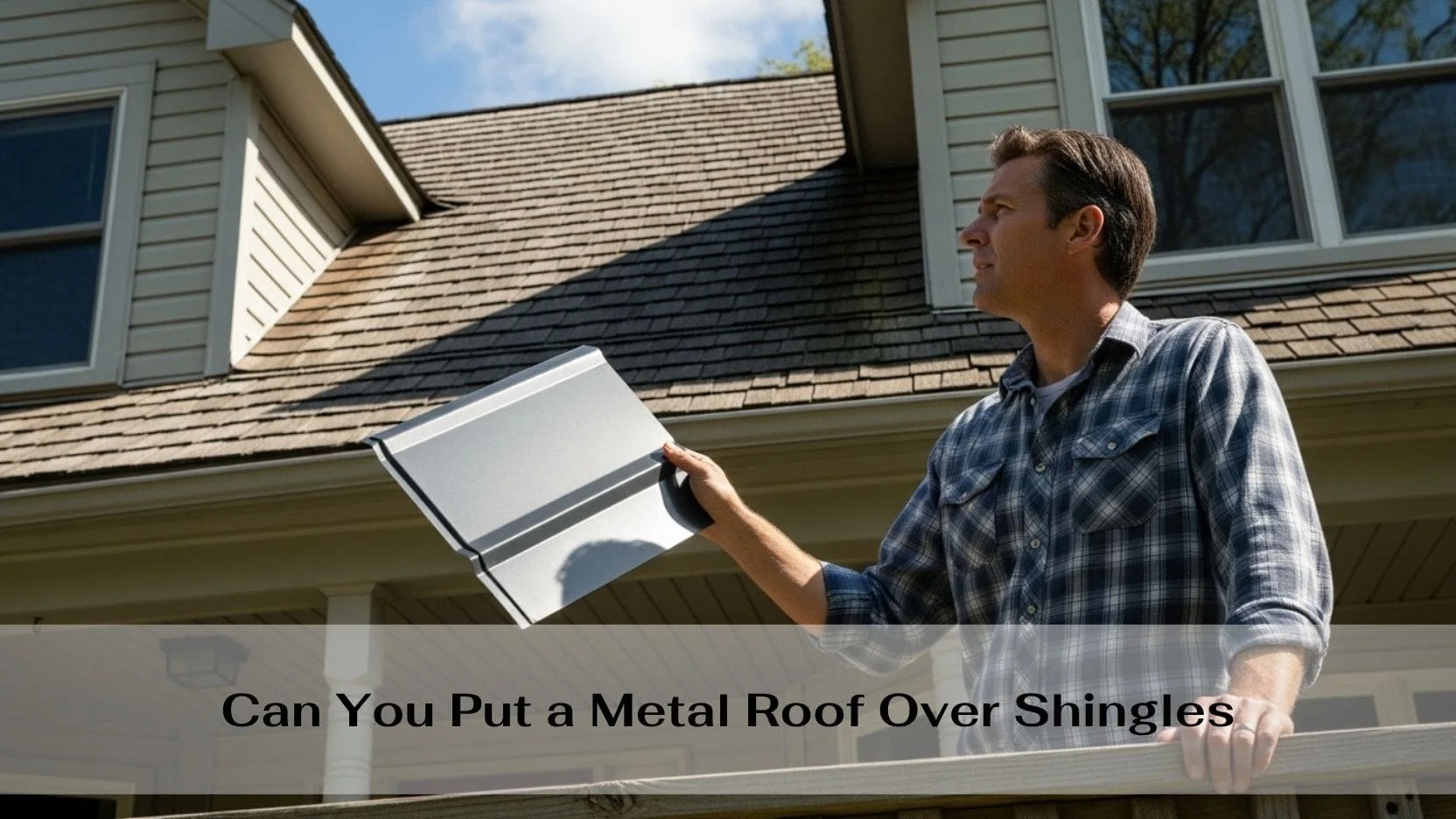
Yes, in most cases you can. But whether you should depends on your existing roof’s condition, your local building code, and what your contractor finds when they pull back the drip edge. This guide covers exactly when a metal-over-shingles overlay makes sense for San Antonio homeowners, when it does not, and what the process looks like from start to finish.
The question comes up on almost every metal roofing estimate we do for older homes in San Antonio: “Can you just put the metal right over my existing shingles?” The short answer is yes, most of the time. The longer answer is that it depends on three things your contractor must verify before a single panel goes on the roof: how many layers of roofing are already up there, whether the decking underneath is solid and dry, and what the City of San Antonio and Bexar County building code allows for your property.
Skipping that verification step is where overlay projects go wrong. A metal roof installed over wet decking, rotted sheathing, or a second layer of shingles that already exceeded the local code maximum will fail faster than the shingles it covered and create problems that cost far more to fix than the tear-off you tried to avoid. This guide explains what makes an overlay a smart financial decision and what red flags mean you need a tear-off first.
A contractor who quotes a metal overlay without walking the roof and probing the decking for soft spots is guessing. The shingles hide everything underneath. Wet, delaminated, or rotted OSB or plywood will not hold fasteners properly, which means the metal panels will not be secured correctly and the roof will have air and water infiltration points from day one. Any reputable San Antonio metal roofing contractor will pull back the drip edge and inspect a sample section of the deck before approving an overlay scope.
Eligibility
A metal-over-shingles installation is a legitimate and code-compliant roofing method when the right conditions are present. It is not a shortcut or a lower-quality option. Many metal roofs installed over shingles outlast tear-off replacements because the existing shingle layer adds a secondary drainage plane and a small amount of additional insulation. The key is that all of the following conditions must be confirmed before the project begins.
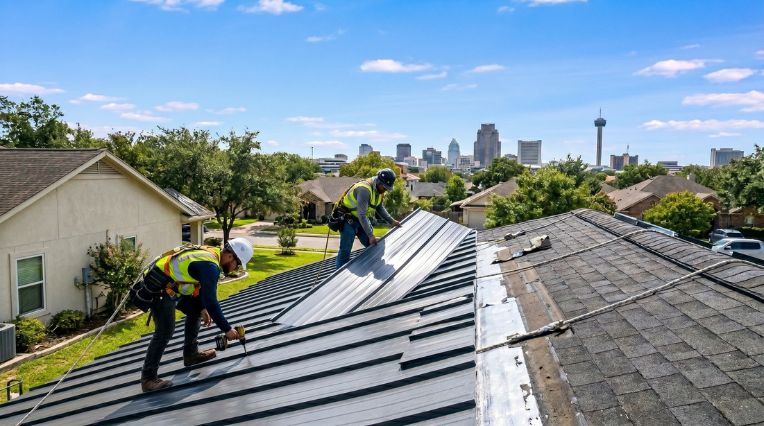
Only one existing layer of shingles: Most Texas building codes and the City of San Antonio permit a maximum of two total roofing layers. If there is currently one layer of asphalt shingles, you are eligible for a metal overlay. If there are already two layers, the existing roofing must be torn off before any new material goes on.
Deck is dry and structurally sound: The sheathing underneath the shingles must have no soft spots, delamination, rot, or moisture damage. A contractor who does not check this is leaving the most important variable unverified.
Shingles are lying reasonably flat: Heavily curled, buckled, or raised shingles create an uneven base that causes the metal panels to telegraph the irregularities from above. This is primarily a visual issue for exposed-fastener panels, but it can also affect the water-shedding performance of the metal if the gaps underneath are large enough to allow wind-driven rain to enter.
Ventilation is adequate: Adding a metal layer over shingles slightly reduces airflow at the eave. Before approving an overlay, a qualified contractor will confirm that your existing soffit and ridge ventilation meets the code minimums required for the total roof assembly. In most San Antonio homes built after 1990, this is not a problem. Older homes with limited soffit venting may need vent upgrades as part of the project.
- Contractor physically counts the existing roofing layers before quoting an overlay
- Decking inspected by pulling back the drip edge and probing for soft spots
- Shingle surface assessed for severe curling or raised edges that would compromise the panel base
- Attic ventilation measured against code requirements for the combined roof assembly
- Building permit pulled: overlay projects in San Antonio require a permit just like tear-off replacements
- Written scope confirms overlay is approved based on actual inspection, not assumption
Code and Permits
Texas adopts the International Residential Code (IRC), which the City of San Antonio and Bexar County enforce through local permitting and inspection. Under the IRC and the local amendments adopted by San Antonio, the maximum number of roofing layers on a residential structure is two. That means one existing layer of shingles plus one new layer of metal panels is permitted. Three layers total are not.
This is where many homeowners get surprised during a re-roofing project. If a previous owner already overlaid a second layer of shingles on your home, you now have two layers before the metal even goes on. In that case, a complete tear-off to the deck is required by code before any new roofing material is installed. A contractor who installs metal as a third layer without a permit is putting you in violation and creating a liability problem that follows the property, not the contractor.
Always pull a permit for a metal overlay in San Antonio, even when the contractor suggests it is not required. A permit creates an official record that the work was done legally and inspected. It protects you if you sell the home, file an insurance claim, or discover a problem years later. If a contractor tells you that a re-roofing project does not require a permit in San Antonio, that is a red flag. All re-roofing projects over the entire roof surface require a permit under the City of San Antonio Development Services Department guidelines.
One additional code consideration for San Antonio homeowners: roof pitch matters. Metal roofing systems have minimum slope requirements that vary by panel type. Standing seam metal panels typically require a minimum 1:12 pitch. Exposed-fastener corrugated or ribbed panels may have different minimums depending on the product. If your existing roof has a very low slope, your contractor must confirm that the metal panel system specified for your project is rated for that pitch.
- Existing layer count confirmed: one layer permits an overlay, two layers require full tear-off first
- Building permit application submitted to City of San Antonio Development Services before work begins
- Roof pitch confirmed as compatible with the specified metal panel system’s minimum slope requirements
- Inspection scheduled: city inspector must sign off on the completed installation
- Homeowner receives a copy of the permit and the final inspection sign-off for their records
- Work documented for the home file: permits transfer with the property when the home is sold
Installation
The most common misunderstanding homeowners have about metal-over-shingles installations is that the contractor simply lays the metal panels on top of the existing shingles and fastens them down. A properly executed overlay involves several preparation steps before any panel goes on the roof. Skipping these steps is what creates the leaking, corrosion, and panel movement problems that give metal overlays a bad reputation in some circles.
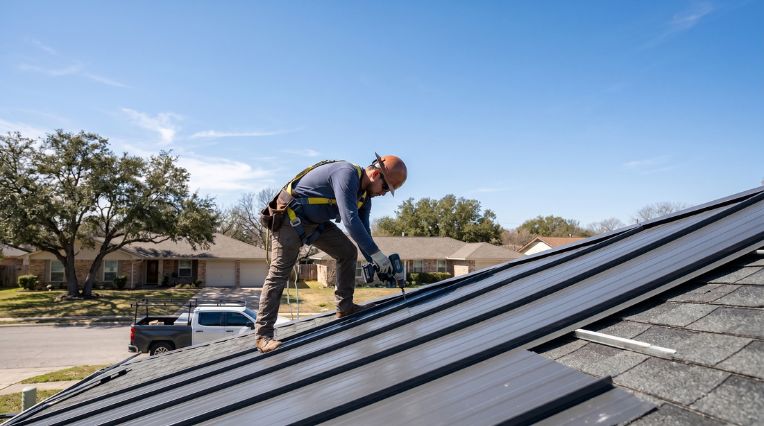
Step 1: Deck and shingle inspection. The contractor pulls back the drip edge at the eave and probes the deck for soft spots, moisture, and delamination. Any damaged sections of decking are replaced before the overlay proceeds. Severely curled or raised shingles are nailed flat or cut out and replaced with new shingle material to create a consistent base.
Step 2: Furring strips or underlayment installation. Depending on the panel system specified, the contractor installs either horizontal wood furring strips or a layer of underlayment designed for metal roofing. Furring strips are used with exposed-fastener panel systems to create a nail base and an air gap that allows moisture to escape. Underlayment-only installation is more common with standing seam systems.
Step 3: Flashing replacement. All existing flashing at valleys, chimneys, skylights, vents, and the eave drip edge is removed and replaced with new metal-compatible flashing. This is not optional. Old flashing sized and designed for shingles will not create a proper seal against metal panels. This is also the right time to inspect the fascia and soffit for any rot or damage before the new drip edge goes on.
Step 4: Panel installation. Metal panels are installed from the eave up, following the manufacturer’s installation guidelines for that specific panel profile. Fasteners are driven at the correct torque into either the furring strips or directly through the shingles into the deck, depending on the system. Each row of panels is lapped correctly per the manufacturer’s specification for the roof pitch.
Step 5: Ridge cap, trim, and sealant. Ridge caps, rake trim, and eave trim are installed to complete the weather seal at every edge and transition. Butyl tape or manufacturer-specified sealant is applied at all overlaps and penetrations. This final step is where many lower-cost overlay installations cut corners, leaving open paths for water to enter under the panel edges.
- Deck probed for soft spots before overlay is approved; damaged sections replaced
- Severely curled or raised shingles nailed flat or removed before panels are installed
- All existing flashing removed and replaced with metal-compatible flashing at every penetration
- Furring strips or underlayment installed per the panel manufacturer’s specifications
- Panels fastened at correct torque, not over-driven or under-driven
- Ridge cap, rake trim, and eave trim installed and sealed per manufacturer guidelines
Cost Comparison
The main reason homeowners choose a metal overlay over a tear-off replacement is cost. Tear-off involves removing all existing roofing material, hauling it away, and inspecting the bare deck before new material goes on. That labor and disposal cost is real. On a 2,000 square foot roof in San Antonio, tear-off typically adds $1,500 to $3,000 to the project cost depending on the number of layers being removed and the roof’s pitch and accessibility.
| Factor | Metal overlay over shingles | Full tear-off and metal replacement |
|---|---|---|
| Upfront cost | Lower: no tear-off or disposal fees | Higher: adds $1,500 to $3,000 for tear-off on a typical San Antonio home |
| Deck visibility | Limited: only inspected at edges and sample points before installation | Full: entire deck is exposed and can be assessed and repaired as needed |
| Deck repairs | Possible but difficult once panels are installed: hidden damage can worsen | All damaged decking is visible and repaired before new roofing goes on |
| Weight added | Adds the weight of the metal panels plus shingle layer remains below | Shingles removed, only metal panel weight added to the structure |
| Noise profile | Shingle layer acts as a buffer: rain noise reduced compared to a tear-off metal installation | Slightly more rain noise unless additional sound underlayment is installed |
| Final appearance | Panel surface may telegraph slight irregularities from uneven shingle base | Flat, uniform appearance with a consistent panel surface from edge to edge |
| Future re-roofing | Next re-roof requires full tear-off of both the metal and shingles below | Future re-roof starts from a clean deck: one less layer to remove |
| Lifespan impact | No meaningful reduction in metal roof lifespan if deck is sound and overlay is done correctly | Full 40 to 70 year metal roof lifespan from a clean, inspected deck |
Ask your contractor to give you side-by-side pricing for both the overlay and the tear-off replacement before you decide. Once you see both numbers on paper, the decision becomes clearer. If the tear-off option is only 15 to 20 percent more expensive and your shingles are older than 15 years, the certainty of starting from a clean deck is usually worth the difference. If the savings are substantial and the deck inspection comes back clean, the overlay is a sound choice.
- Both overlay and tear-off prices received in writing before a decision is made
- Deck condition verified by physical inspection, not assumed based on age alone
- Existing shingle age noted: shingles older than 20 years may have moisture intrusion not visible from the surface
- Structural load reviewed: older homes with undersized rafters may not meet code with the added weight of a second layer
- Warranty reviewed: some metal roofing manufacturers require a tear-off for the full product warranty to apply
- Future plans considered: if you are planning to sell within five years, check whether your buyer’s lender requires a clean deck report
Tear-Off Required
The overlay option is off the table in any of the following situations. These are not judgment calls or gray areas. When these conditions are present, installing metal over the existing shingles creates a roof that will fail, potentially causing significant interior damage and a repair bill that far exceeds the tear-off cost you were trying to avoid.
Two existing layers of shingles: This is a hard stop. San Antonio and Texas building code does not permit a third roofing layer on a residential structure. Any contractor who proposes a metal overlay when two shingle layers are already present is proposing an unpermitted installation that will fail a city inspection and create a code violation that stays with your property title.
Soft spots or rot in the deck: A deck with soft spots, delaminated OSB, or rot cannot properly hold the fasteners that anchor the metal panels. Over time, the fasteners will pull through the compromised wood, panels will lift, and water will enter. The deck sections must be replaced before any new roofing goes on, and that repair is much easier with the shingles already removed.
Active moisture, wet shingles, or visible mold: If the existing shingles are wet, if the deck shows signs of moisture damage, or if mold is present in the attic below, covering that moisture with a metal roof traps it. Trapped moisture accelerates rot and mold growth under the new roof, destroying the deck and eventually requiring a full tear-off plus deck replacement anyway. The solution is tear-off, drying, mold remediation if needed, deck repair, and then metal installation.
Severe shingle curling or buckling: Shingles that are significantly curled, cupped, or buckled cannot be flattened adequately by nailing them down. They create an irregular base that prevents metal panels from seating correctly, leaves air gaps along the panel underside, and in some cases causes the panels to rock or flex under foot traffic and wind load. When curling is severe across more than 25 percent of the roof surface, tear-off is the cleaner starting point.
- Two existing shingle layers confirmed: tear-off is legally required before metal installation
- Soft spots or rot found in deck during inspection: sections must be replaced with tear-off in place
- Wet shingles or attic mold present: moisture must be eliminated before any new roofing is installed
- Severe curling across more than 25% of the roof surface: tear-off provides a flat, consistent panel base
- Metal system manufacturer’s warranty requires a tear-off: confirm in writing before deciding to overlay
- Structural load calculation shows the existing framing cannot support the added weight: deck inspection only possible after tear-off
Use this table to quickly identify whether your home is a candidate for a metal overlay or whether a tear-off is required. Every scenario should be confirmed by a qualified San Antonio metal roofing contractor who has physically inspected your roof.
| Your situation | Overlay eligible? | Next step |
|---|---|---|
| One shingle layer, flat surface, solid deck | Yes | Pull permit, install metal overlay with proper underlayment and new flashing |
| Two shingle layers already present | No | Full tear-off of both layers required by code before metal installation |
| One layer, but deck has soft spots | No | Tear-off, deck repair, then metal installation on solid sheathing |
| One layer, moderate curling, no rot | Possibly | Nail down curled shingles, confirm they lie flat enough for panel seating |
| One layer, wet shingles or attic mold present | No | Tear-off, dry out, remediate mold, repair deck, then metal installation |
| One layer, house built before 1970 | Evaluate carefully | Structural load review and full deck inspection required; older framing may not support combined weight |
| Overlay desired but manufacturer warranty requires tear-off | No for full warranty | Decide whether the warranty coverage gap is acceptable or choose tear-off to preserve full coverage |
| One layer, shingles 5 to 10 years old, deck confirmed dry | Yes | Ideal overlay candidate: young shingle base adds drainage plane; clean deck reduces risk |
- Contractor has physically inspected the roof surface and the deck at the eave before quoting
- Existing layer count confirmed in writing: one layer permits overlay, two layers require tear-off
- Deck condition documented: no soft spots, no moisture, no visible rot
- Building permit application submitted to the City of San Antonio Development Services Department
- Both overlay and tear-off pricing received in writing for side-by-side comparison
- Metal panel manufacturer’s warranty reviewed: confirm whether tear-off is required for full coverage
- All existing flashing removed and replaced with metal-compatible flashing at every penetration
- Furring strips or underlayment installed per the panel manufacturer’s specifications
- Curled or raised shingles nailed flat before panels are installed over them
- Panels installed per manufacturer’s installation guide for the specific roof pitch
- Fasteners driven at correct torque, not over-driven or under-driven
- Ridge cap, rake trim, and eave trim installed and sealed with appropriate sealant or butyl tape
- City of San Antonio inspection completed and signed off before final payment is made
- All job site debris removed: old flashing, metal trimmings, and packaging
- Warranty documents received: both the manufacturer’s product warranty and the contractor’s workmanship warranty
- Permit and inspection sign-off kept on file: these transfer with the property at sale
- Attic ventilation confirmed: airflow at the eave and ridge meets code minimums after overlay is complete
- Next inspection date noted: metal roofs over shingles should be inspected every two to three years in San Antonio’s climate
Can you put a metal roof over shingles in San Antonio?
How many layers of shingles can you have under a metal roof?
Does putting metal over shingles void the metal roof warranty?
What are the main downsides of putting metal over shingles?
How much cheaper is a metal overlay compared to a full tear-off and replacement?
Does the roof deck need to be inspected before installing metal over shingles?
Get a free metal roof estimate in San Antonio
Not sure whether your home qualifies for a metal overlay or whether a tear-off is the right call? We will inspect your roof for free, count the existing layers, check the deck, and give you honest side-by-side pricing for both options.
[/et_pb_code][/et_pb_column][/et_pb_row][/et_pb_section]