

If you own or manage a commercial property in San Antonio, your roof is one of the most critical and most overlooked assets on your balance sheet. A failing commercial roof can disrupt operations, void insurance coverage, and cost significantly more to fix when problems are left unaddressed. This guide gives you the straightforward information you need to make smart roofing decisions for your business.
RRSATX: San Antonio Roofing Company serves commercial property owners across San Antonio with inspections, repairs, replacements, and storm damage assessments from two local locations: 4324 Monterey St, San Antonio, TX 78237, and 318 E Nakoma Dr #210, San Antonio, TX 78216.
What Does A Commercial Roofing Contractor Do?
A commercial roofing contractor installs, repairs, inspects, and maintains roofing systems on non-residential buildings including retail centers, warehouses, office buildings, multifamily properties, and industrial facilities.
Unlike residential roofers, commercial contractors work with flat and low-slope roofing systems, handle larger square footage, and must comply with commercial building codes specific to Texas and Bexar County.
Core services include:
- Roof inspections and condition assessments
- Installation of commercial roofing systems (TPO, modified bitumen, metal, EPDM)
- Storm damage repair and insurance documentation
- Preventative maintenance programs
- Emergency leak response
How To Choose The Best Commercial Roofing Contractor In San Antonio, TX
The best commercial roofing contractor in San Antonio will be licensed in Texas, carry commercial-grade liability and workers’ compensation insurance, and have documented experience with your specific roof type.
When evaluating contractors, look for:
- Texas contractor license — verify through the Texas Department of Licensing and Regulation
- Commercial roofing references — not just residential jobs
- Manufacturer certifications — such as GAF, Firestone, or Carlisle certified installers
- Written warranties — covering both materials and workmanship
- Local presence — a contractor with a San Antonio address is accountable and accessible
Key takeaway: Do not hire a storm-chasing contractor with no local office after severe weather. They often disappear before warranty issues arise.
Commercial Roof Repair VS. Roof Replacement: Which One Do You Need?
Repair is appropriate for isolated damage covering less than 25% of the roof surface. Replacement is typically the smarter investment when the roof is 15 to 20 years old, shows widespread damage, or has had repeated failed repairs.
| Situation | Recommendation |
| Single leak, roof under 10 years old | Repair |
| Multiple leaks, aging membrane | Replacement |
| Storm damage (localized) | Insurance claim + repair |
| Widespread membrane failure | Full replacement |
| Ponding water issues | Assess drainage + possible replacement |
A qualified commercial roof inspector can core-test the existing roof to determine moisture saturation levels, which directly informs this decision.
Average Commercial Roofing Cost In San Antonio, TX
Commercial roofing in San Antonio typically costs between $5 and $15 per square foot, depending on the roofing system selected, roof complexity, and current condition of the substrate.
General cost ranges:
- TPO single-ply membrane: $5 to $8 per sq. ft.
- Modified bitumen: $4 to $7 per sq. ft.
- Standing seam metal roofing: $10 to $15 per sq. ft.
- EPDM rubber roofing: $4 to $8 per sq. ft.
San Antonio’s heat, UV exposure, and hail events can accelerate roof degradation, making material selection a long-term cost factor not just an upfront one.
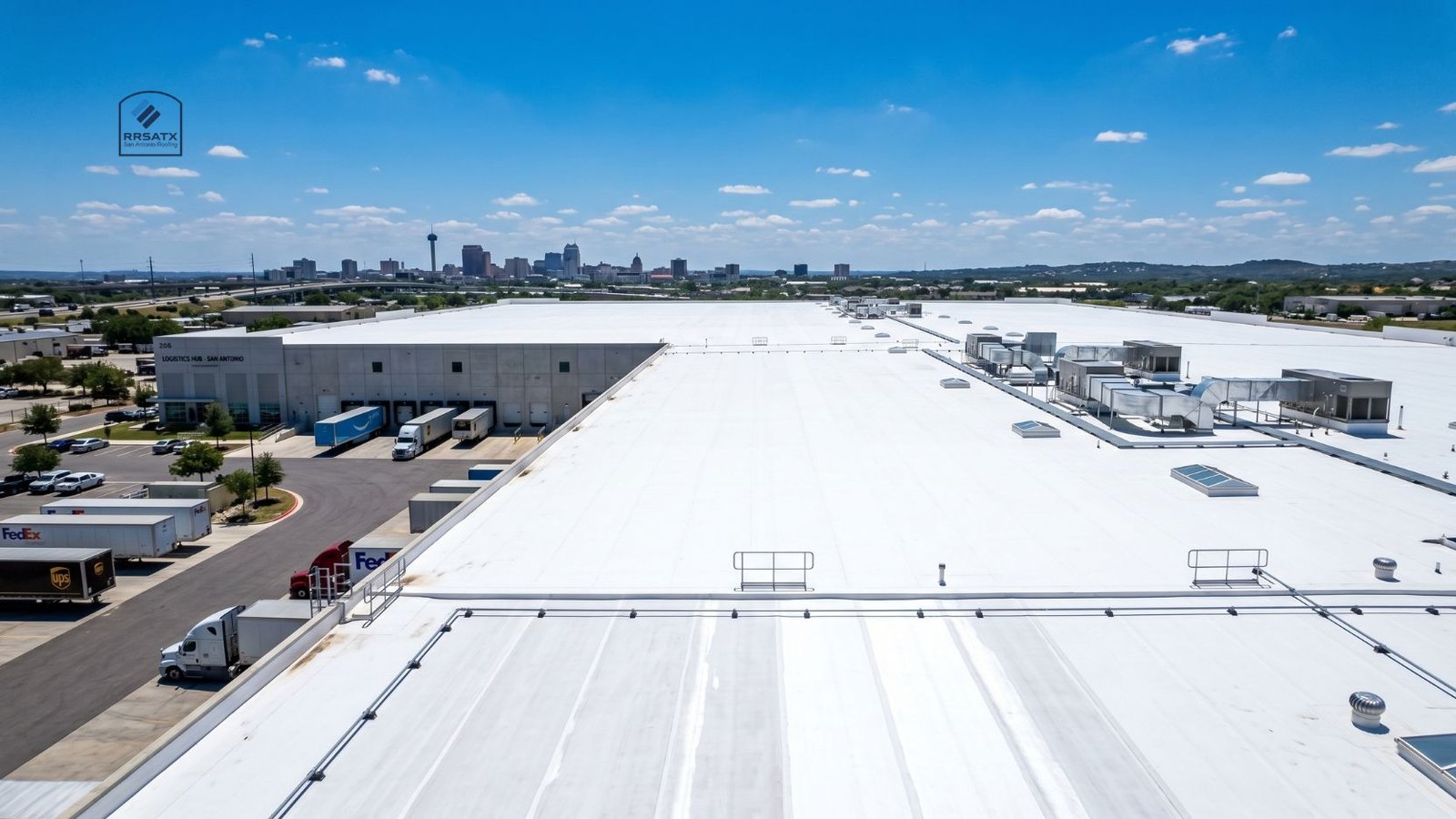
Best Roofing Materials For Commercial Buildings In San Antonio
TPO and metal roofing are the top-performing materials for commercial buildings in San Antonio due to their heat reflectivity, durability in hail-prone conditions, and long service life.
- TPO (Thermoplastic Polyolefin): Excellent UV resistance, Energy Star rated, seams heat-welded for superior leak protection. Lifespan: 20 to 30 years.
- Standing Seam Metal: Best long-term durability, handles hail impact well, recyclable. Lifespan: 40 to 60 years.
- Modified Bitumen: Cost-effective for re-roofing, good for low-slope applications. Lifespan: 15 to 20 years.
- EPDM: Common on older flat roofs, flexible in temperature extremes. Lifespan: 20 to 25 years.
TPO VS. Metal Roofing For Commercial Properties In San Antonio
TPO is the more budget-friendly option with solid performance; metal is the better long-term investment for buildings that owners plan to hold for decades.
| Factor | TPO | Standing Seam Metal |
| Upfront cost | Lower | Higher |
| Lifespan | 20 to 30 years | 40 to 60 years |
| Hail resistance | Moderate | High |
| Energy efficiency | High (reflective) | High |
| Maintenance | Low | Very low |
For San Antonio’s intense summer heat, both materials outperform older built-up roofing (BUR) systems in energy performance.
Signs Your Commercial Roof Needs An Inspection
Schedule a professional inspection immediately if you notice interior water stains, bubbling or blistering on the membrane, visible seam separation, or debris buildup around drains.
Additional warning signs:
- Ponding water 48 hours after rainfall
- Visible daylight through the roof deck in any interior space
- Sudden spike in HVAC energy costs (often linked to compromised insulation)
- Roof age exceeding 15 years with no documented maintenance history
How Storm Damage Affects Commercial Roofs In San Antonio
San Antonio averages multiple severe hail events and high-wind storms annually, and commercial flat roofs are particularly vulnerable to membrane punctures, seam failures, and drainage blockages after storms.
After any significant weather event:
- Document visible damage with photos before any cleanup
- Contact your insurance carrier to open a claim
- Have a licensed commercial roofing contractor perform a written damage assessment
- Avoid temporary patch work that could affect the insurance payout
Key takeaway: Insurance adjusters assess commercial roofs differently than residential. A contractor experienced in commercial insurance claims can protect your payout.
How Often Should A Commercial Roof Be Inspected In Texas?
Commercial roofs in Texas should be inspected at minimum twice per year once in spring before peak storm season and once in fall after summer heat stress plus after any major weather event.
Texas building management best practice:
- Spring inspection: Check drainage, membrane seams, flashings
- Fall inspection: Assess UV and heat damage from summer
- Post-storm: Immediate assessment after hail or wind events
Most commercial roof warranties also require documented inspections to remain valid.
Commercial Roof Maintenance Checklist For Texas Businesses
Preventive maintenance extends roof life by 30 to 50% and is significantly less expensive than emergency repairs or premature replacement.
Twice-annual maintenance checklist:
- Clear all roof drains and scuppers
- Inspect and reseal all penetration flashings (HVAC units, vents, skylights)
- Check membrane seams for lifting or cracking
- Inspect parapet walls and coping caps
- Remove any debris or standing vegetation
- Document condition with photos and written report
FAQs
How Long Does A Commercial Roof Replacement Take In San Antonio?
Most commercial roof replacements are completed in 3 to 10 business days depending on building size, material selected, and weather conditions. Large warehouse facilities may take longer.
Can I File An Insurance Claim For Hail Damage On My Commercial Roof?
Yes. If a licensed roofing contractor confirms hail damage, you can file a claim under your commercial property policy. Timeliness matters; most Texas policies require claims to be filed within one year of the storm event.
Does RRSATX: San Antonio Roofing Company Handle Commercial Properties?
Yes. RRSATX: San Antonio Roofing Company works with commercial building owners across San Antonio for inspections, repairs, replacements, and storm damage assessments from locations on Monterey St and E Nakoma Dr.