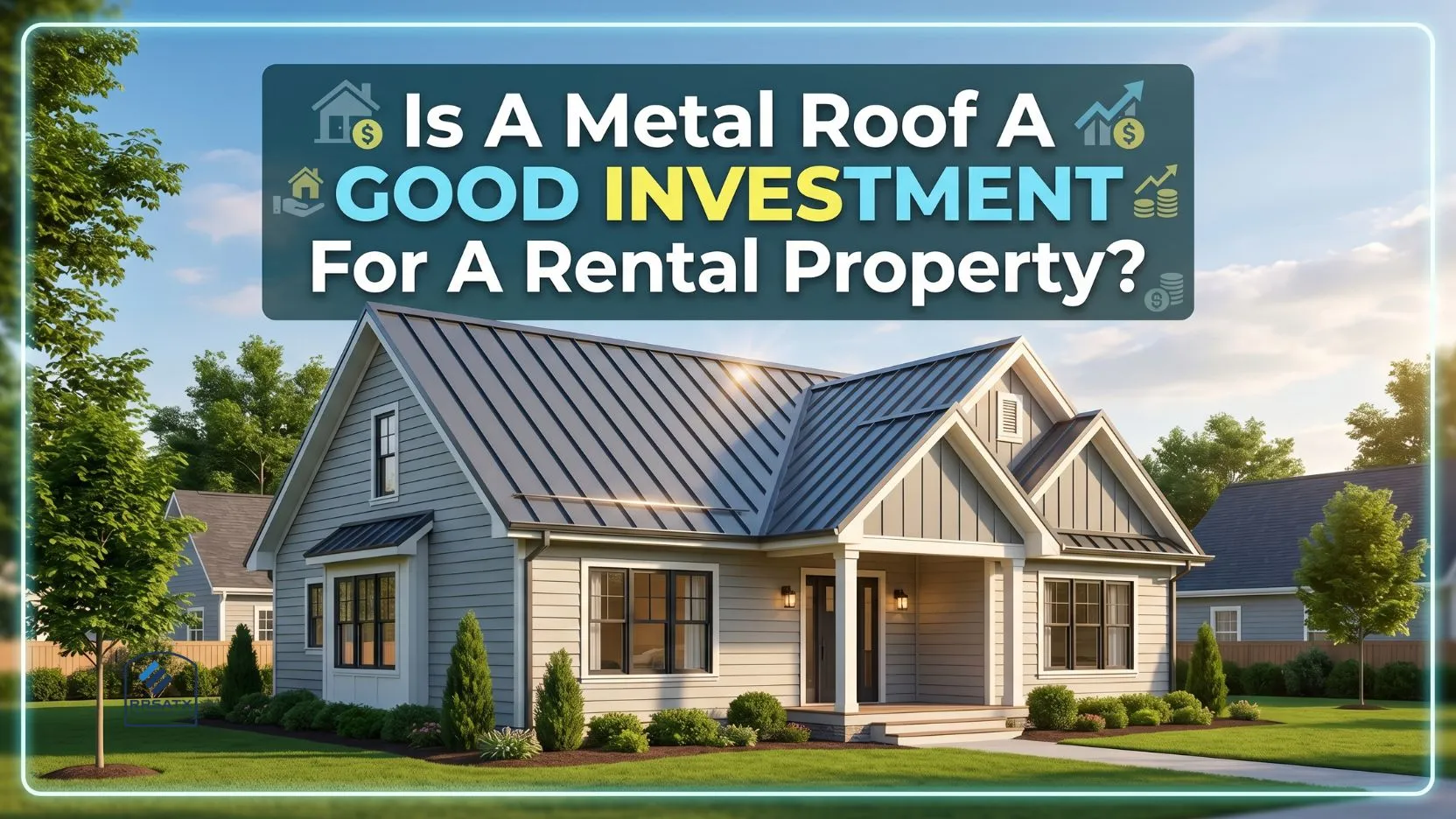
Rental property owners in San Antonio are switching to metal roofing for one reason: it costs more upfront and far less over time. This guide covers the full financial picture lifespan, ROI, tax treatment, tenant appeal, and when the numbers actually make sense for your property.
If you own a rental property in San Antonio, your roof is not just a building component. It is one of the largest recurring maintenance expenses you will face over your ownership period. Asphalt shingles in the Texas heat typically need replacement every 15 to 20 years. Add in hail damage, UV degradation, and the cost of emergency repairs between cycles, and roofing becomes one of the biggest drains on rental property cash flow over time.
Metal roofing changes that calculation entirely. A standing seam or metal panel roof installed today has a realistic service life of 40 to 70 years in the San Antonio climate. For a landlord who plans to hold a property for 20, 30, or even 40 years, that means paying for one roof instead of two or three. The upfront cost is higher. The lifetime cost is substantially lower. The question is not whether metal is a better roof. It is whether the math works for your specific property, your hold strategy, and your current financial position.
This guide covers every factor that matters when making that decision: the real cost comparison against asphalt, the tax treatment available to rental property owners, the impact on property value and insurance premiums, the tenant appeal factor in the San Antonio rental market, and the specific conditions where metal roofing delivers the clearest return.
Most landlords compare metal roofing to asphalt by looking at the installation quote alone. That comparison almost always makes metal look expensive. The right comparison includes all replacement cycles, all repair calls, all insurance premium differences, all lost rent during emergency repairs, and all depreciation benefits across the full ownership period. When you run those numbers over 40 years, the picture looks very different. A contractor who gives you a metal roof quote without walking you through that lifetime cost comparison is not giving you enough information to make a sound decision.
The most important number in any roofing decision for a rental property is not the installation quote. It is the total cost across your expected ownership period. In San Antonio, asphalt shingles last 15 to 20 years under ideal conditions. The Texas summer heat, UV intensity, and regular hail events push that timeline toward the shorter end. A 30-year architectural shingle installed in San Antonio may need replacement after 18 to 22 years in practice.
A metal roof installed on the same property will outlast two full asphalt replacement cycles and likely a third. The compounding effect of avoiding those replacement costs, along with the lower ongoing maintenance expense, is what makes metal roofing financially sound for long-term rental property holders.
- Calculate your expected hold period for the property before comparing roofing systems
- Get the total cost over your hold period, not just the installation quote, from your contractor
- Ask your contractor how many asphalt replacements the property has already had and when the next one is due
- Factor in one to two hail damage events over a 20-year period when estimating asphalt repair costs
- Request a side-by-side 30-year cost comparison in writing before making a decision
Metal roofing costs two to three times more to install than asphalt shingles on the same property. On a typical single-family rental in San Antonio, that means the upfront difference between systems runs $8,000 to $18,000 depending on the metal type, roof pitch, and panel profile selected. That is a real cash flow difference that a landlord needs to plan for.
The key financial question is not whether you have the cash today. It is whether the higher upfront cost makes sense given your financing options, your tax position, and your hold period. Rental property owners have several tools available that ordinary homeowners do not, including depreciation deductions and the ability to treat certain roofing expenditures as business expenses.
Rental property owners have access to financing tools that reduce the effective out-of-pocket cost of a metal roof installation. A home equity line of credit or a cash-out refinance on the investment property can fund the installation while the tax deductions and insurance savings begin working immediately. Some landlords also structure metal roof installations as a capital improvement at the time of a property acquisition, rolling the cost into the purchase financing. Talk to your CPA and a San Antonio metal roofing contractor together before deciding on the financing path the right structure depends on your tax position, your property basis, and your hold-period plan.
- Get quotes for both exposed-fastener and standing seam systems so you can compare at different price points
- Ask your lender whether a cash-out refinance or HELOC makes sense for funding the installation
- Calculate your estimated break-even year based on avoided replacement costs and insurance savings
- Confirm with your CPA whether the roof qualifies as a capital improvement or a repair expense for tax purposes
- Request a written 40-year cost comparison from your contractor that includes all asphalt replacement cycles
This is the roofing investment factor that most San Antonio landlords underestimate. When you replace or install a roof on a rental property, the IRS does not treat it the same way as a roof on your personal residence. A new roof on a rental property is a capital improvement that can be depreciated over time, creating a tax deduction that reduces your net rental income each year for the life of the depreciation schedule.
Under current IRS rules, residential rental property improvements are depreciated over 27.5 years using the straight-line method. A metal roof installation that costs $20,000 on a rental property generates approximately $727 per year in depreciation deductions. Over the full depreciation schedule, that totals $20,000 in deductions against your rental income, directly reducing the federal and state taxes owed on that income.
| Scenario | Installation cost | Annual depreciation deduction | Total tax benefit (27.5 yrs) |
|---|---|---|---|
| Metal panel system (small rental) | $14,000 | $509 per year | $14,000 in deductions against rental income |
| Metal panel system (standard rental) | $20,000 | $727 per year | $20,000 in deductions against rental income |
| Standing seam system (higher-value rental) | $30,000 | $1,091 per year | $30,000 in deductions against rental income |
| Repair under $2,500 threshold | $1,800 | Fully deductible in year one | Full amount deducted in the tax year of the repair |
Bonus depreciation and Section 179 provisions change from year to year based on federal tax legislation. In some tax years, landlords have been able to accelerate depreciation deductions using bonus depreciation, taking a larger portion of the deduction in the first year rather than spreading it over 27.5 years. Whether that strategy is available in 2026 and whether it applies to your specific situation depends on your tax filing status and the property classification. This guide does not constitute tax advice. Discuss the specific treatment with a CPA who works with rental property owners before installation.
- Confirm the roof qualifies as a capital improvement to your rental property with your CPA before installation
- Get the contractor's invoice itemized separately from any other work done at the same time
- Ask your CPA whether bonus depreciation or Section 179 applies to your property in the current tax year
- Document the old roof's depreciation basis if it was already being depreciated you may need to write off the remaining basis on the old roof
- Contact your insurance carrier after installation to request a premium review and get the reduced premium in writing
The financial return on a metal roof does not stop at the avoided replacement cost. Metal roofing affects two ongoing cost categories that landlords pay every year: insurance premiums and maintenance expenses. Both move favorably when you upgrade from asphalt to metal on a San Antonio rental property.
Insurance carriers in Texas treat metal roofing differently from asphalt in their risk models. A metal roof is more resistant to hail, wind, fire, and UV degradation than asphalt shingles. Some carriers offer premium discounts of 20% to 30% for metal-roofed properties in hail-active zones. In the San Antonio market, that can translate to $300 to $800 in annual premium reduction on a standard landlord policy, depending on the carrier and the coverage level. Over a 40-year roof lifespan, that accumulates to $12,000 to $32,000 in premium savings alone.
Maintenance savings are equally significant for landlords. Every emergency roof repair call has a direct cost and an indirect cost. The direct cost is the repair invoice. The indirect cost is tenant disruption, the time you spend coordinating the repair, and the risk of water damage to interior finishes that the repair does not fully cover. Metal roofs generate far fewer emergency repair events than asphalt roofs over their lifespan. A well-installed metal panel or standing seam system requires inspection every two to three years and minimal corrective maintenance outside of hail events.
- Call your landlord insurance carrier before installation and ask about premium adjustments for qualifying metal roof systems
- Get the premium discount terms in writing from the carrier after installation is complete
- Schedule a professional inspection every two to three years to keep the roof's warranty and maintain insurance eligibility
- Track all maintenance costs on your rental property by year so you have an accurate picture of your actual roofing expense over time
- Check whether your carrier has a preferred metal roof system list that qualifies for the maximum discount before choosing your panel type
Tenant quality and lease retention are core drivers of rental property ROI. A high-quality tenant who stays in a property for three or four years saves a landlord thousands of dollars in turnover costs, vacancy losses, and re-leasing fees. The condition of a rental property exterior is one of the factors that higher-quality tenants evaluate when deciding where to live.
A metal roof is a visible sign of quality construction and property care. In the San Antonio rental market, properties with metal roofing are positioned as better-maintained than comparable properties with aging asphalt shingles. This matters most in mid-range and upper-mid-range rental price points where tenants have choices and evaluate properties on quality, not just price. At the entry-level rental price point, it matters less as a differentiator but still reduces vacancy risk because the property presents well.
| Rental segment | Metal roof tenant appeal | Rental premium potential | Lease retention benefit |
|---|---|---|---|
| Entry-level (under $1,400/mo) | Moderate. Reduces vacancy by signaling property quality. | Low. Price is the primary driver at this segment. | Moderate. Better condition reduces maintenance-related complaints. |
| Mid-range ($1,400 to $2,200/mo) | High. Tenants compare properties actively and notice quality differences. | Moderate. $50 to $100 per month premium is supportable in well-located properties. | High. Fewer maintenance issues means fewer lease non-renewals due to property condition. |
| Upper-mid and premium ($2,200+/mo) | High. Expected as a baseline quality indicator. Absence of metal roofing is more noticeable than its presence. | Moderate to high. Premium positioning is supported by all quality finishes including the roof. | High. Tenants paying premium rents have higher maintenance expectations. Metal roofing meets those expectations. |
The biggest tenant-related ROI driver is not rental rate increases. It is lease renewal rate. A single vacancy on a mid-range San Antonio rental property costs between $2,000 and $4,000 when you account for the lost rent during the vacancy period, any turnover maintenance, and leasing fees. If a metal roof reduces your vacancy frequency by even one event per decade, that alone covers a meaningful portion of the cost premium over asphalt. Tenants who feel their landlord maintains the property well are significantly more likely to renew. A metal roof, properly presented during the leasing process, is a real differentiator for tenant quality and retention.
- Photograph the metal roof installation for your property listing photos to visually communicate the upgrade
- Note the metal roof in your rental listing description as a property feature with the year of installation
- Track your vacancy rate before and after the installation to measure the actual retention impact
- Consider a modest rent increase at renewal after the installation, positioned as a reflection of the property's improved condition and lower tenant utility costs from better insulation performance
- Mention to prospective tenants that a metal roof means fewer maintenance disruptions during storms, which is a genuine quality-of-life benefit in the San Antonio climate
When a rental property sells, the roof is one of the first things a buyer's inspector evaluates. An aging asphalt roof is a negotiating chip for buyers they use it to push for price reductions, seller concessions, or roof replacement credits. A metal roof that still has decades of service life remaining removes that negotiation point entirely and can contribute positively to the property's appraised value.
National appraisal data consistently shows that metal roofing adds an average of 4% to 6% to residential property values compared to properties with standard asphalt roofing. On a San Antonio rental property valued at $250,000, that represents $10,000 to $15,000 in appraised value difference. The actual impact varies by neighborhood, the condition of comparable properties in the submarket, and the appraisal methodology used, but the directional effect is consistently positive.
- Note the installation date and manufacturer warranty details in your property records for disclosure at sale
- Get a copy of the roofing contractor's warranty documentation and the manufacturer's product warranty to transfer to the buyer
- Commission a pre-listing appraisal that specifically accounts for the metal roof condition and remaining life when preparing to sell
- Disclose the metal roof material, installation year, and warranty status in your listing to attract investor buyers specifically looking for low-maintenance properties
- Instruct your real estate agent to position the metal roof as a key financial benefit for prospective buyers in the listing narrative
Metal roofing is not the right answer for every rental property situation. The investment makes the most sense under specific conditions. Use this framework to evaluate where your property fits before committing to a system.
| Property situation | Metal roof recommendation | Reasoning |
|---|---|---|
| Hold period 20 or more years | Strong yes | At least one full asphalt replacement cycle is avoided. Lifetime savings are clear and substantial. |
| Property in active San Antonio hail zone | Strong yes | Hail damage is a recurring event. Metal's hail resistance eliminates repeated repair and insurance claim cycles. |
| Mid-range or premium rental price point | Yes | Tenant quality, retention benefit, and rental premium potential are highest at these price points. |
| Planning to sell within 5 years | Depends on roof condition | If the current roof is within 5 years of replacement, metal is worth the premium for resale positioning. If the current roof is new, wait. |
| Entry-level rental, thin margins | Consider metal panel | Standing seam may be hard to justify. Exposed-fastener metal panel is a more affordable metal option worth evaluating on a 30-year cost basis. |
| Planning to sell within 2 to 3 years, current roof is sound | No | Insufficient hold period to recover the installation cost premium before sale. Repair and maintain what exists. |
| Multi-unit property (duplex to fourplex) | Yes | Higher roof square footage means insurance savings and avoided replacement costs are proportionally larger. ROI improves at scale. |
- Calculated your expected property hold period and confirmed it is 15 years or longer
- Obtained a 30 to 40 year total cost comparison from your contractor (installation plus all replacement cycles)
- Confirmed the insurance premium reduction with your carrier and calculated the 20-year cumulative savings
- Discussed tax treatment with your CPA to confirm the roof qualifies as a depreciable capital improvement
- Evaluated financing options: cash, HELOC, cash-out refinance, or property acquisition financing
- Received quotes for both exposed-fastener metal panel and standing seam systems to compare at different price points
- Confirmed the metal system's wind and hail resistance ratings match what your insurance carrier requires for the premium discount
- Verified the contractor is licensed and insured in Texas and has installed metal roofing on residential rental properties in San Antonio
- Reviewed the manufacturer's material warranty and the contractor's workmanship warranty for the selected system
- Confirmed the panel color and finish are appropriate for San Antonio's climate reflective finishes reduce cooling loads and can lower tenant utility costs
- Notified your insurance carrier and requested a premium reassessment with documentation of the new system
- Updated your property records with the installation date, system specifications, and warranty documentation
- Scheduled first post-installation inspection for 12 to 18 months after installation to confirm all flashings and fasteners are properly seated
- Updated your rental listing to reflect the metal roof as a property feature
- Informed your CPA of the installation so the capital improvement can be entered into your depreciation schedule for the current tax year
Get a free metal roof estimate for your San Antonio rental property
Tell us about your property, your hold period, and your current roof condition. We will give you a clear written estimate, a 30-year cost comparison against asphalt, and an honest recommendation on whether metal roofing makes sense for your specific investment.


