
[et_pb_section fb_built=”1″ admin_label=”section” _builder_version=”4.16″ global_colors_info=”{}”][et_pb_row admin_label=”row” _builder_version=”4.16″ background_size=”initial” background_position=”top_left” background_repeat=”repeat” global_colors_info=”{}”][et_pb_column type=”4_4″ _builder_version=”4.16″ custom_padding=”|||” global_colors_info=”{}” custom_padding__hover=”|||”][et_pb_code _builder_version=”4.27.6″ _module_preset=”default” hover_enabled=”0″ global_colors_info=”{}” sticky_enabled=”0″]
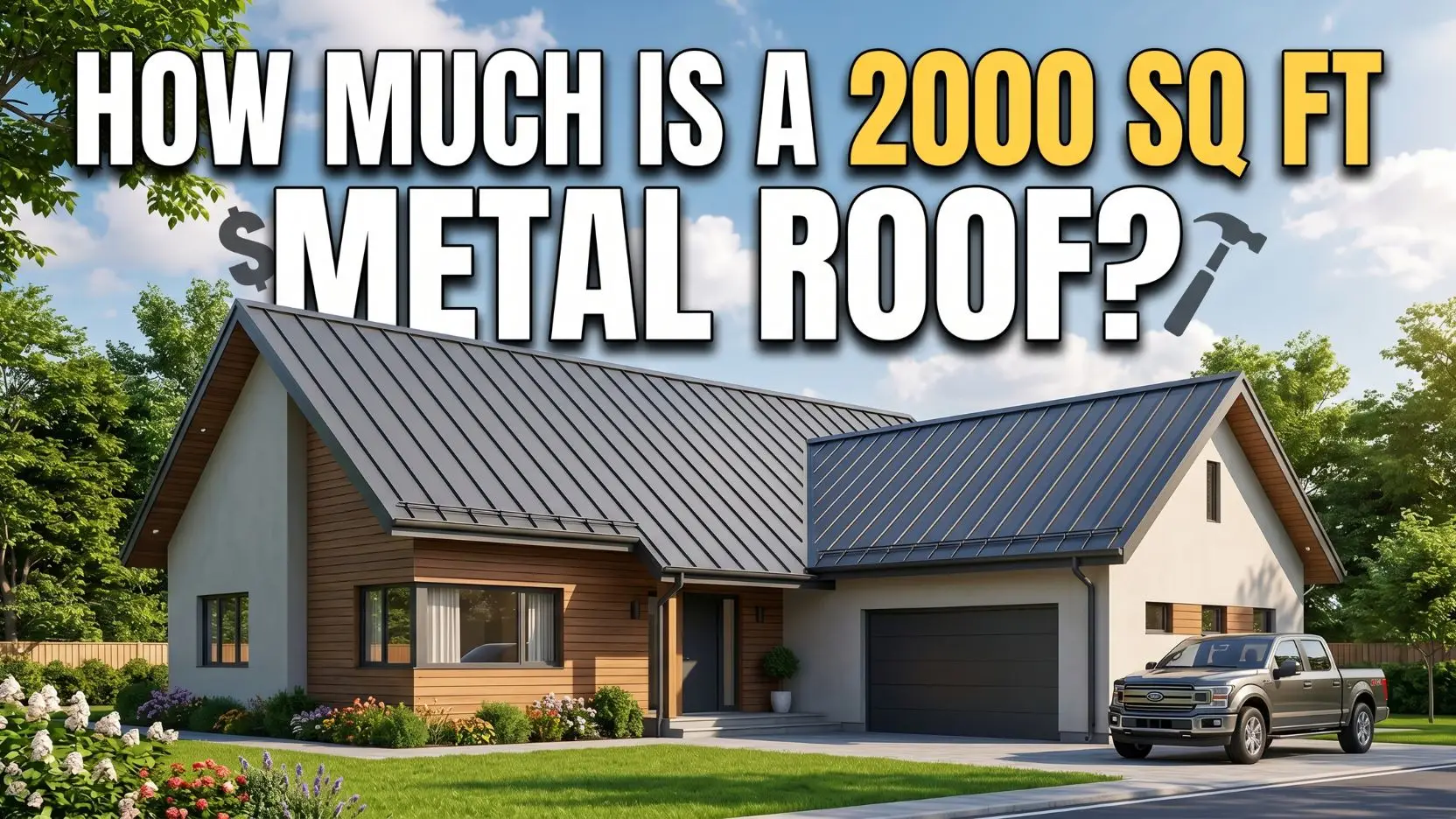
A straight answer to the most common question we get from San Antonio homeowners. This guide covers every cost variable for a 2,000 sq ft metal roof, breaks down pricing by material type, and explains exactly what drives your final number up or down.
A 2,000 sq ft metal roof in San Antonio can cost anywhere from $14,000 to $48,000 fully installed. That is a wide range, and the gap between the low end and the high end is not a contractor pricing up a job. It is the difference between a budget-grade corrugated panel and a premium concealed-fastener standing seam system. Understanding what sits inside that range, and which variables move the number in each direction, is exactly what this guide covers.
The answer also depends on a detail most homeowners miss: a 2,000 sq ft home does not have 2,000 sq ft of actual roof surface. Roof slope, overhangs, and the number of hips, valleys, and dormers all add surface area on top of the floor plan footprint. A typical 2,000 sq ft San Antonio home has between 2,200 and 2,700 sq ft of actual roof surface once you account for pitch. That difference matters when you are comparing quotes or trying to estimate your number before calling a contractor.
Every metal roof price you see online is quoted per roofing square (100 sq ft of actual roof surface), not per square foot of your home’s living area. A legitimate quote will include a full material takeoff showing the actual measured roof area. If a contractor quotes you a total price without explaining the actual square footage they are pricing, ask for the breakdown before moving forward. The difference between a 2,000 sq ft home footprint and the actual roof surface area is routinely 15 to 35 percent more material.
Before breaking down cost by material type, it helps to understand the five variables that push a metal roof price up or down regardless of the panel you choose. Every quote you receive will be shaped by these factors, whether the contractor explains them or not.
Material Cost
The type of metal panel you choose is the single largest driver of cost on any roofing job. A budget corrugated steel panel and a premium standing seam aluminum roof can be installed on the exact same 2,000 sq ft San Antonio home and come back at prices that are $25,000 apart. Here is how each panel type pencils out at current San Antonio pricing.
- Steel gauge confirmed: residential metal roofing should be 24 or 26 gauge for panels, not 29 gauge
- Coating system specified: Kynar 500 or Hylar 5000 PVDF coatings outperform polyester coatings significantly in Texas UV conditions
- Panel profile and rib height provided in writing (affects wind uplift resistance and water shedding) uplift resistance and water shedding
- Manufacturer warranty terms confirmed: material warranty separate from paint/finish warranty
- Fastener type for exposed fastener panels: stainless steel or coated steel screws, not zinc-plated
Complexity Factor
Two homes with identical floor plans can produce very different metal roofing costs if their roof shapes differ. A simple gable roof with two clean planes is the least expensive configuration to install metal on. A hip-and-valley roof with multiple dormers, a steep pitch, skylights, and several chimney or pipe penetrations requires significantly more cutting, flashing, and labor hours.
Pitch matters both for surface area and for safety. A 4:12 pitch (relatively low slope) is straightforward for a crew to walk and work on. A 10:12 or 12:12 pitch requires safety equipment, slows the crew down, and adds labor time. Most San Antonio metal roofing contractors price steep-slope work at a higher per-square rate than low-slope installations.
Many San Antonio homes built in the 1970s and 1980s have relatively low-pitch gable or hip roofs that are actually favorable for metal roofing installation. If your home has a straightforward roofline, your labor costs will be at the lower end of the range for your chosen material. Ask your contractor to separate material cost and labor cost in the quote so you can see exactly how complexity is affecting your number.
Substrate Costs
Before any metal panel goes on your San Antonio home, the existing roof system has to be addressed. Most residential metal roofing installations fall into one of three scenarios: tearoff and replacement of the existing shingle roof, installation over existing shingles (in certain limited situations), or replacement of a deteriorated flat or low-slope roof system. Each scenario carries a different added cost.
| Substrate scenario | Typical added cost (2,000 sq ft home) | Key considerations |
|---|---|---|
| Shingle tearoff and disposal | $1,500 to $3,500 | Single layer tearoff is faster; two or three layers add cost and weight. Texas disposal fees apply. |
| Decking inspection and repair | $500 to $3,000 depending on condition | Rotted or delaminated decking must be replaced before metal panels are installed. Cannot be assessed accurately until existing roofing is removed. |
| Metal over shingles (direct overlay) | Saves $1,500 to $3,500 on tearoff | Only appropriate in specific situations with a sound single layer of shingles and no moisture damage. Not always recommended and not allowed under all building codes. Discuss with your contractor. |
| Underlayment | $800 to $1,800 | Metal roofing requires a premium synthetic underlayment rated for use under metal panels. Standard felt is not adequate for a metal roof in Texas heat. |
| New decking installation (full) | $3,000 to $6,500 | Required when existing decking is structurally compromised. Less common but not rare on homes from the 1960s and 1970s. |
Labor
Metal roofing is a skilled trade. The installation techniques for standing seam, snap-lock, and metal shingle systems are meaningfully different from asphalt shingle work, and a crew that primarily installs asphalt will not produce the same quality result on a metal roof as a crew that specializes in it. In San Antonio’s current labor market, metal roofing labor runs between $3.50 and $9 per sq ft of actual roof surface, depending on the panel system and the complexity of the job.
Factors that increase your labor cost beyond these baseline figures include roof pitch above 8:12, high number of valleys and penetrations, second-story or multi-story work, job site accessibility issues (narrow lots, fencing, landscaping), and scheduling during peak demand periods after major storm events. Factors that reduce labor cost include a simple single-plane or two-plane gable roof, easy ground-level staging access, and flexible scheduling during slower seasons.
A significantly lower labor price from one contractor compared to others is not automatically a bargain. In San Antonio’s roofing market, low labor quotes sometimes indicate unlicensed subcontractors, no workers compensation coverage, or a crew without specific metal roofing experience. Always verify your contractor’s license with the Texas Department of Licensing and Regulation and request a certificate of insurance showing workers compensation coverage before work begins.
- Contractor holds a current Texas roofing contractor license (verify at tdlr.texas.gov) tdlr.texas.gov
- Workers compensation insurance confirmed in writing, not just general liability
- Crew has demonstrated experience with the specific panel system being installed
- Project manager or foreman will be on site during installation, not just a subcontracted crew
- Installation follows manufacturer’s guidelines, which is required to maintain the material warranty
- Workmanship warranty provided separately from the manufacturer material warranty
Watch Out
The base material and labor cost is what most contractors quote upfront. The items below are sometimes included, sometimes excluded, and sometimes added as change orders after the job has started. The cleanest way to protect yourself is to ask each contractor to confirm in writing whether every item on this list is included in their quote or excluded and separately priced.
| Cost item | Typical range | Notes |
|---|---|---|
| Permit fee (City of San Antonio / Bexar County) | $200 to $800 | Required for full roof replacement. Some contractors include this; others do not. Pulling a permit is required by code. |
| Ridge vent or ventilation upgrades | $400 to $1,200 | Metal roofing changes attic airflow dynamics. A ventilation assessment at the time of installation prevents moisture problems later. |
| Gutters and downspout reconnection | $300 to $1,500 | Existing gutters must be disconnected and reconnected at the new roof drip edge. Older gutters sometimes need replacement at the same time. |
| Flashing upgrades (chimney, skylights, pipe boots) | $150 to $600 per penetration | Old lead or galvanized flashings are not compatible with certain metal panels. Stainless or aluminum flashing is required at penetrations on most metal systems. |
| Drip edge and fascia board repair | $200 to $1,200 | Deteriorated fascia boards are commonly discovered during tearoff. Metal roofing drip edge profile differs from standard shingle drip edge. |
| Satellite dish or solar panel disconnection and reconnection | $150 to $500 per item | Anything roof-mounted must be removed before installation and remounted after. Confirm who is responsible and what this costs. |
| Snow guards (optional for San Antonio) | $400 to $1,000 | Not required in most San Antonio climates but occasionally requested for steep-pitch installations or covered entryways. |
These ranges reflect fully installed costs in the San Antonio market as of 2026, including standard tearoff of one existing shingle layer, premium synthetic underlayment, standard drip edge, and basic penetration flashing. Costs assume a moderate-complexity roof with a pitch between 4:12 and 8:12. Steep pitches, complex rooflines, or significant decking repairs will add to these figures.
| Metal panel type | Cost per sq ft (installed) | Total for 2,000 sq ft home | Best suited for |
|---|---|---|---|
| Corrugated steel (exposed fastener) | $7 to $11 | $14,000 to $22,000 | Budget-focused projects, simple rooflines, agricultural or shed-style additions |
| R-panel (exposed fastener) | $8 to $12 | $16,000 to $24,000 | Cost-conscious homeowners who want metal durability without premium panel pricing |
| Metal shingles (steel or aluminum) | $10 to $15 | $20,000 to $30,000 | Neighborhoods with conventional aesthetic requirements, strong hail resistance priority |
| Stone-coated steel | $11 to $16 | $22,000 to $32,000 | Homeowners who want metal performance with a tile or shake appearance |
| Standing seam steel (concealed fastener) | $14 to $20 | $28,000 to $40,000 | Long-term investment, premium appearance, low maintenance priority |
| Standing seam aluminum (concealed fastener) | $16 to $24 | $32,000 to $48,000 | Maximum corrosion resistance, coastal proximity, longest warranty horizon |
The upfront cost of a metal roof is higher than asphalt shingles. A comparable asphalt shingle re-roof on the same 2,000 sq ft San Antonio home runs $8,000 to $14,000. That makes a metal roof appear to cost two to three times more at the point of purchase. The total cost comparison looks very different when you account for service life and long-term savings.
An asphalt shingle roof in San Antonio’s climate lasts 15 to 20 years before requiring full replacement. Over 50 years, a homeowner will replace an asphalt roof two or three times, spending $8,000 to $14,000 each time plus the carrying cost of each replacement project. A standing seam metal roof installed once at $30,000 to $40,000 will routinely outlast all three of those shingle cycles. Add in lower maintenance costs, potential homeowners insurance discounts for hail-resistant metal roofing, and modest energy savings from reflective metal coatings in Texas summer heat, and the total cost difference narrows considerably over time.
Homeowners insurance is worth addressing directly for San Antonio residents. Several major Texas insurers offer premium discounts for homes with Class 4 impact-resistant metal roofing, which includes most metal shingle and standing seam systems. The discount varies by insurer and policy, but ranges from 10 to 30 percent on the dwelling coverage portion of your premium. Call your insurer before finalizing your material choice to confirm which systems qualify for a discount under your specific policy.
- Identify your roof’s actual configuration: pitch, number of planes, valleys, penetrations, and dormers
- Note your current roofing material and how many existing layers are on the roof
- Decide on a material category before calling: corrugated, standing seam, or metal shingles
- Check your HOA rules if applicable, as some associations restrict metal roofing material types or colors
- Contact your homeowners insurance carrier and ask which metal roofing systems qualify for impact-resistant discounts
- Confirm the actual roof square footage in the quote, not your home’s floor plan area
- Verify that tearoff, disposal, underlayment, and drip edge are either included or itemized separately
- Ask how decking repairs discovered during tearoff are handled and what the per-sheet cost will be
- Confirm the permit is included and confirm who is responsible for pulling it
- Verify the steel gauge or aluminum thickness being quoted: 24 or 26 gauge for residential panels
- Confirm the coating system for painted panels: PVDF (Kynar 500 or Hylar 5000) for Texas climate performance
- Compare workmanship warranty terms in addition to manufacturer warranty terms
- Verify the contractor’s Texas roofing license at tdlr.texas.gov
- Request and review the certificate of insurance, confirming both general liability and workers compensation
- Confirm the installation crew has specific experience with your chosen panel system
- Get the payment schedule in writing and avoid any contractor requiring full payment upfront
- Confirm the project timeline and what happens if materials are delayed
How much does a metal roof cost on a 2,000 sq ft house in San Antonio?
Why is my metal roof quote so much higher than what I found online?
Is a metal roof worth the extra cost over asphalt shingles in San Antonio?
What is the cheapest metal roof option for a 2,000 sq ft San Antonio home?
How long does it take to install a metal roof on a 2,000 sq ft home?
Can I finance a metal roof in San Antonio?
Get a free metal roof estimate for your San Antonio home
Tell us your home’s size, your current roofing situation, and what you are trying to accomplish. We will give you a clear, itemized written estimate at no cost and no obligation.
[/et_pb_code][/et_pb_column][/et_pb_row][/et_pb_section]