
[et_pb_section fb_built=”1″ admin_label=”section” _builder_version=”4.16″ global_colors_info=”{}”][et_pb_row admin_label=”row” _builder_version=”4.16″ background_size=”initial” background_position=”top_left” background_repeat=”repeat” global_colors_info=”{}”][et_pb_column type=”4_4″ _builder_version=”4.16″ custom_padding=”|||” global_colors_info=”{}” custom_padding__hover=”|||”][et_pb_code _builder_version=”4.27.6″ _module_preset=”default” global_colors_info=”{}”]
Most San Antonio homeowners with a 1,500 square foot house spend between $12,000 and $24,000 for a professionally installed metal roof. The range is wide because metal roofing is not one product. This guide breaks down exactly what drives cost, what each panel type runs in 2026, and how to budget realistically for your home.
Metal roofing has become one of the most requested upgrades among San Antonio homeowners, and for good reason. The Texas climate is hard on asphalt shingles. Extreme summer heat, hailstorms, and ultraviolet exposure wear a standard shingle roof down fast. Metal handles all of it better, and it lasts two to three times longer than asphalt when properly installed.
The question most homeowners come to us with first is simple: what is this going to cost? On a 1,500 square foot house, the answer depends on which type of metal panel you choose, how complex your roofline is, and whether any decking or structural work is needed underneath. This guide gives you real San Antonio numbers for 2026 so you can budget honestly before you call a single contractor.
A 1,500 square foot home does not have a 1,500 square foot roof. Roof square footage is calculated by measuring the actual surface area of the sloped roof, which is always larger than the footprint of the house. On a standard gable roof with a moderate pitch, a 1,500 square foot home typically has between 1,600 and 1,900 square feet of actual roof surface. Add dormers, hips, valleys, or a steeper pitch and that number climbs further. Every cost estimate in this guide is based on typical roof square footage for a 1,500 square foot San Antonio home, not just the house footprint.
Material Cost
Metal roofing is not one product. It is a category that covers several different panel types, each with its own material cost, installation requirements, and expected lifespan. The panel type you choose will do more to determine your final price than almost any other factor on a 1,500 square foot home.
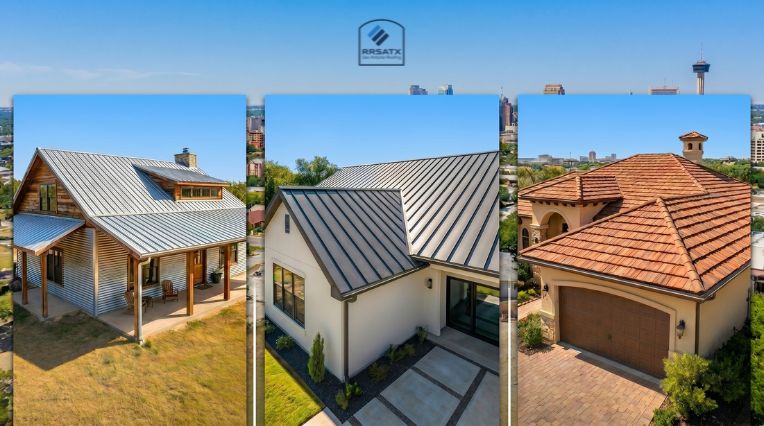
Corrugated steel panels are the most budget-friendly metal roofing option. These are exposed-fastener panels with a wave or rib profile. They cost less per square foot for both materials and installation, but they require more maintenance over time because every fastener is a potential leak point.
Standing seam metal panels are the premium option. Fasteners are hidden beneath interlocking panel seams, which eliminates the exposed-fastener leak risk and gives the roof a clean, modern appearance. They cost significantly more up front but require far less maintenance over their lifespan.
Stone-coated steel panels look like tile or shingles but perform like metal. They are popular in San Antonio neighborhoods where traditional aesthetics matter. They sit in the middle of the price range and offer excellent hail resistance.
- Confirm whether your HOA has restrictions on panel profile or panel color before committing to a type
- Ask your contractor to specify the gauge of steel being quoted: 26-gauge is standard residential; 24-gauge is thicker and more hail-resistant
- Standing seam is available in Galvalume, painted steel, or aluminum; clarify which substrate is included in the quote
- Stone-coated steel: confirm the stone chip warranty and the base steel warranty are both documented
- For budget-conscious buyers, corrugated steel is a legitimate option if annual maintenance inspections are part of the plan
Labor Cost
Labor is the cost that surprises most homeowners because it varies more than material pricing does. Two contractors quoting the same panel on the same house can come in thousands of dollars apart based on crew experience, how they handle the tear-off of your existing roof, and whether they factor in deck repair, flashing replacement, and cleanup in the base price or add them as line items.
In San Antonio, metal roofing labor typically runs between $3.50 and $7.00 per square foot on a standard residential installation. On a 1,500 square foot home with a moderately pitched roof, that works out to roughly $5,600 to $11,200 in labor alone. Standing seam labor runs at the high end of that range because the concealed clip-and-lock system requires more precision and time than an exposed-fastener installation.
Always ask if tear-off and disposal is included in the quoted price. Some San Antonio contractors quote metal roof installation assuming the existing roof stays in place as a substrate, which is sometimes permissible depending on your local code and the condition of the decking. Others include full tear-off and disposal in the base price. This one line item can represent a $1,500 to $3,500 difference on a 1,500 square foot house. Get it in writing before you compare quotes side by side.
- Confirm tear-off and disposal is included or explicitly excluded in the written quote
- Ask whether the crew doing the installation is the contractor’s own crew or a subcontractor
- Verify the quote includes flashing installation at all penetrations: vents, skylights, chimney, and eave edges
- Steep roofs: confirm the quote accounts for the actual pitch of your roof, not a flat estimate
- Ask about the crew size and expected installation timeline for your specific home
- Confirm that all labor is covered under a workmanship warranty separate from the material warranty
Roof Complexity
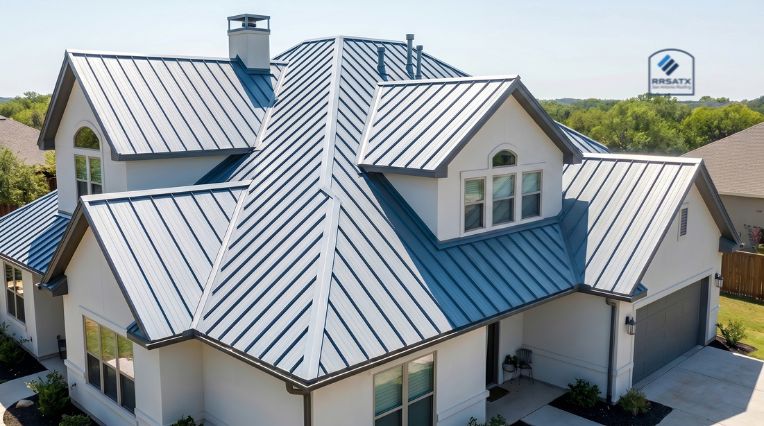
A simple gable roof with no dormers, no skylights, and a moderate pitch is the least expensive roofline to cover in metal. Add a hip roof configuration, a couple of dormers, multiple valleys, or a chimney to flash and every one of those features adds installation time, material waste, and flashing work to the total cost.
In San Antonio, many older homes in established neighborhoods have complex rooflines that were designed for asphalt shingles, which are easy to cut and fit around transitions. Metal panels require more precise cuts and more custom flashing work at every transition point. A complex roofline can add 15 to 30 percent to a metal roof installation compared to the same square footage on a simple gable configuration.
Roof pitch: Pitch is measured as rise over run. A 4:12 pitch rises 4 inches for every 12 inches of horizontal run. Roofs at 7:12 or steeper require additional safety equipment, slower installation, and more experienced crews. In San Antonio, most ranch-style homes have lower pitches of 3:12 to 6:12, which keeps labor costs in the standard range.
Number of valleys and hips: Every valley where two roof planes meet requires careful metal panel cuts and valley flashing. More valleys mean more material waste and more labor. A hip roof with four sloping planes costs more to cover than a simple gable roof with two planes of the same total square footage.
Penetrations: Each chimney, vent pipe, skylight, or HVAC curb that penetrates the roof requires custom flashing fabricated and installed by the metal roofing crew. This is skilled work that is priced separately from the panel installation itself.
- Contractor has measured the actual roof surface area not estimated from the home’s floor plan square footage
- All dormers, valleys, hips, and transitions are identified and accounted for in the written scope
- Every penetration is listed in the quote: vents, pipes, HVAC curbs, skylights, chimneys
- Pitch has been measured and confirmed in writing not approximated from the ground
- Material waste is factored into the quoted material quantity complex rooflines typically require 10 to 15 percent overage
- Custom flashing fabrication and labor is broken out as a line item, not buried in a flat per-square-foot rate
Hidden Costs
Every metal roof installation quote is written before the old roof comes off. What gets found underneath is a variable no honest contractor can fully predict. In San Antonio, where many homes were built in the 1970s, 1980s, and 1990s with asphalt shingles that have been replaced at least once, it is common to find rotted or damaged decking boards once the layers come off. This is especially true in homes that had slow leaks or deferred maintenance over the years.
Decking repair is billed as an additional cost on top of the original quote. Most San Antonio metal roofing contracts include language that covers this scenario. The cost of replacing damaged plywood decking runs between $2 and $4 per square foot for the decking material itself, plus labor. On a 1,500 square foot home, a moderate amount of decking damage say, 200 square feet of replacement adds roughly $600 to $1,200 to the project. Severe or widespread rot can push that figure to $2,500 or more.
Underlayment is a required component of every metal roof installation and adds to the total cost. Metal roofing requires a high-temperature synthetic underlayment that can handle the heat conducted through the panels in San Antonio summers. Standard asphalt felt is not appropriate under metal because it degrades from heat exposure over time. Budget for underlayment as part of the base installation cost, not as a surprise add-on.
Ask your contractor to inspect the attic before writing the quote. An experienced San Antonio metal roofer can often spot early signs of decking damage from below before the old shingles come off. Stained decking, soft spots visible through the attic, or signs of past leak paths are all indicators that additional repair work is likely. Getting a realistic decking repair estimate built into your budget from the start is far better than being surprised mid-project.
- Contract language includes a clear policy for how decking damage is priced and communicated once tear-off begins
- Underlayment type is specified in writing: high-temp synthetic is the correct product for metal roofing in San Antonio
- Attic inspected before tear-off to flag likely problem areas in advance
- Decking repair is priced per square foot, not as a flat unknown contingency
- Any decking replaced with plywood of matching thickness to the existing decking
- Ice and water shield installed at eaves and valleys, even in a warm climate like San Antonio, as required by current installation standards
Long-Term Value
Metal roofing costs more up front than asphalt shingles. There is no way around that. On a 1,500 square foot San Antonio home, a mid-grade asphalt shingle installation runs roughly $6,000 to $10,000 installed. A comparable metal roof runs $12,000 to $20,000. That gap is real and it matters for homeowners on a tight budget or planning to sell within a few years.
Where the calculation changes is over a 30-year window. An asphalt shingle roof in the San Antonio climate typically lasts 15 to 20 years before it needs full replacement. That means a homeowner who puts on asphalt shingles today will likely replace the roof at least once, and possibly twice, before a metal roof installed at the same time would need attention. Factor in two asphalt replacements over 30 years and the total cost of asphalt often equals or exceeds the original metal roof installation cost, without accounting for the lower maintenance costs metal carries over its lifespan.
| Cost factor | Asphalt shingles (30-yr horizon) | Metal roof (30-yr horizon) |
|---|---|---|
| Initial installation (1,500 sq ft home) | $6,000 to $10,000 | $12,000 to $24,000 |
| Expected replacement cycles in 30 years | 1 to 2 full replacements | None metal lasts 40 to 70 years |
| Estimated maintenance costs | $500 to $1,500 per roof lifespan | $200 to $800 over 30 years |
| Typical energy savings (reflective coating) | None unless cool-roof shingles | 10 to 25 percent reduction in cooling load |
| Insurance premium impact | Standard rate | Potential 5 to 35 percent discount (ask your insurer) |
| Estimated 30-year total cost | $14,000 to $24,000 | $12,000 to $25,000 |
- Ask your contractor for the specific impact resistance rating of the panels being quoted (Class 1 through Class 4)
- Call your homeowner’s insurance carrier before installation to confirm what discount applies to the specific panel type and rating
- Request the manufacturer’s warranty duration in writing: most quality metal roofing carries a 40-year or lifetime material warranty
- Ask about the paint or coating warranty separately from the substrate warranty they are different documents
- Request a Kynar or PVDF coating on painted panels for maximum UV resistance in the San Antonio sun
- Confirm the workmanship warranty covers the installation labor for a minimum of 10 years
These ranges reflect real San Antonio market pricing in 2026 for a 1,500 square foot home. All figures include materials, labor, tear-off of one existing shingle layer, standard underlayment, and basic flashing. Decking repairs, steep-pitch surcharges, and complex flashing at dormers or chimneys are additional.
| Panel type and scenario | Estimated total cost | Best for | Lifespan |
|---|---|---|---|
| Corrugated steel, simple gable roof | $8,000 to $13,000 | Budget-focused buyers, secondary structures, simple rooflines | 30 to 40 years |
| Corrugated steel, hip or complex roof | $11,000 to $16,000 | Budget-focused buyers with more complex rooflines | 30 to 40 years |
| Stone-coated steel, simple gable roof | $12,000 to $17,000 | Traditional aesthetic neighborhoods, HOA communities | 40 to 50 years |
| Stone-coated steel, hip or complex roof | $15,000 to $21,000 | Complex rooflines where traditional look is required | 40 to 50 years |
| Standing seam, simple gable roof | $16,000 to $20,000 | Long-term homeowners, energy savings priority, low maintenance | 50 to 70 years |
| Standing seam, hip or complex roof | $19,000 to $24,000+ | Premium installation, maximum durability, concealed fasteners | 50 to 70 years |
- Decide on your budget range and prioritize: lowest upfront cost, best long-term value, or specific aesthetic requirement
- Check with your HOA if applicable some HOAs restrict standing seam color and panel profile
- Call your insurance company and ask what discount applies to Class 4 impact-resistant metal roofing on your policy
- Inspect your attic for signs of existing moisture, rot, or past leaks before any contractor arrives it gives you better information for the conversation
- Get at least three written quotes not phone estimates with material type, gauge, and installation method specified
- Confirm tear-off and disposal is included or explicitly excluded in each quote so you can compare them accurately
- Ask each contractor to break out material cost and labor cost as separate line items
- Verify that the contractor carries a minimum of $1 million general liability and workers compensation insurance
- Ask for the manufacturer’s warranty documentation and the contractor’s workmanship warranty terms in writing before signing
- Decking damage policy confirmed in writing: how it is identified, how it is priced, and how you will be notified
- Panel color and profile confirmed in writing with the specific manufacturer product name or SKU
- Underlayment type confirmed: high-temp synthetic underlayment is the correct product for metal roofing
- All penetrations listed in the scope: vents, pipes, skylights, chimneys, HVAC curbs
- Permit pulled by the contractor if required by the City of San Antonio or Bexar County for your specific project
How much does a metal roof cost for a 1,500 sq ft house in San Antonio?
Is a metal roof worth the extra cost over asphalt shingles in San Antonio?
What is the cheapest type of metal roof for a 1,500 sq ft house?
How long does it take to install a metal roof on a 1,500 sq ft house in San Antonio?
Will a metal roof lower my homeowner’s insurance in San Antonio?
Can I install a metal roof over my existing shingles in San Antonio?
Get a free metal roof estimate for your San Antonio home
Tell us your home’s square footage, roofline type, and what panel options you are considering. We will measure the roof, inspect the decking, and give you a clear written estimate at no cost.
[/et_pb_code][/et_pb_column][/et_pb_row][/et_pb_section]