

Hiring a roofer · San Antonio, Texas
What Should a Roofing Contract Include? A Texas Homeowner’s Checklist
A roofing contract is the only promise that counts once the crew shows up. This checklist walks through each part of a residential roofing contract, from scope and materials to payments and warranties, plus the Texas and federal rules that protect San Antonio homeowners before and after they sign.
The short answer
What should a roofing contract include? The contractor’s full identity, a detailed scope of work, the exact materials, how damaged decking is handled, the schedule, payment terms tied to finished work, change-order rules, written warranties, and cleanup. In Texas, a contract likely to be paid from an insurance claim must also carry a deductible notice, and residential contracts come with lien-law disclosures. Every promise belongs in writing, with no blank spaces, before you sign.
What should a roofing contract include before you sign?
A good roofing contract answers who, what, with which materials, when, for how much, and what happens if something changes. If a question about the job isn’t answered on paper, it isn’t really agreed.
Texas law backs that up. The Property Code’s “Know Your Rights and Responsibilities” disclosure tells homeowners to put every promise, warranty, or representation in the written agreement, because an oral promise that isn’t in the agreement may not be enforceable under Texas law. [3] The Texas Department of Insurance (TDI) adds a simple rule: read every document before you sign it. [1]

This is general information, not legal advice
This checklist explains common contract terms and Texas consumer rules for homeowners. For questions about a specific contract, consult a Texas attorney.
Contractor identity and contact details
The contract should name exactly who you’re hiring. That means the legal business name, a physical address, phone, email, and the person who’s your contact on the job.
TDI says bids should be on company letterhead with a phone number and address, and recommends verifying the contractor’s name, address, phone number, and references and making sure the contractor has insurance or a bond. [1][2] Our guides on how to vet a roofing contractor online and questions to ask a roofing pro before hiring cover the checking itself.
Scope of work: exactly what the roofer will do
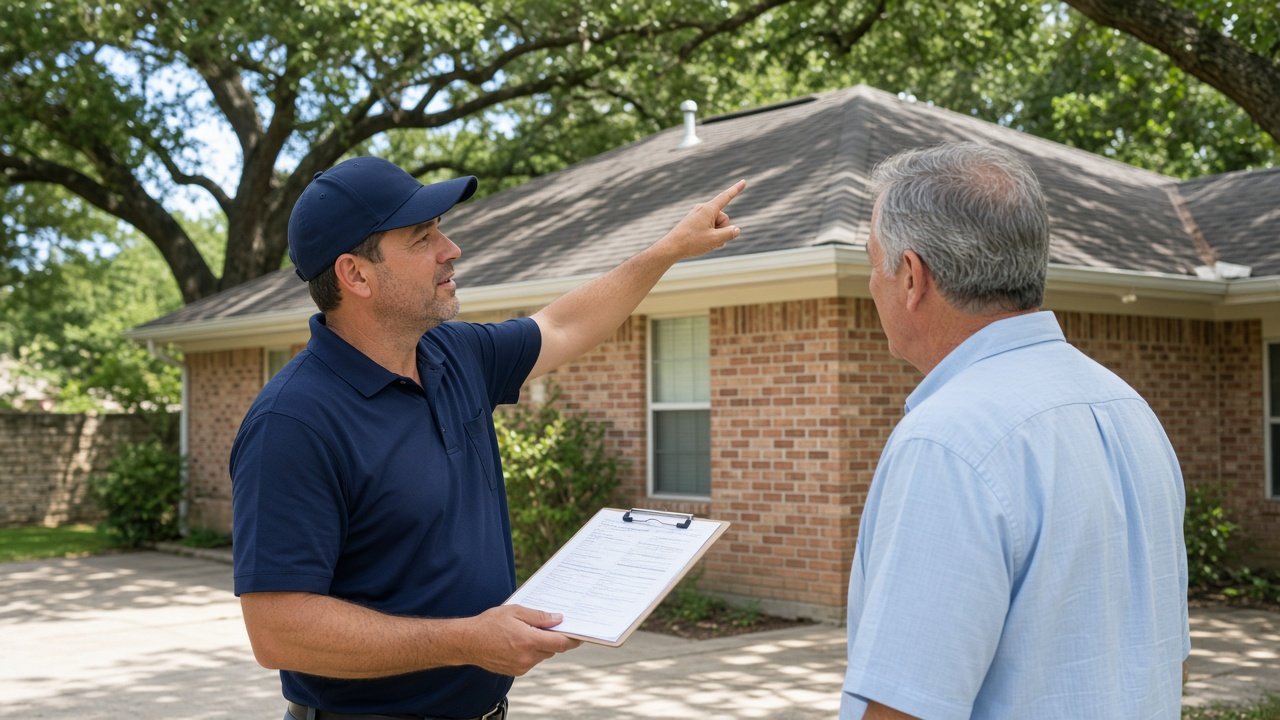
The scope should leave no room to guess. It should say which parts of the roof are covered, whether it’s a repair or a full replacement, whether old layers are torn off, and what isn’t included.
The Property Code disclosure says a written agreement should include a description of the work, the required or estimated time for completion, the cost or how it will be determined, and the payment procedure, including the statutory reservation of funds and the conditions for final payment. [3] If the contract just says “replace roof,” ask for detail. Our guides on what’s included in a roof estimate and what to look for in roofing quotes show what a detailed proposal looks like.
Materials listed by brand, product, and color
“Shingles” isn’t a material list. The contract should name the manufacturer, product line, and color for the shingles, tile, or metal, along with the underlayment, flashing, drip edge, and ridge cap.
TDI advises making sure the contract lists the materials the contractor will use, and watching for defective or low-quality materials as the work moves along. [1] A specific list also lets you compare bids fairly and matters for the manufacturer’s warranty.

Tear-off, decking, and permits
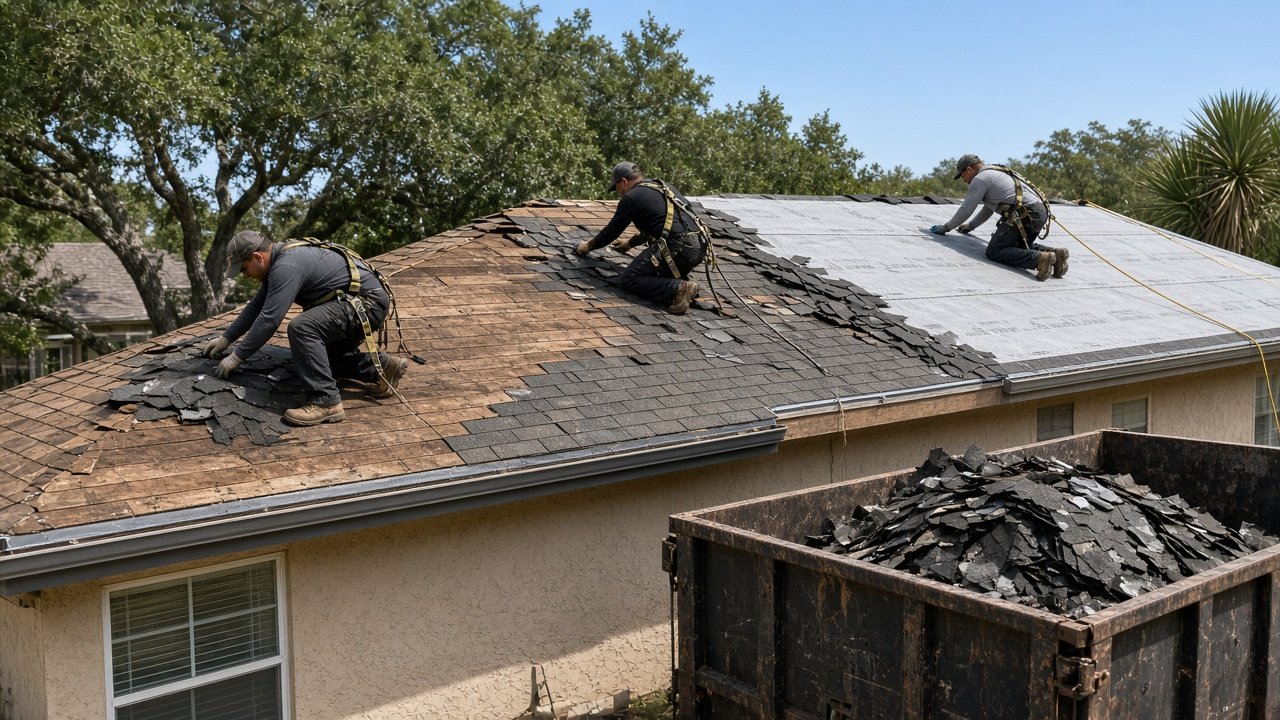
Damaged or rotted decking often can’t be seen until the old roofing comes off, so the contract should say how it’s handled before the old shingles come off.
TDI recommends having the roof deck inspected and replacing deteriorated or damaged decking before the new roof covering goes on. [2] Look for a clear unit price or line-item method for decking replacement, a note on who decides what gets replaced, and a promise that you’ll be shown or sent photos first. Our guides on how roof decking affects longevity and roof wood rot repair cost explain what’s involved.
RRSATX also recommends the contract state who pulls the permit and schedules any required inspections. Our guide to roofing permits covers what homeowners should know.
Schedule, property protection, and cleanup
The schedule and the cleanup are part of the deal, so write them down.
The Property Code disclosure says the agreement should include the required or estimated time for completion. [3] In practice, look for a start window, how weather delays are handled, and how you’ll be told about changes. RRSATX also suggests the contract spell out property protection and cleanup:
- Tarps over landscaping, patios, and pool areas
- Where the dumpster goes and how the driveway is protected
- Daily debris pickup and full haul-off at the end
- A magnetic nail sweep of the yard and driveway
- A final walkthrough with you before the job is called done
Payment terms, change orders, and warranties
Payments should follow the work, not run ahead of it. The contract should state the deposit terms, any progress payments tied to clear milestones, and that final payment is due only after the work is finished.
TDI warns against paying a large amount or the full price up front and says not to make final payment until the contractor finishes all the work. After a disaster, it’s against the law for out-of-town contractors to ask for a down payment before they start. [1] TDI also says to beware of contractors who only accept cash or want money before materials are on site. [2]
Change orders: any added work, such as extra decking, should be written, priced, and signed before it’s done. Remember the Property Code warning that oral promises left out of the agreement may not be enforceable. [3]
Warranties: a contractor’s workmanship warranty and the manufacturer’s material warranty are separate, and both should be in writing with their terms. TDI recommends keeping copies of all agreements and warranty terms. [1][2] See warranties for new roofs explained and understanding your roof’s warranty.
Insurance claim language and the Texas deductible notice
If insurance is paying for your roof, read the contract’s claim wording with extra care.
TDI warns homeowners not to sign contracts that say “Homeowner agrees to the listed repairs for the value of insurance proceeds.” It also notes that scammers may call a contract an “estimate” or a “release” just to get on your roof, and says never to sign a contract with blank spaces. [1] Under Texas Insurance Code §4102.163, a contractor may not act as a public adjuster or advertise to adjust claims for a property it is providing or may provide contracting services on, even with a power of attorney or other agreement. [4]
Texas Business and Commerce Code §27.02 requires a contract for goods or services reasonably expected to be paid wholly or partly from a property insurance claim, with a contract price of $1,000 or more, to contain a notice in at least 12-point boldfaced type stating that Texas law requires the insured to pay any applicable deductible. It is an offense for the seller to pay, waive, absorb, rebate, or otherwise help the insured avoid the deductible without the insurer’s consent. [5] TDI puts it plainly: it’s against the law to offer to waive a deductible or work it into a bid. [1] For more, see how your roof deductible works in Texas and our roof replacement insurance claim guide. RRSATX’s storm damage roofing service documents damage for you; your insurer handles the claim.
Texas lien protections and the Know Your Rights disclosure
Texas lien law protects homeowners who know the steps. Under Property Code §53.255, the original contractor must give you the “Know Your Rights and Responsibilities” disclosure before a residential construction contract is signed. [3]
According to that disclosure, before work starts the contractor must give you a list of subcontractors and suppliers, with updates, and a disbursement statement with each payment request. If a subcontractor or supplier goes unpaid, you may become liable and your property may be subject to a lien for the unpaid amount, even if you didn’t contract with them directly. The disclosure tells homeowners to reserve 10 percent of payments during the work and for 30 days after final completion. On final completion and before final payment, the contractor must furnish an affidavit that all bills have been paid, and you should get a signed, notarized lien release before releasing withheld funds. You’re entitled to have your own attorney review these documents. [3]
Your right to cancel under the FTC Cooling-Off Rule
If you sign at home, federal rules may give you time to change your mind.
The Federal Trade Commission’s Cooling-Off Rule gives you three days to cancel certain sales made at your home or workplace, including when you invited the salesperson. The right lasts until midnight of the third business day after the sale, and Saturday counts as a business day. The seller must tell you about your cancellation right at the time of sale and give you a cancellation form in duplicate plus a copy of the dated contract showing the seller’s name and address. [6]
Emergency repairs and repairs or maintenance you requested aren’t covered, but extra goods or services beyond your request are. You don’t need a reason to cancel. Send the cancellation by a mail method that gives you proof of mailing and receipt, as the FTC suggests. Some states give more rights. [6]
Before you sign: a roofing contract checklist
Hold this list next to the contract. If any line is missing, ask before you sign.
- You compared at least three written bids, as TDI recommends [1][2]
- The contractor’s legal name, address, phone, and insurance or bond are confirmed
- The scope, materials, decking method, permit, and cleanup are written in
- Payments are tied to finished work, and the final payment comes last
- Every promise and both warranties are in writing, and there are no blank spaces
- The deductible notice is present if insurance is paying
- You received the Know Your Rights disclosure
- You read every page and have signed copies of everything
- An attorney reviewed the contract if you’re unsure about any term
If something feels off, read our guide to roof repair scams. When you’re ready for a written proposal, RRSATX offers a free roof inspection for roof repair and roof replacement projects in San Antonio.
Local roofing service
About Affordable Roofing Contractors San Antonio
Affordable Roofing Contractors San Antonio, also known as RRSATX, provides roof repair, roof replacement, storm damage roofing, roof inspections, and asphalt, metal, and tile roofing in San Antonio. Ask us to walk you through any line of our proposal before you sign.
- Phone
- (713) 504-2341
- sales@affordableroofingcontractorssanantonio.com
- Address
- 4324 Monterey St, San Antonio, TX 78237
- Contact
- Request a free roof inspection
Roofing contracts in Texas: questions answered
Is a roofing estimate the same as a contract?
Not always, so read the document’s title and terms. TDI warns that scammers may call a contract an “estimate” or a “release” just to get on your roof. [1] Never sign anything you haven’t read.
Can my roofer handle my insurance claim for me?
A Texas contractor may not act as a public adjuster or advertise to adjust claims for a property it is working on or may work on. [4] A roofer can document damage, but the claim is between you and your insurer.
Can a roofer cover my deductible?
No. Texas law makes it an offense for the seller to pay, waive, absorb, or rebate the deductible without the insurer’s consent. [5] An offer to “take care of” your deductible is a red flag.
How much should I pay up front?
Keep it modest and tied to the contract’s terms. TDI warns against large or full payments up front and says not to make final payment until all the work is finished. [1][2]
Can I cancel a roofing contract after signing?
Possibly. The FTC Cooling-Off Rule covers certain sales made at your home, though emergency repairs and repairs you requested aren’t covered. [6] Read your contract’s cancellation terms and ask a Texas attorney if you’re unsure.
What is a lien release, and when do I get it?
It’s a signed, notarized document confirming a subcontractor or supplier has been paid. The Property Code disclosure says to get one before releasing withheld funds. [3]
Explore the roofing topic
More help hiring a roofer
Get a written roofing proposal you can check line by line
Ask RRSATX for a free roof inspection and a clear, itemized proposal for your San Antonio home.