
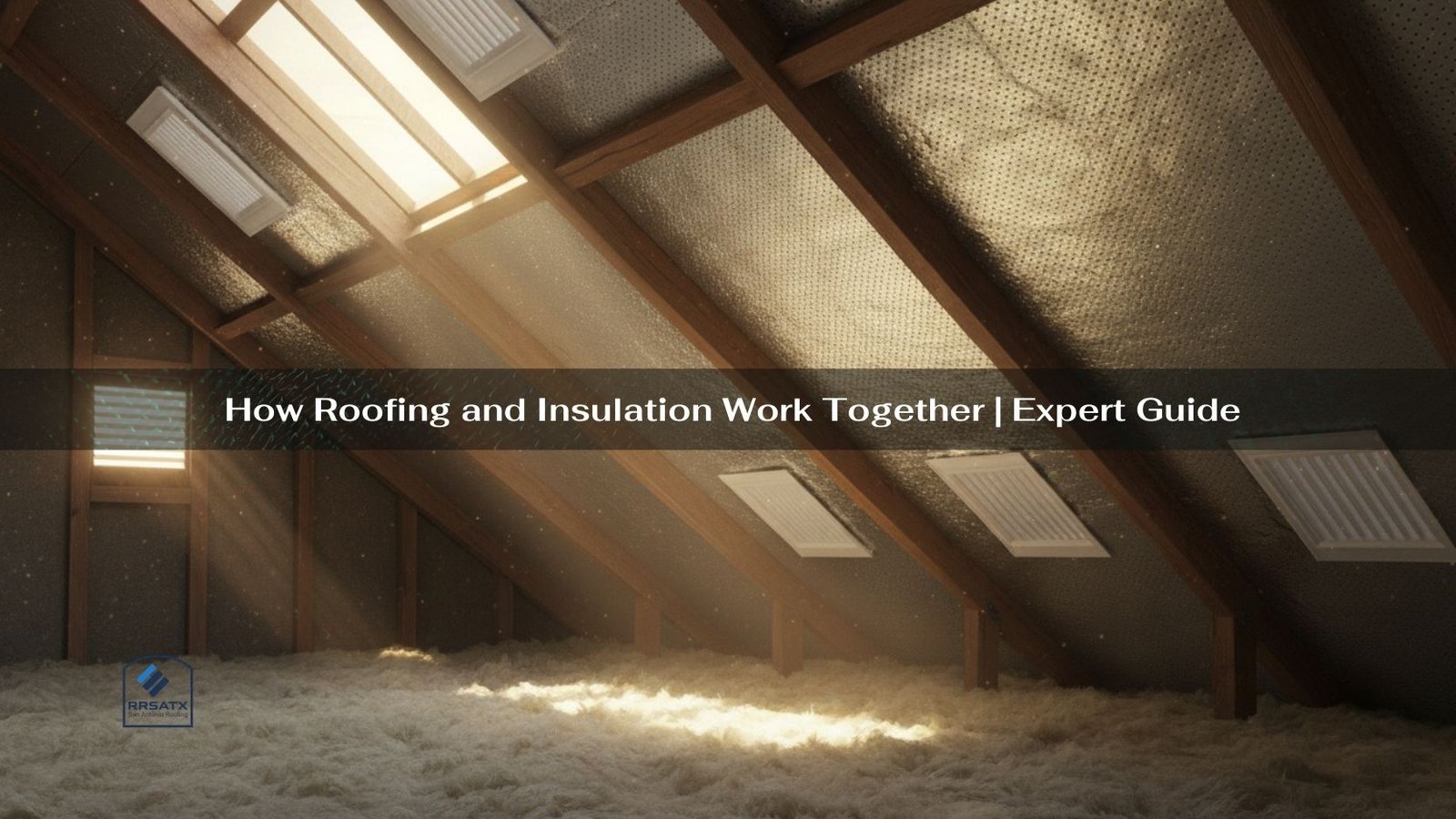
Your roof and insulation aren’t separate systems, they’re partners in protecting your home. When these two components work together properly, they create a thermal envelope that keeps your home comfortable, reduces energy costs, and prevents costly structural damage. When they don’t, you’re left with ice dams, moisture problems, skyrocketing utility bills, and premature roof failure.
Most homeowners focus on the visible aspects of their roof missing shingles, curling edges, or obvious leaks. But the real performance of your roofing system depends on what’s happening underneath. The relationship between your roof deck, ventilation, and insulation determines whether your roof will last 15 years or 30, whether your cooling bills stay reasonable or spiral out of control, and whether you’ll face expensive moisture damage down the line.
Understanding how roofing and insulation work together isn’t just academic knowledge, it’s practical information that affects your wallet, your comfort, and the longevity of one of your home’s most expensive components.
The Science Behind Roofing And Insulation Integration
The relationship between roofing and insulation operates on fundamental thermodynamic principles. Your roof serves as the primary barrier against external elements, while insulation regulates heat transfer between your conditioned living space and the outside environment.
Heat naturally moves from warmer areas to cooler ones through three mechanisms: conduction, convection, and radiation. In Texas summers, intense solar radiation heats your roof surface to temperatures exceeding 160°F. Without proper insulation, this heat conducts through the roof deck directly into your attic space, creating a massive heat reservoir that overwhelms your air conditioning system.
The inverse happens during winter months. Heated air from your living space rises and attempts to escape through the roof assembly. Inadequate insulation allows this warmth to pass through, cooling the underside of your roof deck. When temperatures drop, this temperature differential creates conditions for condensation, moisture accumulation, and potential structural damage.
According to research on building energy efficiency, proper attic insulation can reduce cooling costs by 10-50% in hot climates, a significant factor in San Antonio’s climate where cooling represents the largest residential energy expense.
The roofing material itself contributes to this thermal system. Metal roofs reflect more solar radiation than traditional asphalt shingles, reducing heat absorption. Tile roofs create natural air gaps that enhance ventilation. Each roofing type requires specific insulation strategies to optimize performance.
How Heat Transfer Affects Your Roof System
Understanding heat movement through your roof system reveals why insulation placement and ventilation matter so critically.
Radiant Heat And Solar Gain
Your roof surface absorbs solar radiation throughout daylight hours. Dark-colored asphalt shingles can reach surface temperatures of 170°F on summer afternoons. This absorbed heat radiates downward toward the attic space, transferring energy to the roof deck, framing members, and eventually into your living space.
Radiant barriers reflective materials installed in the attic space can reflect up to 97% of radiant heat back toward the roof surface. When combined with adequate insulation, radiant barriers create a dual defense system that dramatically reduces cooling loads.
Conductive Heat Transfer
Heat conducts through solid materials. Without insulation, heat transfers directly from your hot roof deck through ceiling joists into your home’s interior. The rate of conductive heat transfer depends on the material’s thermal conductivity and thickness.
Quality insulation materials have low thermal conductivity, meaning they resist heat flow. The R-value measures this resistance; higher R-values indicate better insulating performance. But R-value alone doesn’t tell the complete story.
Convective Air Movement
Air movement within your attic space affects overall thermal performance. Warm air rises naturally through convection. In poorly sealed attics, conditioned air from your living space infiltrates upward, while hot attic air can leak downward through ceiling penetrations, light fixtures, and other openings.
Proper air sealing combined with insulation prevents these convective loops. The insulation layer must be continuous and properly installed to eliminate thermal bypasses gaps where air can move freely around the insulation.
The Critical Role Of Ventilation
Ventilation represents the third essential component in the roofing-insulation partnership. Many homeowners mistakenly believe that more insulation alone solves all thermal problems. In reality, balanced ventilation is equally critical.
Attic Ventilation Fundamentals
Proper attic ventilation requires both intake vents (typically soffit vents) and exhaust vents (ridge vents, gable vents, or powered fans). This creates continuous airflow that removes heat and moisture from the attic space.
The general rule requires one square foot of net free ventilation area for every 150 square feet of attic floor space. With properly installed vapor barriers, this can be reduced to 1:300. However, ventilation must be balanced with equal intake and exhaust capacity.
Inadequate ventilation allows heat to accumulate in the attic, dramatically increasing cooling costs. In winter, trapped moisture from household activities condenses on cold roof decking, leading to mold growth, wood rot, and insulation degradation.
Common Ventilation Mistakes
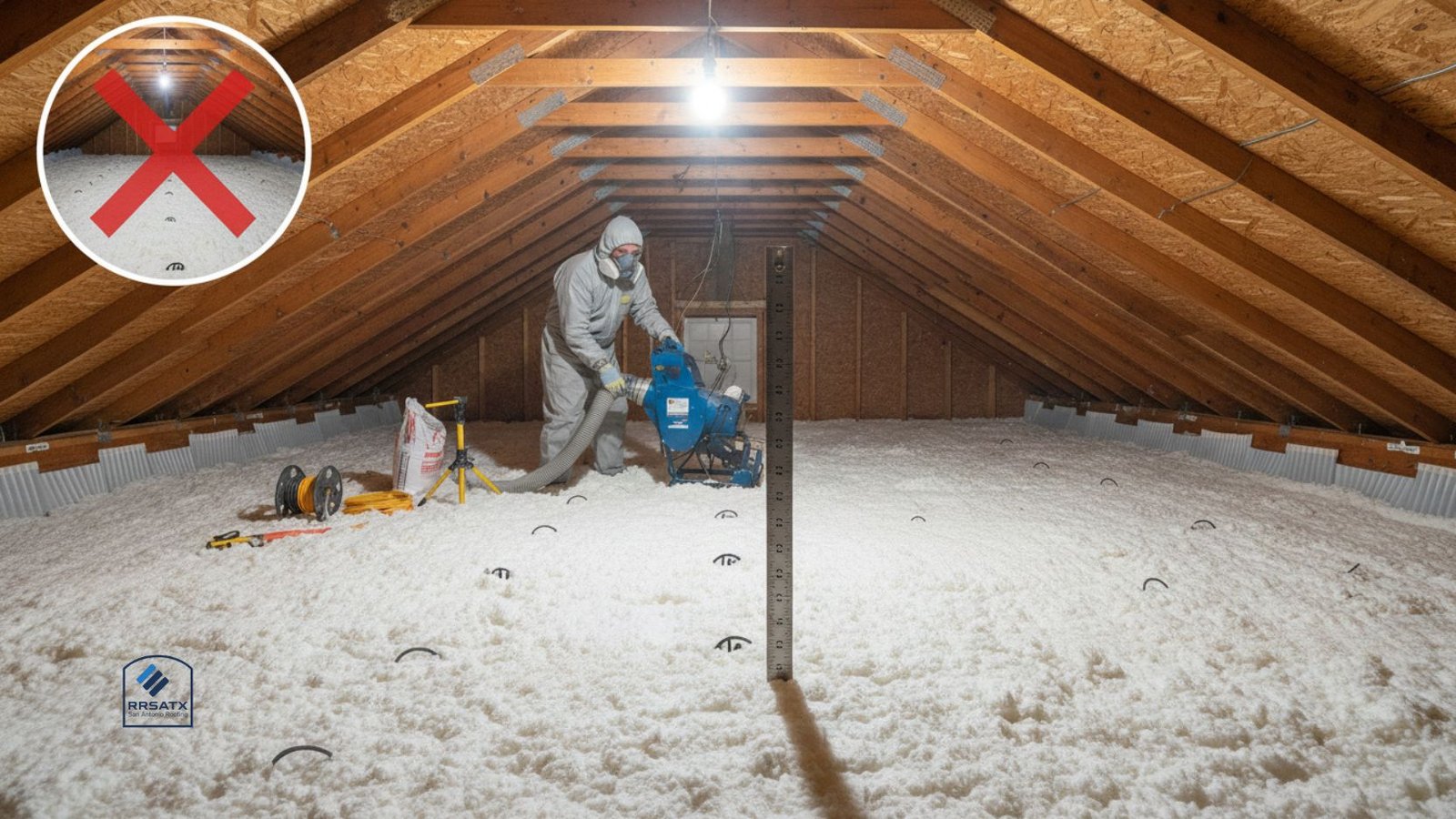
Blocking soffit vents with insulation represents one of the most common installation errors. When blown-in insulation extends to the roof edges, it prevents air intake, destroying the ventilation system’s effectiveness. Proper installation requires baffles or chutes that maintain clear airflow channels from soffit to ridge.
Over-ventilating the exhaust while under-ventilating the intake creates negative pressure that can pull conditioned air from the living space. This wastes energy and defeats the insulation’s purpose.
Mixing ventilation types such as combining ridge vents with powered attic fans can create short-circuit airflow patterns where air moves from one exhaust point to another rather than flowing from intake to exhaust.
Ventilation For Different Roof Types
Metal roofs benefit from enhanced ventilation since metal conducts heat rapidly. Creating an air gap between the metal panels and roof deck through battens or purlins improves thermal performance significantly.
Tile roofs inherently provide some ventilation through the profile of the tiles themselves. However, they still require proper attic ventilation to remove accumulated heat.
Flat or low-slope roofs present unique ventilation challenges. These systems often rely on different ventilation strategies, including mechanical ventilation or specialized venting systems integrated into the roof assembly.
Common Problems When Roofing And Insulation Don’t Work Together
When roofing and insulation systems aren’t properly integrated, several predictable problems emerge that cost homeowners thousands in repairs and energy waste.
Ice Dams And Freeze-Thaw Damage
While less common in San Antonio, understanding ice dams illustrates the roofing-insulation relationship clearly. Ice dams form when heat escapes through inadequate insulation, warming the roof deck. Snow melts, runs down to the colder eaves, and refreezes, creating ice buildup that forces water under shingles.
In Texas, the analogous problem involves thermal cycling. Extreme temperature fluctuations stress roofing materials. Poor insulation allows greater temperature swings on the roof deck, accelerating material degradation and shortening roof lifespan.
Moisture Accumulation And Mold
Warm, humid air from your living space contains significant moisture. When this air contacts cold surfaces in an improperly insulated attic, condensation occurs. This moisture saturates insulation (reducing its effectiveness), promotes mold growth, and causes wood rot in structural members.
According to building science research, moisture problems account for the majority of premature building failures. The solution requires both insulation to maintain consistent temperatures and vapor barriers to prevent moisture migration.
Premature Shingle Failure
Excessive attic heat dramatically shortens asphalt shingle life. Shingles rated for 25-30 years can fail in 15 years when exposed to extreme attic temperatures. The heat accelerates thermal aging, causing shingles to become brittle, crack, and lose granules prematurely.
Proper insulation and ventilation keep attic temperatures within acceptable ranges, protecting your roofing investment and maximizing material lifespan.
Energy Waste And Comfort Issues
Poorly integrated roofing and insulation systems create noticeable comfort problems. Rooms directly below the attic feel hotter in summer and colder in winter. Air conditioning runs constantly without achieving comfortable temperatures. Energy bills climb unnecessarily.
Department of Energy studies show that air sealing and insulation improvements typically provide the highest return on investment among home energy upgrades, often paying for themselves within 3-5 years through reduced utility costs.
Optimal Insulation Types For Different Roofing Systems
Different roofing systems require specific insulation approaches to maximize performance and longevity.
Fiberglass Batt Insulation
Fiberglass batts remain popular due to low cost and DIY-friendly installation. However, effectiveness depends entirely on proper installation. Gaps, compression, or improper fitting dramatically reduces actual R-value.
Fiberglass works well in standard attic spaces with conventional framing. It requires careful attention to air sealing before installation; fiberglass doesn’t stop air movement, only heat conduction.
Best applications: Standard residential attics with regular joist spacing and minimal penetrations.
Blown-In Cellulose Or Fiberglass
Blown-in insulation fills irregular spaces completely, eliminating gaps that reduce batt insulation effectiveness. Cellulose offers slightly better performance than fiberglass and contains fire retardants for safety.
This approach works exceptionally well for existing homes where accessing attic spaces makes batt installation difficult. Professional installation ensures proper depth and coverage.
Best applications: Retrofit applications, attics with irregular framing, areas requiring high R-values.
Spray Foam Insulation
Spray foam provides superior air sealing and insulation in a single application. Closed-cell spray foam offers the highest R-value per inch and adds structural rigidity to the roof deck.
This premium option costs more initially but delivers exceptional performance. Spray foam particularly benefits cathedral ceilings and complex roof geometries where maintaining ventilation channels proves difficult.
When applied directly to the underside of the roof deck, spray foam creates an unvented “conditioned attic” where HVAC equipment and ductwork operate within the thermal envelope, a significant efficiency advantage.
Best applications: New construction, major renovations, cathedral ceilings, conditioned attic conversions.
Rigid Foam Board
Rigid foam boards provide high R-values in minimal thickness. They’re often used above the roof deck in commercial applications or as supplemental insulation in residential projects.
Installation requires careful attention to seams and gaps. Joints should be taped or sealed to maintain air barrier continuity.
Best applications: Flat roofs, commercial buildings, supplemental insulation over existing systems.
R-Value Requirements And Climate Considerations
R-value measures insulation’s resistance to heat flow. Higher numbers indicate better insulating performance. However, optimal R-value depends on climate, existing insulation, and cost-effectiveness.
Climate Zone Recommendations
San Antonio falls within Climate Zone 2, characterized by hot summers and mild winters. The Department of Energy recommends R-30 to R-60 for attic insulation in this zone, with R-38 representing a practical minimum for most homes.
Achieving these R-values requires:
- 10-14 inches of fiberglass batt insulation
- 11-16 inches of blown cellulose
- 5-8 inches of closed-cell spray foam
Existing homes often have R-11 or R-19 insulation installed decades ago. Upgrading to current standards delivers immediate energy savings.
Diminishing Returns
Adding insulation delivers diminishing returns beyond certain thresholds. Moving from R-11 to R-30 provides substantial benefits. Moving from R-30 to R-60 provides smaller incremental gains.
The cost-effectiveness sweet spot for most Texas homes falls between R-38 and R-49. Higher values make sense for extremely hot areas or when future energy cost increases are anticipated.
Metal Roofing Considerations
Metal roofs conduct heat rapidly, making adequate insulation even more critical. The combination of reflective metal roofing and high R-value insulation creates an exceptionally efficient system for hot climates.
Many homeowners report 15-25% energy savings after replacing dark asphalt shingles with light-colored metal roofing combined with insulation upgrades.
The Moisture Barrier System
Controlling moisture represents an essential but often overlooked aspect of roofing-insulation integration.
Vapor Barriers VS. Air Barriers
Vapor barriers slow moisture diffusion through building assemblies. Air barriers prevent air leakage carrying moisture. In hot climates like San Antonio, air barrier performance often matters more than vapor barrier properties.
Contrary to older building practices, vapor barriers in hot-humid climates should typically be positioned toward the exterior (warm) side or eliminated entirely in favor of vapor-permeable materials. This allows any trapped moisture to dry toward the interior.
Air Sealing Priorities
Before adding insulation, seal major air leakage points:
- Attic hatch or access door
- Recessed lighting fixtures
- Plumbing and electrical penetrations
- HVAC duct penetrations
- Chimney chases
- Wall top plates
These penetrations allow far more heat and moisture transfer than traditional diffusion through materials. Building science experts estimate that air leakage accounts for 25-40% of heating and cooling energy waste in typical homes.
Condensation Control
Preventing condensation requires maintaining surface temperatures above the dew point. Adequate insulation keeps interior surface temperatures warm in winter and cool in summer, preventing moisture accumulation.
In extreme cases, mechanical dehumidification may be necessary. However, properly designed roofing-insulation systems typically control moisture through temperature management alone.
Installation Best Practices
Proper installation determines whether your roofing-insulation system performs as designed or underdelivers.
Timing Integration
Ideally, roofing and insulation work should be coordinated during new construction or major renovations. This allows optimal integration of all components roofing materials, ventilation systems, insulation, and air barriers.
During roof replacement, inspect and upgrade insulation simultaneously. The roof replacement provides access to assess insulation condition, add ventilation baffles, and seal air leakage points that are otherwise inaccessible.
Maintaining Ventilation Clearances
Baffles or chutes must maintain clear air pathways from soffit to ridge. These should extend from the soffit to at least 4 inches above the insulation height, ensuring blown insulation doesn’t settle and block airflow over time.
Ridge vents require sufficient clearance typically 2 inches minimum between insulation and roof deck to function properly. Compressed or blocked ridge vents defeat the entire ventilation system.
Continuous Coverage
Insulation effectiveness depends on continuous coverage without gaps, compression, or voids. Even small gaps create thermal bypasses where heat flows freely, dramatically reducing overall system performance.
Professional installation using thermal imaging can identify these problem areas that remain invisible to visual inspection alone.
Proper Depth And Density
Blown insulation must achieve specified depths uniformly across the entire attic space. Settling occurs over time, so initial installation depth should account for 10-15% settling.
Spray foam requires proper mixing ratios and application techniques. Improper mixing reduces R-value and potentially creates off-gassing problems.
Energy Efficiency And Cost Savings
The financial benefits of properly integrated roofing and insulation systems extend beyond monthly utility bills.
Measurable Energy Savings
Homeowners typically see 20-30% reductions in cooling costs after proper attic insulation and air sealing. In San Antonio’s climate, where cooling represents 60-70% of residential energy use, these savings accumulate quickly.
A typical 2,000 square-foot home might spend $1,800-2,400 annually on cooling. Reducing this by 25% saves $450-600 per year enough to recoup insulation investment within 5-7 years.
Extended Roof Lifespan
Properly insulated and ventilated roofs last significantly longer. Keeping attic temperatures within acceptable ranges prevents premature shingle aging, reduces thermal stress on all materials, and minimizes moisture-related degradation.
Extending a 25-year roof to 30+ years through proper insulation represents thousands in delayed replacement costs, another substantial financial benefit often overlooked in energy calculations.
Increased Home Value
Real estate market research shows that energy-efficient homes command premium prices and sell faster than comparable homes without efficiency upgrades. Properly documented roofing and insulation improvements appeal to informed buyers concerned about long-term operating costs.
Incentives And Rebates
Many utility companies and government programs offer rebates for insulation upgrades. These incentives reduce upfront costs and improve investment returns. Check with your local utility and city programs for current offerings.
When To Upgrade Both Systems Simultaneously
Certain situations create ideal opportunities for addressing both roofing and insulation together.
During Roof Replacement
Roof replacement provides the perfect opportunity to assess and upgrade attic insulation. Contractors already have equipment and personnel on-site. Access to the attic is convenient. Coordinating both projects reduces overall costs compared to separate undertakings.
Before approving the roof replacement, request a complete attic assessment including:
- Current insulation type, condition, and R-value
- Ventilation adequacy
- Air sealing needs
- Moisture or mold issues
- Structural concerns
After Storm Damage
Insurance claims for storm damage sometimes cover related improvements. If wind or hail damages your roof, the resulting claim might include insulation upgrades if the assessor determines that inadequate ventilation contributed to the damage.
During Home Renovations
Major renovations offer opportunities for comprehensive improvements. Adding square footage, finishing an attic space, or converting a garage all create access points for insulation upgrades.
When Comfort Problems Arise
Persistent comfort issues: hot rooms in summer, cold rooms in winter, uneven temperatures throughout the home often indicate insulation or air sealing problems. Rather than continuously adjusting HVAC equipment, addressing the root cause through insulation improvements delivers permanent solutions.
Professional Assessment And Inspection
Professional evaluation identifies problems that homeowners typically miss and provides data-driven improvement recommendations.
What A Comprehensive Inspection Includes
A thorough roofing and insulation assessment should examine:
Roofing Components:
- Shingle condition, granule loss, and remaining life expectancy
- Flashing integrity around penetrations and transitions
- Ventilation adequacy (intake and exhaust)
- Signs of moisture intrusion or previous leaks
- Structural concerns including sagging or deterioration
Insulation And Attic Systems:
- Current insulation type, depth, and estimated R-value
- Coverage uniformity and gap identification
- Ventilation baffle presence and condition
- Air sealing quality at penetrations
- Moisture, mold, or pest issues
- Ductwork condition if located in attic
Thermal Imaging Technology
Infrared thermal imaging reveals heat loss and air leakage patterns invisible to standard inspection. These scans identify:
- Missing or inadequate insulation
- Air infiltration points
- Thermal bridges where heat bypasses insulation
- Moisture accumulation areas
- HVAC duct leakage
Professional contractors in San Antonio increasingly offer thermal imaging as part of comprehensive assessments, providing homeowners with visual documentation of problem areas and improvement opportunities.
Getting Actionable Recommendations
Request detailed written reports that prioritize improvements by return on investment. The assessment should specify:
- Current conditions and performance gaps
- Recommended improvements with material specifications
- Expected energy savings from each upgrade
- Cost estimates for proposed work
- Estimated payback periods
This information allows informed decisions about which improvements to prioritize based on budget, goals, and expected benefits.
Conclusion
The relationship between roofing and insulation fundamentally determines your home’s energy efficiency, comfort, and long-term structural integrity. These systems don’t operate independently; they function as integrated components of your home’s thermal envelope.
Proper integration requires understanding heat transfer principles, selecting appropriate materials for your climate and roofing type, ensuring adequate ventilation, controlling moisture, and executing professional installation. When these elements align, homeowners enjoy substantial energy savings, extended roof lifespan, improved comfort, and increased property value.
For Texas homeowners facing intense summer heat and mild winters, the roofing-insulation partnership deserves careful attention. The extreme temperature differentials between conditioned living spaces and superheated attic areas create conditions where inadequate insulation wastes tremendous energy and accelerates roof deterioration.
Whether you’re planning a roof replacement, experiencing comfort issues, or simply seeking to reduce energy costs, evaluating both roofing and insulation together provides the complete picture necessary for informed decisions.
At RRSATX: San Antonio Roofing Company, we understand that your roof’s performance extends far beyond the shingles you can see. Our comprehensive approach examines the entire roofing system from the decking and ventilation to the insulation and air sealing ensuring every component works together efficiently.
Our free 12-point inspection assesses not just your visible roof condition but also the critical insulation and ventilation systems that determine actual performance. We check for hidden issues that cost you money every month through wasted energy and accelerated material degradation.
With over 100 five-star reviews and decades of experience serving San Antonio homeowners, we’ve seen how proper roofing-insulation integration transforms home performance. Don’t wait for leaks or runaway energy bills to signal problems. Contact us today at 713-504-2341 or email info@roofrepairsanantoniotx.com for your complimentary inspection.
Let our trusted local team show you how roofing and insulation working together can protect your investment, reduce your costs, and keep your home comfortable year-round in the Texas heat.