
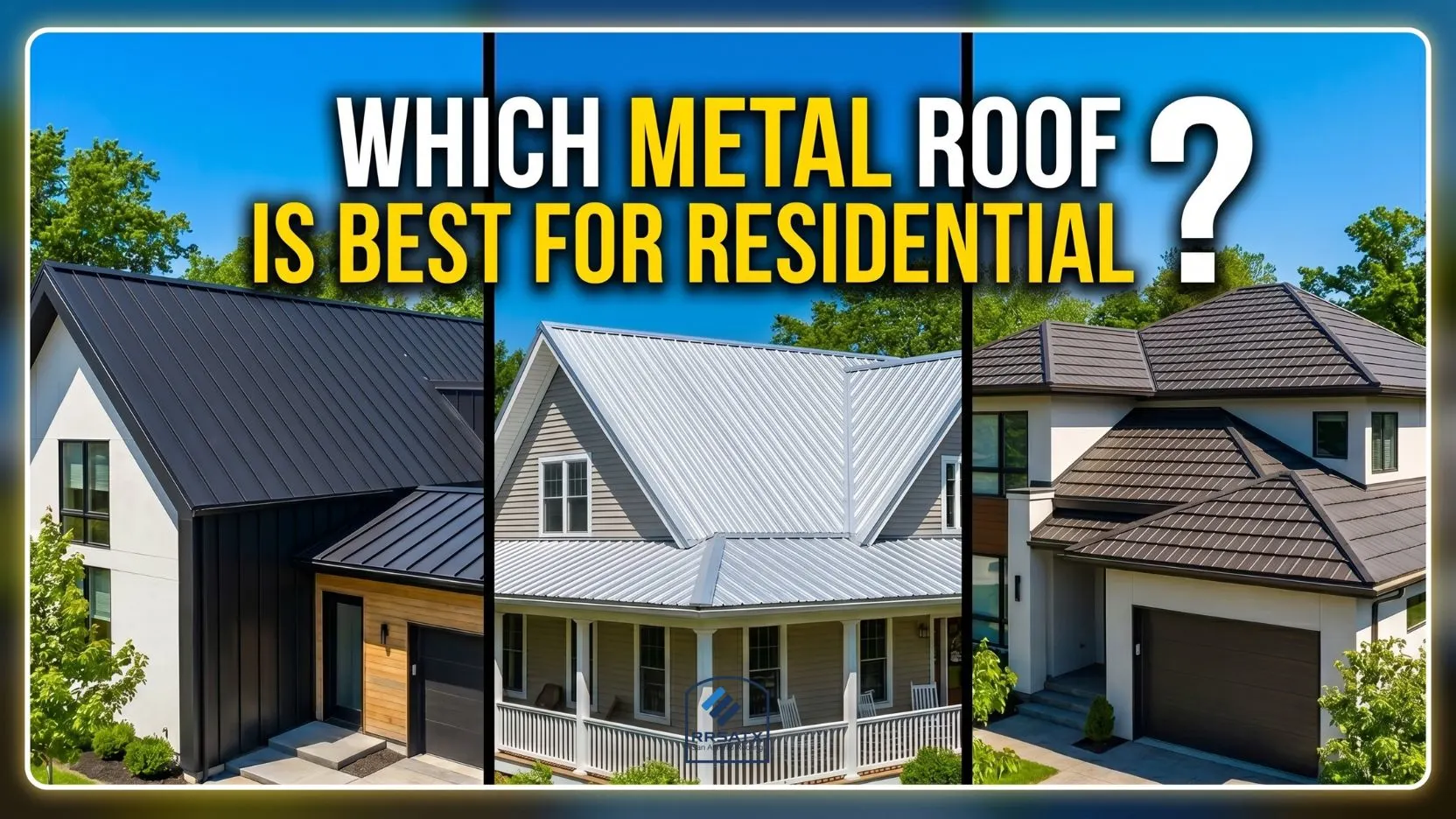
[et_pb_section fb_built=”1″ admin_label=”section” _builder_version=”4.16″ global_colors_info=”{}”][et_pb_row admin_label=”row” _builder_version=”4.16″ background_size=”initial” background_position=”top_left” background_repeat=”repeat” global_colors_info=”{}”][et_pb_column type=”4_4″ _builder_version=”4.16″ custom_padding=”|||” global_colors_info=”{}” custom_padding__hover=”|||”][et_pb_code _builder_version=”4.27.6″ _module_preset=”default” hover_enabled=”0″ global_colors_info=”{}” sticky_enabled=”0″]
Not every metal roof is built the same, and the wrong choice for San Antonio’s climate can cost you in repairs, energy bills, and lifespan. This guide compares every residential metal roofing type side by side so you can make a confident, informed decision before you spend a dollar.
The question of which metal roof is best for a residential home in San Antonio does not have a single answer. It depends on five factors: depending on your budget, your home’s architecture, how long you plan to stay in the house, and how much maintenance you are willing to do over the years. Standing seam, corrugated steel, exposed-fastener panels, stone-coated steel, and metal shingles all show up on San Antonio homes, and each one performs differently under this region’s intense UV exposure, hail events, and wide temperature swings.
This guide breaks each type down honestly. You will see what each one costs installed in San Antonio, how long it lasts in the Texas climate, what its real weaknesses are, and which homeowner it is best suited for. By the end, you will have a clear picture of which option fits your specific situation.
The most common metal roofing mistake San Antonio homeowners make is choosing a material based on price per square foot alone without factoring in the total 20-year cost of ownership. A less expensive corrugated panel system installed today can cost more over its lifetime than a premium standing seam system once you factor in maintenance, fastener replacement, and the likelihood of re-roofing sooner. The best metal roof for your home is the one that fits your budget today and your ownership plan for the next two or three decades.
Best Overall
Standing seam is the gold standard for residential metal roofing in San Antonio, and it earns that status for reasons that matter in this climate. The defining feature is that all fasteners are concealed beneath the raised seams that lock panels together. No screw penetrates the exposed face of the roof. That single design decision eliminates the leading cause of metal roof leaks and removes an entire category of maintenance that screw-down systems require over time.
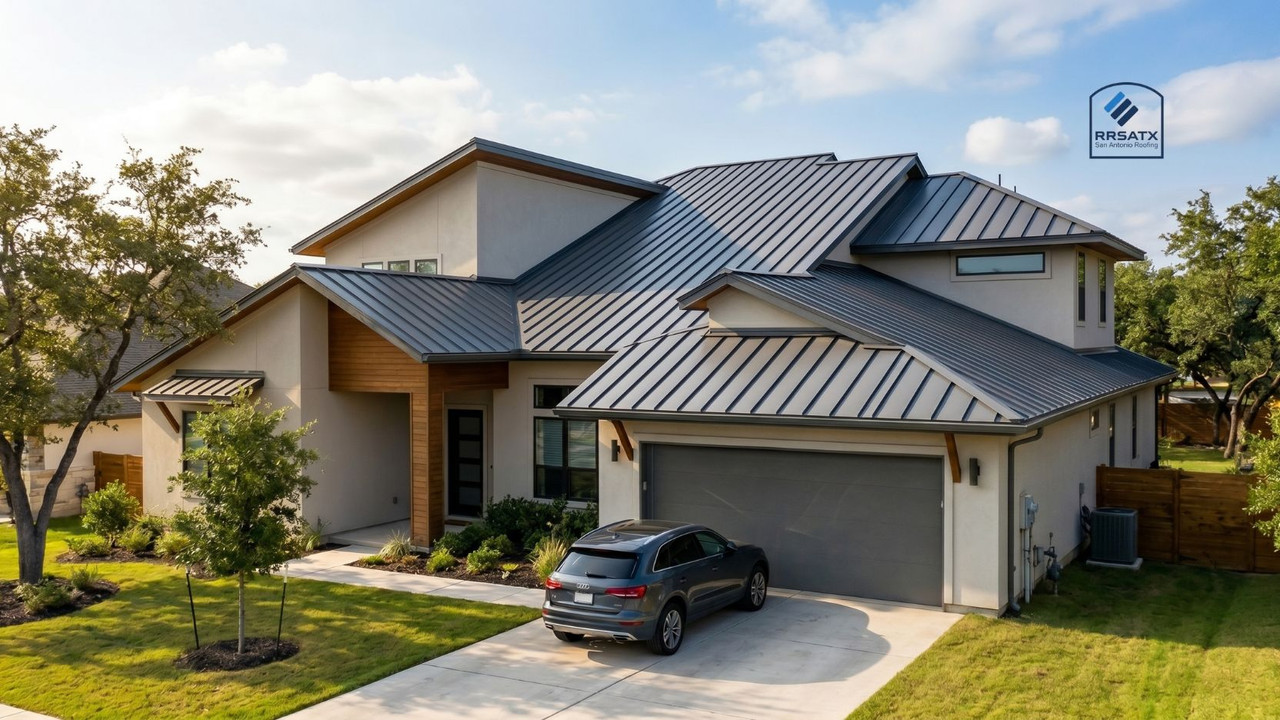
How it handles San Antonio’s heat: Standing seam panels float on clips rather than fixed fasteners, which allows the metal to expand and contract freely with temperature changes. San Antonio roofs can reach 160 degrees Fahrenheit on a summer afternoon. A roof system that cannot accommodate that thermal movement will eventually crack sealant, loosen fasteners, and develop leaks. Standing seam is engineered for exactly this kind of stress.
Lifespan in Texas conditions: A properly installed standing seam roof on a San Antonio home will last 50 to 70 years with minimal maintenance. That means most homeowners who install one today will never need another roof on that home.
Best fit: Standing seam is the right call for homeowners who plan to stay in the house long-term, who want the lowest possible maintenance over the next 40 or 50 years, or who are on a street where curb appeal and home value matter. It is not the right call if your primary goal is the lowest possible upfront cost.
- Confirm panel gauge: 24-gauge steel is the residential standard; 26-gauge is thinner and better suited to lower-slope commercial applications
- Verify the clip system allows thermal movement; fixed clips on long panel runs cause oil-canning and stress cracking over time
- Ask about PVDF (Kynar) coating rather than SMP paint; PVDF holds color and resists chalking for decades longer in San Antonio’s UV exposure
- Confirm the contractor has standing seam-specific installation experience; it is not the same skill set as corrugated panel installation
- Request Class 4 impact rating documentation if an insurance discount is part of your decision
Budget Option
Corrugated steel is what most San Antonio homeowners picture when they think of a metal roof. The wavy or ribbed profile is familiar on everything from farm buildings to urban infill homes, and there is a reason for that ubiquity: corrugated steel delivers solid, reliable protection at a significantly lower upfront cost than standing seam. The tradeoff is in the fastening system and what that means for long-term maintenance.
Corrugated panels are installed with exposed fasteners: screws that pass through the face of the panel and into the decking below. Each screw has a rubber or neoprene washer that seals the penetration. In San Antonio’s climate, those washers degrade over 10 to 15 years from UV exposure and thermal cycling. When the washers fail, every fastener becomes a potential leak point. That is not a reason to avoid corrugated steel, but it is a maintenance reality that homeowners need to budget for.
Spend the extra money on 26-gauge over 29-gauge corrugated steel if your home is in a San Antonio hail corridor neighborhood. The difference in panel cost is relatively small, typically a few hundred dollars on a standard residential roof. The difference in dent resistance and coating durability under golf-ball-sized hail is significant. Thin 29-gauge panels can dent visibly from hail that barely marks a 26-gauge panel, which matters both for aesthetics and for the long-term integrity of the protective coating.
Best fit: Corrugated steel is the right choice for homeowners who want the entry point to metal roofing without the standing seam price tag, who are comfortable with periodic maintenance checks, or who are re-roofing a rental property or secondary structure where a 30-year system is the target horizon rather than 60.
- Specify 26-gauge minimum for residential applications in San Antonio’s hail zone
- Confirm a Galvalume or galvanized coating on the base steel for corrosion resistance
- Ask for a factory-applied paint finish rather than bare galvanized if the roof is visible from the street
- Plan for a fastener inspection and sealant refresh at the 10 to 12-year mark; budget roughly $500 to $1,200 for a professional pass on a standard home
- Confirm panel overlap dimensions with the contractor; a minimum of two corrugations of overlap on side laps is needed for proper water shedding
Curb Appeal
Stone-coated steel panels are steel substrates covered with an acrylic film and bonded stone granules that give them the visual profile of traditional roofing materials (asphalt shingles, clay tile, or cedar shake) while delivering the durability and energy performance of metal. For San Antonio homeowners in neighborhoods with HOA requirements or in areas where a standing seam profile would look out of place on a traditional-style home, stone-coated steel is often the best answer.
The stone coating adds texture and mass that also helps with noise reduction compared to bare corrugated steel, which is a common concern for homeowners who have heard that metal roofs are loud during rain. A properly installed stone-coated steel system with a solid decking substrate is noticeably quieter than bare metal panels during heavy Texas rainstorms.
Best fit: Stone-coated steel is the right option for homeowners in traditional-style neighborhoods where standing seam would look out of place, for those who want the noise reduction benefit of a granule-coated surface, or for anyone whose HOA requires a tile or shingle appearance.
- Confirm the base steel gauge: 26-gauge is the residential standard; thinner panels are more susceptible to hail damage
- Ask about the acrylic coating and granule bonding warranty; better manufacturers offer 50-year transferable warranties
- Verify installation follows the manufacturer’s overlap and fastening pattern exactly; improper installation voids most warranties
- Inspect gutters after the first major hail event; granule loss into gutters is a sign of coating damage that should be addressed before it exposes the steel
- Confirm color match availability if a future partial replacement is ever needed; discontinued colors create a long-term replacement headache
Mid-Range
Metal shingles are individual steel or aluminum shingles stamped to mimic the profile of traditional asphalt shingles. They install similarly to asphalt shingles, in overlapping courses from the eave up, which means a qualified roofing crew can install them without standing seam-specific training. That broader installation base generally keeps labor costs lower than a standing seam system of comparable coverage.
The appeal for San Antonio homeowners is straightforward: metal shingles deliver a significant lifespan improvement over asphalt shingles, typically 40 to 50 years versus 20 to 25 years for a standard three-tab or architectural shingle, while maintaining a low-profile appearance that fits traditional home styles and most HOA requirements. They also perform meaningfully better than asphalt in hail events, with most metal shingle products rated to Class 3 or Class 4 impact resistance.
Metal shingle installation quality varies significantly between contractors in San Antonio. Because the installation process looks similar to asphalt shingles on the surface, some roofers attempt metal shingle jobs without adequate training on the fastening pattern, underlayment requirements, and thermal expansion allowances specific to metal panels. Always ask the contractor how many metal shingle roofs they have installed in the past year and ask to see at least one completed reference project before signing a contract.
Best fit: Metal shingles are the right choice for homeowners upgrading from asphalt who want a substantial lifespan improvement without the standing seam price, for those in traditional-style neighborhoods where a panel profile would look out of place, and for anyone who wants Class 4 hail protection with a low-profile appearance.
- Confirm impact rating: Class 4 is the top tier and qualifies for insurance discounts with most Texas insurers
- Ask about the paint system; PVDF (Kynar) coating outperforms SMP in UV resistance over a 40-year lifespan in San Antonio
- Verify the underlayment specification; metal shingles require a higher-temperature underlayment than asphalt shingles to handle attic heat in Texas summers
- Confirm the fastening pattern leaves room for thermal expansion; over-driven or edge-fastened shingles can buckle under temperature extremes
- Ask about the contractor’s specific training and completed projects with this product
Specialty
Most residential metal roofing in San Antonio is steel: Galvalume-coated or painted steel that handles the Texas climate well. But aluminum is worth understanding as an alternative, particularly for homeowners in areas with higher moisture exposure, those adding a metal roof over a structure with existing moisture issues, or those looking to reduce the load on an older roof structure. Aluminum is naturally corrosion-resistant without a galvanized coating, it is roughly one-third lighter than steel, and it holds a paint coating well over time.
The practical tradeoff in San Antonio is that aluminum dents more easily than steel under hail impact. In an area where golf-ball-sized hail is a realistic annual risk, that matters. Aluminum is not a bad choice in San Antonio, but it is better suited to homeowners whose primary drivers are corrosion resistance and weight rather than impact performance. For most residential applications in Bexar County, a properly coated steel system delivers better overall value in this climate.
Best fit: Aluminum roofing makes the most sense for homeowners adding a metal roof to a structure with a history of moisture issues, for homes with lower-sloped roofs where standing water is more likely, or for homeowners who are specifically trying to minimize roof load on an older structure. For most standard San Antonio residential applications, steel delivers better impact performance for the price.
- Confirm the panel gauge; aluminum compresses more easily than steel, so a thicker gauge matters more for hail-prone areas
- Avoid mixing aluminum panels with steel fasteners or flashings; dissimilar metals in contact cause galvanic corrosion over time
- Confirm the paint system is formulated for aluminum; some coatings designed for steel adhere differently to aluminum substrates
- Ask whether aluminum is genuinely the right choice for your specific home and location, or whether Galvalume steel achieves the same goals at a lower cost
Use this table as a quick reference when comparing quotes or discussing options with a contractor. Every figure reflects typical installed costs and realistic performance expectations for the San Antonio and Bexar County market in 2026.
| Metal Roof Type | Installed Cost (San Antonio) | Lifespan (Texas Climate) | Maintenance Level | Best For |
|---|---|---|---|---|
| Standing Seam | $9 to $15 per sq ft | 50 to 70 years | Very low | Long-term ownership, maximum performance |
| Corrugated Steel | $3 to $6 per sq ft | 25 to 40 years | Moderate: fastener checks required | Budget-conscious homeowners, rental properties |
| Stone-Coated Steel | $7 to $11 per sq ft | 40 to 50 years | Low | Traditional neighborhoods, HOA requirements |
| Metal Shingles | $6 to $10 per sq ft | 40 to 50 years | Low to moderate | Asphalt upgrade, Class 4 hail protection |
| Aluminum Panels | $8 to $14 per sq ft | 40 to 60 years | Low | High-moisture areas, weight-sensitive structures |
- Decide your primary driver: lowest upfront cost, longest lifespan, lowest maintenance, or specific appearance requirement
- Confirm your HOA requirements before selecting a profile; some prohibit exposed metal panels entirely
- Factor in how long you plan to stay in the home; a 30-year system makes more sense if you plan to sell in 10 years than a 60-year standing seam investment
- Check with your homeowners insurance provider about Class 4 impact rating discounts before finalizing the panel choice; the savings can meaningfully offset the price difference between options
- Confirm the panel gauge: thicker is better in San Antonio’s hail corridor; 24-gauge or 26-gauge for steel, not 29-gauge
- Verify the coating system; PVDF (Kynar) outperforms SMP for color retention and UV resistance over decades in Texas sun
- Ask for the manufacturer’s warranty document and read the exclusions; many warranties are voided by installation errors that are not your fault but are your problem
- For stone-coated or shingle systems, confirm color availability for future repairs; discontinued products create matching headaches years down the line
- Confirm the contractor has installed the specific product you are considering; this is different from general metal roofing experience
- Request references for completed projects with that product in San Antonio; ask to see or visit at least one
- Verify insurance coverage: at least $1 million general liability and current workers compensation
- Get the installation warranty in writing, separate from the material warranty, with a minimum two-year workmanship coverage period
- Confirm the contractor pulls permits for the installation; permitted work protects your investment and is required for most insurance claims
Which metal roof is best for residential homes in San Antonio specifically?
Is a metal roof worth it for a residential home in San Antonio?
How long does a metal roof last on a residential home in San Antonio?
Are metal roofs loud during rain in San Antonio?
Can I install a metal roof over my existing asphalt shingles in San Antonio?
What metal roof color is best for San Antonio homes?
Get a free metal roof consultation in San Antonio
Not sure which metal roof type is right for your home? We will walk your roof, assess your situation, and give you a clear recommendation with a written estimate with no pressure and no cost.
[/et_pb_code][/et_pb_column][/et_pb_row][/et_pb_section]