
[et_pb_section fb_built=”1″ admin_label=”section” _builder_version=”4.16″ global_colors_info=”{}”][et_pb_row admin_label=”row” _builder_version=”4.16″ background_size=”initial” background_position=”top_left” background_repeat=”repeat” global_colors_info=”{}”][et_pb_column type=”4_4″ _builder_version=”4.16″ custom_padding=”|||” global_colors_info=”{}” custom_padding__hover=”|||”][et_pb_code _builder_version=”4.27.6″ _module_preset=”default” hover_enabled=”0″ sticky_enabled=”0″]
Corrugated metal is the most affordable path into metal roofing for San Antonio homeowners, but the final price varies more than most contractors advertise. This guide breaks down every cost factor so you know exactly what you are paying for before you sign anything.
Corrugated metal roofing is the most searched and most installed metal roof type for residential homes in San Antonio, and the reason is simple: it delivers genuine metal roofing durability at a price point that is meaningfully lower than standing seam, stone-coated steel, or metal shingles. But the installed cost range for corrugated metal is wider than most homeowners expect. A basic 29-gauge corrugated panel job on a simple gable roof can come in under $8,000. A 24-gauge Galvalume system with a factory finish, underlayment, flashing, and ridge work on a complex hip roof can push past $18,000 on the same square footage.
This guide explains every variable that drives that range. By the time you finish reading, you will know what a fair corrugated metal roof quote looks like for your specific home in San Antonio, what line items you should be asking about, and where contractors typically cut corners to hit a lower number.
A corrugated metal roof installed at $4 per square foot with 29-gauge panels and no underlayment is not the same value as one installed at $6 per square foot with 26-gauge Galvalume panels, a quality synthetic underlayment, and stainless-fastened ridge work. The cheaper system will need fastener replacement and resealing within 12 to 15 years and may need full replacement by year 25. The better system, properly maintained, reaches 35 to 40 years with no major interventions. Always compare quotes on the same spec sheet before you compare numbers.
Cost Factor
Gauge is the thickness measurement for steel panels, and in corrugated metal roofing it is the most important number on the spec sheet. The gauge scale runs counterintuitively: a lower gauge number means thicker, stronger steel. Standard residential corrugated roofing in San Antonio is available in 29-gauge, 26-gauge, and 24-gauge. Each step up in thickness adds material cost but improves hail resistance, dent resistance, coating longevity, and overall lifespan.
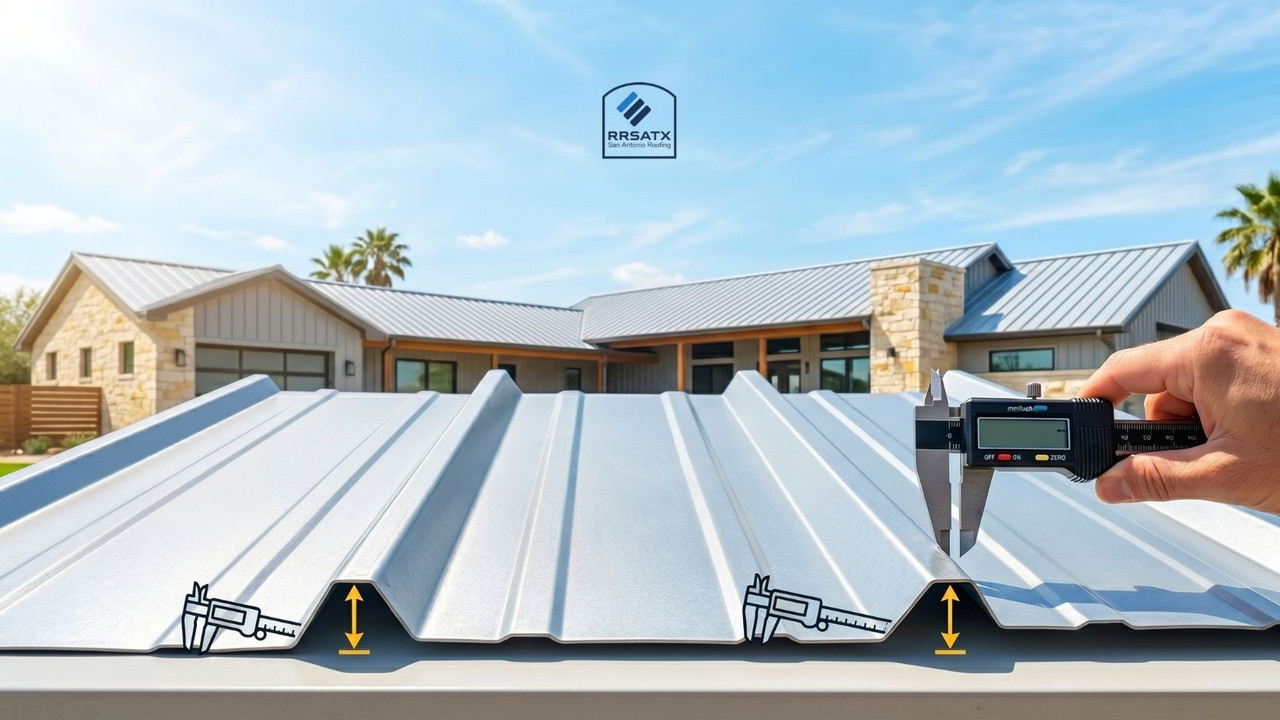
29-gauge: The lightest and least expensive option. Common on agricultural buildings and budget residential jobs. Dents more easily under hail impact and the thinner coating degrades faster under San Antonio’s UV intensity. Fine for a detached garage or patio cover. Not the right call for a primary residence in this hail corridor.
26-gauge: The residential standard for San Antonio. Meaningfully stronger than 29-gauge under hail impact, holds factory paint coatings longer, and reaches 30 to 40 years with proper maintenance. This is the gauge we recommend for most homes in Bexar County.
24-gauge: The premium tier. Noticeably heavier, more resistant to large hail, and typically qualifies for Class 4 impact ratings that earn insurance discounts. Best suited to high-wind or severe hail zones and homeowners who want the longest possible service life from a corrugated system.
- Gauge number is specified on the written quote; a dollar amount without a gauge spec is an incomplete quote
- For a primary residence in San Antonio, 26-gauge is the minimum acceptable specification
- 24-gauge is the right call if your neighborhood has a history of golf-ball-sized or larger hail events
- If two quotes give different gauges, you are not comparing apples to apples; bring them to the same spec before comparing prices
Cost Factor
Corrugated metal panels come in several profiles. The classic round-wave corrugated pattern is the most familiar and the most affordable. R-panel and PBR-panel profiles have a trapezoidal rib structure that adds rigidity and handles water more aggressively on lower-slope roofs. The profile you choose affects both the installed cost and how the roof performs on your specific roof pitch.
More consequential than the profile is the coating system applied to the steel. Bare Galvalume provides corrosion resistance but no color and no UV protection for the steel itself. Paint systems add both, but not all paint systems are equal under San Antonio’s sun. The two options you will see on quotes are SMP (silicone-modified polyester) and PVDF, commonly sold under the brand name Kynar 500.
Lighter colors reduce cooling costs in San Antonio’s summers and are worth specifying regardless of coating system. A light gray, tan, or white corrugated panel with an Energy Star-rated finish can reduce attic temperatures by 20 to 30 degrees compared to a dark-colored roof, which translates directly to lower air conditioning bills during the months when San Antonio’s heat is most intense. Ask your contractor specifically whether the panels are Energy Star rated and whether the coating qualifies for the federal cool roof tax credit.
- Coating type is specified on the quote; “painted” alone is not a sufficient specification
- For a residential roof in San Antonio expected to last 30 or more years, PVDF is the better long-term choice over SMP
- Confirm the panel profile is appropriate for your roof’s pitch; classic corrugated wave panels require a minimum 3:12 pitch for reliable water shedding
- Ask whether the color you select is in stock locally or requires a special order; special-order panels can add two to four weeks to the project timeline
- Request an Energy Star certification number for the panel if a cool roof credit or HOA approval is relevant to your project
Cost Factor
The roofing industry measures area in squares, where one square equals 100 square feet. But the square footage of your home’s footprint is not the same as the square footage of your roof. Pitch multiplies the actual surface area beyond the footprint. A 2,000-square-foot home with a steep 8:12 pitch has roughly 30 percent more roof surface than the same footprint at a 4:12 pitch. More surface area means more material and more labor.
Complexity compounds this further. A simple gable roof with two planes, no penetrations, and a straight ridge is the lowest-cost configuration for corrugated metal installation. Every hip, valley, dormer, chimney, skylight, HVAC curb, or vent stack adds flashing work, custom panel cuts, and labor time that increases the total cost independent of the panel material itself.
Material waste is another complexity-driven cost that rarely appears clearly on quotes. A simple gable roof wastes approximately five to eight percent of the panel material in cuts and trims. A complex hip roof with multiple valleys can waste 15 to 20 percent of material. Contractors account for this with a waste factor in their material estimate. Ask each contractor what waste percentage they used and confirm it is appropriate for your specific roof geometry.
- Ask the contractor to confirm the measured square footage of your actual roof surface, not just your home’s footprint
- Request that steep-slope surcharges appear as a line item on the quote rather than buried in the per-square-foot rate
- Confirm the waste factor percentage used in the material estimate; 8 to 12 percent is typical for moderate-complexity roofs
- Ask about flashing specifications at every penetration; chimney flashing and skylight flashing should be specified by material type and method
- If your roof has a valley, confirm whether the contractor uses open metal valleys or closed valleys; open valleys are generally more durable for corrugated panel systems
Cost Factor
The panels are the visible part of a corrugated metal roof. What goes underneath them determines how the system performs in the long run. Underlayment, decking condition, and tear-off costs are three line items that vary significantly between quotes and are frequently where low-bidding contractors cut to hit an attractive price.
Underlayment: Metal roofing generates significant heat on the underside of the panel during San Antonio summers. Standard asphalt felt underlayment (15-pound or 30-pound) breaks down rapidly under that heat and should not be used under metal panels. A high-temperature synthetic underlayment rated for metal roofing applications is the correct specification. It costs more than felt but lasts the life of the roof rather than degrading within five to ten years and voiding most manufacturer warranties.
Decking inspection and repair: Any corrugated metal roof installation should include a decking inspection before panels go down. Soft spots, rot, and delamination in the plywood or OSB below are common in San Antonio homes that have had chronic leak issues under the previous roof. Replacing damaged decking typically costs $2 to $4 per square foot for material and labor. A contractor who does not inspect the decking before installing panels is setting you up for a problem that will surface after the job is complete.
- Underlayment type is specified on the quote; high-temp synthetic is the correct specification for corrugated metal in San Antonio
- Tear-off cost appears as a separate line item with a per-square-foot rate, not bundled invisibly into the panel installation price
- Decking inspection is explicitly included in the scope of work before panel installation begins
- Decking replacement is quoted as a contingency line item with a per-square-foot rate so you know the cost before it surfaces mid-job
- If the contractor proposes installing over existing shingles, confirm that your home is not already at two layers and that local code permits the overlay
Cost Factor
Corrugated metal panels are held to the decking with exposed fasteners: screws that pass through the panel face and seat against a rubber or neoprene washer that seals each penetration. The quality of those fasteners and washers matters more than most homeowners realize. Standard carbon steel screws rust out in San Antonio’s humidity within 10 to 15 years, eventually staining the panels and allowing water entry at every penetration point. Stainless steel or zinc-aluminum alloy fasteners last significantly longer and cost more.
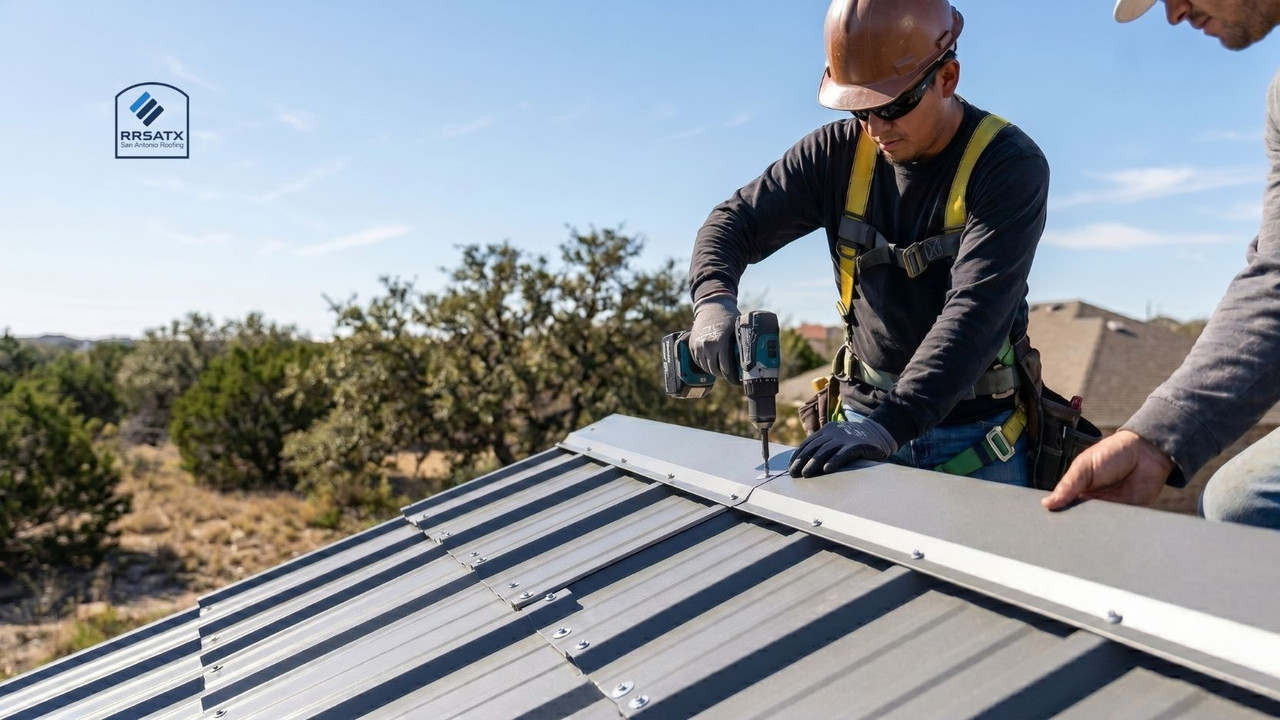
Washer quality: The rubber washer on each exposed fastener is the primary seal at every panel penetration. Cheap EPDM washers degrade under UV exposure in five to eight years. Better-quality neoprene or EPDM washers treated for UV resistance last 15 to 20 years. This is a specification worth asking about specifically.
Ridge cap and trim: The ridge cap seals the peak of the roof where two panel planes meet. Properly installed ridge caps use a foam closure strip between the cap and the panel corrugations, plus a quality sealant at each fastener. Cut-rate ridge work skips the foam closures and uses a minimal sealant bead that dries out in a few years, making the ridge the first place a corrugated metal roof leaks.
- Fastener material is specified on the quote: stainless steel is the preferred specification for residential corrugated metal roofing in San Antonio
- Washer type is specified; UV-rated neoprene or high-quality EPDM is the correct call for this climate
- Ridge cap installation includes foam closure strips at both the ridge and eave; this should be a stated line item or scope description
- Trim and flashing metal matches the panel coating; mismatched metals cause galvanic corrosion at contact points over time
- Fastener spacing follows the panel manufacturer’s installation guide; over-spaced fasteners allow panel uplift in high-wind events
Cost Factor
Labor for corrugated metal roof installation in San Antonio runs $1.50 to $3.50 per square foot depending on roof complexity, pitch, and the local contractor market. On a simple gable roof it sits toward the lower end. On a multi-plane hip with steep pitch and multiple penetrations, it reaches the upper end. Unlike standing seam, corrugated panel installation does not require specialized equipment or highly trained crews, which keeps the labor rate relatively accessible. What it does require is correct fastener torque, proper panel overlap, and precise flashing work at every transition point.
Corrugated metal is faster to install than most other metal roofing systems, which means the labor portion of the total cost is lower relative to the material cost than with standing seam. For budget comparison purposes, expect labor to represent 40 to 55 percent of the total installed cost of a corrugated metal roof in San Antonio in 2026.
Scheduling your corrugated metal roof installation in the late fall or winter can reduce your total cost by 10 to 15 percent in San Antonio. Roofing contractors in Bexar County are at peak demand from March through September when storm season drives high call volume. The same crew with the same materials will often offer more competitive pricing in November through February when scheduling pressure eases. The work quality is identical; the timing just shifts your negotiating position. Summer installs also mean crews are working in 100-plus-degree conditions, which can affect workday length and the number of days needed to complete the job.
- Labor cost appears as a separate line item on the quote, not bundled into a single per-square-foot installed rate with no breakdown
- Steep-slope surcharge is disclosed upfront if your roof pitch exceeds 6:12
- The quoted crew size and estimated project duration are reasonable for your roof’s complexity; a one-person crew quoted to complete a complex 2,500-square-foot roof in one day is a red flag
- Ask whether the crew is in-house employees or subcontracted labor; subcontracted crews vary more in quality and accountability
- Confirm the contractor carries current workers compensation insurance before any crew member steps onto your roof
Use this table to build a realistic budget before you contact contractors. Every figure reflects current San Antonio and Bexar County market pricing in 2026. Adjust based on your specific roof size, complexity, and the gauge and coating you select.
| Line Item | Typical Cost (San Antonio) | Notes |
|---|---|---|
| 29-gauge corrugated panels (installed) | $3.00 to $4.50 per sq ft | Budget tier; not recommended for primary residences in the San Antonio hail zone |
| 26-gauge corrugated panels (installed) | $4.50 to $6.00 per sq ft | Residential standard for Bexar County; best value for most homeowners |
| 24-gauge corrugated panels (installed) | $6.00 to $7.50 per sq ft | Premium tier; worth it for Class 4 rating and maximum lifespan |
| SMP paint upgrade (over bare Galvalume) | +$0.25 to $0.60 per sq ft | Good for 15 to 20 years before noticeable fading in Texas sun |
| PVDF / Kynar coating upgrade | +$0.60 to $1.20 per sq ft | Best long-term color retention; recommended for roofs expected to last 30 or more years |
| High-temp synthetic underlayment | $0.40 to $0.75 per sq ft | Required for manufacturer warranty compliance; do not accept felt under metal panels |
| Tear-off (single layer asphalt shingles) | $1.50 to $2.50 per sq ft | Required if existing roof is at two layers or if decking inspection is needed |
| Decking replacement (if needed) | $2.00 to $4.00 per sq ft of damage | Budget a contingency of 5 to 10 percent of roof area for most re-roofing projects |
| Labor (simple gable, low pitch) | $1.50 to $2.00 per sq ft | Two planes, minimal penetrations, standard pitch |
| Labor (moderate complexity) | $2.00 to $2.75 per sq ft | Hip roof or multiple penetrations at standard pitch |
| Labor (complex or steep pitch) | $2.75 to $3.50+ per sq ft | Multi-plane, steep access, significant flashing work |
| Stainless fastener upgrade | +$150 to $400 total job | Pays for itself by eliminating rust staining and fastener-point leaks over the roof’s lifespan |
| Ridge cap with foam closure strips | +$200 to $500 total job | Non-negotiable for a properly sealed corrugated metal roof; do not accept a quote that excludes this |
- Know your roof’s approximate square footage; a rough estimate helps you sanity-check contractor quotes before they measure
- Decide on your minimum gauge specification: 26-gauge for most San Antonio residences, 24-gauge if your neighborhood has a severe hail history
- Identify your coating priority: PVDF if you want maximum color retention and longevity, SMP if budget is the primary driver
- Check with your homeowners insurance provider about Class 4 impact rating discounts before finalizing the gauge; the savings can offset the upgrade cost within a few years
- Count your penetrations: chimneys, skylights, vents, HVAC curbs. Each one adds flashing cost that should appear on your quote
- Panel gauge, profile, and coating type are explicitly stated on the written quote
- Underlayment type is specified; high-temp synthetic is the only acceptable specification under corrugated metal in San Antonio
- Tear-off cost appears as its own line item with a per-square-foot rate
- Decking replacement appears as a contingency line item with a per-square-foot rate for damaged area
- Fastener material is specified; stainless steel is the preferred call for residential longevity in this climate
- Ridge cap work includes foam closure strips; this should be stated in the scope description
- Labor cost is separated from material cost so you can evaluate both independently
- Steep-slope surcharge is disclosed if applicable to your roof
- Warranty terms are stated: manufacturer warranty on panels, separate workmanship warranty on installation
- At least two written quotes received on the same specification so you are comparing equivalent systems
- Certificate of insurance reviewed and verified: general liability at $1 million minimum, current workers compensation
- Contractor has pulled or confirmed they will pull the required permit; permitted work is required for most insurance claims and future home sales
- Payment schedule reviewed: a deposit of 30 to 40 percent is standard; never pay more than 50 percent upfront or the full amount before work begins
- Workmanship warranty period confirmed in writing: two years is a reasonable minimum, five years is better
How much does a corrugated metal roof cost in San Antonio in 2026?
Is corrugated metal roofing worth it for a San Antonio home?
How long does a corrugated metal roof last in San Antonio?
What gauge corrugated metal roof is best for San Antonio?
Can I install corrugated metal roofing over my existing shingles in San Antonio?
How do I compare corrugated metal roof quotes in San Antonio?
Get a free corrugated metal roof estimate in San Antonio
Tell us about your home, your current roof, and what you are trying to accomplish. We will measure the roof, walk you through the gauge and coating options that fit your budget, and give you a written estimate with no pressure and no cost.
[/et_pb_code][/et_pb_column][/et_pb_row][/et_pb_section]