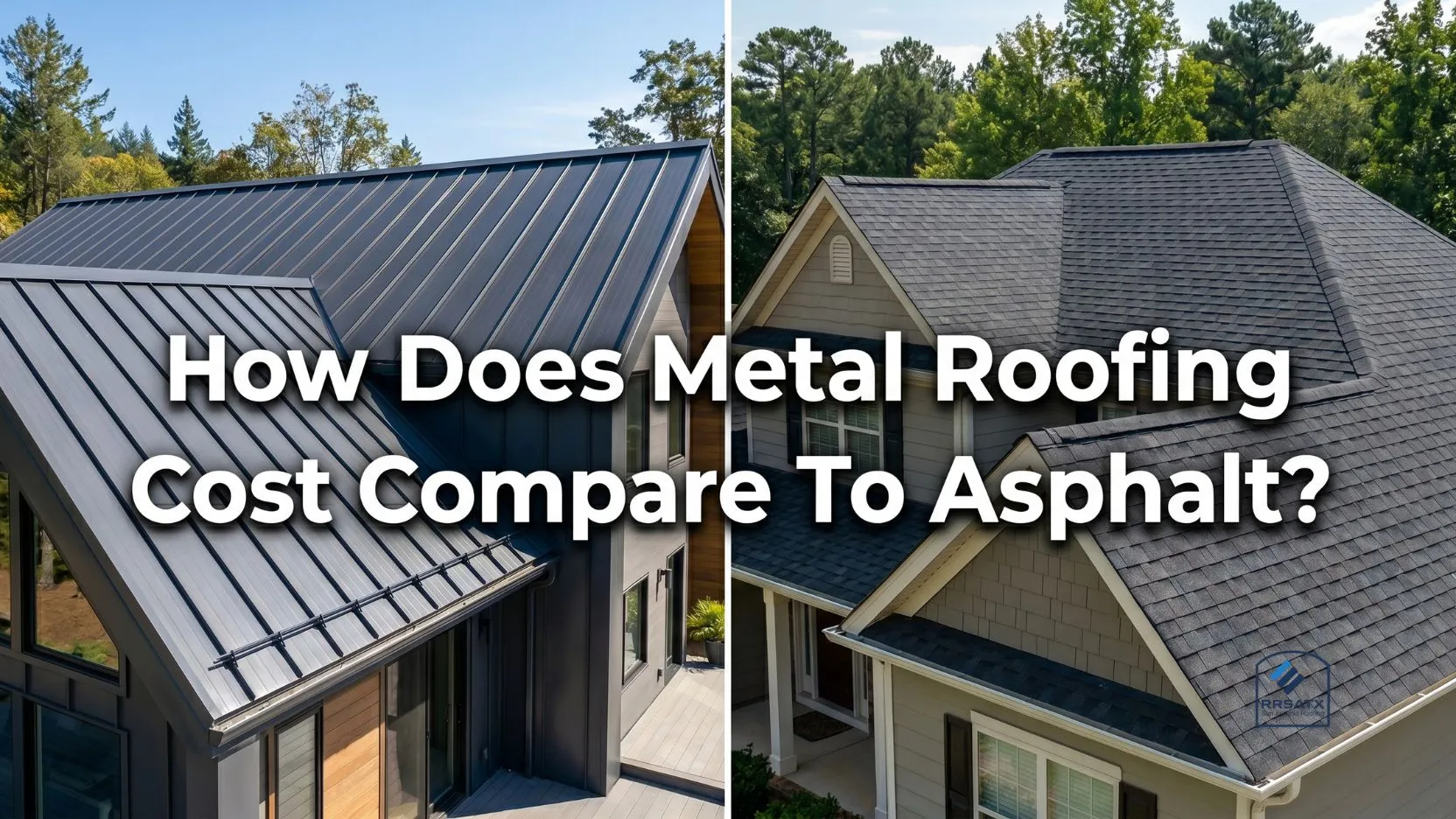
Metal costs more upfront than asphalt shingles. But when you factor in lifespan, maintenance, energy savings, and resale value in the San Antonio climate, the math shifts in a direction most homeowners do not expect. This guide breaks down every number.
The most common question San Antonio homeowners ask when they are choosing between metal and asphalt is a simple one: how much more does metal cost? The short answer is that metal roofing typically runs two to three times the upfront installed price of a standard architectural asphalt shingle roof on the same house. On a 2,000-square-foot San Antonio home, that difference can range from $8,000 to $18,000 depending on the metal type, panel profile, and roof complexity.
But the upfront number is only part of the picture. Asphalt shingles in the San Antonio climate typically last 15 to 20 years before they need full replacement. A standing seam metal roof installed on the same house will last 40 to 60 years with minimal maintenance. When you calculate the cost over that full period, including two or three asphalt replacements versus one metal installation, the gap narrows significantly, and for many homeowners it reverses entirely.
This guide breaks down the real installed costs for both roofing systems in San Antonio in 2026, covers what drives the price differences within each category, and gives you the honest lifetime cost math so you can make a decision based on actual numbers rather than first impressions.
A roof that costs $12,000 and lasts 20 years costs $600 per year. A roof that costs $22,000 and lasts 50 years costs $440 per year. Most homeowners compare roofing options by the check they write today. The contractors who give you the most useful advice compare options by what you actually spend over the time you own the property. In San Antonio's climate, that framing almost always favors metal for anyone planning to stay in their home longer than 15 years.
Installed roofing costs in San Antonio reflect labor, materials, tear-off of the existing roof, underlayment, and all associated trim and flashing work. The ranges below are based on current San Antonio market pricing for a standard residential roof with average complexity. Steeper pitches, multiple valleys, skylights, and chimneys increase the price on both systems.
- Tear-off and disposal of existing roofing included some contractors quote material only
- Underlayment specified by brand and type synthetic underlayment is the San Antonio standard for both systems
- All flashings (drip edge, chimney, valleys, pipe boots) included in the scope
- Permit pulled by the contractor required for full replacements in San Antonio and Bexar County
- Manufacturer warranty documentation provided at completion, not just the contractor's warranty
Manufacturer warranties on architectural asphalt shingles often run 30 years, which gives many homeowners an inflated sense of how long the product will actually last in South Texas. San Antonio's climate intense UV exposure from June through September, temperatures that push asphalt to the edge of its thermal tolerance, and periodic hail events significantly shortens real-world shingle life compared to cooler, less severe climates.
In our experience installing and replacing roofs across Bexar County, architectural asphalt shingles in San Antonio typically need full replacement at the 15-to-20-year mark. The warranty covers manufacturing defects, not accelerated aging from climate. A metal roof installed in San Antonio today, properly maintained, should still be performing well in 40 to 60 years.
| Roofing System | Expected Lifespan in San Antonio | Replacements in 50 Years | Typical Maintenance |
|---|---|---|---|
| 3-tab asphalt shingles | 12 to 18 years | 3 to 4 full replacements | Periodic resealing; granule loss accelerates with age |
| Architectural asphalt shingles | 15 to 22 years | 2 to 3 full replacements | Flashing inspection every 5 years; algae treatment in shaded areas |
| Corrugated / exposed-fastener metal | 30 to 45 years | 1 to 2 full replacements | Fastener inspection and resealing every 10 to 15 years |
| Standing seam metal | 40 to 60 years | 0 to 1 full replacements | Flashing inspection every 10 years; minimal otherwise |
Asphalt warranties are written for national averages, not for South Texas. A 30-year shingle will reach the end of its practical service life significantly earlier in San Antonio than in, say, Denver or Seattle. The UV index in San Antonio is among the highest in the continental United States, and asphalt is a petroleum-based product that degrades under sustained UV exposure. If you are comparing a 50-year metal warranty to a 30-year asphalt warranty, understand that the asphalt warranty is covering you against defects, not against the normal effects of being a San Antonio roof for three decades.
- Is the warranty prorated or non-prorated? Prorated warranties pay out less the older the roof is.
- Does the warranty transfer to a new owner if you sell the home?
- What voids the warranty? Poor ventilation is the most common warranty-voiding condition in San Antonio attics.
- Is the installer certified by the manufacturer? Some full warranty coverage requires a certified installer.
- What does the workmanship warranty cover, and for how long? This is the contractor's warranty, separate from the manufacturer's.
Neither metal nor asphalt is a zero-maintenance roofing system, but the maintenance demands and costs are significantly different. Asphalt shingles require periodic inspection, flashing resealing, gutter cleaning, and algae or moss treatment in shaded areas. As the shingles age, granule loss accelerates, and repair callouts become more frequent in the final five years of the roof's life.
Metal roofing requires less frequent maintenance and the repair events tend to be more isolated. On exposed-fastener systems, the primary maintenance task is periodic inspection and replacement of fasteners and sealant, typically every 10 to 15 years. Standing seam systems have virtually no fastener maintenance requirement and the most common service call is flashing resealing at chimneys, skylights, and vent penetrations.
- Year 5: Both systems full visual inspection, gutter cleaning, flashing check
- Year 10: Asphalt granule loss assessment, algae treatment if needed. Metal fastener and sealant inspection
- Year 15: Asphalt likely first localized section repair or spot replacement. Metal fastener pass if exposed-fastener system
- Year 18 to 22: Asphalt full replacement becoming necessary. Metal still in active service life with decades remaining
San Antonio's summer heat makes roof energy performance a practical financial consideration rather than a marketing talking point. A standard dark asphalt shingle roof can reach surface temperatures of 150 to 175 degrees Fahrenheit on a July afternoon in San Antonio. That heat radiates into the attic and increases the load on your air conditioning system throughout the day and into the evening.
A reflective metal roof with a light or medium-tone coating can reduce that surface temperature by 50 to 80 degrees Fahrenheit compared to dark asphalt. The Department of Energy has documented cooling cost reductions of 10 to 25 percent for homes in hot climates that install Energy Star-rated reflective metal roofing. In San Antonio, where summer air conditioning bills are a significant household expense, that reduction adds up to real savings year after year.
The cooling cost math for a typical San Antonio home: If your household spends $250 per month on electricity from June through September, roughly $125 of that is cooling. A 20 percent reduction from a reflective metal roof saves approximately $25 per month during the four-month peak cooling season. That is $100 per year in energy savings. Over 40 years, that adds up to $4,000 in direct savings, and that calculation uses conservative figures and does not account for rising electricity rates.
CPS Energy, San Antonio's municipal utility, periodically offers rebates for Energy Star-rated roofing products. Before you finalize your roofing decision, check the current CPS Energy residential rebate program and ask your contractor whether the metal roofing system they are proposing qualifies. Rebate availability changes year to year, but when the program is active it can reduce the upfront cost gap between metal and asphalt by several hundred dollars. The CPS Energy website maintains the current rebate schedule.
- Does the proposed metal panel carry an Energy Star rating for solar reflectance?
- What is the Solar Reflectance Index (SRI) rating of the specific color and coating you are recommending?
- Is there adequate ridge and soffit ventilation in place to allow the attic to exhaust the heat that is reflected off the roof surface?
- Will the roof coating maintain its reflectance over time, or does it degrade with UV exposure and require recoating?
The most useful way to compare metal and asphalt roofing costs in San Antonio is to look at what you would spend on each system over a fixed period: the expected lifespan of one metal roof installation. The example below uses a 2,000-square-foot home with an average-complexity roof and conservative cost assumptions on both sides.
| Cost Category | Architectural Asphalt (over 50 years) | Standing Seam Metal (over 50 years) |
|---|---|---|
| Initial installation | $13,000 (2026 dollars) | $30,000 (2026 dollars) |
| Second full replacement (~year 18) | $17,000 (estimated future cost) | Not required |
| Third full replacement (~year 36) | $21,000 (estimated future cost) | Not required |
| Ongoing maintenance (50 years) | $6,000 to $9,000 estimated | $3,000 to $5,000 estimated |
| Energy savings offset (50 years) | Minimal | $4,000 to $8,000 estimated |
| Estimated total outlay | $57,000 to $63,000 | $29,000 to $35,000 |
These are illustrative figures that use 2026 San Antonio pricing and apply a modest 3 percent annual cost increase to future asphalt replacements, which historically understates how roofing costs have actually risen. The metal roof scenario assumes one system serves the full 50-year period with normal maintenance. Even with the significant upfront premium, standing seam metal comes out ahead on total cost over a 50-year horizon in most San Antonio scenarios.
If you plan to sell the home within 5 to 10 years, the lifetime cost advantage of metal does not have time to materialize for you personally. A fresh architectural asphalt roof raises the appraised value of a home and attracts buyers. A standing seam metal roof may or may not appraise for its full premium in the current San Antonio market. If your planning horizon is short, the upfront cost difference matters more and asphalt may be the more practical choice. If you are in your long-term home or managing a rental property you plan to hold, metal becomes the financially superior option at the 15-to-20-year mark.
- Planning to own the home for 15 or more years the crossover point where metal total cost catches up to asphalt
- High cooling costs homes with large square footage or poor attic ventilation benefit more from metal's reflectance
- Frequent hail exposure metal roofing sustains less damage per event than asphalt, meaning fewer insurance claims and lower deductible costs over time
- Rental property ownership one roof installation serving a 40-year hold is a significant operating cost reduction
- Resale positioning metal roofing is an increasingly recognized value marker in the San Antonio real estate market
There is no single right answer to the metal vs. asphalt question for every San Antonio homeowner. The right choice depends on your planning horizon, your budget, your home's existing structure, and how you weigh upfront cost against long-term ownership cost.
- You plan to sell the home within 7 to 10 years and a fresh roof is primarily a resale asset
- Your current budget does not accommodate the metal upfront premium and financing is not a preferred option
- Your roof structure needs significant decking repair and you want to minimize total project scope
- The neighborhood's price range limits how much roofing premium the market will support at resale
- You want a faster, simpler installation with more installer options in the San Antonio market
- You are in your long-term home and want to do this once for the next 40 to 50 years
- You own a rental property in San Antonio and want to minimize maintenance and replacement cycles
- Your energy bills are high and your attic ventilation is good enough to take advantage of reflective metal's cooling benefit
- You have had recurring hail damage claims on your asphalt roof and want a system that handles impact better
- You want the roof to be a genuine long-term asset rather than a recurring replacement expense
- You can finance the upfront difference at a reasonable rate the lifetime savings often cover the financing cost
Get a free metal vs. asphalt roofing estimate in San Antonio
Tell us about your home, your goals, and your timeline. We will walk your roof, assess your current system, and give you a clear side-by-side cost comparison with no pressure and no obligation.


