
[et_pb_section fb_built=”1″ admin_label=”section” _builder_version=”4.16″ global_colors_info=”{}”][et_pb_row admin_label=”row” _builder_version=”4.16″ background_size=”initial” background_position=”top_left” background_repeat=”repeat” global_colors_info=”{}”][et_pb_column type=”4_4″ _builder_version=”4.16″ custom_padding=”|||” global_colors_info=”{}” custom_padding__hover=”|||”][et_pb_code _builder_version=”4.27.6″ _module_preset=”default” hover_enabled=”0″ sticky_enabled=”0″]
Copper is one of the longest-lasting roofing materials available to San Antonio homeowners. This guide covers exactly how long a copper roof lasts, what affects its lifespan, what it costs, and whether the investment makes sense for a rental property or primary home in South Texas.
A copper roof is the closest thing to a permanent roofing solution that exists. On historic buildings across Europe and the northeastern United States, copper roofs installed in the 1700s and 1800s are still performing today. That kind of longevity is not common in the roofing world, and it is the main reason copper commands such a high upfront price. But it also raises a practical question for San Antonio homeowners and rental property investors: does a roof that lasts 100 or more years make financial sense in Texas, and what does it take to actually get that kind of lifespan out of it?
This guide answers both questions directly. It covers how long copper roofs actually last, what shortens that lifespan, what copper roofing costs in San Antonio in 2026, how the South Texas climate affects copper’s performance and appearance, and how to decide whether copper is the right call for your property.
Most roofing materials degrade over time. Copper does the opposite. As it weathers, it develops a patina, the well-known blue-green layer that forms on the surface. That patina is not corrosion in the damaging sense; it is a stable, tightly bonded layer of copper carbonate that actually protects the metal beneath it from further oxidation. A copper roof that has fully patinated is more resistant to moisture and corrosion than a brand-new copper roof fresh off the installation truck. This is a fundamental difference from steel, aluminum, or asphalt, and it is the reason copper roofs last as long as they do.
Lifespan
A properly installed copper roof has a documented lifespan of 70 to 100 years at a minimum. In low-pollution environments with good installation quality and minimal physical damage, copper roofs regularly exceed 100 years. The roofing industry broadly recognizes copper as one of the two or three longest-lasting roofing materials available alongside slate and high-grade clay tile.
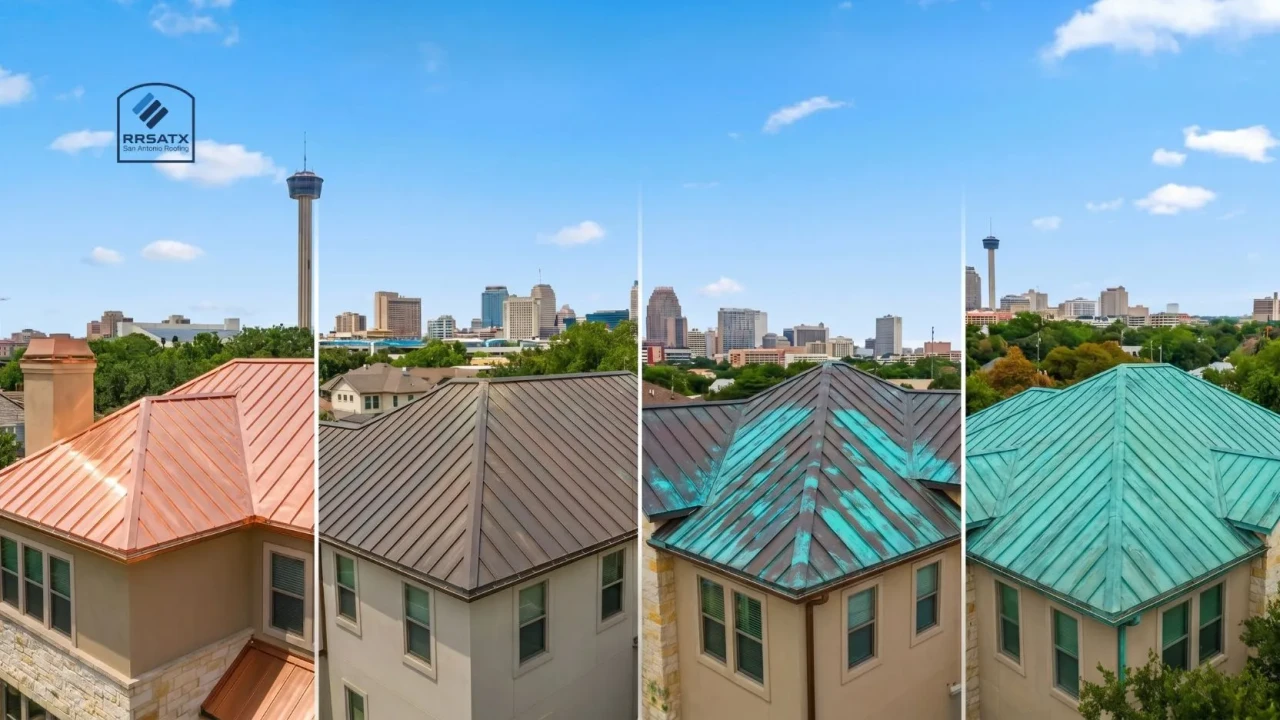
New copper (bright orange-pink): A freshly installed copper roof has a bright, warm metallic appearance. This is the raw copper surface before any weathering has occurred. It is visually striking but also the stage at which the surface is most vulnerable to surface scuffs and handling marks.
Early patina (brown and dark bronze): Within the first one to three years in the San Antonio climate, copper begins to oxidize and turns a rich brown or dark bronze color. This stage is sometimes called the “chocolate” phase. The surface is beginning to stabilize.
Full patina (blue-green verdigris): Over the following several years, the surface continues to react with moisture and carbon dioxide in the air and develops the familiar blue-green patina. In San Antonio’s semi-arid climate, this process typically takes seven to ten years, longer than in coastal or high-humidity regions.
- A copper roof installed today may outlast the current owner, the next owner, and possibly the one after that
- No re-roofing costs for the life of most ownership periods, even for long-term investment properties
- Insurance premiums may be lower on properties with copper or other premium metal roofing materials
- Property appraisers and buyers in the San Antonio market recognize copper roofing as a premium feature
- The roof will not appear on a capital expenditure schedule for rental property financial planning
Lifespan Threats
Copper roofs are remarkably self-sufficient once installed correctly and left alone. The threats that meaningfully shorten their lifespan are predictable and almost all trace back to installation decisions or what comes into contact with the copper surface. Understanding them upfront is the difference between a roof that lasts 100 years and one that develops problems in 20.
Galvanic corrosion from dissimilar metals: This is the most serious threat to a copper roof. When copper comes into direct contact with certain other metals, particularly aluminum, steel, or zinc, a small electrical current runs between the two metals in the presence of moisture. That current accelerates corrosion on the less noble metal. On a copper roof, this typically shows up as accelerated deterioration around steel fasteners or at points where an aluminum gutter contacts a copper panel edge. A qualified installer uses only copper or copper-alloy fasteners and flashing materials throughout the system to eliminate this risk entirely.
Copper runoff damage to adjacent materials: As rain washes over a copper roof, it picks up small amounts of dissolved copper ions. That runoff can stain concrete, masonry, and painted surfaces with a blue-green tint. It can also damage aluminum gutters and flashing below the copper surface through the same galvanic mechanism described above. This is a design and installation planning issue, not a sign that the copper roof itself is failing, but it does require attention during the planning phase.
Thermal expansion is a critical installation consideration for copper roofing in San Antonio. Copper expands and contracts significantly with temperature changes, and the gap between a January night and a July afternoon on a San Antonio rooftop easily exceeds 100 degrees Fahrenheit. A copper roofing system must be designed with expansion joints, floating clips, and seam profiles that allow this movement without buckling the panel or fatiguing the metal at fastener points. Standing seam copper panels handle thermal movement better than flat-lock systems. Any installer who does not discuss expansion allowances during the planning phase is a contractor to avoid.
- Steel or aluminum fasteners used anywhere in the copper roofing system
- No expansion joints or floating clips on panel runs longer than 10 feet
- Aluminum gutters installed to receive runoff directly from a copper panel edge
- Panels fastened through the face rather than at concealed clip points on standing seam systems
- Inadequate slope on flat or near-flat copper sections that allow water to pond
- No underlayment or incompatible underlayment that traps moisture against the copper underside
Climate Factors
San Antonio’s climate is one of the more demanding roofing environments in the country. Intense UV exposure, extreme summer heat, occasional severe hailstorms, and low average humidity create conditions that shorten the lifespan of many roofing materials. Copper handles most of these conditions better than its alternatives, though the local climate does affect a few specific performance characteristics.
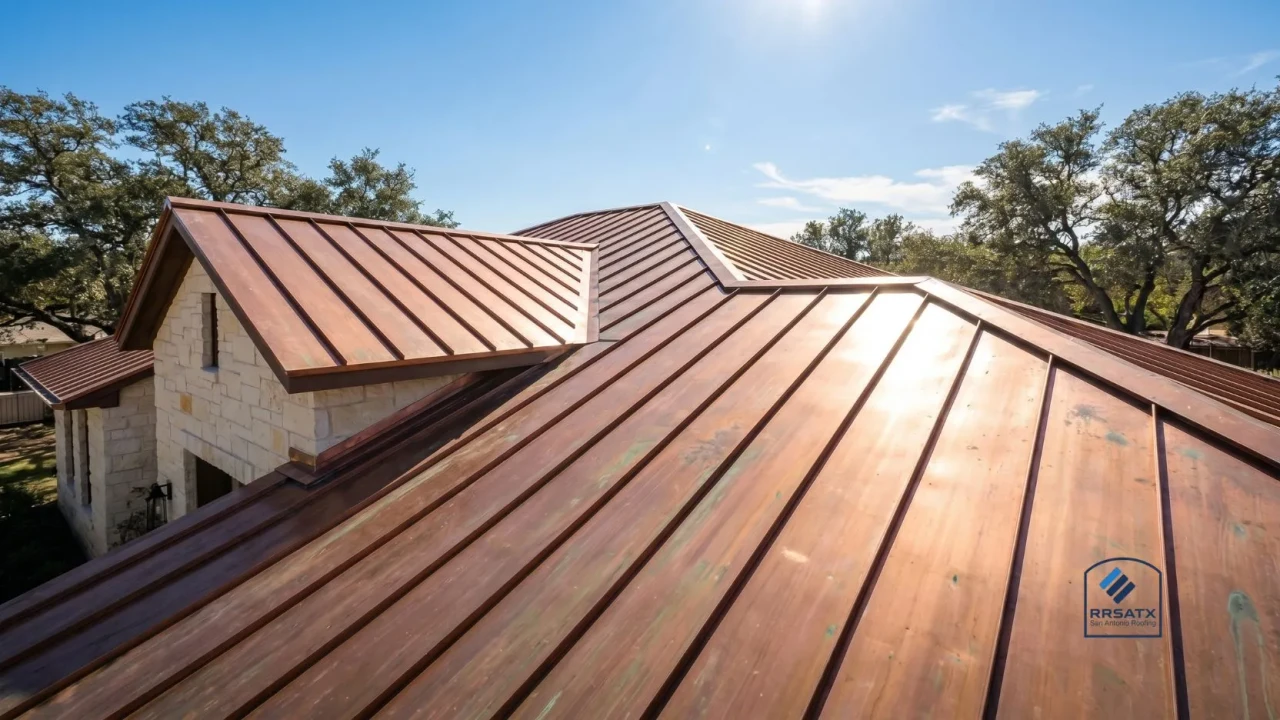
Heat performance: Copper has a high reflectivity when new and maintains good thermal performance even as it ages. Unlike asphalt shingles, copper does not soften, crack, or lose granules in extreme heat. The expansion and contraction cycles in San Antonio summers are significant, but a properly designed system handles them without fatigue over its full lifespan.
Hail performance: Copper is softer than steel or stone-coated steel, which means large hail will dent copper panels more readily than harder metal alternatives. However, cosmetic denting in copper does not break a protective coating or expose base metal to rust the way it does with painted steel panels. A dented copper panel continues to perform normally unless the dent is severe enough to crack the seam or puncture the panel, which requires very large hail and direct impact.
UV and heat resistance: Copper is completely unaffected by UV exposure in terms of structural integrity. It does not fade, chalk, crack, or degrade under direct sunlight the way polymer-based roofing products do. The surface color will change with UV exposure as part of the patination process, but that is an appearance change, not a performance change.
- Design expansion allowances for temperature swings that can exceed 100 degrees Fahrenheit between seasons
- Select 16-ounce or 20-ounce copper minimum for field panels to handle hail impact without seam damage
- Plan gutter material and downspout routing to avoid copper runoff contacting aluminum or painted surfaces
- Expect a longer patination timeline than in coastal Texas or the eastern United States
- Confirm underlayment is a synthetic product compatible with copper, not a felt that traps moisture
Cost Guide
Copper roofing is among the most expensive roofing options available. That upfront cost is real and it is the primary reason most San Antonio homeowners do not choose copper for a standard residential re-roof. But the cost comparison changes substantially when you account for the fact that a copper roof installed today may never need to be replaced in the lifetime of the property.
| Roofing material | Installed cost (San Antonio, 2026) | Expected lifespan | Replacements over 100 years | Approx. 100-year cost |
|---|---|---|---|---|
| 3-tab asphalt shingles | $4 to $6 per sq ft | 15 to 20 years | 5 to 6 times | $20 to $36 per sq ft (not counting inflation) |
| Architectural asphalt shingles | $5 to $8 per sq ft | 25 to 30 years | 3 to 4 times | $15 to $32 per sq ft |
| Galvalume steel (standing seam) | $10 to $16 per sq ft | 40 to 60 years | 1 to 2 times | $20 to $32 per sq ft |
| Copper (standing seam) | $25 to $50 per sq ft | 100+ years | 0 | $25 to $50 per sq ft |
For a long-term rental property in San Antonio, copper makes financial sense on a different calculation than a primary residence. A rental property owner who installs copper eliminates roof replacement from the capital expenditure budget permanently. On a property held for 30 or more years, the avoided re-roofing costs (typically $8,000 to $18,000 per replacement on a standard San Antonio home) and the avoided loss of rental income during re-roofing can offset a substantial portion of the copper premium. Run the numbers against your specific hold period and rental income assumptions before dismissing the upfront cost.
- Get quotes from at least two contractors with documented copper roofing experience, not just general metal roofers
- Confirm the quote specifies copper gauge (16 oz or 20 oz minimum for field panels)
- Ask whether copper gutters and downspouts are included or will be quoted separately
- Confirm all fasteners and flashings in the quote are copper or copper alloy, not steel or aluminum
- Ask the contractor for references from copper roofing jobs completed at least five years ago
- Factor avoided re-roofing costs into your total cost of ownership before comparing to asphalt alternatives
Decision Guide
Copper is not the right roofing material for every San Antonio homeowner. Its advantages are real and substantial, but the upfront cost is significant enough that the decision deserves a clear-eyed evaluation rather than a decision made purely on longevity or aesthetics.
| Your situation | Copper recommendation | Reasoning |
|---|---|---|
| Long-term hold on a primary residence (20+ years) | Strong candidate | Lifetime cost advantage and elimination of future re-roofing disruption justify the premium for a long-term owner. |
| Short-term ownership (under 10 years) | Not recommended | You will not recoup the premium in resale appreciation over a short hold period. A quality steel standing seam roof is a better fit. |
| Long-term rental property (10+ year hold) | Strong candidate | Eliminates roof from capital expenditure planning, reduces maintenance calls, and protects rental income from re-roofing disruption. |
| Historic or architecturally significant home | Highly recommended | Copper is often historically appropriate and may be required by historic preservation guidelines. Adds significant appraised value. |
| Accent sections only (bay windows, porch caps) | Excellent choice | Achieves copper’s aesthetic and longevity benefits in high-visibility areas at a fraction of a full-roof budget. |
| Budget-constrained re-roof decision | Not recommended | A properly installed Galvalume steel standing seam roof at $10 to $16 per sq ft delivers 40 to 60 years of performance at less than half the cost. |
Copper is not the only premium metal roofing option available to San Antonio homeowners. Here is how it compares to the other metal roofing materials our crews work with regularly.
| Material | Lifespan | Cost (installed, San Antonio) | Hail performance | Maintenance | Best use case |
|---|---|---|---|---|---|
| Copper (standing seam) | 100+ years | $25 to $50/sq ft | Good dents but does not rust | Very low essentially none once installed | Long-term primary or rental, historic homes |
| Galvalume steel (standing seam) | 40 to 60 years | $10 to $16/sq ft | Excellent harder than copper | Low periodic inspection recommended | Best value metal roof for most San Antonio homes |
| Aluminum (standing seam) | 40 to 50 years | $12 to $18/sq ft | Good softer than steel, dents under hail | Low naturally corrosion resistant | Coastal properties where steel rust is a concern |
| Stone-coated steel | 40 to 50 years | $10 to $20/sq ft | Good coating can chip under large hail | Low to moderate coating should be inspected after hail | Homeowners who want a tile or shake appearance |
| Zinc (standing seam) | 80 to 100 years | $20 to $40/sq ft | Good similar to copper in softness | Very low self-healing patina | Alternative to copper with similar longevity at slightly lower cost |
- Contractor has documented experience with copper roofing specifically, not just general metal roofing
- References provided from copper roofing jobs completed at least five years prior
- Certificate of insurance received and verified with at least $1 million in general liability coverage
- Contractor is licensed in Texas and can pull any required building permits for the project
- Copper gauge specified in writing: 16 oz minimum for field panels, 20 oz for high-traffic or hail-prone areas
- All fasteners confirmed as copper, stainless steel, or copper-alloy, not aluminum or galvanized steel
- All flashing materials confirmed as copper or compatible alloy, not aluminum or painted steel
- Underlayment specified as a synthetic product compatible with copper, not organic felt
- Panel profile and seam type specified: standing seam or flat-lock, with expansion provisions documented
- Expansion joint locations and floating clip design confirmed for San Antonio’s temperature range
- Copper runoff routing planned so it does not contact aluminum gutters, painted concrete, or masonry
- Gutter material confirmed: copper gutters recommended; if aluminum gutters are retained, a separation plan is required
- Historic district approval obtained if the property falls under King William, Monte Vista, or other San Antonio preservation guidelines
- HOA approval obtained if required for the property’s neighborhood
- Total installed cost received in writing with a breakdown of materials and labor
- Lifetime cost of ownership calculated and compared to the alternative roofing material being considered
- Warranty terms for both materials and workmanship confirmed in writing
- Insurance agent notified before installation begins to confirm any premium adjustment for premium metal roofing
How long does a copper roof last in Texas?
Does a copper roof require maintenance?
How much does a copper roof cost in San Antonio?
Does copper roofing add value to a home in San Antonio?
Will copper roofing hold up against San Antonio hailstorms?
How long does it take for a copper roof to turn green in San Antonio?
Get a free copper roofing consultation in San Antonio
Tell us about your property, your goals, and your budget. We will give you an honest assessment of whether copper is the right fit and a written estimate at no cost.
[/et_pb_code][/et_pb_column][/et_pb_row][/et_pb_section]