The honest answer depends on more than the material price. This guide breaks down what DIY metal roofing actually costs San Antonio homeowners versus what a licensed contractor charges, what the hidden costs look like, and when going the DIY route ends up costing more in the long run.
It is a fair question. Metal roofing materials are available at big-box stores and roofing supply houses, the panels look straightforward to install, and the price difference between buying materials yourself and hiring a contractor is easy to see on paper. So yes, on the surface, DIY metal roofing looks cheaper.
But the surface is not the whole story. Labor is only one part of what a professional installation costs you. The other parts include tool rental or purchase, the cost of waste and measurement errors, the value of manufacturer warranties that require licensed installation, and the very real cost of a metal roof that leaks because the fasteners were over-driven, the ridge caps were not sealed correctly, or the panels were not lapped in the right direction for Texas weather.
This guide puts the real numbers side by side so you can make an honest comparison. We cover what DIY materials actually cost, what you will spend on everything else you need, where DIY installations most commonly fail, and when it genuinely makes sense to handle part of the project yourself.
Metal roofing panels from most major manufacturers carry a 30 to 50 year paint warranty and a 40-plus year structural warranty. Almost all of those warranties require installation by a licensed contractor. When you install the panels yourself, you are buying a material with a long warranty and immediately voiding it. If panels fail, rust through, or develop coating defects after a DIY installation, the manufacturer will not cover the replacement cost. That changes the real value of the savings you are banking on.
This is where the DIY case looks strongest. Metal roofing panels are available to homeowners without a contractor license, and the retail price per square foot is real. But the panel price is not the full material cost. A complete metal roofing installation includes trim pieces, ridge caps, eave trim, rake trim, closure strips, butyl tape, sealant, and the fasteners themselves. Those components add 20 to 35 percent on top of the raw panel cost in most residential installations.
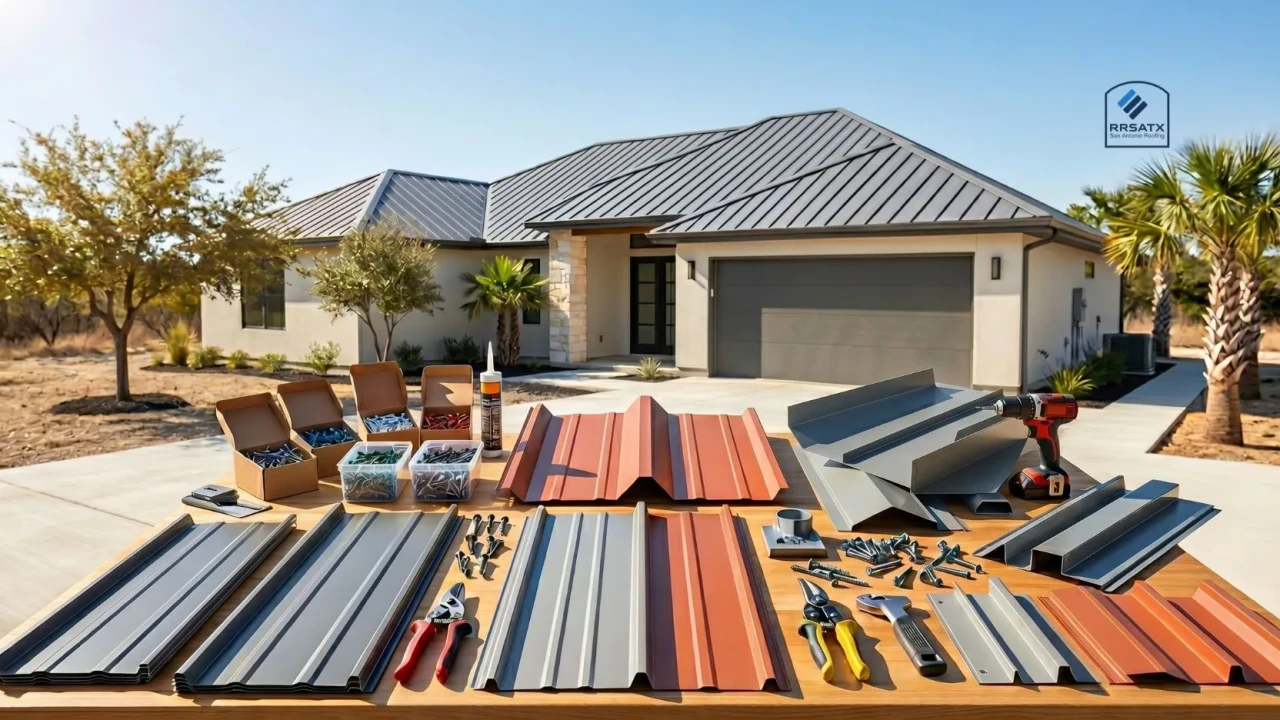
Contractor pricing advantage: Licensed roofing contractors buy panels, trim, and fasteners at wholesale pricing, typically 15 to 25 percent below what a homeowner pays at a supply house or big-box retailer. That gap narrows the labor savings significantly on larger jobs. On a 2,000 square foot roof, a contractor's lower material cost can offset $600 to $1,200 of the labor charge before you count a single hour of your own time.
Waste factor: Professional installers account for waste through accurate measurement and experience with cutting patterns for hip roofs, valleys, and dormers. Homeowners installing metal roofing for the first time typically waste 12 to 20 percent more material than a professional crew, which adds back a portion of the apparent savings.
- Panel gauge confirmed at 26-gauge or heavier for residential applications
- All trim pieces priced: ridge cap, eave trim, rake trim, gable trim, and any hip or valley flashing
- Closure strips included: open or closed foam closures matched to the panel profile
- Fastener type confirmed: correct gauge screws with EPDM-gasketed heads for the panel material
- Butyl tape and sealant included in the material list for all seams and penetrations
- Waste overage of at least 12% added to the panel quantity for a standard gable roof, more for complex lines
This is the line item that most DIY metal roofing estimates forget completely. A professional roofing crew shows up with every tool already owned and depreciated across hundreds of jobs. A homeowner starting a metal roofing project has to buy or rent every tool needed for the work. When you add those costs up, the savings calculation changes substantially.
Metal roofing cannot be cut with a standard circular saw blade without producing dangerous metal shards and a rough edge that compromises the panel seal. Proper cutting requires a metal-cutting blade in a circular saw, aviation snips for detail cuts, or a metal nibbler for long straight cuts. The fastening drill must have an adjustable clutch to prevent over-driving the EPDM-gasketed screws, which is one of the most common installation errors that causes leaks. Roofing in San Antonio's heat also requires appropriate fall protection equipment, which is non-negotiable for any roof with meaningful pitch.
Metal roofing is among the most physically demanding and fall-risk residential roofing work you can take on as a homeowner. Metal panels are slippery, particularly when they heat up in the San Antonio sun, which can push surface temperatures above 160 degrees Fahrenheit in summer. Falls from residential roofs are the leading cause of serious injury among DIY homeowners. A proper safety harness, anchor system, and roof jacks are not optional. If you do not own this equipment and are not experienced with it, the rental cost and learning curve need to be part of your honest cost comparison.
- Metal-cutting circular saw blade purchased not a standard wood blade
- Screw gun clutch tested to prevent over-driving the EPDM-gasketed fasteners
- Safety harness and roof anchor system in place before stepping on the roof
- Roof jacks or scaffold set for working surfaces on pitched sections
- Aviation snips available for trim cuts and detail work around penetrations
- Magnet bar on hand for cleanup of metal shavings from the roof surface and gutters
A full metal roof replacement in San Antonio requires a building permit in most cases. The City of San Antonio Development Services Department requires a roofing permit for any full roof replacement. The permit triggers an inspection, which means the installation has to meet the City's current building codes for fastener spacing, underlayment, and flashing at penetrations.
Homeowners can pull their own permits in Texas you do not need a contractor license to apply for a homeowner permit. But the inspection requirement means the work has to actually be code-compliant. A failed inspection means rework. In some cases, a re-inspection fee applies. Contractors factor inspection compliance into their installation method; homeowners doing this for the first time often discover code requirements they were not aware of only after the inspector flags the work.
Homeowner insurance and a DIY roof: This is the item most homeowners do not check before starting. Some homeowner insurance policies require that roof replacements be performed by a licensed contractor to remain valid. If a DIY-installed metal roof develops a leak that causes interior water damage, your insurer may investigate the installation and deny the claim if the work was not performed by a licensed contractor. Call your insurance provider and ask directly before starting any DIY roofing project.
Resale implications: When you sell your home in San Antonio, the buyer's inspector will typically ask for permit documentation on any roof replacement. A roof installed without a permit, or one that failed inspection and was never corrected, becomes a disclosure issue and can complicate or reduce the value of a sale.
- Building permit applied for through the City of San Antonio Development Services Department
- Homeowner insurance policy reviewed to confirm DIY installation does not void coverage
- Current IRC and San Antonio building code requirements reviewed for fastener spacing and underlayment
- Permit posted on the property before work begins
- Inspection scheduled upon completion not skipped to save time
- Permit documentation saved for future resale disclosure
We have repaired a lot of DIY metal roofing installations in San Antonio over the years. The failures tend to concentrate in the same places every time. Not because homeowners are careless, but because metal roofing has specific technical requirements that are easy to overlook if you have not installed it before. The Texas climate adds another layer of stress: the thermal expansion and contraction a San Antonio metal roof experiences between January and August is extreme, and installations that are not done to handle that movement develop problems quickly.
Over-driven fasteners deserve a longer explanation because they cause more DIY metal roof leaks than any other single factor. A roofing screw with an EPDM gasketed washer is designed to seat at a specific compression: the washer should flatten slightly but not be crushed. When a screw is driven too far, the washer is compressed past its sealing point, the rubber deforms, and the seal fails. Water then enters through the fastener hole rather than being blocked by it. A standard cordless drill without an adjustable clutch, or a clutch set too aggressively, will over-drive nearly every screw in the field. Discovering this after 3,000 screws have been installed is an expensive problem to fix.
If a DIY metal roof installation in San Antonio later requires a contractor repair pass for fasteners, penetrations, or ridge caps, the total project cost often exceeds what a professional installation would have cost from the start. A 2,000 square foot roof at $9 to $11 per square foot installed by a licensed contractor comes to $18,000 to $22,000. The same roof in DIY materials plus tools plus a post-installation repair call for the most common failure points can reach $15,000 to $20,000, without the warranty, the professional workmanship guarantee, or the insurance coverage that a licensed install carries.
- Screw gun clutch set and tested on a scrap piece before touching the roof washer should compress but not crush
- Panel lap direction confirmed against the prevailing wind direction for San Antonio (predominantly from the south-southeast)
- Synthetic underlayment installed before any panels go down, lapped correctly at seams
- All penetrations flashed before surrounding panels are fastened not after
- Ridge cap closure strips (both open and closed foam) installed on both the inside and outside of the ridge
- Fastener count verified against the panel manufacturer's specification for the wind zone, not estimated
We are not arguing that homeowners should never touch their own metal roofing. There are legitimate scenarios where DIY is appropriate, cost-effective, and produces a good result. The key is being honest about which scenarios those actually are versus which ones just look good on a YouTube video.
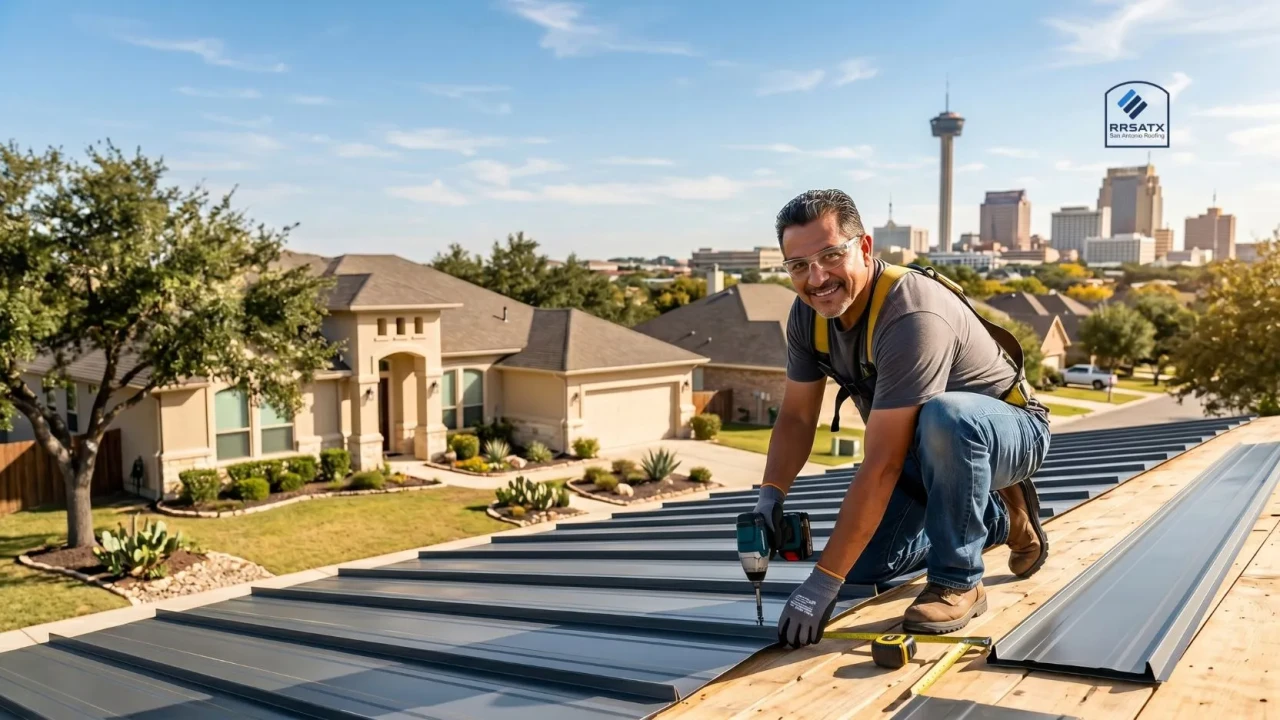
Outbuildings, sheds, and detached garages: A low-slope metal roof on a storage building, detached garage, or agricultural structure is genuinely a reasonable DIY project. Stakes are lower, access is easier, and simple panel systems like corrugated metal or R-panel are forgiving to work with. This is where most successful DIY metal roofing stories actually come from.
Simple gable roofs with no penetrations: A gable roof with one or two slopes, no skylights, no HVAC curbs, and no complex valleys is significantly more manageable than a hip roof with multiple planes and penetrations. The simpler the geometry, the more the DIY case holds up.
Partial DIY tear-off and prep only: Some San Antonio homeowners choose to handle the tear-off and haul-away of the old roofing material themselves and hire a contractor for the metal installation. This is a legitimate way to reduce total project cost without taking on the highest-risk installation work yourself.
| Project type | DIY suitability | Why |
|---|---|---|
| Storage shed or outbuilding (low slope, no penetrations) | Good DIY candidate | Low stakes, simple geometry, forgiving panel profiles, no permit required in many cases for small structures |
| Detached garage with simple gable roof | Reasonable DIY candidate | Manageable scale, limited penetrations, good first-time project for someone with construction experience |
| Primary residence, simple gable, no penetrations | Possible for experienced DIYers | Higher stakes and permit requirement, but manageable if the installer has prior metal roofing experience or has taken a training course |
| Primary residence, hip or complex roof with multiple penetrations | Strongly recommend professional installation | Complex geometry, multiple flashing points, high failure risk, and the financial exposure of a full reroof make professional installation the better value |
| Tear-off only (homeowner handles, contractor installs metal) | Excellent hybrid approach | Saves $500 to $1,500 on labor without taking on installation risk. Confirm the contractor is comfortable with this arrangement before committing. |
| Standing seam metal roof (any structure) | Not recommended for DIY | Requires specialized seaming tools ($800 to $2,000 to rent or buy), precise panel alignment, and factory training for most warranty-qualifying systems |
- Roof geometry assessed: simple gable roofs are DIY-friendly; complex hip, valley, and dormer configurations are not
- Penetration count confirmed: each skylight, HVAC curb, and pipe boot is a significant technical challenge for a first-time installer
- Full cost comparison completed: materials plus tools plus permits plus waste plus your time, compared against two or three contractor quotes
- Homeowner insurance coverage confirmed as remaining valid after a DIY installation
- Manufacturer warranty terms reviewed: most void coverage for unlicensed installations
- Partial DIY option considered: tear-off and prep handled by homeowner, installation by licensed contractor
This comparison uses a standard residential reroof on a 2,000 square foot single-story home with a simple to moderate roof line. Costs will vary based on roof pitch, panel type, the number of penetrations, and current material pricing.
| Cost item | DIY estimate | Licensed contractor | Notes |
|---|---|---|---|
| Metal panels (corrugated or R-panel) | $6,000 to $8,000 | Included in contract price | Contractor buys at wholesale; retail adds 15 to 25% |
| Trim, ridge caps, closures, and flashing | $1,500 to $2,500 | Included in contract price | Often underestimated by DIYers |
| Fasteners, sealant, and butyl tape | $400 to $700 | Included in contract price | Use correct gauge screws with EPDM washers |
| Underlayment (synthetic) | $400 to $700 | Included in contract price | Required under most panel systems |
| Tool purchase or rental | $200 to $950 | $0 | Cutting tools, screw gun, safety equipment |
| Building permit | $100 to $300 | $100 to $300 | Same cost whether homeowner or contractor pulls it |
| Waste and measurement overage | $600 to $1,200 | Minimal (contractor experience) | First-time installers waste 12 to 20% more material |
| Labor | Your time (40 to 80 hours) | $4,000 to $6,000 | Labor is 30 to 40% of a contractor's installed price |
| Total out-of-pocket cost | $9,200 to $14,350 | $18,000 to $28,000 | DIY saves $5,000 to $14,000 before warranty and risk factors |
| Manufacturer warranty | Voided (unlicensed install) | Full 30 to 50 year warranty | A significant long-term value difference |
| Workmanship warranty | None | 1 to 10 years depending on contractor | Covers labor cost of any installation defects |
- Full DIY material cost calculated including panels, all trim pieces, fasteners, underlayment, sealant, and waste overage
- Tool cost included: either purchase price or rental cost for the project duration
- Permit cost included in both the DIY and contractor comparison
- Your labor valued honestly: 40 to 80 hours of your time on a primary residence reroof
- At least two licensed contractor quotes obtained to use as the comparison baseline
- Homeowner insurance policy reviewed for DIY installation restrictions
- Panel manufacturer warranty terms checked: does licensed installation void the warranty?
- Roof geometry assessed: simple gable vs. complex hip or multi-plane configuration
- Penetration count confirmed: number of HVAC curbs, skylights, pipe boots, and chimneys
- Fall protection plan in place before any work begins on a pitched roof in San Antonio's heat
- Tear-off and haul-away handled by homeowner to reduce contractor labor cost
- Outbuildings or simple structures handled as separate DIY projects
- Contractor consulted about which prep tasks they will allow the homeowner to complete
- Any partial DIY scope confirmed in writing with the contractor before the contract is signed
Get a free metal roof installation quote in San Antonio
Not sure whether DIY or a licensed contractor makes more sense for your project? We will walk you through the real numbers for your specific roof, with no sales pressure and no obligation.